Labour’s new ambassador to the U.S. founded Global Counsel, a firm with major fossil fuel clients.
Labour’s top diplomat to Donald Trump’s United States leads a public affairs firm that has attempted to influence the new UK government on behalf of the oil and gas giant Shell, and the coal mining company Anglo American.
Peter Mandelson – who was a Cabinet minister under former Labour prime ministers Tony Blair and Gordon Brown – has been accepted as the UK’s ambassador to the U.S. by Trump’s new administration.
In addition to his new diplomatic role, which he will formally begin in February, Mandelson is president and chair of Global Counsel, a London-based political consultancy and lobbying organisation. He will retain shares in the company even after taking up his new position in Washington DC, the Financial Times has reported.
According to official records, after July’s general election Global Counsel lobbied the new Labour government on behalf of Shell, one of the world’s most polluting companies.
Shell is still committed to exploring for new sources of oil and gas and does not have any plans to reduce the overall amount it produces by 2030, in contravention of climate science. In 2021, the District Court of the Hague found that the total CO2 emissions of the Shell group exceeded the emissions of many states, including the Netherlands.
Lobbyists must declare if they have attempted to arrange meetings or influence ministers or senior civil servants on behalf of their clients. However, the contents of these discussions are not publicly available.
Global Counsel seemingly has close ties to the Labour Party. Prior to the 4 July election, the company supplied a staff member to Tulip Siddiq, who served as financial secretary to the Treasury until 14 January, a donation in kind worth £35,835, according to the register of MPs’ financial interests.
Global Counsel is one of seven consultancies with a history of donating to Labour that have lobbied on behalf of fossil fuel clients since July’s election.
The client list at Mandelson’s lobbying firm also includes Anglo American, a British mining multinational which is a major producer of coal, and U.S. multinational bank JP Morgan, which has financed $430 billion in fossil fuel projects since the 2015 Paris Agreement, including $40 billion in 2023, according to the NGO Banktrack.
Another client, UK bank Standard Chartered, has financed $71 billion in fossil fuel projects in the same period, including $7 billion in 2023.
Other Global Counsel clients include food and beverage giant Nestle, which has emissions three times the size of its home country Switzerland, and the controversial tech firm Palantir, founded by Trump ally Peter Thiel.
Mandelson, who called Trump “reckless and dangerous to the world” in 2019, this week told Fox News his previous remarks were “ill-judged and wrong”, and that he has a “fresh respect” for the new U.S. president.
Global Counsel, and the Cabinet Office were approached for comment.
Transatlantic Ties
Mandelson’s appointment comes at a crucial time for climate policy, with a transatlantic network of political actors working increasingly closely to derail global action to achieve net zero emissions.
Since his inauguration last week, President Trump has removed the U.S. from the flagship 2015 Paris climate accord, banned offshore wind farms, and declared a “national energy emergency” in order to open new oil and gas projects.
His plans could add an extra four billion tonnes of carbon dioxide equivalent to U.S. emissions by 2030, according to the climate publication Carbon Brief.
Trump received more than $32 million from the oil and gas sector for his 2024 campaign. The fossil fuel industry spent $445 million on political donations, lobbying and advertising between January 2023 and November 2024 to influence Trump and Congress, according to the green advocacy group Climate Power.
As DeSmog revealed last month, Mandelson’s counterpart, Trump’s ambassador to the UK Warren Stephens, runs a firm with investments in several oil and gas companies, including one wholly owned by his family business.
The UK government is committed to removing fossil fuels from the UK’s power system by 2030, but this week approved a third runway at Heathrow Airport – the second most polluting airport in the world, according to a 2021 study – and pledged to remove environmental regulations on new building projects.
According to the UN’s Intergovernmental Panel on Climate Change (IPCC), the world’s foremost climate science body, the next few years are crucial if we want to limit the worst effects of global warming, including drought, flooding, and heat waves.
To keep within the 1.5C warming limit set by the Paris Agreement, the IPCC says that emissions need to be reduced by at least 43 percent by 2030 compared to 2019 levels, and at least 60 percent by 2035.
Hintze, who has donated more than £4 million to the Conservatives since 2002, also donated £10,000 in August to leadership hopeful Priti Patel, who was voted out of the contest by Tory MPs this week. Tugendhat also received £3,000 from Hintze in December.
The GWPF actively campaigns against the government’s climate policies and rejects established science on rising temperatures, calling carbon dioxide a “benefit to the planet”.
Lord Hintze has said he believes “there is climate change” caused “in part due to human activity over the past century”, but “all sides must be heard” on climate change “to reach the right conclusion for society as a whole”.
Authors working for the world’s foremost climate science body, the UN’s Intergovernmental Panel on Climate Change (IPCC), have said that “it is a statement of fact, we cannot be any more certain; it is unequivocal and indisputable that humans are warming the planet”.
The IPCC has stated that we are in the midst of “widespread and rapid [changes] … unprecedented over many centuries, to many thousands of years”.
Between the 2019 general election and the start of the 2024 campaign, the Conservatives received £8.4 million from fossil fuel interests, highly polluting industries, and climate science deniers.
Cleverly, Tugendhat, Patel are not the only Tory leadership hopefuls to have received donations from figures associated with the GWPF. DeSmog revealed in August that Kemi Badenoch had received £10,000 towards her campaign from Neil Record, a millionaire Tory donor and chair of Net Zero Watch (NZW), the GWPF’s campaign arm.
Record is also a “life vice president” of the Institute of Economic Affairs (IEA) think tank, which he chaired until July 2023. The IEA, which supports new fossil fuel production, has received funding from the oil giant BP every year from 1967 to at least 2018.
Record has given money to both the IEA and the GWPF, which are part of the Tufton Street network of think tanks and lobbying groups based in Westminster campaigning for less government regulation, including on climate change.
The latest register of interests also shows that Record donated £2,000 to Tory MP Jesse Norman, who is publicly supporting Badenoch’s campaign.
As DeSmog has reported, Tugendhat also received donations and gifts worth £7,000 during the general election campaign from Tory donor and former party treasurer Lord Michael Spencer, who is a fossil fuel investor.
Spencer is the largest shareholder in Deltic Energy, which this year received licences to explore the North Sea for oil and gas. He also holds shares in Pantheon Resources, a UK company exploring for oil in Alaska.
Spencer, who has donated £6 million to the Conservatives since 2005, previously told DeSmog that oil and gas investments are less than two percent of his portfolio.
Views on Net Zero
Tugendhat, Badenoch, and Patel have vocally criticised the UK’s climate policies.
In a July interview on GB News, Tugendhat said the UK’s target of achieving net zero emissions by 2050 was “not realistic”. Badenoch said in 2022 that it was “arbitrary” and last year suggested she would back delaying it, which would contravene the UK’s legally-binding climate commitments. Patel shares this position, and told GB News last year that net zero targets should be “paused” because the “public are not ready”.
Polling by More in Common and E3G during the general election period found that a majority of people in every UK constituency are worried about climate change. Some 61 percent of 2024 Conservative voters said they are worried about climate change, matched by 76 percent of Labour voters, and 65 percent of the country overall.
In his GB News interview, Tugendhat also defended the previous government’s support for new oil and gas extraction, saying: “Drilling our own oil in the North Sea is more carbon efficient than bringing it in from anywhere else.”
The claim that UK oil and gas has a lower carbon footprint than imports is “misleading” and can only be achieved “by comparing UK gas production to the very dirtiest gas imports”, according to the research and campaign group Uplift.
Cleverly has supported the 2050 target but has said he would favour a “competition-based approach” rather than using the power and funding of the state. However, the private sector has often acted to delay climate action. According to the non-profits groups NewClimate Institute and Carbon Market Watch, which surveyed 51 major companies, their median goal is to cut emissions by 30 percent by 2030 – well below the 43 percent reduction identified by the IPCC.
Cleverly’s leadership campaign told DeSmog that “We thank all of our donors for their support for James Cleverly as the best candidate to unite the Conservative Party and win the next general election.”
Tugendhat, Patel, and Hintze have been approached for comment.
The broadcaster’s in-house content studio has been paid to promote fossil fuel firms and petrostates with a history of persecuting journalists.
The BBC has produced dozens of films and articles for oil and gas companies, agricultural giants, fossil fuel states, and high-emission transport firms in recent years, DeSmog can reveal.
Experts say the BBC has been “greenwashing” the image of companies and countries contributing to global emissions by trumpeting their dubious climate credentials and promoting their favoured solutions to the crisis.
The content was produced by BBC StoryWorks, a studio that produces videos, podcasts, and articles paid for commercial clients, which it publishes on BBC channels outside the UK.
On its website, BBC StoryWorks boasts that it leverages the reputation of the BBC – “our century-long pedigree as the world’s most trusted storytellers” – to create content for commercial clients “that moves and inspires curious minds, across platforms and across the globe”.
BBC StoryWorks produces traditional adverts for its clients, as well as content “with an editorial style” (known as “branded” or “native” content).
Branded content appears outside the UK on the BBC website – the most viewed news platform in the world – and on its non-UK broadcast channels, in a similar format to normal editorial output. However, branded content promotes the paying client and typically features interviews with the client’s senior executives. It is only distinguished by a disclaimer that it has been paid for by an external organisation.
BBC Studios – which includes StoryWorks – generated £1.8 billion of sales in the year 2023/24, according to the broadcaster’s annual accounts. The BBC‘s financial deficit is projected to reach nearly £500 million next year, with the licence fee – its primary funding source – having been frozen for several years by the last Conservative government.
In recent months, the BBC has created content for a number of oil and gas companies, including the French fossil fuel company Engie, which owns a number of coal-fired power plants and relies heavily on gas for its energy production.
BBC StoryWorks has also produced content for liquified natural gas (LNG) companies, and has touted the energy source as a cleaner alternative to other fossil fuels. This is despite experts warning that the booming LNG industry could contribute more heavily to the climate crisis than the ongoing use of coal, the most carbon-intensive fossil fuel.
Agriculture accounts for 21 percent of global greenhouse gas emissions, and BBC StoryWorks has produced films for some of the world’s biggest food and farming firms, including Nestlé and Bayer, often promoting the disputed green technologies backed by the industry. As previously revealed by DeSmog, BBC StoryWorks has produced dozens of documentaries sponsored by the pesticide giant Corteva, publicising the technologies developed and sold by the firm.
Petrostates with a history of human rights abuses – including the imprisonment of journalists – have also been promoted by BBC StoryWorks.
An investigation by DeSmog and Drilled previously revealed that many of the world’s most trusted English-language news outlets regularly promote the fossil fuel industry’s narratives on climate-related topics. Bloomberg, The Economist, the Financial Times, the New York Times, Politico, Reuters, and the Washington Post all have internal commercial studios that create advertising content for fossil fuel firms.
The BBC is committed to science-led climate reporting and in 2021 signed the Climate Content Pledge, promising to do “more and better climate story-telling on screen across all genres.”
However, critics say that BBC StoryWorks is using the broadcaster’s reputation – including its role as a public service broadcaster – to make money from commercial content that often flouts its editorial values.
“The contracts to make this sort of content are won on the back of the BBC’s reputation as an honest and impartial broadcaster,” Patrick Howse, the BBC’s former Baghdad bureau chief, told DeSmog. “Accepting money from sources like this, to make content like this, risks undermining the BBC’s own hard-won reputation and will ultimately put it on the wrong side of history.
“This is a huge disservice to the BBC’s audiences, and a betrayal of the many brave and conscientious BBC journalists around the world who see holding power to account and telling the truth as their raison d’etre.”
Last year was the warmest year since global records began in 1850. The world’s foremost climate science body, the UN’s Intergovernmental Panel on Climate Change (IPCC), has said that “immediate and deep emissions reductions” are needed “across all sectors” to limit global warming to 1.5C – the global target established by the 2015 Paris Agreement.
In June 2024, UN Secretary-General António Guterres said that advertising agencies had “aided and abetted” the fossil fuel industry, “acting as enablers to planetary destruction”.
“Fossil fuels are not only poisoning our planet – they’re toxic for your brand,” he said.
A BBC StoryWorks spokesperson said that the studio “operates entirely separately from the BBC’s editorial operations” and that its output “is clearly labelled as commercial content”.
However, content labelling doesn’t always help readers and viewers to understand that it has been paid for by a commercial client. A 2018 Boston University study found that only one in 10 people recognised native advertising – which includes branded content – as advertising rather than reporting.
The BBC StoryWorks spokesperson added that, “BBC StoryWorks operates under robust and established governance and is required to comply with the BBC’s guidelines as set out in the publicly available Advertising and Sponsorship Guidelines.
“Central to these guidelines is a commitment to factual accuracy in any piece of content. All of the content cited in this article was approved as compliant with the BBC’s advertising guidelines prior to its publication.”
Fossil Fuel Firms and False Solutions
In April and June, BBC StoryWorks published two articles paid for by Engie, a global energy company with annual revenues of $60 billion, which is part-owned by the French state. The articles promoted Engie’s green credentials, claiming it has a mission “to accelerate the energy transition”, despite the firm’s extensive fossil fuel interests.
Though ENGIE has ambitious renewable development objectives, it plans to expand its LNG terminals in Europe, is one of the top European developers of gas power plants globally, and has agreed to import American shale gas beyond 2040.
Between 2016 and 2022, the firm sold 16 of its coal plants – a 60 percent reduction in its coal capacity. However, Engie chose to sell these assets rather than close them down. This transferred the polluting plants to different owners, meaning that the plants will still contribute to global emissions.
The BBC StoryWorks articles didn’t provide information about the company’s existing polluting activities, or the global need to rapidly scale-down oil, gas, and coal production.
Professor Peter Newell, an academic at the University of Sussex specialising in environmental politics, told DeSmog: “Because branded content looks like regular BBC journalism which the public trust as independent, it compromises the integrity of the organisation and its public role, including to help society respond seriously to the climate crisis.”
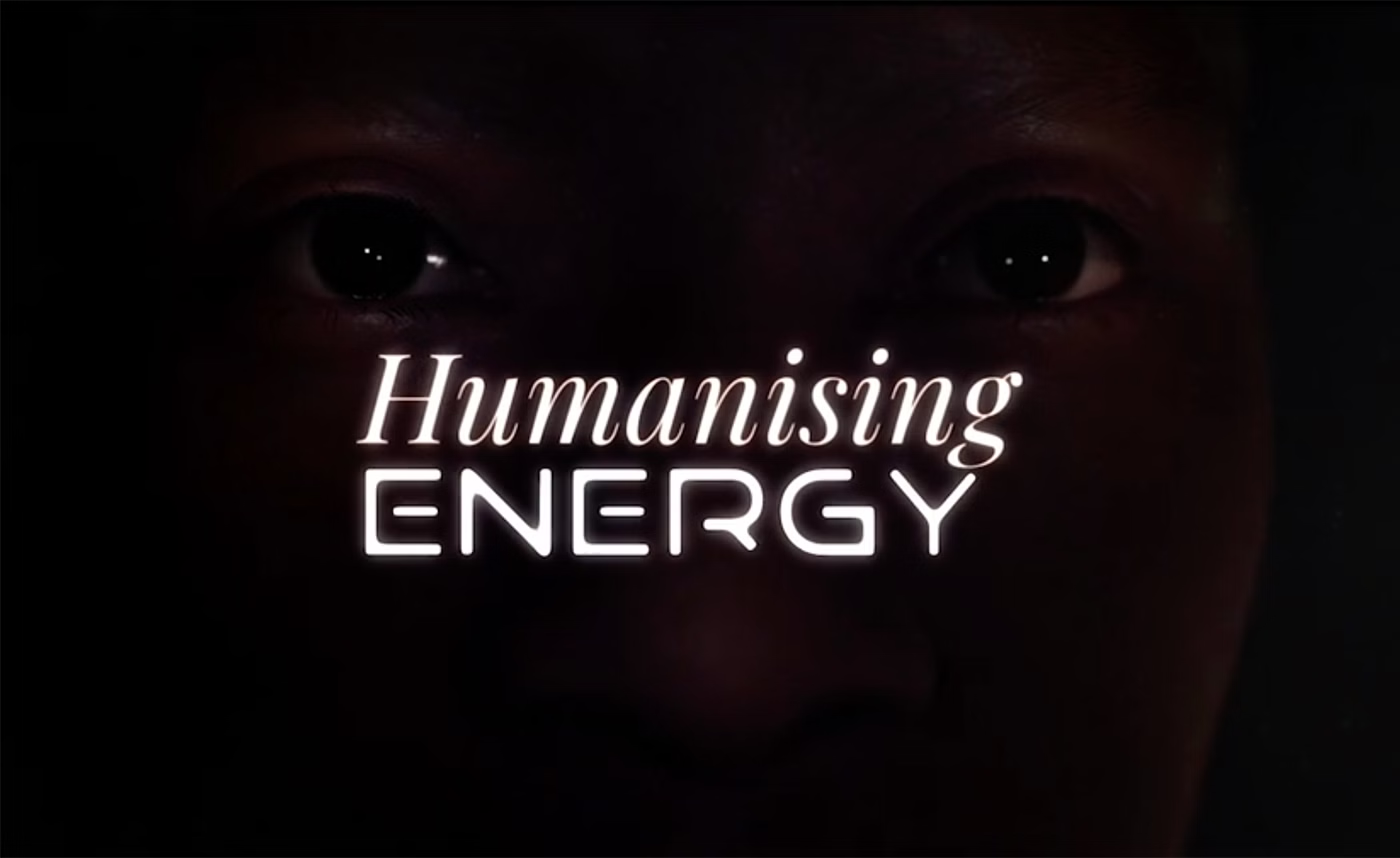
In 2021, the broadcaster launched a “Humanising Energy” series “presented by” the World Energy Council, a global forum for sustainable energy development, followed by a second series in 2023.
The two series featured dozens of five-minute films paid for by individual firms, showcasing their supposed climate solutions. These films typically involved one-on-one interviews with people either creating or benefiting from these green innovations, as well as cinematic shots of the technologies being deployed.
A screenshot of a BBC StoryWorks film from its ”Humanising Energy“ series. Credit: BBC
Sponsors of films in the two Humanising Energy series included the fossil fuel companies Engie Brazil, Gasum (the largest distributor of LNG in the Nordic countries), CLP Holdings (which has said it won’t phase out its coal assets before 2040, and hasn’t committed to phasing out its gas assets), Mabanaft, and Invenergy, the energy services firm Voith, and the engine manufacturer Cummins.
All of these films touted the supposed climate credentials of the featured companies, without examining their contribution to global emissions or the viability of the featured technologies.
In January 2024, Cummins agreed to pay a record $1.7 billion fine – the second largest environmental penalty ever in the U.S. – after facing charges that it equipped roughly one million vehicles with devices that bypassed emissions sensors. The company didn’t admit wrongdoing.
Just a few months earlier, BBC StoryWorks produced a film for Cummins boasting of the firm’s efforts to help decarbonise commercial vehicles.
The Invenergy film focused on its construction of an LNG plant in El Salvador. While the content attempted to show how the plant was providing energy and jobs to the local community, it also tried to tout the environmental benefits of natural gas.
During the film, an Invenergy spokesperson suggested that natural gas generates 30 percent less carbon dioxide than other fossil fuels, neglecting the fact that natural gas is composed largely of methane, which is over 80 times more potent than CO2 across a 20 year period. Even relatively small methane leaks during the process of extracting, shipping, and processing natural gas contribute significantly to global emissions.
One of the films in the Humanising Energy series – “The evolution of home energy” – promoted the role of hydrogen in supplying home heating. Yet, while green hydrogen is widely accepted as necessary for decarbonising heavy industry and other sectors where alternative renewable energy sources are unworkable, it is not considered viable for heating homes.
A peer-reviewed assessment of over 50 independent studies in 2024 concluded that hydrogen use in domestic heating is inefficient, costly and resource-intensive compared to other low-carbon options such as heat pumps.
The BBC StoryWorks film was paid for by DNV, a Norwegian company that claims to be “the world’s leading resource of independent energy experts and technical advisors”, including the oil and gas sector. DNV says on its website that it “delivers broad technical expertise and experience to enable hydrogen to play a key role in the energy transition”.
A DNV spokesperson said that, “While DNV does work with oil and gas companies and organisations across renewable energy production, it is not involved in the direct production or distribution of energy… Our approach to energy solutions is rooted in comprehensive research and rigorous testing, and our position as an independent third party is a central part of our identity and our work.”
The Humanising Energy series also featured twofilms advocating for the development and deployment of sustainable aviation fuels (SAFs) – one paid for by the aviation giant Boeing, and one paid for by the energy and chemicals company Sasol alongside the gas company Linde.
A screenshot of a BBC StoryWorks film, sponsored by Boeing, from its ”Humanising Energy“ series. Credit: BBC
SAFs have been criticised as being environmentally damaging and currently economically unviable. The Advertising Standards Authority this month banned a Virgin Atlantic advert for making the “misleading” claim that it had developed a “100 percent sustainable aviation fuel”.
In August 2022, the International Council on Clean Transportation (ICCT) said that the amount of money invested by airlines in SAFs was “insufficient” and that it seemed as though the technology was simply “about burnishing airlines’ images” by inflating their environmental credentials.
Sasol told DeSmog that its SAF initiatives were not an example of greenwashing and that it believes SAFs hold the “promise to be an enabler of our own decarbonisation and contribute to decarbonising aviation.”
Aviation contributes approximately 2.5 percent of worldwide greenhouse gas emissions, yet BBC StoryWorks has produced content for a number of airlines in recent months and years, including Uzbekistan Airways (March 2024), China Southern Airline (2022), and Korean Air (2017).
BBC StoryWorks has also worked extensively with other polluting transport companies.
It produced an advertising campaign for the shipping and cruise company Cunard that appeared on BBC StoryWorks social media pages in July 2024. Europe’s 218 cruise ships emitted as much sulphur oxides as one billion cars in 2022.
BBC StoryWorks has also produced brandedcontent for the car company Hyundai, as well as for Lexus, Volkswagen, and Jaguar. In addition, the studio has produced a six-part series paid for by the Indian multinational motorcycle company Royal Enfield.
Transport contributes roughly one quarter of all energy related greenhouse gas emissions, while outdoor air pollution is estimated to cause more than 3.2 million premature deaths worldwide every year.
“This important investigation reveals that BBC StoryWorks has been doing the greenwashing work of major polluting firms driving the climate crisis by obscuring their role and promoting their preferred ‘solutions’, however discredited by science,” Professor Newell told DeSmog.
Greenwashing is when a company falsely brands something as eco-friendly, green or sustainable. In 2017, the BBC itself produced a guide to the “seven ways to spot businesses greenwashing”.
Big Ag Polluters
BBC StoryWorks has also been paid to produce content for major agricultural polluters and their lobbyists. This content has often promoted the technological hacks that food and farming giants claim will reduce the sector’s emissions, rather than the more fundamental changes in production and consumption that scientists say will be crucial in limiting Big Ag’s climate impact.
In 2023, BBC StoryWorks produced an advertising campaign for the pesticides giant Bayer, the world’s second largest crop chemicals company, boasting of the firm’s efforts to facilitate “scientific breakthroughs”.
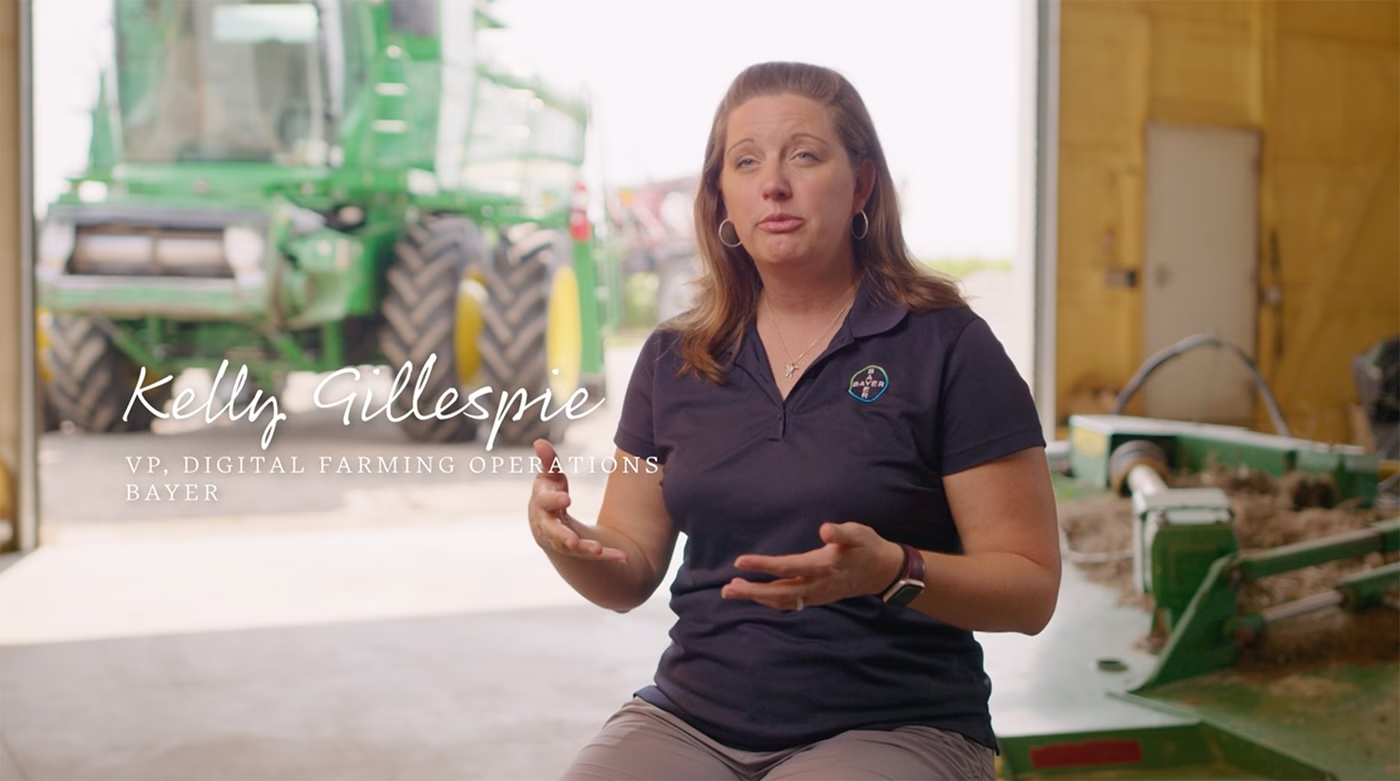
In addition, as part of a branded content series in late 2023 entitled “The Climate and Us”, BBC StoryWorks was paid by Bayer to produce a film on the digital apps helping farmers to monitor and reduce their emissions.
The film, which featured an interview with Bayer’s vice president of digital farming operations, promoted the firm’s technologies with no additional comment from experts on its efficacy, or Bayer’s stance on climate change.
A screenshot of a BBC StoryWorks film, sponsored by Bayer. Credit: BBC
According to the Pesticides Action Network, over a third of Bayer’s sales derive from products that are highly hazardous to the environment, animal or human health. (The methodology for this classification is strongly disputed by Bayer on the grounds that it uses different criteria to internationally accepted rules).
Bayer told DeSmog that it is “committed to ambitious sustainability goals and has a positive track record while recognising the ongoing challenge.”
Experts say that the overuse of chemical pesticides is harming the future of food production. Biodiversity is in sharp decline across the world, and numbers of birds and pollinators are plummeting in Europe.
Bayer, which makes almost $10 billion in agrochemical sales every year, has also faced millions of dollars in lawsuits over health issues allegedly related to its products, including from farmers.
In 2023, DeSmog revealed that BBC StoryWorks had produced three documentary series and 26 articles – viewed at least 65 million times – sponsored by Corteva, one of the world’s largest pesticide firms.
The BBC said that the Corteva-sponsored content, which focused on sustainable food production, was editorial in nature and not influenced by its corporate client. However, experts said the documentaries gave a “totally biased” picture of global food problems, while the content promoted a number of the technologies developed by Corteva.
BBC StoryWorks also produced two articles in 2023 paid for by Australian Dairy – the country’s industry trade group.
The first article promoted the supposed contribution of milk and dairy to a healthy diet, while the second advocated for “precision farming” – in other words, using technology to ensure that resources are used efficiently and to track climate impacts.
Scientists and health professionals agree that dairy products are not necessary for a healthy diet, and they agree that for people who are able to have a varied diet, lower meat and dairy consumption is healthier than diets higher in milk and dairy.
Experts also doubt that precision farming can be rolled out widely enough to meaningfully reduce agricultural emissions. The environmental group Friends of the Earth has said that: “Faced with global climate and biodiversity emergencies, better ‘optimisation’ of existing production processes cannot possibly go far enough to meet the challenges we face.”
According to a March 2024 Harvard Law paper, which surveyed more than 200 environmental and agricultural scientists, meat and dairy production must be drastically reduced – and fast – to align with the Paris Agreement. The report concluded that global emissions from livestock production need to decline by 50 percent during the next six years, with “high-producing and consuming nations” taking the lead.
Sophie Nodzenski, a senior campaign strategist on food and agriculture at Greenpeace International told DeSmog: “Tinkering with the status quo is no longer an option. Meat and dairy companies are climate killers. The livestock sector is one of the leading sources of human-made methane emissions, which move us faster and further past the 1.5C threshold, worsening global heating.
“Meat and dairy companies must stop misleading the public with pseudo solutions and focus on reducing their livestock herds drastically to bring down emissions instead. This reduction can give us a fighting chance against climate chaos.”
In 2023, BBC StoryWorks also produced content for the world’s largest food and drink company Nestlé, boasting of the company’s efforts to support sustainable farming through “regenerative agriculture”.
The film failed to acknowledge that Nestlé – whose 87.5 million tonnes of annual emissions are similar to those of Chile – spent 14 times more on “marketing and administration” in the last year than it did on regenerative agriculture over the previous five years combined.
A screenshot of a BBC StoryWorks film, sponsored by Nestlé. Credit: BBC
“Nestlé’s strong focus on using regenerative agriculture to compensate for the greenhouse gas emissions from livestock farming – one of Nestlé’s main strategies to achieve net zero – is not backed by robust scientific evidence,” Nodzenski said.
“Increasing carbon storage in soils, as well as forests and other vegetation, is necessary, but should not replace a drastic reduction of greenhouse gas emissions from livestock farming – one of the main sources of Nestlé’s emissions.”
The Nestlé film was part of a “Food for Thought” series backed by the trade body FoodDrink Europe, whose members feature major polluters including Cargill, Coca-Cola, and Unilever.
A Nestlé spokesperson said: “We continue to invest in and deliver on our net zero roadmap. By the end of 2023, we had reduced our greenhouse gas (GHG) emissions by 13.5 percent in absolute terms since 2018. Our GHG reduction targets are third-party approved by the Science Based Targets initiative and include a 20 percent absolute cut by 2025 and 50 percent by 2030 covering all sources of agricultural emissions in our supply chain.
“We continue to ramp up our climate efforts using world class research and development, including via the Nestlé Institute for Agricultural Sciences.
“Nestlé has committed to invest $1.2 billion to pay premiums to farmers for ingredients grown using regenerative agriculture practices, provide technical assistance and support investment.”
Petrostates
Over recent years, BBC StoryWorks has also produced content for some of the world’s leading fossil fuel states, many of which have a poor record on human rights and press freedom.
This year’s flagship COP29 climate summit will be held in Baku, Azerbaijan. The country is a petrostate with oil and gas production accounting for roughly half of its GDP and over 90 percent of its exports. The country, run under an authoritarian system with little effective political opposition, plans to increase fossil fuel production by a third over the next decade.
Azerbaijan’s government has also been accused by of a media crackdown by the advocacy group Human Rights Watch ahead of November’s summit, arresting 25 journalists and activists in the past year.
However, since November 2023, BBC StoryWorks has produced several adverts promoting Azerbaijan as a place to visit, while greenwashing its image.
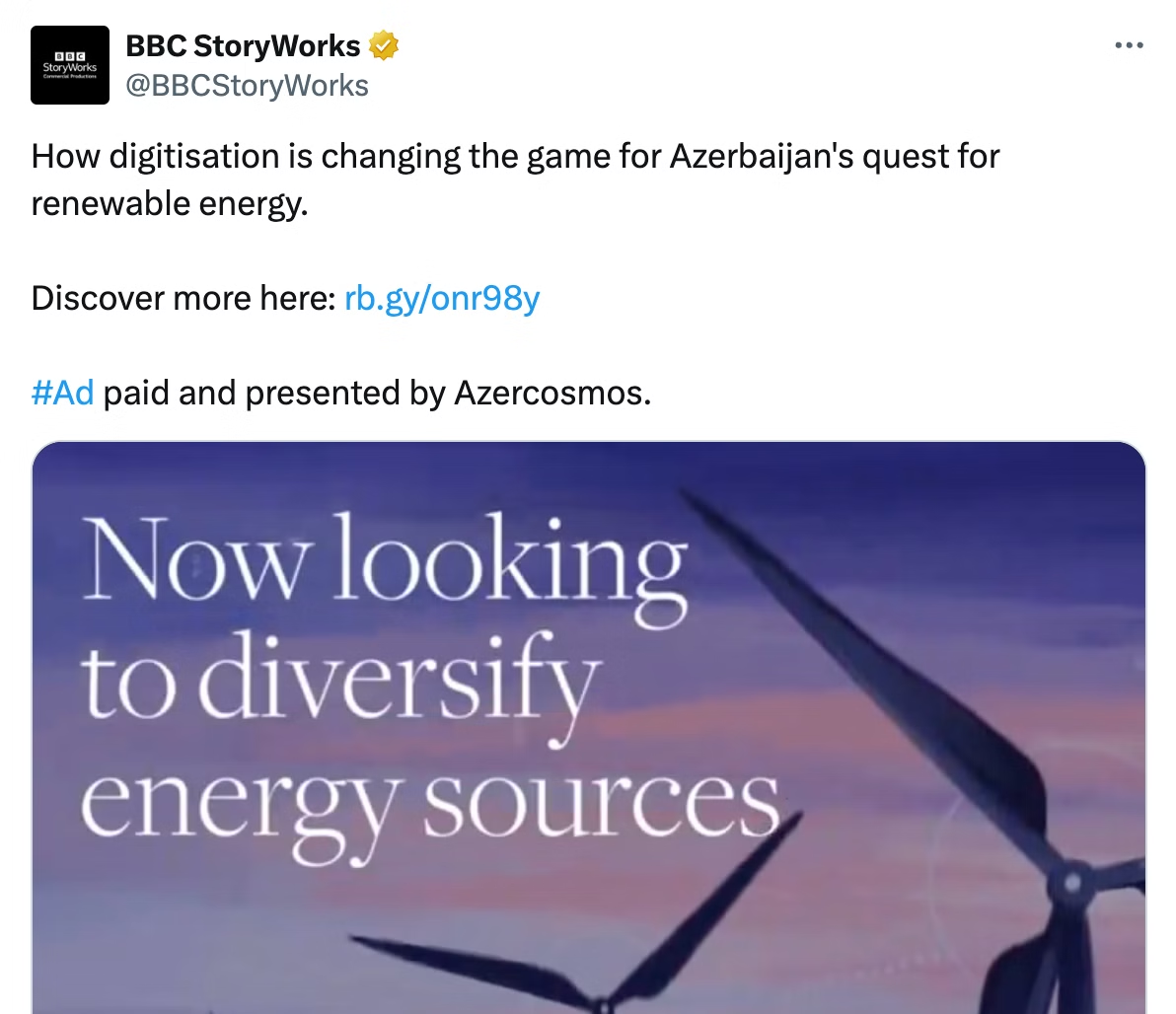
For example, in December 2023, the studio released an advert paid for by the country’s space agency Azercosmos, attempting to show “How digitisation is changing the game for Azerbaijan’s quest for renewable energy.”
The advert was accompanied by an article claiming that Azerbaijan plans to transition “from an oil- and gas-based economy into a thriving modern hub.” The article did not mention the country’s plan to expand fossil fuel production, which contravenes globally agreed efforts to limit rising temperatures.
A screenshot of a BBC StoryWorks advert, sponsored by Azercosmos. Credit: BBC
BBC StoryWorks has also produced content promoting the United Arab Emirates (UAE), the host of the 2023 COP28 climate summit and another petrostate with a poor human rights record.
In 2023, the studio produced a branded content podcast series on behalf of Abu Dhabi Tourism, featuring five 20-minute episodes each “highlighting the message that Abu Dhabi [the capital of the UAE] is a destination for every kind of traveller”.
The series was shortlisted for a 2023 World Media Award and, in the award submission, the BBC said it “challenged preconceived notions and [positioned] the city as a cultural gem worth exploring”. The series was downloaded 115,000 times, according to the BBC.
The UAE derives roughly 40 percent of its income from oil and gas, and this isn’t the only time that BBC StoryWorks has produced content promoting the petrostate.
The story stated that the UAE is “planning to increase oil production to more than five million barrels a day by 2030”, but said that the country “has been looking toward more sustainable energy sources”. It went on to say that “Clean energy projects are coming of age” in the UAE, “from record-breaking solar parks and green hydrogen to waste-to-energy plants”.
The UAE’s overall climate action has been rated as “critically insufficient” by the Climate Action Tracker, an independent scientific project that monitors government climate action and measures it against the Paris Agreement.
Weeks before COP28, the country’s national oil company, ADNOC, awarded contracts worth $17 billion for the development of new offshore gas fields.
The Gulf state also has a poor record on human rights and press freedom. The UAE continues to arrest and imprison activists, academics, and lawyers who speak out against its monarchic rulers. UAE authorities also continue to discriminate against women, LGBTQ communities, and migrants.
According to Reporters Without Borders, “The government prevents both local and foreign independent media outlets from thriving by tracking down and persecuting dissenting voices.”
“The rise of renewable energies in oil-rich regions” article also attempted to promote the ways in which “women are playing an increasing role in the renewable energy sector”. The story cited the fact that women are leading green initiatives in Kuwait, and Jordan.
However, many Gulf states routinely discriminate against women. In Kuwait for example, the country’s personal status laws discriminate against women in matters of marriage, divorce, and child custody.
Despite this, BBC StoryWorks has frequently promoted the country. In December 2023, the studio published an advert from the Kuwait Fund, the country’s state-run development agency, boasting of its efforts to help “disadvantaged regions, women and minorities”.
Reporters Without Borders states that Kuwait’s censorship laws prohibit journalists “from criticising the government, the emir, the ruling family, its allies or religion”. In particular, it is “difficult for journalists to tackle migrant worker rights, women’s rights and corruption.”
Oil and gas revenues account for roughly 60 percent of Kuwait’s GDP.
BBC StoryWorks has also produced content for the petrostate Qatar, promoting the country as a tourist destination despite its record of discriminating against women and minorities.
BBC StoryWorks has a history of working for repressive regimes, including China. The U.S. publication Deadline reported in December 2022 that BBC StoryWorks had partnered with at least nine Chinese state-affiliated bodies, including a media outlet banned from broadcasting in the UK.
“Those commissioning and paying for this content are deliberately using the BBC’s brand to greenwash or whitewash their own reputations. It’s an exercise of cynical manipulation,” the BBC’s former Baghdad bureau chief Patrick Howse told DeSmog.
“Commissions like this are lucrative and therefore attractive to a corporation that has been deliberately and severely financially squeezed by the UK government over a long period. This has forced the BBC to seek money from wherever it can find it, and this poses a risk to its editorial independence and honesty, which will ultimately undermine the trust of the BBC’s audience.”
Firefighters set a backfire to protect homes during a wildfire in California in September 2020. (Photo: David McNew/Getty Images)
“The devastation wrought by wildfires, drought, flooding, and heatwaves the world saw in 2023 must not become the new normal,” the report’s author said.
Climate scientists published a report Wednesday showing that the rate of global warming reached an all-time high in the 10 years up to and including 2023 and that the record-breaking heat of last year was primarily due to that human-caused heating rather than other factors such as El Niño.
The scientists found that from 2014 to 2023, the Earth warmed 0.26°C—higher than any previous 10-year period. The report, published in Earth System Science Data, was completed by 57 scientists who used the methods of the United Nations Intergovernmental Panel on Climate Change (IPCC), which produces major reports only every five to 10 years, with the next one expected in 2027. The report authors sought to fill the gap and, at least in one case, to galvanize climate action.
“Rapidly reducing emissions of greenhouse gases towards net zero will limit the level of global warming we ultimately experience. At the same time, we need to build more resilient societies,” lead author Piers Forster, a climate physicist at the University of Leeds in the U.K. and an IPCC author, said in a statement. “The devastation wrought by wildfires, drought, flooding, and heatwaves the world saw in 2023 must not become the new normal.”
Over the course of 2023, temperatures were on average 1.43°C above preindustrial levels, Forster and co-authors found, with an estimated 1.31°C of that due to human-caused global warming, and the relatively small remainder due to variability from events such as El Niño and La Niña.
The report also shows that the Earth’s remaining “carbon budget”—how much can be emitted before reaching 1.5°C of warming, the Paris agreement target—is now roughly 200 gigatonnes, which will take only five years or so for the global population to use. This is down from the 500 gigatonnes that the IPCC estimated remained in the budget as of 2020.
Adam Vaughan, environment editor at The Times, a U.K. newspaper, drew attention to the short time period in which humanity has to act, writing on social media that the 1.5°C target could be “blown” if emissions didn’t go down.
Global warming is advancing at its fastest since modern records began 174 years ago, according to a leading team of climate scientists inc @piersforster. They also found the carbon budget for 1.5C will be blown in around 5 years if emissions stay at current record level pic.twitter.com/7ziiNng0Ok
In a guest post in Carbon Brief, Forster and another co-author explained that their report was “nothing short of alarming, yet it does contain some encouraging news.”
“Greenhouse gas emissions have not yet risen beyond pre-pandemic levels and there is evidence that the rate of increase in CO2 emissions over the past decade has slowed compared to the 2000s,” they said.
Forster, who also led the annual report in its first iteration last year, spoke to reporters in such a way as to avoid doomsday rhetoric.
“If you look at this world accelerating or going through a big tipping point, things aren’t doing that,” he told TheAssociated Press. “Things are increasing in temperature and getting worse in sort of exactly the way we predicted.”
However, the climate news remains dire: Researchers working with even more up-to-date data—through May—have found that the average temperature increase above preindustrial levels is now 1.6°C, and each of the last 12 months has been the hottest on record for that month. Those findings are from data released by the European Union’s Copernicus Climate Change Service and reported by The Washington Post.
Officials pose with shovels for a photo opportunity for the groundbreaking ceremony for Oxys Direct Air Capture facility called Stratos in West Texas on Friday, April 28, 2023. (Photo: Elizabeth Conley/Houston Chronicle via Getty Images)
Direct air capture and similar technologies come with glossy brochures and lofty promises but we must not be fooled. They are a distraction and a scam orchestrated by the fossil fuel industry.
A newly opened facility in Iceland that will remove carbon dioxide from the atmosphere has been heralded as a hopeful turning point in the urgent fight to stop climate catastrophe. In reality, it is further evidence of a new type of techno-optimism that is not quite old-fashioned climate denial, but something you might call climate delusion.
On its face, the technology known as direct air capture (DAC) seems like a plausible, painless solution to the climate crisis: Giant machines pull greenhouse gasses out of the air, and they are either injected underground or integrated into consumer products.
For years, we have been hearing that a massive breakthrough is just around the corner. The clamor grew much louder when the Climeworks facility in Iceland came online. It is the world’s largest DAC facility—and yet is designed to capture just 36,000 tons of CO2 annually—which is, for the sake of comparison, just one percent of the pollution generated by a single coal power plant. There are much larger DAC plans in the works: Occidental Petroleum is part of a group building a facility in Texas that they claim will capture 500,000 tons of CO2 per year.
Handing out free money to polluters is not only broadly unpopular, it is also terrible public policy. Congress must stop the public funding and support for these climate scams.
And while that theoretical capability sounds impressive, it is still less than 0.01 percent of annual U.S. carbon emissions. And these projections become even less impressive when we consider the track record of carbon removal so far. Another recent Occidental project, the Century carbon capture facility, failed to capture more than a third of its capacity before they liquidated this asset.
There is another more fundamental problem with most of these carbon removal technologies: When the captured carbon is used to squeeze out oil from existing wells (a process known as enhanced oil recovery), is it of any climate benefit at all? There is no doubt that Occidental sees direct air capture as a tool to help it continue extracting fossil fuels; when they are touting ‘net zero oil,’ one cannot escape the conclusion that the goal is to greenwash oil extraction as a climate solution.
Breaking ground on the world’s largest DAC facility
To hear proponents of DAC explain it, science tells us this technology is a necessity at this stage in the race to stop climate catastrophe. This is misleading; there is a wide range of modeled pathways for slowing down the rate of global temperature increase, and they do not all rely on carbon removal that have not been shown to work.
Even if DAC was shown to be effective, its costs are astronomical. The Intergovernmental Panel on Climate Change (IPCC) estimates that the cost range of early-stage DAC plants is $600-$1,000/ton of carbon dioxide; and operating DAC at a meaningful scale would consume an estimated one-sixth of the world’s energy output.
By promoting the adoption of technologies they insist will eventually work as advertised, fossil fuel giants can delay the transition away from fossil fuels.
Instead of viewing techno fixes like DAC as a necessity, many in the scientific community warn that reliance on DAC is a risky move that could “obstruct near-term emissions reduction efforts.” This is exactly what makes DAC and carbon capture so appealing to major polluters: By promoting the adoption of technologies they insist will eventually work as advertised, fossil fuel giants can delay the transition away from fossil fuels.
Unfortunately, U.S. taxpayers are funding these false climate solutions; billions of dollars in subsidies are available through the Infrastructure Investment and Jobs Act, and similarly lucrative corporate tax credits are a major part of the Inflation Reduction Act. There is ample evidence that this is a poor investment. A 2020 Treasury Department Inspector General investigation found that nearly 90 percent of tax credits claimed for carbon capture operations were done so with no accompanying verification that any carbon was actually being captured.
Instead of taking corrective action, Congress massively expanded these tax credits, making this scam even more lucrative than before. To make matters worse, the IRS will not release information about which companies are benefiting from this billion dollar taxpayer-funded boondoggle.Handing out free money to polluters is not only broadly unpopular, it is also terrible public policy. Congress must stop the public funding and support for these climate scams. Continuing to encourage the expansion of direct air capture will waste precious money and time and perpetuate further harms on communities most affected by fossil fuel pollution.