Tag: international humanitarian law

  • World Leaders Blasted Over ‘Grave’ Violations of International Law by Israel

    Spread the love

    Original article by JON QUEALLY republished from Common Dreams under Creative Commons (CC BY-NC-ND 3.0). 
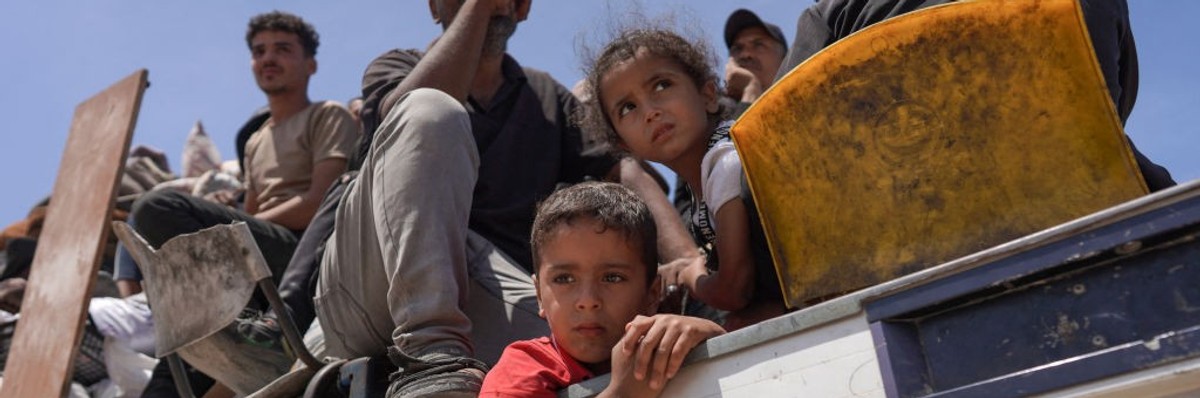
    Palestinian who fled Rafah in the southern Gaza Strip ride with their belongings in the back of a truck, as they arrive to take shelter in Deir el-Balah in the central part of the Palestinian territory on May 12, 2024.  (Photo by AFP via Getty Images)

    “The first step for Third States in upholding their own legal obligations to ensure [international humanitarian law] is respected is to stop the Rafah invasion, open all land crossings and lift internal barriers for humanitarian access,” said an international coalition.

    While ordinary citizens from across the globe have expressed their condemnation of the ongoing carnage and suffering in Gaza, a coalition of 20 international human rights groups on Wednesday excoriated world leaders for standing idly by as Israel carries out “a grave violation of international humanitarian law” with its military assault on Rafah.

    With the United Nations agencies reporting that as many as 450,000 people have already attempted to flee the encircled southern city where more than 1.4 million had sought refuge, a joint statement by the groups—including Amnesty International, Oxfam, Médecins du Monde International Network, and Mercy Corps—rebuked Israel’s evacuation orders as “unlawful” and chided third-party countries for violating their own obligations under international humanitarian law (IHL) by refusing to intervene.

    “Third States have the responsibility to urgently act in bringing to an end, and pursue accountability for, the Grave Breaches of IHL taking place in Gaza,” said the groups. “The first step for Third States in upholding their own legal obligations to ensure IHL is respected is to stop the Rafah invasion, open all land crossings and lift internal barriers for humanitarian access.”

    According to the statement, Israel’s ongoing violations are clear and obvious:

    The Israeli military’s “evacuation orders” are unlawful and amount to forcible transfer, a grave violation of international humanitarian law (IHL). Israel has ordered hundreds of thousands of Palestinians to flee, without providing civilians and humanitarian actors clear information nor timeframe. IHL sets clear conditions for an evacuation to be lawful: the occupying power must ensure that these displacements are temporary and that displaced persons are provided with satisfactory conditions of hygiene, health, safety and nutrition, and members of the same family must not be separated. Israeli authorities have failed to meet any of these requirements.

    With Wednesday marking the 76th anniversary of the Nakba, when Palestinians were forced to leave their homes en masse following the establishment of the Israeli state in 1948, a new wave of forced displacement is now upon the people of Gaza only served to heighten the harsh reality for those with nowhere safe to go.

    Ilan Pappe, a scholar of Palestinian history at the University of Exeter, explained to Al-Jazeera that while some comparisons with the original Nakba make sense, what is happening now to the people of Gaza is “even worse” in many ways.

    “What we see now are massacres which are part of the genocidal impulse, namely to kill people in order to downsize the number of people living in Gaza,” Pappe said. On Tuesday, a group of ultra-nationalist Israelis, including members of the Prime Minister Benjamin Netanyahu’s Cabinet, marched in the city of Sderot near the Gaza border as they called for resettlement of the enclave.

    “Ethnic cleansing is a terrible crime against humanity but genocide is even worse,” said Pappe. “So I think we are seeing a transition from using ethnic cleansing as the main method of taking as much of Palestine as possible, with as few Palestinians in it as possible—we are moving into a far more lethal method, that of genocide.”

    According to the joint declaration by rights groups on Wednesday, Israel’s military assault in Rafah is “disrupting the humanitarian response” of relief organizations and the United Nations, amounting to a “breach of the U.N. Security Council resolutions 2720 and 2728 as well as the International Court of Justice’s provisional measures ordering Israel to enable the provision of basic services and humanitarian assistance.”

    In remarks Tuesday, U.N. Secretary-General António Guterres said Israel’s escalating military operations and evacuation orders in Rafah “are further impeding humanitarian access and worsening an already dire situation.”

    “For people in Gaza,” said Guterres, “nowhere is safe now.”

    Despite the concerns from U.N. agencies and international relief groups, the U.S. government under President Joe Biden on Tuesday said it was preparing a $1 billion weapons shipment for Israel to bolster its military capabilities.

    Because of such military support, the human rights coalition argued in its Wednesday declaration that the U.S. “bears a significant responsibility” for Israel’s violations of international humanitarian law. “In addition to halting the transfer of high payload bombs, the U.S. should also use all its leverage to halt the ongoing military operation in Rafah,” the groups said.

    Those in the human rights coalition said it is the Palestinian people paying the price for the failure of world leaders to meet their obligations to put a stop to the forced displacement of civilians in Gaza.

    “We have been warning for months that Israel must be stopped from entering Rafah or Gaza would face an even greater humanitarian catastrophe” than it already has, said Florence Rigal, president of Médecins du Monde France. “The inaction of third countries is seen as a lack of concern for the consequences for the exhausted civilian population. It is unacceptable and immediate action must be taken to prevent further suffering.”

    Original article by JON QUEALLY republished from Common Dreams under Creative Commons (CC BY-NC-ND 3.0). 
  • UN Rights Chief Demands International Probe of Mass Graves Near Gaza Hospitals

    Spread the love

    Original article by JAKE JOHNSON republished from Common Dreams under Creative Commons (CC BY-NC-ND 3.0).
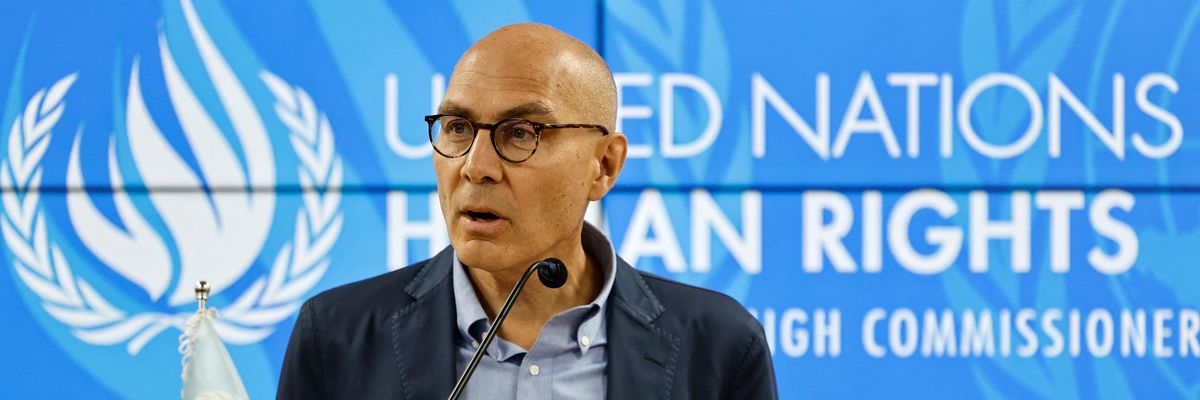
    United Nations High Commissioner for Human Rights Volker Türk speaks during a press conference in Cairo, Egypt on November 8, 2023.
     (Photo: Khaled Desouki/AFP via Getty Images)

    “Hospitals are entitled to very special protection under international humanitarian law,” said Volker Türk, the United Nations high commissioner for human rights.

    The United Nations’ human rights chief on Tuesday called for an international investigation into mass graves discovered at two Gaza hospitals that Israeli forces recently assailed and destroyed, further imperiling the enclave’s barely functioning healthcare system.

    Volker Türk, the U.N. high commissioner for human rights, said in a statement that he was “horrified” by the discovery of mass graves at the Nasser and al-Shifa medical complexes, which the Israel Defense Forces (IDF) reduced to ruins.

    More than 300 bodies were reportedly discovered in the mass grave near the Nasser facility in Khan Younis, Gaza, and eyewitnesses said Israeli soldiers executed civilians during their two-week-long raid of al-Shifa last month.

    Türk demanded an “independent, effective, and transparent” probe into the killings and mass graves, adding that “given the prevailing climate of impunity, this should include international investigators.”

    “Hospitals are entitled to very special protection under international humanitarian law,” he added. “And the intentional killing of civilians, detainees, and others who are hors de combat is a war crime.”

    “Every 10 minutes a child is killed or wounded. They are protected under the laws of war, and yet they are ones who are disproportionately paying the ultimate price.”

    The IDF’s destructive attacks on Nasser and al-Shifa were part of a broader Israeli assault on Gaza’s healthcare system. An analysis released Monday by Save the Children found that the rate of monthly Israeli attacks on healthcare in Gaza since October has exceeded that of any other conflict around the world since 2018.

    The group estimated that Israel has launched an average of 73 attacks per month on healthcare in Gaza—and at least 435 attacks total since October.

    “After six months of unimaginable horror, the healthcare system in Gaza has been brought to its knees,” said Xavier Joubert, Save the Children’s country director in the occupied Palestinian territory. “Healthcare workers are risking their lives daily to give Palestinian children a chance at survival. The constant attacks on healthcare are simply unjustifiable and must stop. Palestinian children must have unimpeded access to services, including healthcare and education.”

    Türk also used his statement Tuesday to condemn Israeli forces’ killing of women and children in airstrikes on the southern Gaza city of Rafah in recent days. The human rights official noted that Gaza doctors rescued a baby from the womb of her mother as the latter succumbed to head injuries from an Israeli strike.

    “The latest images of a premature child taken from the womb of her dying mother, of the adjacent two houses where 15 children and five women were killed—this is beyond warfare,” said Türk. “Every 10 minutes a child is killed or wounded. They are protected under the laws of war, and yet they are ones who are disproportionately paying the ultimate price in this war.”

    Original article by JAKE JOHNSON republished from Common Dreams under Creative Commons (CC BY-NC-ND 3.0).
  • ‘Enough Is Enough’: Ireland Joins ICJ Genocide Case Against Israel

    Spread the love

    Original article byBRETT WILKINS republished from Common Dreams under Creative Commons (CC BY-NC-ND 3.0).

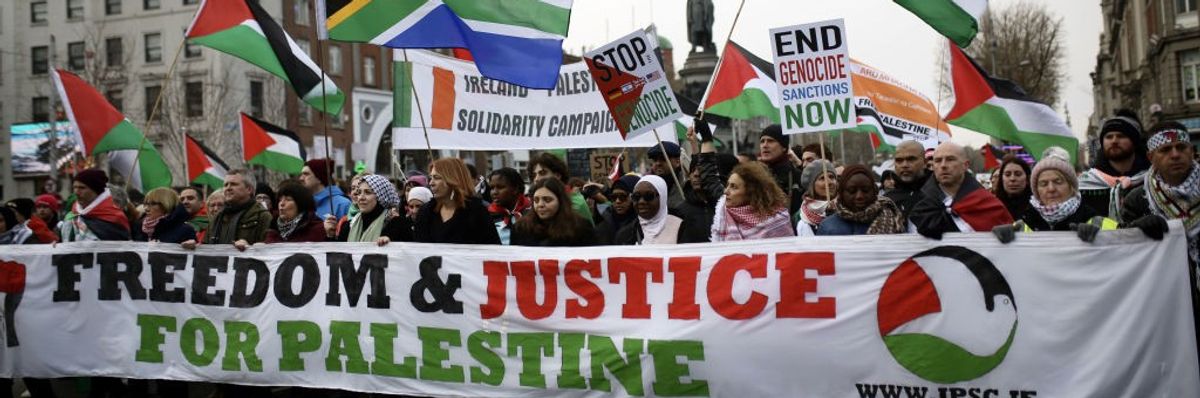
    Palestinian and South African flags are seen at a January 13, 2024 protest for Gaza in Dublin, Ireland.  (Photo: Stringer/Andalou via Getty Images)

    “What we saw on October 7 in Israel, and what we are seeing in Gaza now, represents the blatant violation of international humanitarian law on a mass scale,” said one top Irish official.

    Citing Israel’s “blatant” human rights violations in Gaza, Ireland’s second-highest-ranking official said Wednesday that the country will join the South Africa-led genocide case before the International Court of Justice in The Hague.

    Irish Tánaiste Micheál Martin—the equivalent of a deputy prime minister in other parliamentary nations—said that Ireland decided to intervene in the case after analyzing the “legal and policy issues” pertaining to the case under review by the United Nations’ top court.

    “It is for the court to determine whether genocide is being committed,” Martin—who also serves as Ireland’s foreign and defense minister—said in a statement. “But I want to be clear in reiterating what I have said many times in the last few months; what we saw on October 7 in Israel, and what we are seeing in Gaza now, represents the blatant violation of international humanitarian law on a mass scale.”

    Martin continued:

    The taking of hostages. The purposeful withholding of humanitarian assistance to civilians. The targeting of civilians and of civilian infrastructure. The indiscriminate use of explosive weapons in populated areas. The use of civilian objects for military purposes. The collective punishment of an entire population.

    The list goes on. It has to stop. The view of the international community is clear. Enough is enough. The U.N. Security Council has demanded an immediate cease-fire, the unconditional release of hostages, and the lifting of all barriers to the provision of humanitarian assistance at scale. The European Council has echoed this call.

    South Africa’s case—which is supported by over 30 countries, the Arab League, African Union, and others—incisively details Israel’s conduct in the war, including the killing of tens of thousands of Palestinians, mostly women and children; the wounding of tens of thousands more; the forcible displacement of 90% of the besieged enclave’s 2.3 million people; and the inflicting of conditions leading to widespread starvation and disease. The filing also cited numerous genocidal statements by Israeli officials.

    On January 26, the ICJ issued a preliminary ruling that Israel is plausibly committing genocide in Gaza and ordered its government and military to prevent genocidal acts. Palestinian and international human rights defenders say Israel has ignored the order.

    A draft report released this week by the U.N.’s Human Rights Council found “reasonable grounds to believe” that Israel is committing genocide in Gaza, a move that came on the same day as the U.N. Security Council passed a resolution demanding an immediate cease-fire in the ongoing war.

    “The situation could not be more stark; half the population of Gaza face imminent famine and 100% of the population face acute food insecurity,” said Martin. “As the U.N. secretary-general said as he inspected long lines of blocked relief trucks waiting to enter Gaza during his visit to Rafah at the weekend: ‘It is time to truly flood Gaza with lifesaving aid. The choice is clear: surge or starvation.’ I echo his words today.”

    In a St. Partick’s Day White House meeting with U.S. President Joe Biden—a staunch supporter of Israel—Irish Toaiseach (Prime Minister) Leo Varadkar, who announced earlier this month that he would soon step down, said that “the Irish people are deeply troubled about the catastrophe that’s unfolding before our eyes in Gaza.”

    “And when I travel the world, leaders often ask me why the Irish have such empathy for the Palestinian people,” he added. “And the answer is simple: We see our history in their eyes—a story of displacement, of dispossession and national identity questioned and denied, forced emigration, discrimination, and now hunger.”

    Original article byBRETT WILKINS republished from Common Dreams under Creative Commons (CC BY-NC-ND 3.0).

  • Calls Grow for ‘European Arms Embargo’ on Israel After Dutch F-35 Ruling

    Spread the love

    Original article by JULIA CONLEY republished from Common Dreams under Creative Commons (CC BY-NC-ND 3.0). 

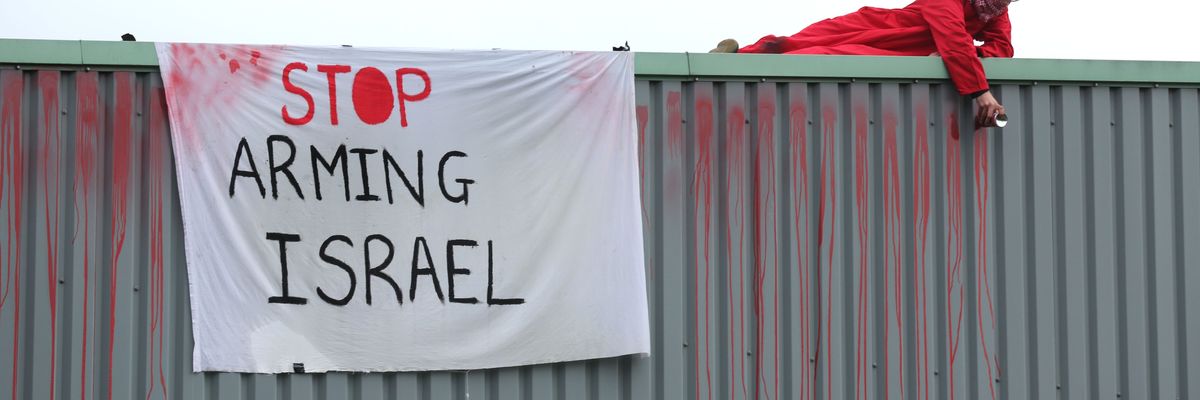
    A protester occupies the roof of Howmet Fastening Systems in Leicester, U.K., which makes components for Israeli F-35s, in October 2023.  (Photo: Palestine Action)

    “Surely it’s time to stop all arm shipments to Israel,” said one British lawmaker, “and implement targeted sanctions against members of the Israeli leadership.”

    While the White House has claimed U.S. President Joe Biden is growing increasingly “frustrated” with Israel’s bombardment of Gaza—largely made possible by U.S. military aid—calls are growing in Europe for governments to halt arms exports to stop their own contributions to the mass killing.

    After a Dutch court ordered the Netherlands to stop exporting F-35 fighter jet parts to Israel on Monday, ruling that the country was running a “clear risk” of helping Israel to violate international human rights law, several British lawmakers intensified their demands that the U.K. also halt arms exports.

    “Selling arms to Israel for its war on Gaza is incompatible with U.K. and international law,” said Diane Abbott, a Labour Party member in British Parliament. “[Prime Minister Rishi] Sunak should follow suit and ban weapon sales to Israel.”

    Natalie Bennett, a member of the Green Party in the British House of Lords, spoke on Tuesday about six-year-old Hind Rajab, whose body was found last week in a car in which her family members had tried to flee Gaza City. The car was riddled with bullet holes, and an ambulance nearby, which paramedics had sent to rescue Hind, had been bombed.

    “Is the government challenging the Israeli government about risks to hundreds of thousands of children in Rafah, now in the path of the Israeli offensive?” said Bennett. “Surely it’s time to stop all arm shipments to Israel… and implement targeted sanctions against members of the Israeli leadership.”

    The U.K. provides about 15% of the components of Israel’s F-35 bombers—the Israeli Air Force’s “flagship asset,” according to the Royal United Services Institute—and has licensed more than $594 million in military exports to Israel since 2015.

    While the U.S. Senate on Tuesday passed a $95 billion foreign aid bill, including $14.1 billion for Israel, some European governments are working to end their complicity in Israel’s mass killing of at least 28,576 Palestinians so far in attacks that have also wounded at least 68,291 and left at least 17,000 children orphaned.

    On February 6, the Walloon regional government in Belgium suspended two licenses for the export gunpowder to Israel, citing the International Court of Justice’s (ICJ) interim ruling last month which found that Israel is “plausibly” committing a genocide in Gaza.

    Italian Foreign Minister Antonio Tajani said in late January that the government had halted all arms sales to Israel in October, when Israel began its bombardment of Gaza in retaliation for a Hamas-led attack on October 7.

    José Albares, Spain’s foreign minister, also said last month that the Spanish government had done the same, but El Diarioreported on Sunday that the country had actually exported $1.1 million in ammunition to Israel in November.

    “The suspension of arms transfers to Israel must be comprehensive and permanent, and not just temporary,” said Alberto Estévez, a spokesperson on weapons issues at Amnesty International Spain. “The Spanish government has wanted to be an example in this crisis in the face of other much more complicit governments, but it must be more forceful to promote a European arms embargo on Israel and Hamas and other Palestinian armed groups, in addition to pressuring the United States to stop the supply of arms to Israel and support the imposition of a global embargo on the U.N. Security Council.”

    On Wednesday, Spanish Prime Minister Pedro Sánchez joined Irish Prime Minister Leo Varadkar in writing to European Commission President Ursula von der Leyen and demanding an “urgent review” of Israel’s compliance with human rights obligations under its trade deal with the European Union.

    “Against the background of the risk of an even greater humanitarian catastrophe posed by the imminent threat of Israeli military operations in Rafah, and given what has occurred, and continues to occur in Gaza since October 2023, including widespread concern about possible breaches of international humanitarian law and international human rights laws by Israel, we ask that the Commission undertake an urgent review of whether Israel is complying with its obligations, including under the E.U./Israel Association Agreement, which makes respect for human rights and democratic principles an essential element of the relationship,” wrote Sánchez and Varadkar.

    The two leaders reiterated their call for an immediate humanitarian cease-fire, which was supported by a large majority of countries in a vote at the U.N. General Assembly in December, “including by 17 E.U. member states.”

    Varadkar and Sánchez also pointed to the ICJ’s interim ruling in South Africa’s case last month, in which the country accused Israel of genocidal violence against Palestinians.

    The orders of the ICJ, which demanded that Israel ensure that humanitarian aid can reach Gaza residents and that its military is not committing acts of genocide, “are binding,” the leaders reminded the European Union.

    Original article by JULIA CONLEY republished from Common Dreams under Creative Commons (CC BY-NC-ND 3.0).