Tag: Iraq

  • US Complicity at a Crossroads: ICC Arrest Warrants Demand Accountability

    Spread the love

    Original article by Raed Jarrar republished from Common Dreams under Creative Commons (CC BY-NC-ND 3.0).
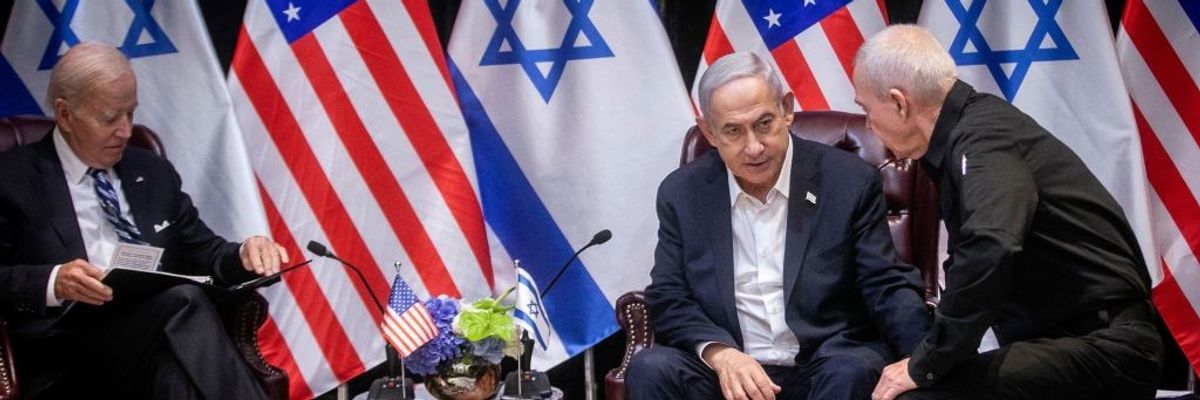
    Israeli Prime Minister Benjamin Netanyahu (center) confers with Defense Minister Yoav Gallant (R), during their meeting with U.S. President Joe Biden at the start of the Israeli war cabinet meeting, in Tel Aviv on October 18, 2023. The International Criminal Court issued arrest warrants for both Netanyahu and Gallant this week. (Photo by Miriam Alster / POOL / AFP via Getty Images)

    Their entanglement in Israel’s war makes U.S. leaders vulnerable to legal accountability not just for aiding and abetting crimes, but for direct complicity in their commission.

    The International Criminal Court (ICC) issued historic arrest warrants on Thursday for Israeli Prime Minister Benjamin Netanyahu and former Defense Minister Yoav Gallant, charging them with war crimes and crimes against humanity. This unprecedented move against Israeli officials holds profound implications not only for Israeli leaders but also for their enablers, including the United States. As the Biden administration continues to provide billions in military aid to Israel, these warrants serve as both a warning and a call to action. To avoid complicity in these crimes, top U.S. officials should immediately halt military assistance or risk legal repercussions for continued support of Israeli war crimes.

    Significantly, the ICC also has a history of issuing sealed indictments that remain confidential until the targeted individuals enter a member state. This means that beyond Netanyahu and Gallant, other Israeli officials, most likely soldiers documented committing gross crimes, likely face undisclosed warrants, with far-reaching implications for Israeli military forces and those who support their actions.

    As the Biden administration continues to provide billions in military aid to Israel, these warrants serve as both a warning and a call to action.

    This development should serve as a wake-up call for the U.S. government. The Biden administration continues to provide billions of dollars in unrestricted military aid to Israel—$17.9 billion this year alone—despite a majority of Americans who now oppose such aid. Israeli forces have used these weapons to commit the very crimes for which the ICC has issued arrest warrants. This is not just morally indefensible; it is legally risky. Article 25(3)(c) of the Rome Statute explicitly outlines criminal liability for aiding and abetting war crimes. While the U.S. is not an ICC member state, its officials and leaders could still face prosecution for enabling crimes under the court’s jurisdiction, such as the crimes underway in Palestine.

    It’s important to note that the Biden administration has not only armed Israel but has also contributed directly to operations on the ground, including intelligence sharing, targeting data, and direct military combat in Yemen and Iraq targeting armed groups who are fighting Israel. This entanglement in Israel’s war makes U.S. leaders vulnerable to legal accountability not just for aiding and abetting crimes, but for direct complicity in their commission. This moment calls for more than celebration—it demands meaningful and decisive action. For justice to prevail, the international community should rise to the occasion and ensure accountability at every level. A critical first step lies with the 124 member states of the ICC. These nations should publicly commit to upholding their obligations under international law by affirming their readiness to arrest Israeli officials if they enter their jurisdiction. Notably, countries such as the Netherlands, France, Canada, Spain, and Italy have already signaled their intent to enforce the ICC’s arrest warrants for Netanyahu and Gallant.

    By cutting ties with leaders implicated in war crimes and crimes against humanity, nations can exert pressure on Israel to change course and demonstrate their commitment to upholding justice and human rights.

    Beyond national commitments, ICC member states could leverage international mechanisms to restrict the movement of indicted individuals. They should work collectively to request Interpol Red Notices for Netanyahu, Gallant, and any other officials facing charges. These notices would alert law enforcement worldwide to the existence of arrest warrants, ensuring that the accused cannot travel freely without risk of apprehension and extradition. Such measures are not merely symbolic; they serve as a tangible step toward accountability, signaling to perpetrators and their supporters that the international community will not tolerate impunity.

    Equally important is the need for countries to reevaluate and sever their political and military ties with Israel’s leadership, at least as long as Netanyahu serves as Israel prime minister. This includes halting weapons sales and other forms of military cooperation with the Netanyahu government. Military aid and arms exports fuel the very crimes that the ICC is now investigating, making complicity in these actions inexcusable. By cutting ties with leaders implicated in war crimes and crimes against humanity, nations can exert pressure on Israel to change course and demonstrate their commitment to upholding justice and human rights. These steps, taken collectively, would not only support the ICC’s mission but also strengthen the principles of accountability and rule of law in international relations.

    Original article by Raed Jarrar republished from Common Dreams under Creative Commons (CC BY-NC-ND 3.0).
  • Israel makes a veiled threat to attack Iraq

    Spread the love

    https://morningstaronline.co.uk/article/israel-makes-veiled-threat-attack-iraq

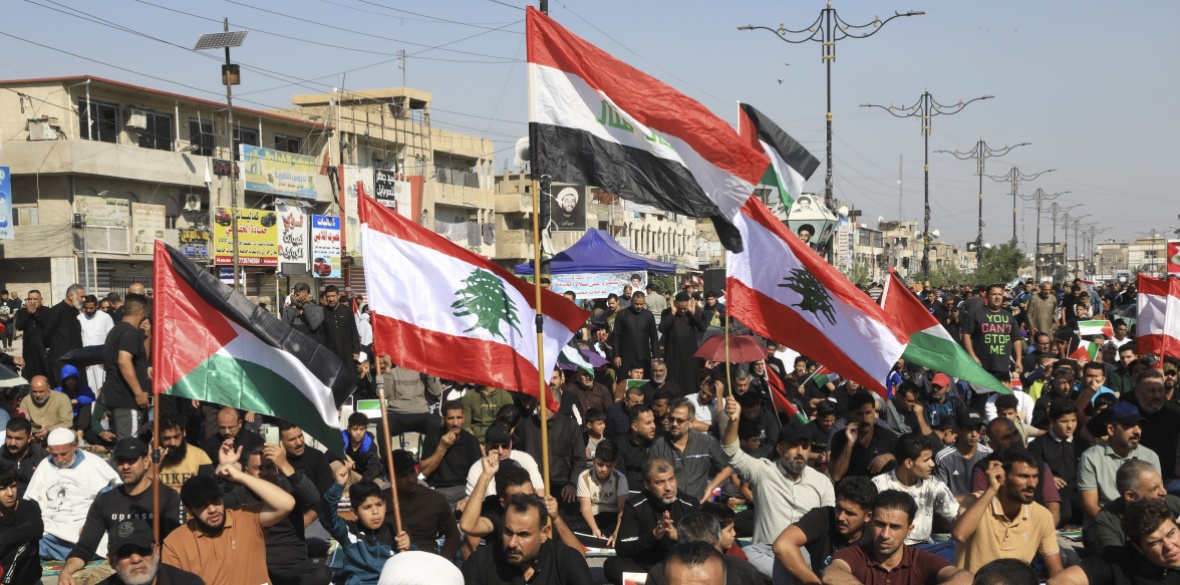
    Followers of Shiite cleric Muqtada al-Sadr chant slogans while waving Iraqi, Lebanese and Palestinian flags protesting against the war in Palestine and Lebanon at Sadr city in Baghdad, Iraq, November 15, 2024

    ISRAEL issued a veiled threat today to strike Iraq in response to recent attacks by militant groups based in that country.

    In a letter to the United Nations security council posted on the X social media platform, Foreign Minister Gideon Saar claimed that his country had the right to “take all necessary measures to protect itself and its citizens against the ongoing acts of hostilities by Iranian-backed militias in Iraq.”

    Militants in Iraq have launched several air attacks against both Israel and US forces since Hamas attacked southern Israel from Gaza on October 7 2023.

    An October 3 drone attack launched from Iraq hit an army base in northern Israel, killing two Israeli soldiers and wounding 24, Mr Saar said.

    In his letter, Mr Saar calls on the UN to take “immediate action” to address the situation.

    …

    https://morningstaronline.co.uk/article/israel-makes-veiled-threat-attack-iraq

  • Britain’s secret defence plan with Israel

    Spread the love

    …

    The UK Ministry of Defence (MoD) refuses to publish a military pact it signed with Israel in December 2020 which could relate to the HEZUK project.

    Former British soldier Joe Glenton, who works for campaign group ForcesWatch, told Declassified: “These leaks show once again how deeply entangled the UK is with Israel. 

    “It has to raise a number of ethical questions given the ongoing genocide in Gaza – and now the assault on Lebanon, itself a UK ally whose army is being trained by British troops”.

    He added: “the public urgently need to know if the military and intelligence engagements detailed in these documents, which appear to date back a few years now, are still live programs. Because if they are, British military and intelligence personnel are being put to work supporting a genocidal state”.

    The MoD refused to clarify whether HEZUK was ongoing.

    A UK government spokesperson said: “We regularly work with partners and allies across the Middle East to contribute to regional security. This includes intelligence sharing, where it benefits our national security, as well as defence industrial collaboration, which supports UK economic growth”.

    …

    Zionist Keir Starmer is quoted "I support Zionism without qualification." He's asked whether that means that he supports Zionism under all circumstances, whatever Zionists do.
    Zionist Keir Starmer is quoted “I support Zionism without qualification.” He’s asked whether that means that he supports Zionism under all circumstances, whatever Zionists do.
    Vote For Genocide Vote Labour.
    Vote For Genocide Vote Labour.
    UK Foreign Secretary David Lammy says that UK is suspeding 30 of 350 arms licences to Isreal. He also confirms the UK government's support for Israel's Gaza genocide.
    UK Foreign Secretary David Lammy says that UK is suspeding 30 of 350 arms licences to Israel. He also confirms the UK government’s support for Israel’s Gaza genocide.
  • Starmer’s hints about the budget suggest UK is set for bleak four years

    Spread the love

    Original article by Paul Rogers republished from Open Democracy.

    https://cdn2.opendemocracy.net/media/images/GettyImages-2159569411.max-760×504.jpg

    Introducing a wealth tax would indicate this is a progressive government. But that seems unlikely

    Taking as his theme the need to “fix the foundations” after “14 years of rot” under Tory rule, new Labour prime minister Keir Starmer this week delivered a message that should bring discomfort to everyone in the months and perhaps years to come.

    Those “14 years of rot” are of no surprise to voters; indeed, they helped ensure a landslide Labour victory in the election in July. But Starmer’s plans to resolve them appear likely to be far harsher than many voters expected.

    The chancellor of the Exchequer, Rachel Reeve, has made numerous hints that hard times are ahead. Her October budget will be uncompromising in its commitment to raising revenue to help fill a fiscal hole reckoned to be around £20bn – but much of this money seems likely to be taken from the poorer sections of society, not the rich.

    Labour will retain unpopular policies introduced by the Conservatives – the ‘bedroom tax’ and limiting child benefit allowances to the first two children, for example – while introducing its own cost-cutting measures, such as reducing the winter fuel allowances for many pensioners.

    These actions contribute to a growing sense that the Starmer government will prove to be decidedly right-of-centre in a country beset with deep divisions of wealth and poverty. Some areas may see an improvement, such as labour rights, but even there, it is a matter of the devil in the detail.

    One area where the government does apparently have cash to spash, though, is military spending, which is set to be substantially increased despite the manifest failures in Afghanistan, Iraq and Libya, and the deeply unpopular Israeli wars on Gaza and the West Bank.

    Labour’s attitude to Israel is certainly unlikely to change, with the Department for Business and Trade reporting on efforts to strike a new trade deal with the country, saying: “Our teams will be entering negotiating rooms as soon as possible, laser-focused on creating new opportunities for UK firms.” An official from the British Embassy in Israel also recently wrote of the “tremendous opportunity for collaboration between Israeli and British companies”.

    A full-scale Strategic Defence Review is also underway, and there are few if any indications that it will start by addressing the grievous failures of the past two decades. If previous experience is anything to go by, it will likely also omit the main challenge to international security: climate breakdown. Without that, the review will not be worth the paper it is written on. Net zero secretary Ed Miliband may be doing his best to maintain the idea of a green transition but the issue would be sidelined by any major increase in government spending.

    On the domestic front, less than two months into the new Labour government the contrast between Food Bank Britain and the ludicrous levels of runaway wealth is apparent. It was coincidentally yet powerfully illustrated just four days before Starmer’s pre-budget speech, by a full-page property advertisement from Sotheby’s in the Financial Times.

    Of the seven properties on sale, one was a relatively modest three-bedroom apartment in Chelsea, on sale for a mere £5m, while the others included a six-bedroom house in Belgravia offered at £18m and a nine-bedroom/five-bathroom place near Regent’s Park for £20m. Another Regent’s Park number was on sale for £25m million, which at least had 7 bathrooms for the 6 bedrooms. Trumping all was a triplex number in Knightsbridge – £50m with exclusive access to Hans Place Gardens.

    While we have to wait for the October budget announcements, we can be reasonably sure that there will be some attempts to raise modest amounts from the wealthier sectors of society, possibly involving changes in capital gains and inheritance taxes. But the best indicator of a changed government would be one willing to bring in wealth taxes, especially those directed at the super-rich.

    Onee of Britain’s largest trade unions, Unite, recently proposed a 1% per annum tax on those with net assets of over £4m, which would include property, shares and bank holdings but not mortgaged property. That is estimated to yield £25bn a year but would be bitterly opposed, with the Daily Mail informing us that: “Millionaires are looking to flee the UK in their droves to escape Labour’s tax raids – with a record number of wealthy Britons tipped to leave the country this year.”

    As things stand, the budget is expected to include substantial cuts in public spending that could be at least partly avoided by such a wealth tax, and it is worth noting that some European countries such as Switzerland and Spain have already introduced them. At least Britain’s wealthy won’t be fleeing “in their droves” to those countries.

    If adopted in October, in even a modest form, a wealth tax would be a reasonable marker for a progressive government. If not, then an opportunity will be missed for placing Labour in a more progressive place in the political spectrum than currently seems at all likely.

    Original article by Paul Rogers republished from Open Democracy.

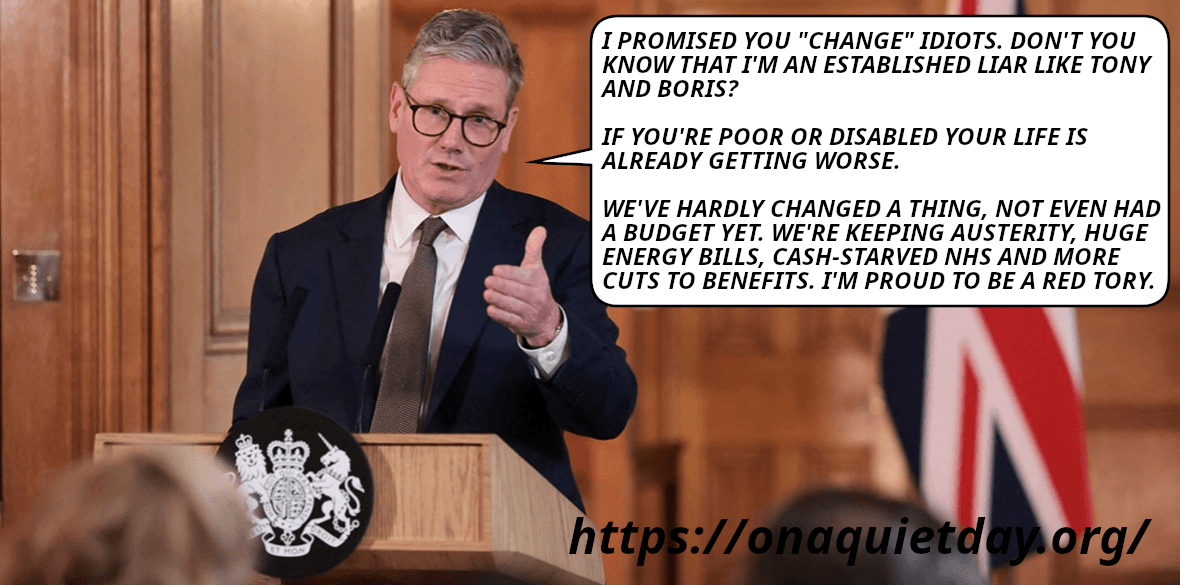
    Keir Starmer confirms that he is continuing Tory policies and that he's proud to be a red Tory.
    Keir Starmer confirms that he is continuing Tory policies and that he’s proud to be a red Tory.
    Keir Starmer says pensioners can freeze to death and poor children can starve and be condemned to failure and misery all their lives.
    Keir Starmer says pensioners can freeze to death and poor children can starve and be condemned to failure and misery all their lives.
  • How will Labour’s new desire to be the party of war shape British politics?

    Spread the love

    [This article was published 3 July 2024, a day before the UK General Election 2024.]

    Original article by Iain Overton republished from OpenDemocracy under a Creative Commons Attribution-NonCommercial 4.0 International licence.

    Protest against nuclear war outside Westminster Abbey, London 2019 | Wiktor Szymanowicz/Future Publishing via Getty Images

    What’s the difference between the defence policies of Labour and Conservatives? Spoiler alert: there isn’t one

    Days after Rishi Sunak announced the country would be going to the ballots, Tory MP Jacob Rees-Mogg released a campaign video in which he declared “security is at the forefront of this general election”.

    It was a grand claim, but an astute one. Sunak and Keir Starmer have indeed spent much of the past six weeks fighting over who is leading the party of defence, while the subject has also dominated headlines (or it did until Nigel Farage re-entered politics and made the election considerably more about immigration).

    From existential concerns about the size of the British army to debates about who supports Trident (and who doesn’t) and the shock announcement of the possible return of National Service, you’d be forgiven for thinking the election is less about voting red, blue, green or yellow, and more about what shade of camouflage you’d prefer your leaders in. 

    But how, exactly, do Labour and the Tories differ when it comes to matters of defence? And how will rising fears from politicians and pundits over threats from Russia, Iran and China affect British politics?

    Early on in the election campaign, Labour leader Starmer declared his the ‘party of national security’ – a sentiment echoed by his shadow defence secretary, John Healey, who said “Labour is now the party of defence.” Their claims came weeks after Starmer took to the pages of the Daily Mail, not his natural ally, to proclaim: “We will back our Armed Forces. We will back our nuclear deterrent. We will back Britain.”

    This messaging appears to be working. That same pro-Tory paper reported in March that Labour is now more trusted than the Conservatives on defence, with voters reportedly associating the latter with cutting military spending, not increasing it.

    This is all quite a reversal. For a time, much of the media painted Labour as actively hostile to the military. It led to the BBC even asking “Has Jeremy Corbyn ever supported a war?” And, in 2019, when a video emerged showing members of the British parachute regiment firing at a poster of the then-Labour leader at a target range in Kabul, it seemed to reflect a wide sentiment that the military and the left were no longer friends. 

    Matters military, it was long felt, were best left to the Tories. After all, in 2021, a Byline Times analysis found that 91% of the veterans who sit in either the House of Commons or the Lords were Conservatives. Of the 44 veteran MPs, 40 were Conservative, while only 2 were Labour.

    It was not always thus. The 1945 General Election, for instance, held as an army of men returned home from World War Two, saw a massive victory for Labour in the UK. Labour won decisively with 393 seats, the Conservatives securing only 197. Labour’s emphasis on social reform clearly resonated with those who had served – the promise of a better country for those who had been ready to die defending it.

    It could be that Starmer is seeking to reignite this spirit, where national defence and the left are not deemed antithetical. And there are some canny election reasons for this.  

    At Action on Armed Violence, we analysed the locations of the ten arms manufacturers based in the UK that have received the highest value and quantity of domestic defence contracts over 2022/3 – finding a significant Conservative bias. The ten firms have 130 locations (listed offices or factories)  across 94 parliamentary constituencies – 67% of which are represented by Tory MPs. Labour represents just 16% of the seats. 

    Of the 20 constituencies with two or more arms manufacturers present, 14 were held by Conservative MPs and just three by Labour. But predicted voting data suggests the Tories will hold onto just two of them on 4 July, while 13 will switch to Labour.

    It is no wonder the Starmer wrote in the Mail: “With Labour, the defence industry will be hardwired into my national mission to drive economic growth across the UK.” If polls are to be believed, the military-industrial complex is about to be painted red – and it’s no coincidence that at least 14 prospective MPs standing for Labour today are ex-military.

    Where does this leave the Tories, then? Conservative Campaign Headquarters (CCHQ) is frantically coming up with new, harder-right ideas to separate the party from Labour. Its National Service ploy, Sunak claims, is “to strengthen our country’s security”. Exactly why battalions of 18-year-olds on Salisbury Plain will make the UK more secure than its nuclear arsenals is not clear.

    As for other differences, while the Conservatives focus on defence spending and global strategic engagement, Labour emphasises European alliances and a broader security perspective. The Liberal Democrats and SNP, meanwhile, both advocate for strong European ties and proactive foreign policies, and the Greens prioritise environmental security. 

    In truth, though, there is seemingly not much to distinguish Labour and Conservatives when it comes to matters of defence. As with Starmer working to avoid the red-tops claiming the nation is not safe in his hands, Labour has been deafeningly silent on issues such as the inquiry into Special Forces’ extra-judicial killings in Afghanistan, the widespread concerns about misogyny, sexual assault and systemic racism in the British military.

    When there is not so much as a camouflage fag paper between the defence policies of the right and the left, the danger is that there are no oppositional voices of any merit. And, in a world where sentiments of war seem to be spreading much faster than sentiments of peace, this lack of critique could easily lead us all to very bad places indeed.

    Original article by Iain Overton republished from OpenDemocracy under a Creative Commons Attribution-NonCommercial 4.0 International licence.

    Simon Jenkins: It’s worrying to see the prime minister cheerleading for war. Will Ukraine turn into Starmer’s Iraq?