Tag: Iraq

  • With pressure mounting on the Biden administration, its pursuit of Assange was becoming both damaging and untenable

    Spread the love
    Julian Assange speaks at London's Ecuadorian Embassy
    Julian Assange speaks at London’s Ecuadorian Embassy

    Emma Shortis, RMIT University

    Today, in a surprise development likely weeks in the planning, WikiLeaks founder Julian Assange was able to leave the United Kingdom for the first time in more than a decade after reaching a plea deal with the US government.

    In the past several months, momentum has been building towards this moment. There was increasing bipartisan support in both the Australian parliament and the US Congress for the Australian citizen’s release. Australian Prime Minister Anthony Albanese has made repeated statements on his behalf, and in April, US President Joe Biden said he was “considering” a request from Australia to drop its prosecution of Assange.

    This all contributed to the sense the matter might be resolved before Assange’s final UK hearing date, previously scheduled for July 9 and 10. The timing of the deal is also a welcome prelude to Albanese’s visit to Washington next week.

    Such a resolution, however, was not inevitable. And it is not over yet.


    A relentless, years-long pursuit

    The United States’ pursuit of Assange has seemingly been relentless since WikiLeaks posted hundreds of thousands of classified military documents in 2010. It wasn’t until 2019 under the then President Donald Trump, however, that he was finally indicted on 17 counts of violating the 1917 Espionage Act.

    The charges against Assange were not just considered unprecedented, they raised significant First Amendment concerns.

    The apparent desire to punish Assange for the embarrassment caused by the leaks – and to deter others from taking similar action – was apparently so strong the CIA allegedly discussed plans to kidnap and even assassinate Assange during the Trump administration, according to US media reports.

    In the UK courts, the US Department of Justice had argued Assange should be subject to US law and extradited to face trial for his actions. However, as a non-citizen, there were questions over whether he could rely on the legal protections afforded by those same laws – particularly the constitutional right to free speech.

    The successful extradition of Assange could have set a precedent by which the US could pursue journalists anywhere in the world for publishing information it did not like, while potentially denying them their fundamental First Amendment rights.

    In a crucial election year in the US that President Joe Biden is framing as an existential fight for the soul of US democracy, the continued pursuit of Assange was as inconsistent as it was ultimately untenable. Viewed from the outside, it appeared the case was causing the Biden administration international embarrassment.

    Biden has been careful to maintain an appropriate distance between the presidency and the Department of Justice. He came into office promising to restore faith in the rule of law following the Trump years, and has meticulously avoided any appearance of interference in the department’s work as it has investigated and indicted his predecessor.

    Assange’s case, however, is wholly different to the charges on which Trump has been indicted. It is certainly possible to interpret Biden’s comment that he was “considering” dropping the charges as a gentle public rebuke of the Department of Justice’s pursuit of the case, given its global implications for a free press.

    Broader implications for the alliance

    The continued pursuit of Assange was also becoming problematic in the context of Australia’s alliance with the US. That relationship is always described as one based on shared democratic values, in contrast to what Biden has repeatedly framed as the coercive and repressive instincts of “authoritarian” powers.

    The decision by the US to pursue a citizen of one of its closest allies for the publication of information, while simultaneously condemning authoritarian states for doing much the same, was both hypocritical and damaging to American standing in the world.

    In the context of growing concern in Australia about the terms of the AUKUS submarine deal and the Australian government’s willingness to go “all-in” with the US militarily, the continued pursuit of Assange gave the impression that Australia’s most important security ally did not take its concerns seriously. Australia appeared simply to be snapping at America’s heels.

    It also added to the sense that the “capital-A Alliance” between the two countries was increasingly dominated by security concerns, often at the expense of democratic accountability.

    Because of the international campaign to free Assange and the support it received in both Australian and American democratic institutions, there appears to be have been a reconsideration of this focus on security interests over democratic values.

    It should be noted, though, that the US didn’t drop its prosecution in the end; Assange has agreed to plead guilty to a felony charge of violating the Espionage Act, which in itself may set a concerning precedent for press freedom.

    And the fact this saga happened at all – and that it has taken more than a decade to get close to resolution – should prompt deep reflection on the values that underpin both Australia’s relationship with its most important security ally and the United States’ role in the world.

    Emma Shortis, Adjunct Senior Fellow, School of Global, Urban and Social Studies, RMIT University

    This article is republished from The Conversation under a Creative Commons license. Read the original article.


  • Protesters across Arab countries call for immediate ceasefire in Gaza

    Spread the love

    Original article by Peoples Dispatch republished from peoples dispatch under a Creative Commons Attribution-ShareAlike 4.0 (CC BY-SA) license.

    Protesters gather in Amman in Jordan demanding an immediate ceasefire in Gaza. Photo: Al Mayadeen

    People took to the streets in a number of countries across West Asia and North Africa after the UN Security Council resolution calling for a ceasefire. However, Israel refused to heed the call and continued its attacks on Gaza on Tuesday

    Large-scale protests broke out in different parts of West Asia and North Africa on Monday, March 25 in support of Palestine with people chanting slogans against the Israeli war in Gaza and demanding an immediate ceasefire. People took to the streets in a number of countries in the aftermath of the UN Security Council resolution that called for a ceasefire.

    Jordanian security forces fired tear gas shells to disperse protesters who tried to storm the Israeli embassy in Amman. Thousands of these protestors chanted slogans in solidarity with the people in Gaza and in support of the Al-Aqsa mosque. Many of them carried Palestinian flags which they hoisted in nearby buildings.

    Similar protests took place in other parts of the country. A day before, Jordanian forces had prevented a large group of people from marching to the Israeli embassy.

    Protests were also organized in the Iraqi capital Baghdad and Cairo in Egypt as well on Monday where hundreds gathered to chant slogans in support of Palestine and demand an immediate ceasefire.

    Hundreds also gathered in Tangiers in Morocco to demonstrate against the continued Israeli genocide of Palestinians in Gaza.

    Protests were also organized in the Nur Shams refugee camp in Tulkarem and in Ramallah in the occupied West Bank on Tuesday. Hundreds of Palestinians, defying Israeli dictates and ongoing attacks, took to the streets in the morning to call for a ceasefire.

    The protests followed the UNSC resolution demanding an immediate ceasefire. The resolution was adopted after the US, which had blocked three similar previous resolutions, decided to abstain. All the other members of the Security Council supported the resolution.

    The resolution called for an immediate ceasefire during the month of Ramadan and for working towards a permanent cessation of hostilities and the release of all hostages. It was welcomed by the Palestinian resistance group Hamas and most of the countries in the region.

    Hamas reiterated its demand for a permanent ceasefire that would lead to the complete withdrawal of all Israeli forces from Gaza and the return of all Palestinians displaced due to the war over five months.

    Nearly the entire population of Gaza, around 2.3 million, has been displaced due to the Israeli war which has killed more than 32,000 and wounded close to 74,000 Palestinians.

    The Iranian foreign ministry welcomed the UNSC resolution, calling it a positive step and demanded its immediate implementation. It also demanded the lifting of all blockades on the supply of aid to Gaza and the opening of all border crossings to the besieged territory and immediate resumption of reconstruction.

    Israel has however rejected the resolution. It carried out fresh attacks on Gaza on Tuesday, killing dozens of Palestinians.

    The resolution accepted by the Security Council is binding on all members of the UN. However, only a fresh vote in the Security Council can decide the future course of action in case one particular party chooses not to implement it.

    Original article by Peoples Dispatch republished from peoples dispatch under a Creative Commons Attribution-ShareAlike 4.0 (CC BY-SA) license.

  • As Biden Bombs Syria and Iraq, 80 Groups Push Gaza Cease-Fire to Avert Wider War

    Spread the love

    Original article by BRETT WILKINS republished from Common Dreams under Creative Commons (CC BY-NC-ND 3.0). 

    The crew of a U.S. aircraft carrier direct warplanes conducting airstrikes against Houthi fighters on January 22, 2024.  (Photo: U.S. Central Command)

    “We urge you to prioritize diplomatic pathways to de-escalation, which must include urgently pressing for and securing a permanent cease-fire in Gaza,” the groups said in a letter to the president.

    As U.S. forces on Friday launched intense airstrikes against Syria and Iraq in retaliation for this week’s deadly drone strike on an American outpost in Jordan, scores of advocacy groups urged President Joe Biden to avoid a wider Mideast war by pressing Israel for a cease-fire in Gaza.

    According to U.S. Central Command (CENTCOM), American warplanes struck Iran’s Islamic Revolutionary Guards Corps (IRGC) Quds Force and “affiliated militia groups” in Syria and Iraq—countries that have suffered various degrees of U.S. bombardment since 2014 and 1991, respectively.

    This, after U.S. and U.K.-led airstrikes last month targeted Houthi fighters in Yemen amid attacks on commercial shipping in the Red Sea.

    “We fear that, as tensions continue in this escalatory spiral, the U.S. could become engaged in a protracted new war that spans across the entire region.”

    “U.S. military forces struck more than 85 targets, with numerous aircraft to include long-range bombers flown from United States,” CENTCOM said Friday. “The facilities that were struck included command and control operations, intelligence centers, rockets and missiles, unmanned aired vehicle storages, and logistics and munition supply chain facilities of militia groups and their IRGC sponsors who facilitated attacks against U.S. and coalition forces.”

    Anti-war voices condemned the latest bombings in the 22-year, open-ended U.S. War on Terror, during which millions of lives have been lost and trillions of dollars spent. A coalition of 80 advocacy groups sent a letter to Biden imploring his administration to eschew war by “leading with diplomacy.”

    “We fear that, as tensions continue in this escalatory spiral, the U.S. could become engaged in a protracted new war that spans across the entire region,” the groups wrote. “To avoid such an unacceptable outcome, we urge you to prioritize diplomatic pathways to de-escalation, which must include urgently pressing for and securing a permanent cease-fire in Gaza.”

    Stephen Miles, president of Win Without War—one of the signatories to the letter—said that “while these strikes come in response to the recent tragic loss of three U.S. service members, there is little reason to believe that they will be any more successful at halting the growing spread of violence across the Middle East than multiple previous rounds of similar U.S. bombing.”

    “Instead, the president should do everything in his power to immediately secure a cease-fire in Gaza, the fire at the core of this regional inferno, while leading robust, regional diplomacy aimed at a genuine de-escalation of violence,” he continued. “More war will only put U.S. forces and people in the region at greater risk than they already are.”

    “Finally, we remain concerned about the clear lack of appropriate legal authorization for this prolonged military engagement,” Miles added. “While the president always retains the constitutional right to engage in self-defense, planned retaliation and prolonged bombing campaigns are not self-defense.”

    Both Republicans and Democrats in Congress have been demanding that Biden attack Iran in retaliation for Sunday’s drone strike on the Tower 22 outpost in northeastern Jordan that killed three soldiers serving in the Army Reserve’s 718th Engineer Company and wounded dozens more.

    The Islamic Resistance in Iraq (IRI)—a coalition of Shia Islamist militant groups backed by Tehran—said it carried out the attack on the U.S. base. Iran denies any involvement in the strike, and the Biden administration admitted Monday that it has no proof that Tehran ordered the attack.

    U.S. support for Israel’s genocidal war on Gaza—which has left more than 100,000 Palestinians dead, wounded, or missing—has stoked intense outrage throughout the Muslim world. IRI warned following Sunday’s strike that “if the U.S. keeps supporting Israel, there will be escalations.”

    “Nothing in the region is likely to de-escalate unless there is de-escalation in Gaza.”

    Trita Parsi, executive vice president of the letter signer Quincy Institute for Responsible Statecraft, said Friday that “Biden’s strategy appears more focused on reducing the militias’ capability to strike the U.S. than reducing their interest in targeting Americans.”

    “This is ultimately a suboptimal strategy. It would be more effective to reduce their interest in striking against the U.S. since that would render their capacity a lesser problem,” Parsi warned. “What would reduce their interest? A cease-fire in Gaza.”

    “But Biden is doing everything he can to avoid putting any real pressure on Israel. He is accepting significant risk to U.S. soldiers—even willing to risk a regional war—just to make sure he doesn’t cross the Netanyahu government on the issue of a cease-fire,” Parsi continued, referring to far-right Israeli Prime Minister Benjamin Netanyahu.

    “Regardless of how Biden’s campaign is choreographed and calibrated not to elicit lethal retaliations from the militias or Iran itself, there is no escaping this reality: Nothing in the region is likely to de-escalate unless there is de-escalation in Gaza,” he added.

    Original article by BRETT WILKINS republished from Common Dreams under Creative Commons (CC BY-NC-ND 3.0). 

  • US approves plan to bomb Iraq and Syria

    Spread the love

    Original article republished from peoples dispatch under a Creative Commons Attribution-ShareAlike 4.0 (CC BY-SA) license.

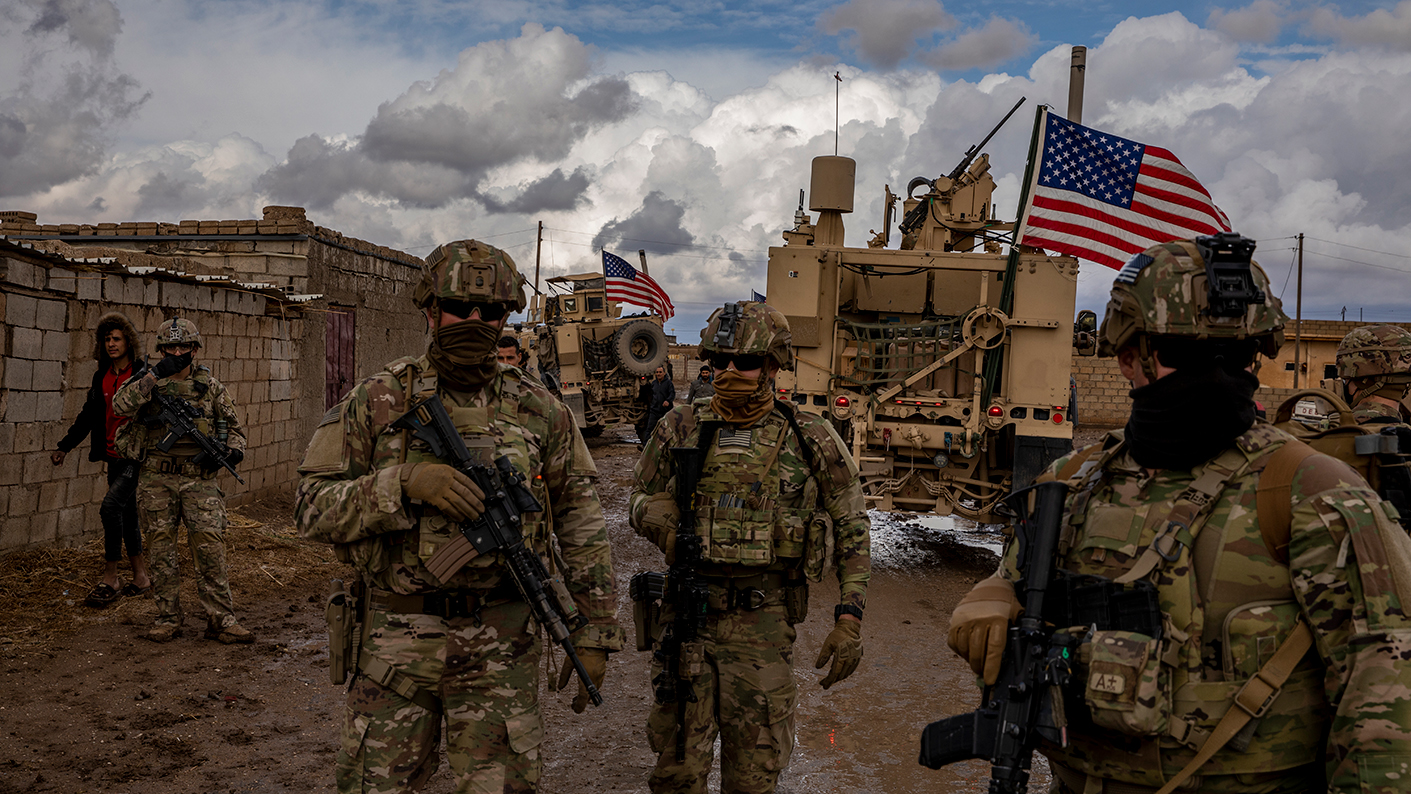
    US troops conduct area reconnaissance in Syria (Photo: Spc. Jensen Guillory)

    The country approved plans to widen the scope of the regional war originating in Israel’s genocide in Gaza

    Following an attack by the Islamic Resistance in Iraq against US foreign outpost “Tower 22”, which killed three US soldiers stationed near the Syria-Jordan border, the United States has approved plans for a multi-day strike against Iraq and Syria. 

    The death of three US troops, the first casualties among US forces in a widening conflict in West Asia, drew attention to the hundreds of US military bases and outposts spread throughout the world. 

    In confirming responsibility for the attack, an Islamic Resistance official declared, “If the United States continues to support ‘israel,’ there will be an escalation.” and that “All American interests in the region are legitimate targets.”

    The United States is using the strikes as a way to continue to blame Iran for the wider resistance in West Asia. The strikes will purportedly be against “Iranian targets.” Resistance organizations such as the Islamic Resistance in Iraq are frequently accused of being Iranian “proxies” by US officials and in the mainstream press. 

    Contrary to seeking peace for the hundreds of thousands being slaughtered in Gaza, the United States and the Western world have continually chased escalation. Earlier in January, the US and the UK began an airstrike campaign against Yemen, in retaliation against the nation’s casualty-free blockade of the Red Sea, which Yemeni forces claim to be carrying out in solidarity in Gaza. The only deaths surrounding the blockade have been suffered by Yemenis, and have been as a result of the US and UK’s bombing campaign. 

    The United States and several Western nations have also directly worsened the plight of Gazans by cutting all their funding to the UNRWA, due to dubious accusations made by Israel that some UNRWA were involved in the October 7 operation. 

    Original article republished from peoples dispatch under a Creative Commons Attribution-ShareAlike 4.0 (CC BY-SA) license.

  • UN Relief Chief Says All-Out War Is ‘Looming Dangerously Close’

    Spread the love

    Original article by JAKE JOHNSON republished from Common Dreams under Creative Commons (CC BY-NC-ND 3.0). 

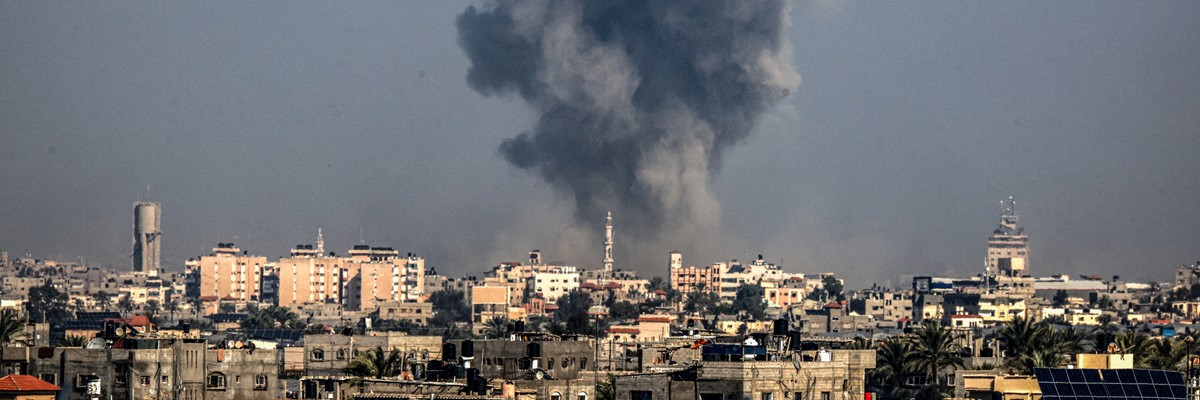
    A picture taken from Rafah on January 6, 2024 shows smoke billowing over Khan Younis in the southern Gaza Strip during Israeli bombardment.  (Photo: AFP via Getty Images)

    “This war should never have started. But it’s long past time for it to end,” said United Nations emergency relief coordinator Martin Griffiths.

    The United Nations’ emergency relief coordinator warned Friday that the threat of a broader conflict in the Middle East is growing rapidly as Israel’s assault continues in Gaza, which the U.N. official said has been rendered “uninhabitable” by near-constant airstrikes and a suffocating blockade.

    “The specter of further regional spillover of the war is looming dangerously close,” Martin Griffiths, the U.N.’s under-secretary-general for humanitarian affairs, said in a statement, pointing to the humanitarian catastrophe in Gaza, mounting Israeli attacks in the West Bank, and rocket attacks on Israel. “Hope has never been more elusive.”

    Griffiths, a longtime diplomat who has described the situation in Gaza as the worst humanitarian crisis he’s ever witnessed, issued his unsparing statement at the tail end of a week that saw Israel and the United States launch deadly strikes in Lebanon and Iraq, killing a senior Hamas official and the leader of an Iran-aligned militia.

    On Saturday, Hezbollah responded to Israel’s drone strike on an office building in the Lebanese capital of Beirut by firing rockets at a military base in northern Israel, heightening fears of an escalatory spiral.

    While the Biden administration insists it wants to avert a regional war, it continues to provide Israel with lethal military aid and oppose international efforts to enact a permanent cease-fire that analysts say is necessary to stop the conflict from spreading. The U.S. is also reportedly drafting plans to bomb Yemen in response to Houthi attacks on vessels in the Red Sea.

    The Houthis have said the attacks will stop once Israel ends its catastrophic assault on the Gaza Strip.

    Griffiths said Friday that the situation in Gaza is shockingly dire, with displaced families “sleeping in the open as temperatures plummet” and the territory’s remaining medical facilities “under relentless attack.”

    “The few hospitals that are partially functional are overwhelmed with trauma cases, critically short of all supplies, and inundated by desperate people seeking safety,” said Griffiths. “Infectious diseases are spreading in overcrowded shelters as sewers spill over. Some 180 Palestinian women are giving birth daily amidst this chaos. People are facing the highest levels of food insecurity ever recorded. Famine is around the corner.”

    “For children in particular,” Griffiths added, “the past 12 weeks have been traumatic: No food. No water. No school. Nothing but the terrifying sounds of war, day in and day out.”

    Much of Gaza has been decimated by Israeli bombs, many of which were supplied by the United States. The Euro-Mediterranean Human Rights Monitor said Friday that around 68,000 housing units in Gaza have been completely destroyed by Israeli airstrikes.

    Roughly 4% of Gaza’s population—more than 90,000 people—has been killed, wounded, or left missing by Israeli attacks since October 7, the group estimated.

    “It is time for the parties to meet all their obligations under international law, including to protect civilians and meet their essential needs, and to release all hostages immediately,” Griffiths said. “It is time for the international community to use all its influence to make this happen. This war should never have started. But it’s long past time for it to end.”

    Original article by JAKE JOHNSON republished from Common Dreams under Creative Commons (CC BY-NC-ND 3.0). 

    Gaza Genocide Prolonged as US Hides Behind Rhetorical Push for Humanitarian Aid

    CNN Admits ‘Disturbing’ Israel-Palestine Coverage Policy ‘Has Been in Place for Years’

    Amid Fears of Wider War, US Reportedly Drafting Plans to Bomb Yemen

    After US Rebuke, Top Israeli Ministers Double Down on Ethnic Cleansing Push

    Palestinians—and the World—Will Never Forget US Complicity With Israel’s Genocide in Gaza