Tag: Italy

  • Naples protests G7 “lords of war”healthcare

    Spread the love

    Original article by Ana Vračar republished from peoples dispatch under a Creative Commons Attribution-ShareAlike 4.0 (CC BY-SA) license.
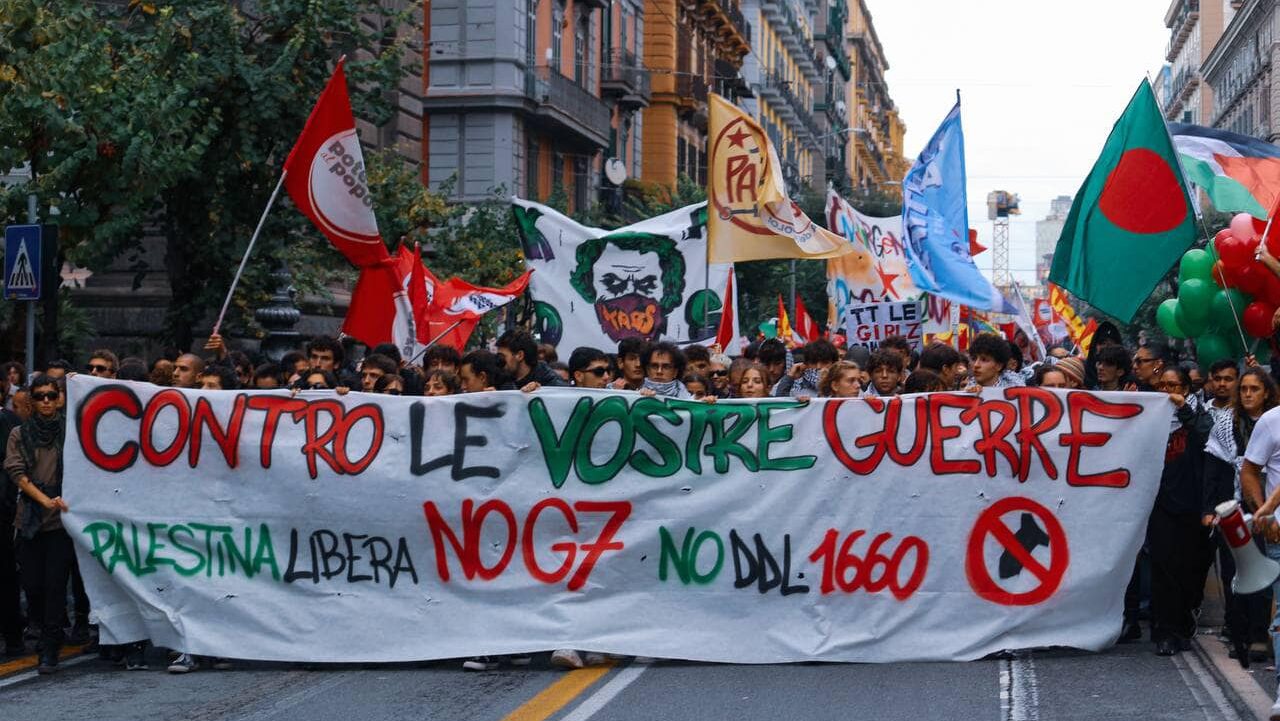
    Source: Ex OPG occupato – Je so’ pazzo/Facebook

    Over 2,000 people took to the streets of Naples against soaring military spending in Europe and increased repression of dissent as G7 defense ministers convened for high-level talks

    Thousands of people took to the streets of Naples on October 19, demonstrating against the G7 military agenda and Italy’s proposed reforms that would limit the freedom to dissent. Protesters, representing a host of organizations including student associations, trade unions, and community centers, rallied against Prime Minister Giorgia Meloni’s government’s policies, demanding a shift in priorities toward social needs instead of military spending. Side by side with the protest in Naples, demonstrations were held in dozens of cities across Italy, as reported by the left political party, Power to the People (Potere al Popolo).
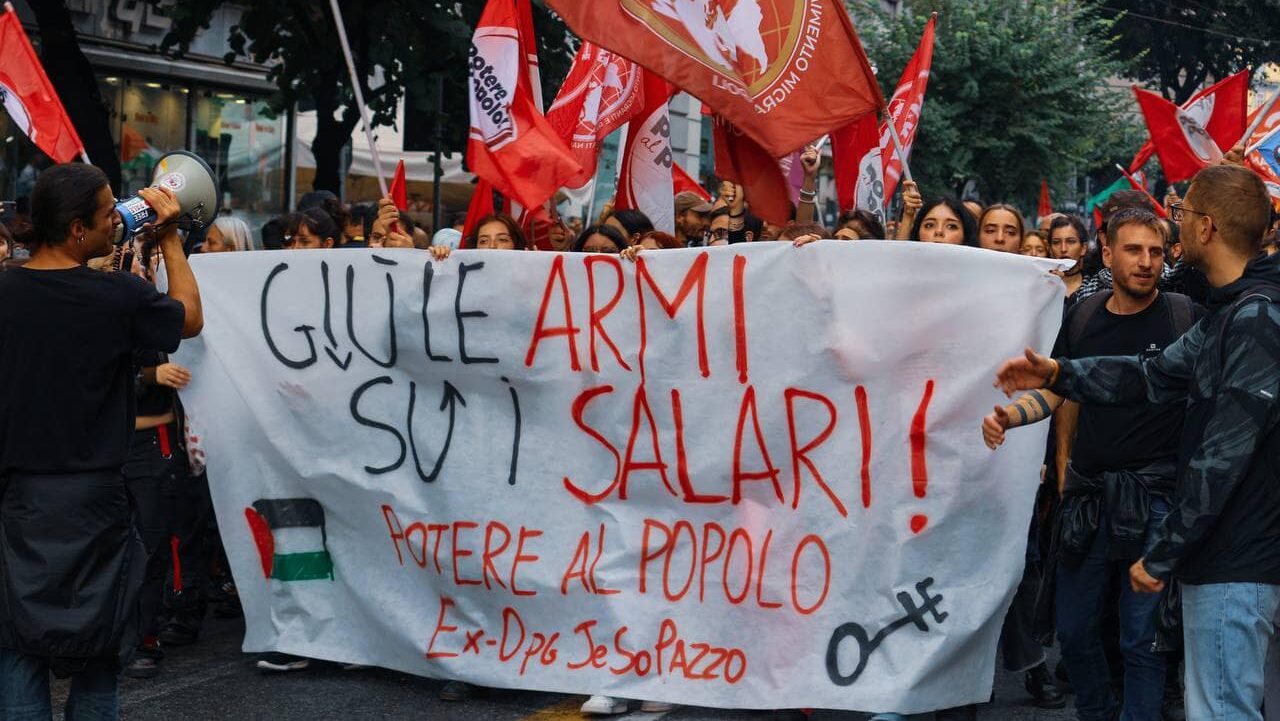
    Protesters carrying a banner reading “Cut the weapons, raise the wages!”. Source: Ex OPG occupato – Je so’ pazzo/Facebook

    The protest was organized to counter a G7 defense ministers’ meeting that took place in Naples from October 18 to 20, with a focus on global military goals. The meeting was seen by protesters as yet another example of Western countries deepening their involvement in wars, including the ongoing genocide in Gaza and the war in Ukraine, instead of pursuing agendas of social justice and peace. In the lead-up to the meeting, local activists voiced their opposition, stating that “lords of war” were not welcome in their city.

    “Never has so much been spent on war, and as a result, war is rampant everywhere,” the associations organizing the march asserted during the preparations. “We refuse to host a meeting in our city that supports the war economy our government has chosen to follow.”

    Two central issues dominated the protest in Naples: the West’s support for Israel as it continues to exterminate the people of Gaza and the increasing repression of dissent at home, embodied in Meloni’s proposed security bill. Many protesters pointed out the link between military aggression abroad and domestic policies that seek to criminalize dissent. European countries continue to actively repress solidarity with Palestine and others, like Italy, are doing so while attempting to silence voices against their policies.

    Read more: Pro-Palestine activists are under attack in Europe

    The new security bill seeks to impose severe restrictions on protests, including strikes and environmental activism. Progressive associations argue that this is a blatant attempt to stifle opposition and consolidate power, and some of them saw Saturday’s protest as a test run for the government’s strategy of suppressing future mobilizations. Days before the protest, authorities tried to restrict the march route, forcing organizers to end the demonstration a kilometer away from the G7 meeting site.

    Despite these attempts, protesters refused to be stopped. They briefly broke through the set course of the rally, marching in areas originally declared off-limits by the authorities. In response, police deployed tear gas and used other forms of violence against them. Naples’ historic center has systematically been blocked off to popular protests, and things are set to get worse if the new bill is passed, protesters said. Because of that, community groups including Ex OPG – Je so’ pazzo called upon people to continue resisting.

    “We believe this repressive project must be stopped, and more importantly, we see it as a reflection of the Meloni government’s fear of what might still be burning beneath the surface of the seeming calm in the country,” they said.

    Read more: Meloni government targets dissent with a new security bill

    Saturday’s protest marked an important moment of resistance against the shrinking of democratic space in Italy, as well as to the strengthening of the armament agenda in Europe. Demonstrators announced they were ready to continue fighting against the security bill and expressed determination to challenge Meloni’s government over announced cuts to social support.

    “Today, this square is sending a loud message: if the government thinks it can ignore social needs, public healthcare, workers’ rights, and housing in favor of pouring billions into military spending, it’s headed in the wrong direction,” said Chiara Capretti from Power to the People.

    Original article by Ana Vračar republished from peoples dispatch under a Creative Commons Attribution-ShareAlike 4.0 (CC BY-SA) license.

  • Meloni government targets dissent with a new security bill

    Spread the love

    Original article by Ana Vračar republished from peoples dispatch under a Creative Commons Attribution-ShareAlike 4.0 (CC BY-SA) license.

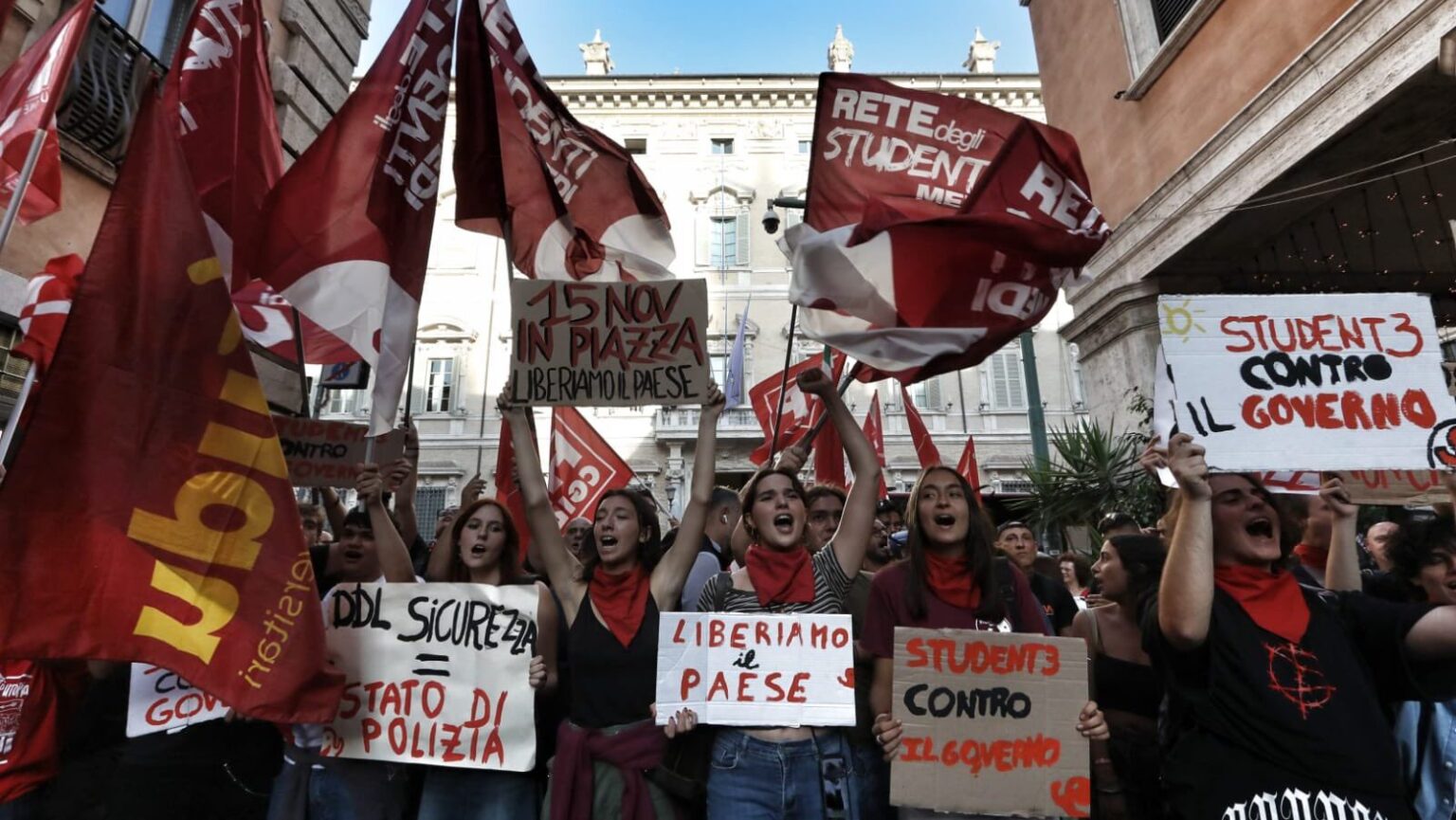
    Source: CGIL/X

    A proposed security bill in the Italian parliament aims to criminalize activism and penalize acts of solidarity

    Giorgia Meloni’s government is on a rampage against popular dissent with a new bill under discussion in the Italian parliament. The proposed legislation seeks to penalize solidarity and criminalize activism, with the working class, migrants, and climate activists particularly at risk. In recent days, widespread protests have erupted, with trade unions, anti-fascist networks, and student groups all vowing to resist Meloni’s plans.

    Giuliano Granato, a member of the left political party Power to the People (Potere al Popolo), criticized the bill’s framing as security legislation. He argued that it should instead be called the “Repression Bill” because “it responds to the country’s social needs only with more imprisonment and crime.”

    “The government is saying that dissent and dispute are crimes in this country,” Granato added. “We believe they are the essence of democracy, and every achievement made over the decades is thanks to the struggles of the working classes.”

    One of the bill’s most significant provisions is a crackdown on activists who block roads or railways during protests. Initially seen as targeting climate activists known for these tactics, the left has warned that it will also affect workers’ struggles. Granato pointed out that workers have also used such methods to protest, including during industrial action at Whirlpool factories over the last years.

    Italy’s largest trade unions have echoed these concerns. The Italian General Confederation of Labor (CGIL) criticized the bill, arguing it represents an attack on trade union mobilizations aimed at protecting jobs and addressing company crises. In a joint statement with ANPI, the national anti-fascist network, the CGIL wrote: “The right wing continues to regard security only in terms of repression and punishment of social struggles.” Both organizations were at the forefront of protests held in several Italian cities on Wednesday, September 25.

    Read more: Europe’s shift to the right must be countered with mass mobilization and politicization

    The bill’s impact would extend beyond activists and workers, with prisoners facing harsh consequences. It proposes penalties for peaceful protests in prisons, such as sit-ins. Furthermore, limited protections currently granted to specific groups, like pregnant women or mothers of infants under one year of age, would be taken away. This would mean that babies would remain jailed with their mothers, despite only a handful of facilities being equipped to accommodate them. Legal and psychological experts have warned of the shocking impact this would have on children’s development even if capacities were expanded.

    Migrants, the poor, and those showing solidarity with them are also at risk under the proposed law. Anti-eviction actions and those refusing to vacate spaces under threat of homelessness would be criminalized. Migrants without residence permits would be barred from legally obtaining SIM cards, their only connection to family and friends at home. Merchants who disobey this provision would face temporary closures.

    While most describe the security bill as paving the way for a permanent police state, some groups might be looking forward to it. Approximately 300,000 police and security personnel would be granted the right to carry unofficial weapons in both private and public spaces – an idea that is likely to instill fear, rather than a sense of security, in the vast majority of the population.

    Opposition to Meloni’s security bill is converging with ongoing resistance to her other policies, including the controversial differentiated autonomy reform. On Thursday, September 26, over 1 million signatures calling for a referendum against the reform were submitted by trade union and social movement leaders. These groups have vowed to remain in the streets, defending their right to protest and express dissent despite the government’s attempts to suppress them.

    Original article by Ana Vračar republished from peoples dispatch under a Creative Commons Attribution-ShareAlike 4.0 (CC BY-SA) license.

  • Right to Asylum Must Be Protected in EU, Says Human Rights Coalition

    Spread the love

    Original article by Jessica Corbett republished from Common Dreams under Creative Commons (CC BY-NC-ND 3.0).

    The Doctors Without Borders vessel Geo Barents intercepted two small boats full of migrants navigating toward Europe
    in the Central Mediterranean on March 16, 2024. (Photo by Simone Boccaccio/SOPA Images/LightRocket via Getty Images)

    “As this legislative cycle starts, the E.U. can and must do better than abandon its commitment to the global refugee protection regime,” said an Amnesty campaigner.

    Nearly 100 human rights organizations came together Tuesday to emphasize that members of the European Union “must guarantee the right to seek and enjoy asylum and uphold their commitments to the international refugee protection system.”

    The joint statement from groups including Amnesty International, Human Rights Watch, and Oxfam came as members of the European Parliament prepare for the July 16 plenary sitting, the first meeting scheduled since the bloc’s June elections, which resulted in the far-right “Patriots for Europe” becoming the third-largest alliance in the legislative body.

    The human rights coalition underscored obligations under Article 18 of the E.U. Charter of Fundamental Rights and expressed concern about “the recent and increasing attempts by the E.U. and its member states to evade their asylum responsibilities by outsourcing asylum processing and refugee protection risk undermining the international protection system.”

    As the groups detailed:

    Italy, for instance, is currently seeking to process asylum applications of certain groups of asylum-seekers outside of its territory, from detention in Albania—which risks leading to prolonged, automatic detention, a denial of access to fair asylum procedures with necessary procedural guarantees, and delayed disembarkation for people rescued or intercepted at sea. Others, such as Denmark and Germany, are assessing the feasibility of this type of arrangement. Fifteen E.U. member states and some political groups have endorsed similar shortsighted measures to shift asylum processing outside E.U. territory and encouraged the European Commission to explore ways to facilitate this through further legislative reform, including through a watered-down ‘safe third country’ concept.

    These attempts must be seen in the context of parallel containment efforts that seek to stem departures and prevent the arrival of asylum-seekers to E.U. territory through partnership agreements with third countries, with little to no attention to the human rights records of those authorities.

    The coalition stressed that “as the extensive track record of human rights violations in partner countries such as Libya demonstrates, the E.U. and Member States have no adequate tools and competencies to effectively monitor or enforce human rights standards outside of E.U. territory.”

    A report published in November by Doctors Without Borders features stories of violence that migrants endured in nations including Libya and Tunisia while trying to get to the E.U. That publication also points out that 2023 was the deadliest year for migration in the Central Mediterranean since 2017, due in part to E.U. countries failing to assist those at risk of drowning.

    In addition to sounding the alarm about current E.U. policies and practices, the coalition on Tuesday cited examples including Australia’s offshore detention scheme, which “demonstrates how these models have created prolonged confinement and restricted freedom of movement, deeply harming both the mental and physical health of people seeking protection.”

    The organizations also pointed to an asylum scheme attempted by the United Kingdom—which left the E.U. in 2020 following the 2016 Brexit vote—and Rwanda, which the statement notes “is not yet in effect following the U.K. Supreme Court declaring it unlawful and in any event is unlikely to be operationalized at any significant scale.”

    The U.K.’s failed attempt to forcibly remove people to the African country was “projected to cost a staggering £1.8 million per asylum-seeker returned,” which is equal to €2.13 million or $2.3 million. The coalition called such schemes “not only an unjustifiable waste of public money, but also a lost opportunity to spend it in ways that would truly aid people seeking asylum by investing in fair and humane asylum systems and the communities that welcome them.”

    Olivia Sundberg Diez, Amnesty’s E.U. advocate on migration and asylum, said in a statement Tuesday that “attempts by states to outsource their asylum responsibilities to other countries are not new—but have long been criticized, condemned, and rejected for good reason.”

    “Just as the U.K.-Rwanda scheme is, rightly, collapsing, the E.U. and its member states should pay attention, stop making false promises, and wasting time and money on expensive, inhumane, and unworkable proposals,” she continued. “As this legislative cycle starts, the E.U. can and must do better than abandon its commitment to the global refugee protection regime.”

    The meeting scheduled for next week will follow the Pact on Migration and Asylum that the European Parliament passed in April and the Council of the E.U. adopted in May. The coalition highlighted that “civil society organizations have been clear about their serious concerns” regarding the reforms while also explaining that “the transfer of asylum-seekers outside of E.U. territory for asylum processing and refugee protection is not provided for in the pact, nor within current E.U. law.”

    “After the E.U. and member states have spent close to a decade attempting to reform the E.U.’s asylum system, they should now focus on implementing it with a human rights-centered approach that prioritizes the right to asylum per E.U. law and fundamental principles of international refugee law to which they remain bound,” the coalition concluded. “They should not, mere weeks after the reform has passed, waste further time and resources on proposals that are incompatible with European and international law.”

    Original article by Jessica Corbett republished from Common Dreams under Creative Commons (CC BY-NC-ND 3.0).

  • DeSmog Launches Investigation Into Food and Farming Misinformation Ahead of EU Elections

    Spread the love

    Original article by Clare Carlile republished from DeSmog.

    Credit: Alberto Perinot/X

    The far right is set to piggyback on agricultural discontent to capture votes in June.

    A large blue billboard stands outside a park in the town of Conegliano in northern Italy. On the left, a man pops a vast cricket into his mouth. On the right, are the words, “Let’s Change Europe before it changes us” – and the dates of the upcoming elections.  

    The poster – an advert for the country’s radical right party Lega per Salvini Premier – refers to a conspiracy theory that has swept across Italy in the last 18 months. Elites in Brussels are planning to replace meat with bugs and are using environmental regulations to do so, or so the theory goes.

    As millions of voters across the EU prepare to head to the polls from 6-9 June, conspiracy theories and misinformation on food and farming could pull voters towards the far right and parties opposing climate-friendly laws.

    In the face of this onslaught of misinformation, DeSmog is launching a new series that investigates misleading claims and their impact on climate policy in the farming sector. 

    Over the next two months DeSmog will monitor the spread of misinformation across the continent, working in seven different languages. We will look to identify false claims and uncover who is spreading these narratives online.

    Agriculture accounts for 11 percent of carbon emissions in the EU, and has contributed to plummeting bird and bee numbers. But tackling the sector’s harms has become one of the most divisive issues on the continent, with tractors blocking highways across Europe during demonstrations this year. 

    The protests – attended by thousands of farmers in several countries – reflected a wide range of concerns, from unfair food prices to calls for protection from increasingly extreme weather. Yet this complexity was barely represented in the media where demonstrations were cast as opposition to environmental measures. 

    Far-right groups also weaponised the protests. In January, Jordan Bardella, lead EU candidate for France’s National Rally (formerly National Front), accused the country’s President Emmanuel Macron of pursuing “the death of agriculture” while Santiago Abascal, leader of Spain’s far-right party Vox, wrote to Macron demanding an end to “aggressions” against Spanish producers, who he described as “victims” of EU policy.

    In the eyes of its critics, green reforms agreed in the last EU term would destroy farming. Plans to cut chemical use and make farmers protect natural habitats would lead to monumental job losses, they claim. The same arguments are used by agricultural corporations that stand to lose out if green reforms are enacted.

    The most extreme opponents, including radical right think tanks and hardline farming groups, see green reforms as part of a plan by Brussels bureaucrats to control the industry and “grab land”. 

    These claims, however, contradict the facts: last year, more than 6,000 scientists said that such nature-friendly measures were “the cornerstone of food security and human health”. 

    The policies that are currently being attacked aim to tackle climate breakdown – the biggest threat to producers across the EU, who are already feeling the effects of global heating. A “staggering portion” of the continent has been exposed to high drought risk in recent years, according to the European Drought Observatory, leading to widespread crop losses.

    Right-wing and far-right groups stand to make massive gains from stoking these tensions. A recent study by the EU’s Committee of the Regions showed that discontented rural areas could be a major source of votes.  

    This series will shine a light on those candidates that are weaponising false claims for electoral gain.

    Original article by Clare Carlile republished from DeSmog.

  • Complicit in genocide: where Israel gets its weapons from

    Spread the love

    Many articles from the Morning Star featured today. https://morningstaronline.co.uk/article/complicit-genocide-where-israel-gets-its-weapons

    Far from ‘standing alone’ Israel is fully supplied with military hardware from various Western and non-Western countries, writes RAMZY BAROUD

    …

    Though many of Israel’s traditional allies in the West are openly disowning its behaviour in Gaza, weapons from various Western and non-Western countries continue to flow, feeding the war machine as it, in turn, continues to harvest more Palestinian lives.

    This compels the question: does Israel truly stand alone when its airports and seaports are busier than ever receiving massive shipments of weapons coming from all directions? Not in the least.

    Almost every time a Western country announces that it has suspended arms exports to Israel, a news headline appears shortly afterwards, indicating the opposite. Indeed, this has happened repeatedly.

    Last year, Rome had declared that it was blocking all arms sales to Israel, giving false hope that some Western countries were finally experiencing some kind of moral awakening.

    Alas, on March 14, Reuters quoted the Italian Defence Minister Guido Crosetto as saying that shipments of weapons to Israel are continuing, based on the flimsy logic that previously signed deals would have to be “honoured.”

    Another country that is also “honouring” its previous commitments is Canada, which announced on May 19, following a parliamentary motion, that it had suspended arms exports.

    The celebration among those advocating an end to the genocide in Gaza were just getting started when, a day later, Ottawa practically reversed the decision by announcing that it, too, will honour previous commitments.

    This illustrates that some Western countries, which continue to impart their unsolicited wisdom about human rights, women’s rights and democracy on the rest of the world, have no genuine respect for any of these values.

    Canada and Italy are not the largest military supporters of Israel. The US and Germany are.

    …

    Many articles from the Morning Star featured today. https://morningstaronline.co.uk/article/complicit-genocide-where-israel-gets-its-weapons