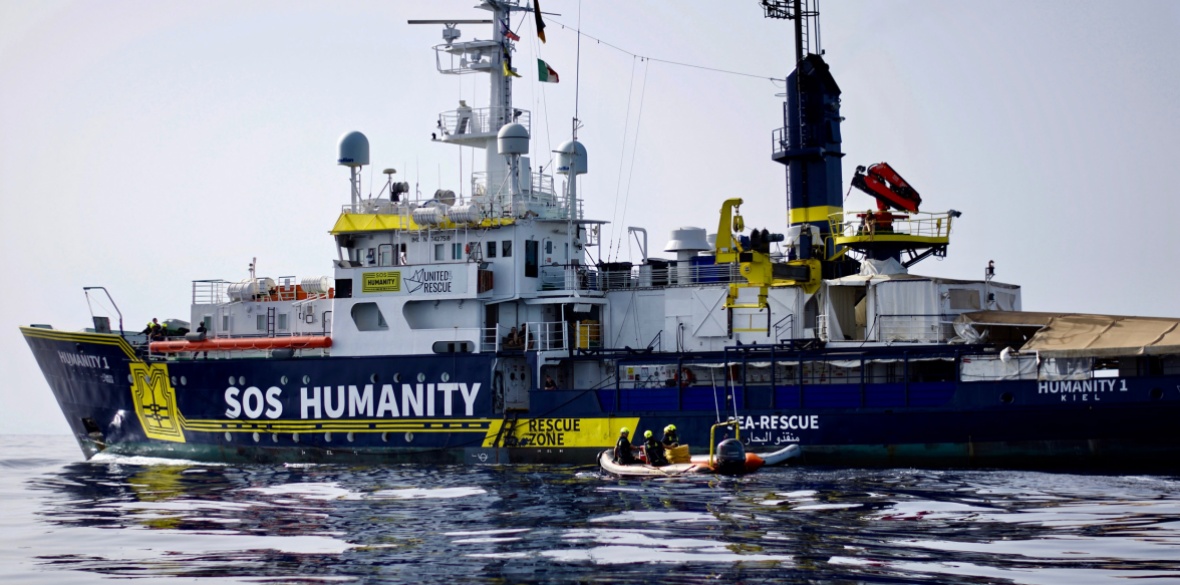
THREE refugee rescue organisations announced today that they are taking legal action against the Italian authorities for the unlawful detention of their rescue ships.
SOS Humanity, Sea-Watch and Sea-Eye released a joint statement today blasting the authorities’ reasoning for keeping their ships in port for a total of 100 days.
The Humanity 1 and Sea-Watch 5 have are being kept in port for 20 days each, while the Sea-Eye 4 is being held for 60 days.
The crews of the three ships rescued a total of 390 people in the central Mediterranean last week, but the authorities allege their crews were uncooperative with the Libyan coastguard.
“Each of the three current detentions is based on false accusations and unlawful demands,” reads the organisations’ joint statement.
“The Italian authorities falsely refer to uncooperative behaviour by the ships’ crews towards the so-called Libyan coastguard.
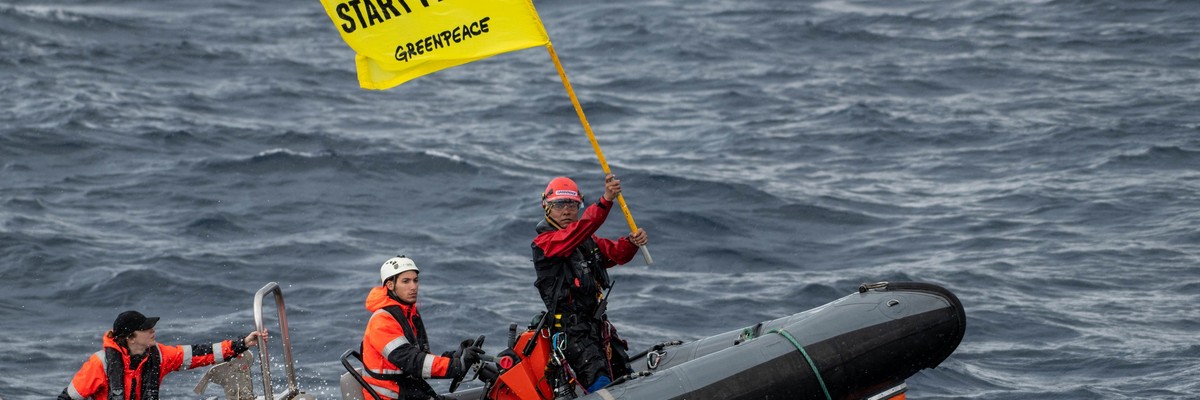
Greenpeace climate justice activists approaching Shell platform en route to major oilfield (Photo: Chris J Ratcliffe / Greenpeace)
“It has become clear: Eni is trying to silence anyone who dares to speak up and denounce the company’s contribution to the fueling of the climate crisis,” says Chiara Campione of Greenpeace Italy.
Greenpeace Italy revealed Wednesday that the Italian multinational energy company Eni is threatening a libel suit against it over reports the organization published about oil and gas companies.
Greenpeace said the potential lawsuit is related to a report on temperature-related premature deaths that may be caused by emissions from oil and gas companies like Eni and a report on the concept of “climate homicide.”
“We face yet another act of intimidation by Eni; it seems that threatening defamation lawsuits is the new sport which the company has decided to pursue most enthusiastically. But we won’t be silenced,” said Chiara Campione of Greenpeace Italy. “This new potential defamation lawsuit follows a similar case initiated by Eni against Greenpeace Italia only a few months ago.”
OOOPS ENI DID IT AGAIN! It seems that threatening defamation lawsuits is the new sport which the company has decided to pursue most enthusiastically. https://t.co/zZjhRdCa0f
Eni was given an opportunity to respond to the findings of the Greenpeace reports, but the group said Eni offered “no substantive rebuttal” and threatened legal action. The organization claimed other oil and gas companies mentioned in these reports have not threatened legal action.
Greenpeace Italy and the climate advocacy group ReCommon are currently suing Eni over its alleged contributions to the climate crisis. The first hearing for that case occurred last month.
“It has become clear: Eni is trying to silence anyone who dares to speak up and denounce the company’s contribution to the fueling of the climate crisis,” Campione said.
The multinational oil giant Shell sued Greenpeace in November for alleged damages related to Greenpeace activists boarding one of the company’s oil platforms. Shell is trying to get as much as $8.6 million in damages, which Greenpeace says would greatly threaten its ability to campaign.
The French multinational oil and gas company TotalEnergies is also suing Greenpeace France over a report that claimed it underestimated its 2019 greenhouse gas emissions.
Greenpeace said Wednesday that these companies are trying to “stop Greenpeace and other organizations from denouncing the damage the fossil fuel industry is causing to people and the planet.”
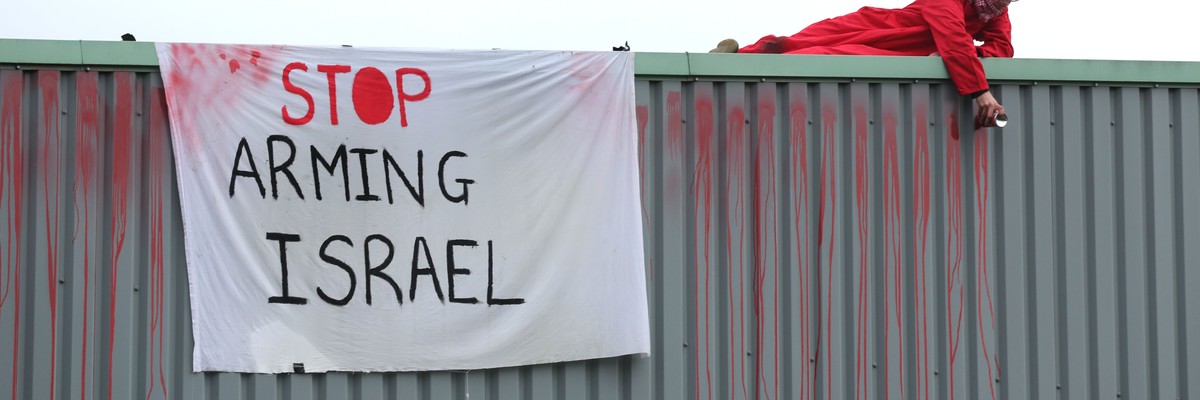
A protester occupies the roof of Howmet Fastening Systems in Leicester, U.K., which makes components for Israeli F-35s, in October 2023. (Photo: Palestine Action)
“Surely it’s time to stop all arm shipments to Israel,” said one British lawmaker, “and implement targeted sanctions against members of the Israeli leadership.”
While the White House has claimed U.S. President Joe Biden is growing increasingly “frustrated” with Israel’s bombardment of Gaza—largely made possible by U.S. military aid—calls are growing in Europe for governments to halt arms exports to stop their own contributions to the mass killing.
After a Dutch court ordered the Netherlands to stop exporting F-35 fighter jet parts to Israel on Monday, ruling that the country was running a “clear risk” of helping Israel to violate international human rights law, several British lawmakers intensified their demands that the U.K. also halt arms exports.
“Selling arms to Israel for its war on Gaza is incompatible with U.K. and international law,” said Diane Abbott, a Labour Party member in British Parliament. “[Prime Minister Rishi] Sunak should follow suit and ban weapon sales to Israel.”
Natalie Bennett, a member of the Green Party in the British House of Lords, spoke on Tuesday about six-year-old Hind Rajab, whose body was found last week in a car in which her family members had tried to flee Gaza City. The car was riddled with bullet holes, and an ambulance nearby, which paramedics had sent to rescue Hind, had been bombed.
“Is the government challenging the Israeli government about risks to hundreds of thousands of children in Rafah, now in the path of the Israeli offensive?” said Bennett. “Surely it’s time to stop all arm shipments to Israel… and implement targeted sanctions against members of the Israeli leadership.”
Natalie Bennett, a @TheGreenParty peer, asks David Cameron about 6 year old Hind, her family & the 2 paramedics sent to rescue her, who were all killed by Israel. She also says isn't it time that UK arms exports to Israel are stopped.
The U.K. provides about 15% of the components of Israel’s F-35 bombers—the Israeli Air Force’s “flagship asset,” according to the Royal United Services Institute—and has licensed more than $594 million in military exports to Israel since 2015.
While the U.S. Senate on Tuesday passed a $95 billion foreign aid bill, including $14.1 billion for Israel, some European governments are working to end their complicity in Israel’s mass killing of at least 28,576 Palestinians so far in attacks that have also wounded at least 68,291 and left at least 17,000 children orphaned.
On February 6, the Walloon regional government in Belgium suspended two licenses for the export gunpowder to Israel, citing the International Court of Justice’s (ICJ) interim ruling last month which found that Israel is “plausibly” committing a genocide in Gaza.
Italian Foreign Minister Antonio Tajani said in late January that the government had halted all arms sales to Israel in October, when Israel began its bombardment of Gaza in retaliation for a Hamas-led attack on October 7.
José Albares, Spain’s foreign minister, also said last month that the Spanish government had done the same, but El Diarioreported on Sunday that the country had actually exported $1.1 million in ammunition to Israel in November.
“The suspension of arms transfers to Israel must be comprehensive and permanent, and not just temporary,” said Alberto Estévez, a spokesperson on weapons issues at Amnesty International Spain. “The Spanish government has wanted to be an example in this crisis in the face of other much more complicit governments, but it must be more forceful to promote a European arms embargo on Israel and Hamas and other Palestinian armed groups, in addition to pressuring the United States to stop the supply of arms to Israel and support the imposition of a global embargo on the U.N. Security Council.”
On Wednesday, Spanish Prime Minister Pedro Sánchez joined Irish Prime Minister Leo Varadkar in writing to European Commission President Ursula von der Leyen and demanding an “urgent review” of Israel’s compliance with human rights obligations under its trade deal with the European Union.
“Against the background of the risk of an even greater humanitarian catastrophe posed by the imminent threat of Israeli military operations in Rafah, and given what has occurred, and continues to occur in Gaza since October 2023, including widespread concern about possible breaches of international humanitarian law and international human rights laws by Israel, we ask that the Commission undertake an urgent review of whether Israel is complying with its obligations, including under the E.U./Israel Association Agreement, which makes respect for human rights and democratic principles an essential element of the relationship,” wrote Sánchez and Varadkar.
The EU's commitment to human rights and dignity can have no exceptions.
Given the critical situation in Rafah, Ireland and Spain have just requested the @EU_Commission to urgently review whether Israel is complying with its obligations to respect human rights in Gaza.
The two leaders reiterated their call for an immediate humanitarian cease-fire, which was supported by a large majority of countries in a vote at the U.N. General Assembly in December, “including by 17 E.U. member states.”
Varadkar and Sánchez also pointed to the ICJ’s interim ruling in South Africa’s case last month, in which the country accused Israel of genocidal violence against Palestinians.
The orders of the ICJ, which demanded that Israel ensure that humanitarian aid can reach Gaza residents and that its military is not committing acts of genocide, “are binding,” the leaders reminded the European Union.
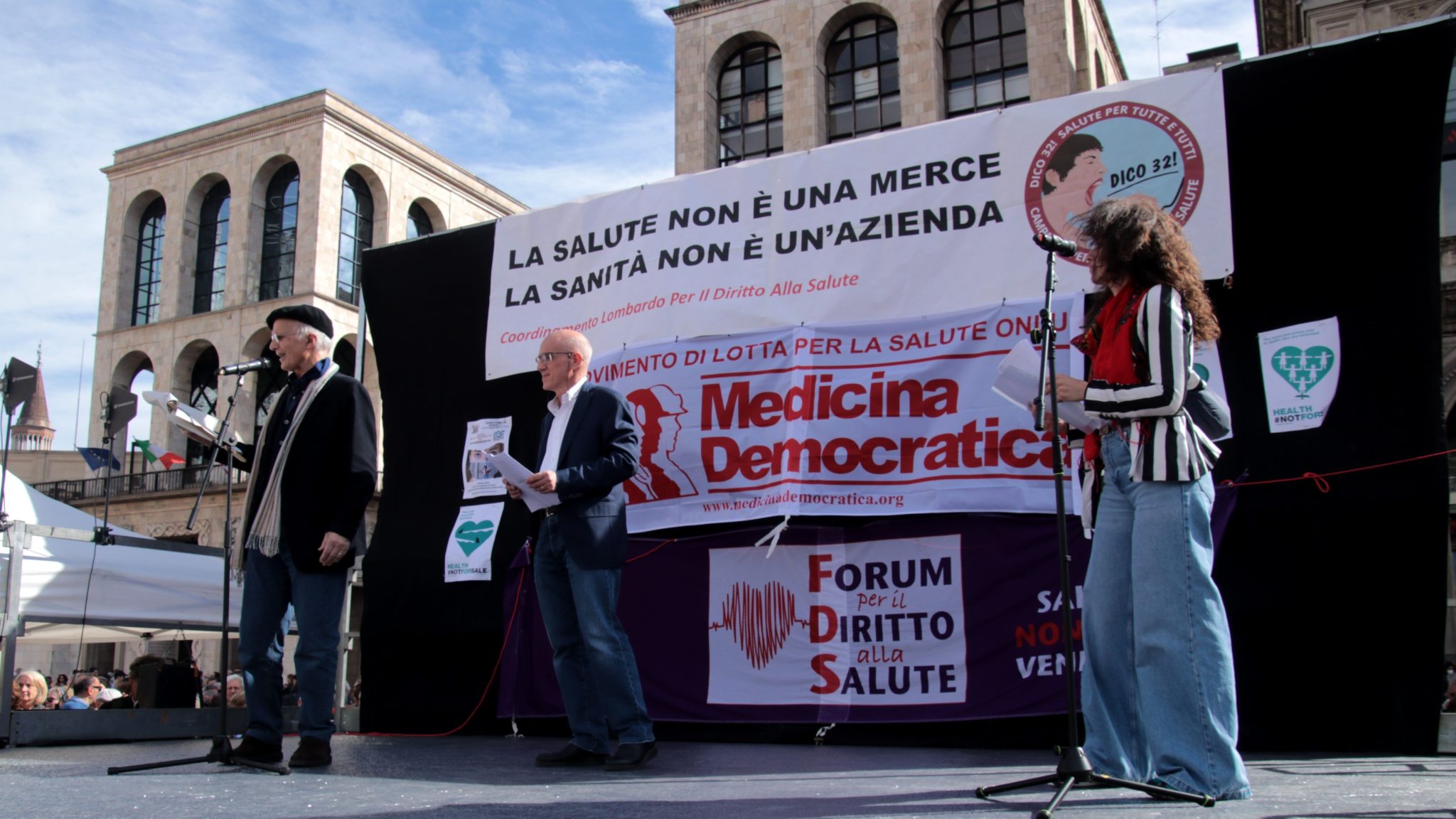
Health activists during a protest in Lombardy. (Photo: Medicina Democratica)
More and more people in Italy mobilize to protect the public health system against privatization and budget cuts promoted by far-right Giorgia Meloni’s government
The functioning and future of Italy’s National Health Service or Servizio sanitario nazionale (SSN) have become one of the most important mobilizing issues for trade unions, civil society organizations, and ordinary citizens. Just like health systems in many other European countries, the SSN has fallen prey to policies that promote the participation of the private sector in service provision, weakening the public, tax-based system, which is supposed to provide care to everyone. With the government of prime minister Giorgia Meloni pushing for a policy of administrative devolution and further cuts to health expenditure, things in the healthcare sector are poised to get even bleaker, as activists and health workers warned during a recent national rally in Rome.
After the national mobilization, the protests headed north to Lombardy, where they should culminate in a central manifestation in Milano on Saturday, 21 October. In the leadup to the local events, Vittorio Agnoletto, a physician and health activist, underlines the importance of people taking to the streets to protect the public health system. He said in a recent blog post, “The best thing for everyone to do right now is to get involved. Get involved in a campaign to defend your local hospital, get involved in a campaign to protect your community health center from falling into the hands of the private sector, get involved in any local health campaign to build its strength.”
Observing the situation of the health system in Lombardy directly, Agnoletto knows first-hand what privatization of the SSN brings. In that region, private health providers gained ground ever since the mid-1990s. During the COVID-19 pandemic, regional policies even went as far as equalizing the public and private sector.
It seems that policy makers in Italy have lost the lessons of the pandemic, as other regions continue to pursue similar policies, undermining the SSN. In 2021, Lombardy’s private health sector received over EUR 6 billion (around USD 6.33 billion) from public sources; in Lazio, it received EUR 3.8 billion (over USD 4 billion). Overall in the same year, there were over 16,500 private health providers in Italy, with a turnover of approximately EUR 62 billion (USD 65.37 billion) in revenue, as Agnoletto warns in his reports.
Of these, EUR 25 billion (USD 26.36 billion) comes from public coffers that could be used to strengthen the SSN and help address some of its most pressing issues, including a chronic lack of health workers and long waiting lists. Wait time for some procedures in Lombardy can take up to 4 years, a fact which pushes those who can afford it toward the private sector. Those who cannot afford it often give up: millions of people in Italy decide not to pursue care because of waiting lists.
With Meloni’s government planning further reductions in health expenditure, it is difficult to imagine the waiting lists in the SSN getting shorter anytime soon. Public health expenditure in Italy, amounting to a little over 6% of GDP, is already below that of EU peers France and Germany, where it stands at 9% or more. Instead of finding ways to address that gap, the government is setting all the wrong priorities, as the left party Potere al Popolo has been warning for years.
Instead of prioritizing the education of health workers, considering the 2021 deficit of 45,000 doctors and 75,000 nurses, government plans have been focused on purchasing high-end technology and building capacities for telemedicine. Of the EUR 15.6 billion (USD 16.45 billion) allocated to health in Italy’s EUR 192 billion-worth (USD 202.45 billion) 2021-2026 recovery plan funded through the European Commission’s Recovery and Resilience Facility, 62% is allocated to technology, and only 8% is foreseen for training and retaining health workers.
The policy of administrative devolution, and thus the decentralization of healthcare, pushed for by the government, represents an additional threat to the public health system. As Margherita Cantelli from Potere al Popolo explains, some aspects of the organization of the health system have previously been decentralized from the state to the regional level. According to Cantelli, this experience is enough of a warning of what would follow if the decentralization were to be taken to another level.
“We’ve seen a clear trend of closures of local hospitals and other health units following the decentralization process, while the private structures continued to receive public funding. The shutting down of these hospitals was part of the privatization trend, and it has pushed the SSN away from the smaller towns and centers. If this kind of decentralization were to grow, there is no doubt that the problems would grow as well,” Cantelli said to People’s Health Dispatch.
According to Cantelli, the best way forward right now is to continue to protest and bring the people’s voice to the spaces where healthcare plans are shaped, thus building a shared idea of the importance of a universal public health service, free for everybody who needs it. “I believe there is a lot of space to explain the links between the problems we are seeing in the field of health and those that we are seeing in the field of labor rights, and we should use this to mobilize together,” she says.
ROME, Oct 19 (Reuters) – Jailed WikiLeaks founder Julian Assange will become an honorary citizen of Rome by early next year following a vote this week by its local assembly, the city’s former mayor Virginia Raggi said on Thursday.
Assange, 52, has been in London’s high-security Belmarsh prison since 2019 and is wanted in the United States over the release of confidential U.S. military records and diplomatic cables in 2010.
…
Other Italian cities have taken similar steps. The northern city of Reggio Emilia granted Assange citizenship last month, while Naples is set to follow shortly.
If extradited to the United States, Assange risks a sentence of up to 175 years in a maximum-security prison.