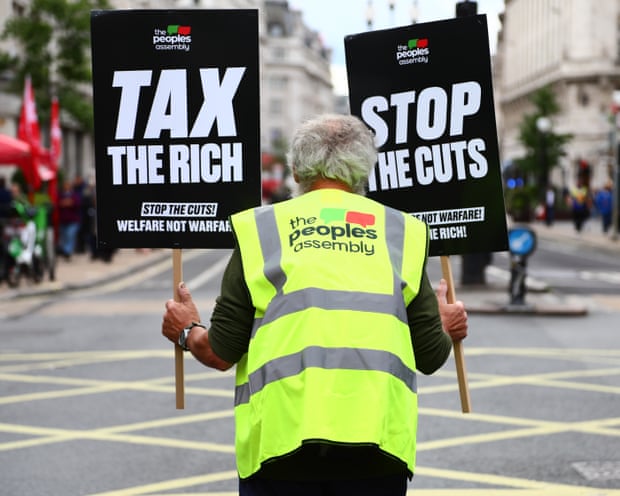
MP Diane Abbott addressing the People’s Assembly Britain is Broken national demonstration in central London, November 5, 2022
SUSPENDING Diane Abbott on the same day a far-right mob attacked police and anti-racists reveals Labour’s “rank hypocrisy,” Stand Up To Racism (SUTR) said yesterday.
The campaign group slammed the party for censuring Britain’s first black woman MP and leading anti-racist while its leader, Prime Minister Sir Keir Starmer, stoked anti-immigrant sentiment with a speech implying Britain was becoming “an island of strangers.”
Anti-racists were surrounded by masked far-right thugs on Thursday night after staging a counter demonstration to an anti-immigration protest outside a hotel in Epping, Essex.
Riot police swarmed the streets after police vans were vandalised and officers assaulted by groups of men trying to reach the hotel.
SUTR co-convener Sabby Dhalu said: “On the same evening as a violent racist riot targeting asylum-seekers erupted outside the Bell Hotel in Epping Forest, Labour decided to suspend Diane Abbott, Britain’s first black woman MP and a leading anti-racist.
Health Secretary Wes Streeting, Chancellor of the Exchequer Rachel Reeves and Prime Minister Sir Keir Starmer at the launch of the government’s 10-year health plan, July 3, 2025
The electorate see no evidence of the government’s promises of change, and the good jobs and decent pay that people are crying out for. Bold action is needed right now, warns SHARON GRAHAM
IT IS true that Labour have taken over an economy ravaged by 14 years of Tory austerity. But that should mean a profound opportunity to deliver change. Britain is broken, yes. But they cannot keep making everyday people pay.
Today MPs will be voting on the government’s despicable plan to cut disability benefits. Just as with every other wrong decision, such as scrapping the winter fuel allowance, rowing back on investment in British industry or failing to ensure proper local authority funding, the excuse will be the same — “we have no choice.” And again it will be absolute rubbish. Of course they have choices.
We are the sixth-richest economy in the world. But the way that wealth is divided is increasingly unequal. The richest 50 families are worth about £500 billion, the same as half the entire UK population. In 1990 there were just 15 billionaires in the UK, but since then their number has jumped to 156.
So, there is a choice. If we taxed the richest 1 per cent just 1 per cent, that would generate about £25 billion. That is a choice. We need a wealth tax now.
Yougov: Would you support or oppose introducing a wealth tax of 2% on wealth above £10 million?Keir Starmer says that the Labour Party under his leadership all feel a small part of Scunthorpe.
At the Disabled People Against Cuts (Dpac) protest against benefit cuts (Picture: Guy Smallman)
MPs will vote on Tuesday on Labour’s vicious ‘welfare reform’ bill
Disabled people say they are in a fight for their lives. Hundreds of people gathered in the sweltering heat at Parliament Square on Monday for a protest organised by Disabled People Against Cuts (Dpac) and others.
Paula Peters from Dpac told the crowd, “There is only one thing to do with this bill—bin it.”
The Labour government claims it has to slash the welfare budget, but is boosting military spending.
Angela Grant from the PCS union said, “They are spending money on selling arms to other countries to kill other people like us. It’s warfare abroad and warfare against disabled people.
“They do not care. They are not listening—until we make them listen. We have seen some U-turns already. That’s people power.”
Disabled journalist Frances Ryan has said, “This is Labour’s poll tax, its tuition fees, its Partygate. Just as the Iraq war was for Tony Blair, disability cuts are the moral stain that will mark Starmer’s government and the party for years to come.”
Many Labour MPs still believe these are the wrong reforms and will vote against the bill next week. Photograph: Alishia Abodunde/Getty Images
Sir Keir Starmer’s plans risk creating lasting inequality – and alienating the very voters who once believed his party stood for their protection
…
The upshot is that existing claimants would be protected, but future ones face tougher rules. Two people with identical conditions could receive support, according to the Institute for Fiscal Studies, that differs by up to £6,560 a year – purely due to timing. This, we’re told, is compassion. The savings – halved to £2.5bn a year – come by offloading the cost on to future claimants. MPs rightly fear this locks in a two-tier system that is deliberately harsher on disabled people.
Older Labour MPs will remember denouncing this very playbook. A decade ago, Iain Duncan Smith pioneered a slow, procedural tightening of welfare – hitting new claimants first, then reassessing the rest – precisely to defuse resistance. Labour opposed it then. Today, it is governing by the same method. It feels out of step with a post-pandemic Britain grappling with a cost of living crisis.
Many Labour MPs believe these are still the wrong reforms and will vote against the bill when it comes back to the House of Commons next week. Clearly, tightened eligibility and a two-tier system may exclude many who need support. If the government wants to raise money, it might ask a little more of those with the broadest shoulders – not those with mobility aids, care plans and the audacity to ask for a fair deal. If ministers truly believe they are acting decently, they should publish the impact assessment and be honest about the consequences.
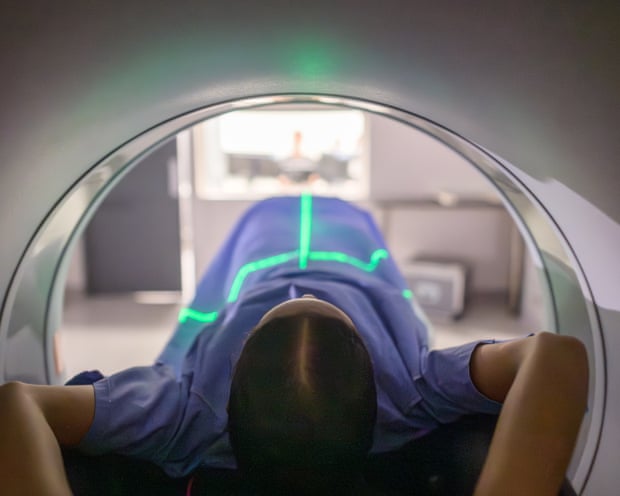
Labour has pledged to double the number of scanners in English hospitals over the course of the parliament. Photograph: wilpunt/Getty Images
‘Shocking statistics’ prompt calls for government funding to replace broken and obsolete medical devices
Almost 100 people have died and 4,000 have been harmed after equipment malfunctions in the NHS in the past three years, prompting calls for more government funding to upgrade broken and obsolete medical devices.
A defibrillator advising paramedics not to administer a shock, an emergency alarm system on a neonatal ward failing, and the camera on an intubation device going dark were just three failures after which patients died.
They are included in figures released for the first time by NHS England that show patients were harmed after 3,915 equipment malfunction incidents – with 87 being followed by a death – since 2022.
Paul Whiteing, the chief executive of Action against Medical Accidents, said: “These are shocking statistics. Behind these numbers are real people who are needlessly harmed, the impact of which will be life-changing and traumatic.
“The scale of the harm and loss of life that has resulted from basic equipment failures and malfunctions shows in stark relief the scale of the tragedy that has resulted from years of underfunding in the NHS.”
…
Matthew Taylor, the chief executive of the NHS Confederation, said: “Modern, up-to-date equipment such as scanners, defibrillators and patient monitors are absolutely essential for hospitals to run safely and more productively. But due to more than a decade of being starved of capital investment, NHS staff have been left with no option but to extend the life of obsolete equipment, which, as this research shows, is putting patients at unnecessary risk and leading to tragic avoidable harm.
“While the additional investment the government has pledged has been a welcome start, without sufficient capital funding it will be hard for the NHS to maintain the standards patients rightly expect and to deliver the government’s ‘plan for change’ promise to cut waiting times.”