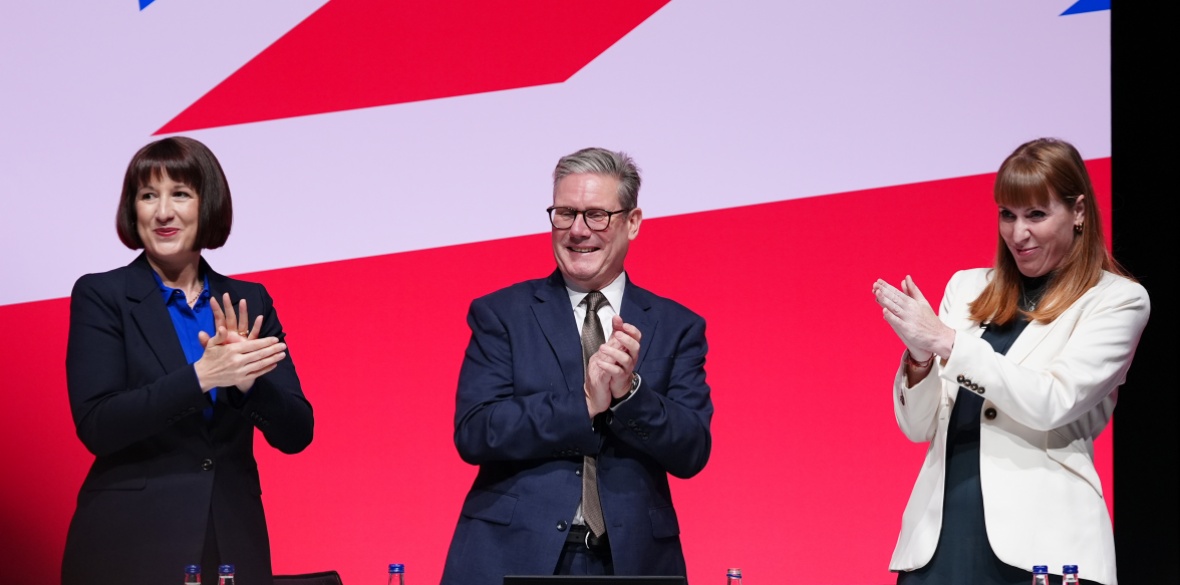
(left to right) Chancellor of the Exchequer Rachel Reeves, Prime Minister Keir Starmer and Deputy Prime Minister Angela Rayner clap their hands during the Labour Party Conference in Liverpool, September 22, 2024
NATIONAL Education Union (NEU) president Sarah Kilpatrick slammed Labour’s renewed austerity today, telling the NEU annual conference that Tory welfare cuts had killed her disabled father.
She accused ministers of “perpetuating and repeating the shameful pattern of punching-down and finger-pointing” by “balancing the books on the backs of the poor.”
On the first day of the conference in Harrogate, North Yorkshire, she described how her father had died at the age of 56 after being stripped of his disability benefits under the Conservative-Liberal Democrat coalition government.
She said that she had experienced poverty as a working-class child in Newcastle upon Tyne and was his carer for a number of years.
“As Iain Duncan Smith gleefully applauded the welfare cuts, I represented my father in a tribunal against the DWP [Department for Work and Pensions] decision to remove his disability benefits,” she told delegates.
“He’d had his gas cut off. Couldn’t afford groceries. His elderly mother was adding tins of food to her shopping to bulk up what I was buying for him, but he isolated himself further still.
“He lost a lot of weight during that time and never really recovered.”
In 2013, her father became one of an estimated 120,000 people who died as a result of the Tories’ austerity programme, she said.
“When Wes Streeting brags to the Tories across the benches that Labour have done what they never could and slashed the welfare bill, this is what they mean,” said Ms Kilpatrick.
“Let’s be clear. Nearly two decades of economic permacrisis has not been caused by disabled people.”
Nor has it been caused by the elderly, refugees, the trans community or children in poverty, she said.
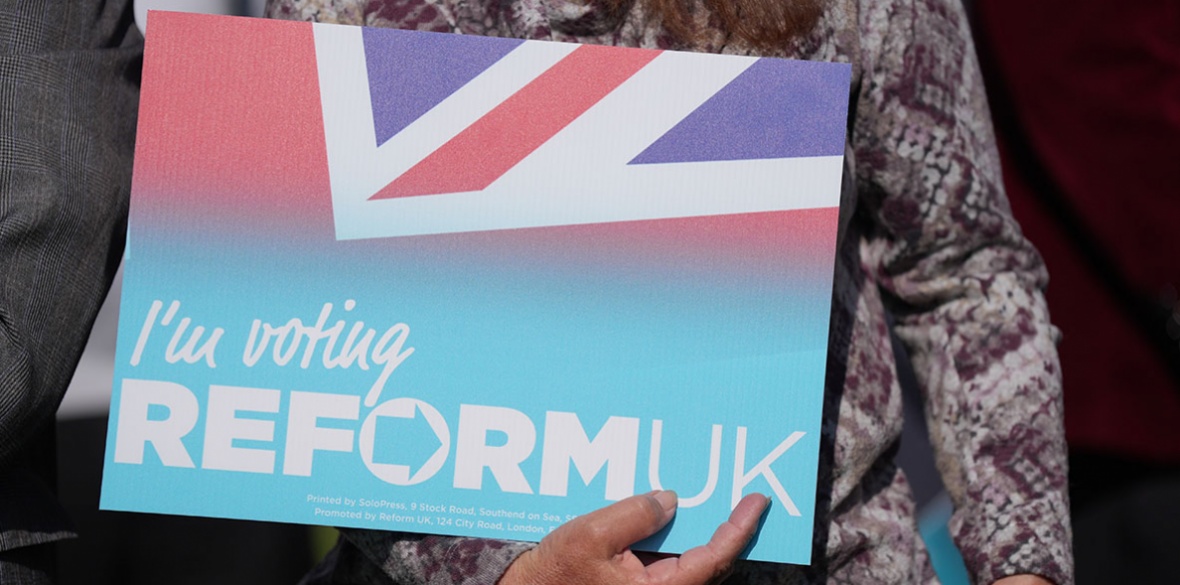
A Reform UK activist holds up a banner as party leader Nigel Farage visits Denby Lodge in Ripley, Derbyshire, whilst on the local election campaign trail, April 10, 2025
KEMI BADENOCH took the first tentative steps towards agreement with the hard-right Reform party today.
The Tory leader green-lighted local deals by Tory councillors to take control of councils in partnership with Nigel Farage’s supporters.
Ms Badenoch claimed that she still ruled out a national deal with Reform to unite the right-wing, but local pacts will be a clear stepping stone towards some type of agreement.
Most opinion polls now show Reform leading the Tories, and sometimes Labour too.
It is estimated that the split between the two right-wing parties might have handed Labour as many as 100 seats at last year’s general election.
Tory strategists fear that, despite Labour’s polling slump, that outcome could be repeated at the next election in the absence of any deal with Reform.
Government cuts to disability benefits will disproportionately inflict suffering on women | Hollie Adams/WPA Pool/Getty Images
Cuts will push hundreds of thousands of women into poverty or force them out of workforce
While the staggering £5bn of planned cuts to disability benefits announced by chancellor Rachel Reeves at last week’s Spring Statement have rightly been the subject of much scrutiny, the disproportionate suffering they will inflict on women has been under-discussed both by politicians and the media.
The government’s own risk assessment found the cuts will push 250,000 adults and 50,000 children in the UK below the poverty line. Women, who are both more likely to be Disabled and more likely to be a carer for a loved one, will be worst affected.
Indeed, single Disabled women make up 44% of those due to lose out from the cuts, and face an average loss of £1,610 per year, the government’s Equality Impact Assessment found.
This demographic has already been significantly affected by austerity cuts to social security and public services since 2010. Such measures, taken together with tax changes, will cost Disabled women an average of £4,000 a year by 2028, according to an analysis that we at The Women’s Budget Group (WGB) published in September last year.
That means, for many Disabled women in the UK, Reeves’ latest cuts follow what has already been an 11% drop in their living standards over the past 15 years. Cutting their living standards further is unthinkable.
Women also make up the majority of the UK’s unpaid carers, who provide care and support to family members, friends, or neighbours. They, too, will be hit hard by the changes.
When a person receives the Personal Independence Payment (PIP) – a benefit to help with the extra costs incurred by long-term ill health or disability – their unpaid carer may be entitled to the Carer’s Allowance benefit. The government plans to reduce the number of people eligible for PIP, which in turn will reduce the number of people eligible for Carer’s Allowance.
A couple where one person loses PIP and the other therefore loses Carer’s Allowance could be over £12,000 worse off annually, according to calculations by anti-poverty charity The Joseph Rowntree Foundation.
Reeves failed to acknowledge this knock-on impact in her speech. Worse still, the Equality Impact Assessment of these changes that was published as the chancellor was still speaking, also made no reference to it (although these impacts were included in the distributional assessment published at the same time).
What’s more, restricting the eligibility for PIP may increase the number of unpaid carers if a Disabled or chronically ill person is no longer able to rely on the benefit to pay somebody to provide their care. This may force women who are currently just about managing to stay in work to reduce their hours or quit their jobs altogether to take on additional care duties for loved ones.
Forcing women out of the workforce in this manner is not only detrimental to their health and wellbeing, it directly undermines the government’s claim that the measures are necessary to reduce economic inactivity.
At the same time, cutting PIP may push some disabled people out of the labour market if they can no longer afford the adaptations and services that enable them to work.
Years of austerity have already weakened our economy and eroded our living standards, leaving us ill-prepared for economic shocks. Cutting vital social security and public services is not the path to improving living standards.
Ahead of the Spring Statement, the WBG, along with more than 40 women’s organisations across the UK, wrote an open letter to the chancellor highlighting the gendered nature of these cuts – and urging her to consider more equitable ways to raise revenue.
Rather than targeting some of the most vulnerable members of our society, the government should be looking into taxing those with the broadest shoulders in our society.
A 2% wealth tax on assets over £10m could raise up to £24bn a year – far exceeding the savings from the proposed disability benefit cuts. This measure has already been called for by Tax Justice UK, which campaigns for a fairer tax system, and Patriotic Millionaires UK, which describes itself as a nonpartisan network of British millionaires.
A wealth tax of this kind could be used for much-needed investment in the foundations of our economy, including our social infrastructure – from childcare and education to social care and local government services.
Moreover, it’s what the public wants. Some 77% would rather the government increase taxes on the very richest than cut public spending, according to recent polling by YouGov for Oxfam.
Investing in social security and public services is not just a cost, but an investment in our society and economy. By choosing to cut benefits instead of implementing a wealth tax, the Government is not just balancing numbers on a spreadsheet. It is making a political choice – one that will deepen inequality and harm those who are already struggling.
Keir Starmer, Angela Rayner and Rachel Reeves wear the uniform of the rich and powerful. They have all had clothes bought for them by multi-millionaire Labour donor Lord Alli. CORRECTION: It appears that Rachel Reeves clothing was provided by Juliet Rosenfeld.Keir Starmer says that his Labour Party is intensely relaxed about assaulting the very poorest and most vulnerable.
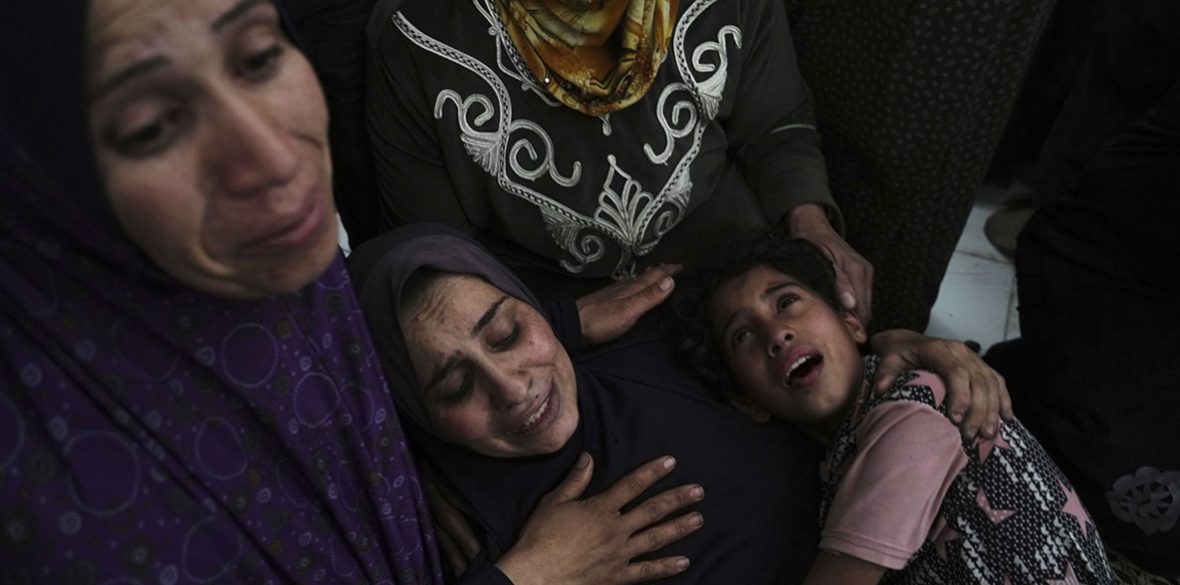
Palestinians grieve over the bodies of their relatives, who were killed by an Israeli air strike, as they prepare for burial at a hospital in Beit Lahiya, Gaza Strip, April 2, 2025
Meanwhile, Labour government toughens rhetoric against the genocide, but stops short of making any changes in policy or practical support for Israel
ISRAEL is expanding its invasion of Gaza to seize “large areas” to “crush and clean the area,” Israeli Defence Minister Israel Katz announced today.
The move came as Gaza’s hospitals reported that an overnight air strike killed more than 50 people, with nearly a dozen being children and a United Nations clinic among the targets.
Mr Katz said the military’s latest offensive in the war-torn strip would involve “seizing large areas that will be added to the security zones of the State of Israel.”
He did not specify which areas of Gaza would be taken over, but called on Gaza residents to “expel Hamas and return all hostages.”
His statement came after Israel ordered the full evacuation of the southern city of Rafah and nearby areas.
The attack was discussed in Parliament today, where Labour toughened its rhetoric against Israel’s actions, but stopped short of offering the slightest change in policy or the practical support it is affording the genocide.
MPs across the Commons pressed the government to be more robust.
Green Party co-leader Carla Denyer said that Israel’s actions were “not about security, but about domination and erasure” of Palestinians.
Asking an urgent Commons question, Ms Denyer accused Israel of “the worst blockade since the war began” and stressed “what is happening is a genocide.”
When, she asked, would the government “take measures under international law against ongoing genocide, illegal occupation and apartheid?”
No time soon was the response from Foreign Office minister Hamish Falconer.
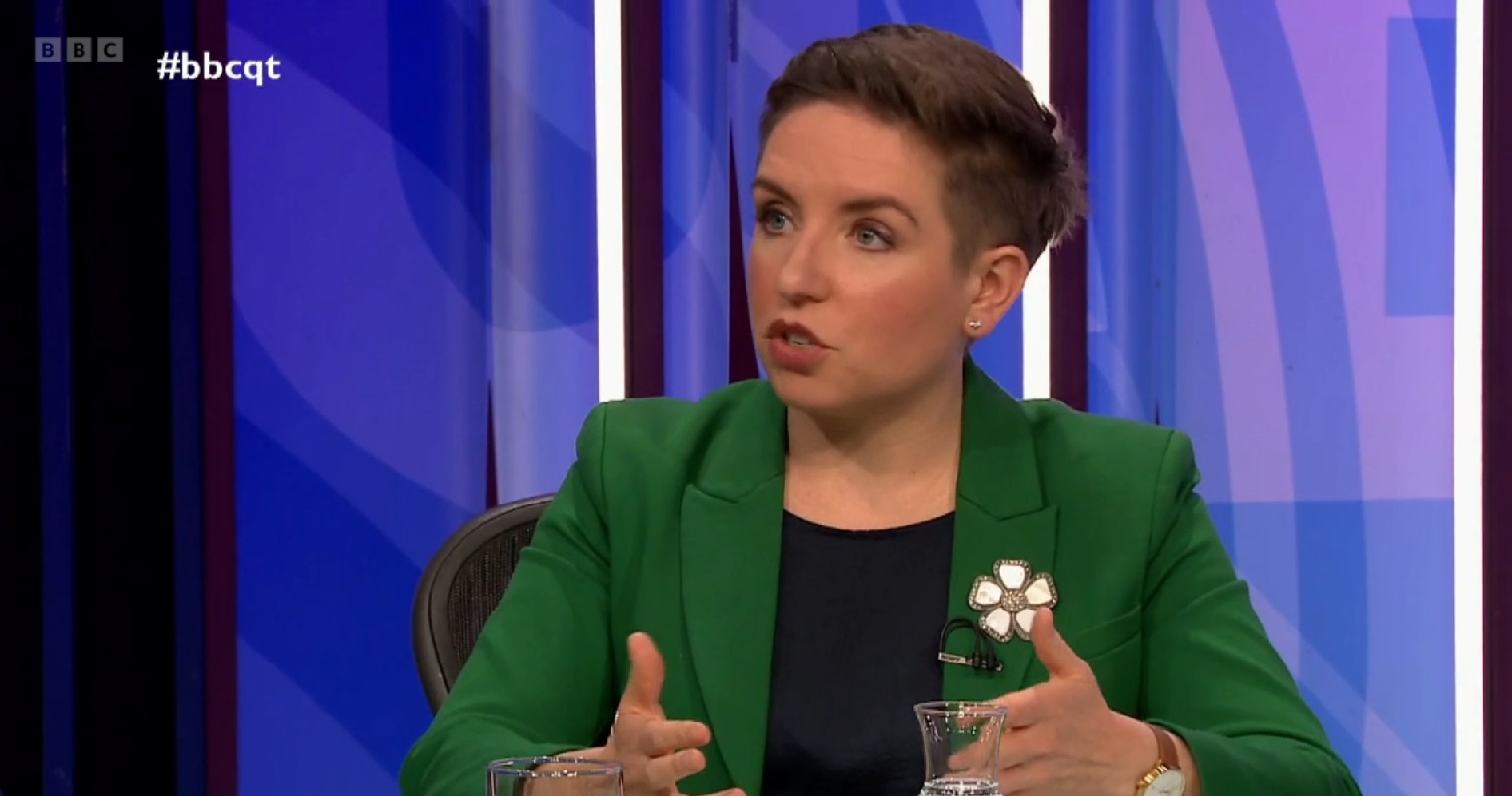
Image of the Green Party’s Carla Denyer on BBC Question Time.
“Energy bills up to nearly £2000 a year. Water bills up by 31% in some areas. Basic food prices keep rising – the list goes on. People aren’t fooling around when they say today is the start of “Awful April”. Especially awful for single parents who we know will be hit hardest by these price hikes.
“These spiralling costs come on the back of axing winter fuel payments for pensioners, refusing to remove the two-child benefit cap and cutting benefits for the sick and disabled.
“These are political choices. Rather than making the poorest and most vulnerable in society bear the brunt of the cost of living crisis, Labour could have chosen instead to tax a tiny percentage of the wealth of multi-millionaires and billionaires. They’ve made a choice, to take money off the old, ill and disabled.
“Labour have again and again made the wrong choices, which has left many of the poorest households at breaking point.”
Keir Starmer says that his Labour Party is intensely relaxed about assaulting the very poorest and most vulnerable.