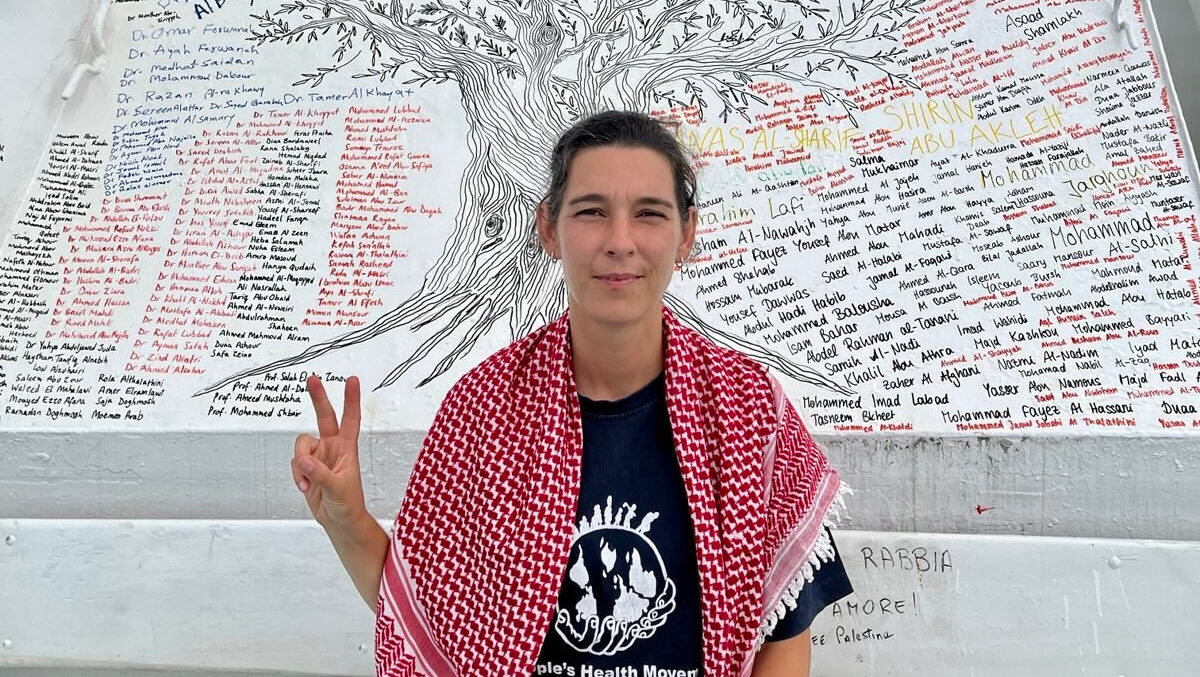
Cuban revolutionary leader Fidel Castro in 2014. Photo: Wikimedia Commons
Nine years after his death, we look back at some of the most relevant themes in Fidel Castro’s final writings after stepping down as President of Cuba.
Fidel Castro is often remembered as one of the most iconic leaders of the 20th century. Despite Washington’s unrelenting attempts to overthrow and even assassinate him, Fidel continued his rule and the development of the Cuban Revolution, which began in 1959 after the overthrow of Fulgencio Batista.
Much is written on his reflections on the development of the revolutionary struggle in the second half of the 20th century, his emblematic speeches, and his universal vision that combined the best of Leninist pragmatism with the sharpness of anti-colonial critical thinking. But Fidel’s vision of the future of humanity during his last years of life, an activity that demanded many hours of reading and writing, is often overlooked.
In fact, Fidel resigned as President of Cuba in 2008, with the aim of ensuring that the transition to another leader would not jeopardize the existence of the Cuban Revolution; many believed that after his death, the Communist Party of Cuba’s government would collapse.
And while many said that Fidel continued to lead the country after his resignation, the truth is that his production of essays and articles increased exponentially. Foreign policy, ecology, coups d’état, and even reflections on baseball and sports were all topics that Castro covered in his copious written work, generally published in Cuban and international newspapers.
The right to live
Fidel insisted that if human beings continued down the path of savage capitalism, they would bring about the end of their own existence. For Fidel, climate change was not only a transformation of certain environmental aspects, but also the destruction of human existence: “Continuing the battle and demanding at all meetings, particularly those in Bonn and Mexico, the right of humanity to exist… is, in our opinion, the only way forward.”
Here Fidel took a stance far removed from any short- or medium-term ideological dispute to adopt a long-term vision, according to which human beings have been incapable of properly managing a legacy of billions of years once they appeared on Earth: “[Human beings] benefit from a fabulous legacy of 4 billion years provided by the Earth… They are only 200,000 years old, but they have already changed the face of the world.”
Furthermore, he found any kind of military spending deeply inappropriate in the face of the inexorable arrival of the end of humanity. “The world is suffering the consequences of climate change at the same time;… A war was the most inappropriate thing that could happen at this time.”
The nuclear danger
Few people knew more about an almost imminent nuclear war than Fidel Castro. During the Cuban Missile Crisis, the world was on the brink of self-destruction. This concern never left Castro, when he warned of the massacre that would take place years later in Palestine: “As soon as the warships of the United States and Israel take their positions… the terrible war will begin.”
Furthermore, he clearly understood that a large-scale war, especially a nuclear one, would not transform the balance of power between social classes. Thus, he warned that after such a war, only “the administration of goods and services” would remain, and it would be carried out by the same elites that currently exist.
Imperialism as a method of domination
Fidel never abandoned the idea that imperialism continued to be the capitalist system’s most refined method for extracting value and subjugating the peoples of the Third World. Militaristic policy, the essence of imperialism, could never abandon its development, even at the expense of other more pressing needs.
He emphasized that in 2008, 42% of global spending was on military expenses: “While USD 1.5 trillion is spent on defense, the number of hungry people in the world reaches 1 billion.” This disparity was no accident, but rather a strategy executed by the great powers, under the pretext of defense cooperation, to impose economic programs and projects that further dispossess Third World countries. Thus, he openly criticized Obama’s foreign policy for Latin America as a ploy to control the Amazon
Science and technology
Fidel’s Marxism could not ignore the impressive technological transformation that took place during the first decades of the 21st century. In this sense, his reflections often focused on the use that transnational companies were making, and could make, in the field of production.
“If robots in the hands of transnational corporations can replace imperial soldiers in wars of conquest… (they can) flood it with robots that displace millions of workers.” Thus, Fidel announced a new process of dispossession of labor, as carried out by the merchant bourgeoisie at the dawn of the Modern Age.
Thus, technology, climate change, imperialism, and so on, could give the impression of rampant pessimism. However, thinking that could be a mistake. It is true that there was a great deal of caution and concern in Fidel’s final reflections, but this should not be confused with a renunciation of collective struggle.
Castro’s final texts always called for organization, for not giving up the strength of will, for continuing to think and work toward another future, one that is not at the mercy of the designs of a few. In short, as Romain Rolland stated and Gramsci popularized, Fidel’s thinking perfectly executed the maxim “Pessimism of the intellect, optimism of the will.”
Jeremy Corbyn, with Zarah Sultana (not pictured) speaking at a discussion on Your Party, their new political party, at The World Transformed conference, at Niamos Radical Arts Centre in Hulme, Manchester, October 10, 2025
With ‘Your Party’ holding its founding conference in Liverpool this weekend, JEREMY CORBYN speaks to Morning Star editor Ben Chacko about its potential, its priorities — and a few of its controversies too
JEREMY CORBYN says the Palestine solidarity movement is a game changer in British politics.
“The Palestine movement is absolutely huge. And like the movement against the Vietnam war of the 1960s, which had a huge impact on political thinking — the rather fossilised structure of both major parties started to disintegrate after that — it means things have to change.”
It’s one of the reasons he says the time is right for a new mass party of the left. “Your Party,” as it is provisionally known, has its founding conference this weekend.
“In my estimation at least two million people in Britain have done something about Palestine over the past 18 months — attend demonstrations, marches, meetings, sent emails, signed petitions.
“A lot of people are coming together on Palestine and at all the Palestine events I’ve been at there’s been a huge interest in the idea of a new party.”
Corbyn, meeting the Morning Star in his Westminster office, isn’t saying one issue would be enough to build a mass movement for change on — but the immense public anger at our Establishment’s complicity in a genocide is a galvanising moment.
One that comes at a time ripe for Labour to be challenged from the left.
“Labour has lost all appeal to the radical sections of the population.” And that, today, means a lot of people.
“Nobody really believes the left are going to be back in power in the Labour Party, because of the structural changes Starmer has brought in,” says Corbyn. Changes everyone knows are intended to prevent anything like Corbyn’s own 2015-20 leadership of the party happening ever again.
“Now is the time for a left party in the tradition of the labour movement. That is where I see myself. I am not leaving the labour movement. I am helping form a political party which will be part of the labour movement.
“We must challenge the ‘triopoly’ of the Tories, Labour and Lib Dems on political, social, environmental and economic thinking. They all believe in austerity, they all believe in market economics, they’re all running away from addressing the environmental crisis and on social justice issues.
“Labour had a ‘loveless landslide’ just over a year ago in the election. A spectacularly low vote for a party moving into government.” Corbyn points out that, while “we didn’t win either election, I fully appreciate that,” the highest Labour votes at general elections this century were both under his leadership, in 2017 and 2019. An important reminder that the idea socialist policies are unpopular at the ballot box is a media-manufactured myth.
Since coming to power Starmer’s government has been “disastrous. Maintaining the two-child benefit cap [finally lifted a day after we spoke], trying to take away the winter fuel allowance, attempting to remove personal independence payments from disabled people.”
On housing, he slams Labour’s refusal to take on the private rental sector or stand up to for-profit builders, who have a stranglehold on construction and resist efforts to include social and council housing in new builds.
He also ties the government’s decision to ramp up military spending to “effective cuts to every other area of public spending.” The government claims it’s increasing spending on the NHS, but he points out that two hospitals near him in north London are cutting spending by £20 million — and all over the country similar cuts are taking place across hospital trusts.
The increased military budget covers “a new generation of nuclear weapons and for the first time since the 1960s airborne nuclear bombs being stationed in Britain. There is no agenda for anything other than war.” And back to the trigger issue, Gaza: “A Labour government has carried on selling arms to Israel while a genocide is going on.”
The appetite for a party that will challenge all this is obvious. But a lot has changed on the British left since Your Party was first announced in July. Most notably, under a new leader, Zack Polanski, the Greens have shifted dramatically left and exploded in size, with many of those joining believed to be from the same 800,000 people who expressed interest in Your Party. Is another left party needed in that context, and isn’t the left becoming a crowded field?
“I want to be part of a socialist party — one fundamentally about social and economic transformation. I agree with a lot of what the Greens say, especially on environmental issues, and will work with them. Just last night I was working with the Greens on an amendment to the English Devolution Bill.
“But this is at root about public ownership and workers’ control.
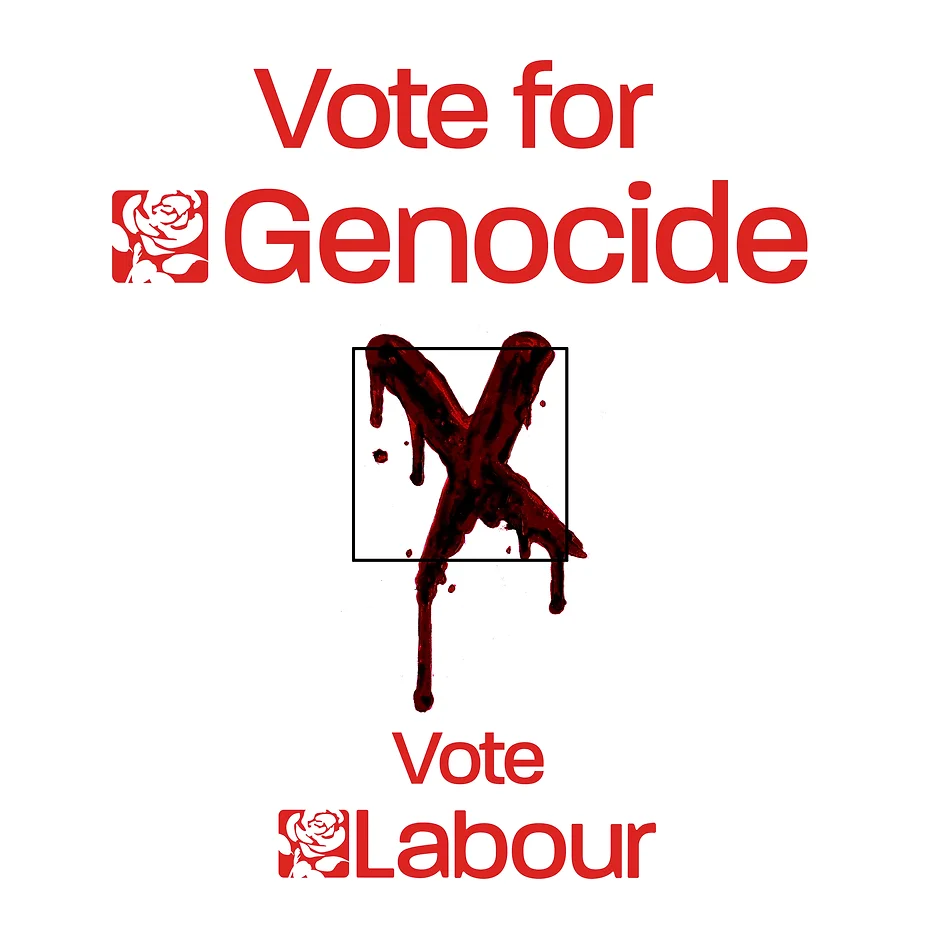
Keir Starmer objects to criticism of the IDF. He asks how could anyone object to them starving people to death, forced marches like the Nazis did, bombing Gaza’s hospitals and universities, mass-murdering journalists, healthworkers and starving people queuing for food, killing and raping prisoners and murdering children. He calls for people to stop obstructing his genocide for Israel.Orcas discuss Genocide-supporting and complicit Zionists. Donald Trump, Keith Starmer, David Lammy, Rachel Reeves, Angela Rayner and Wes Streeting are acknowledged as evil genocide-complicit and supporting cnuts.Vote Labour for Genocide.
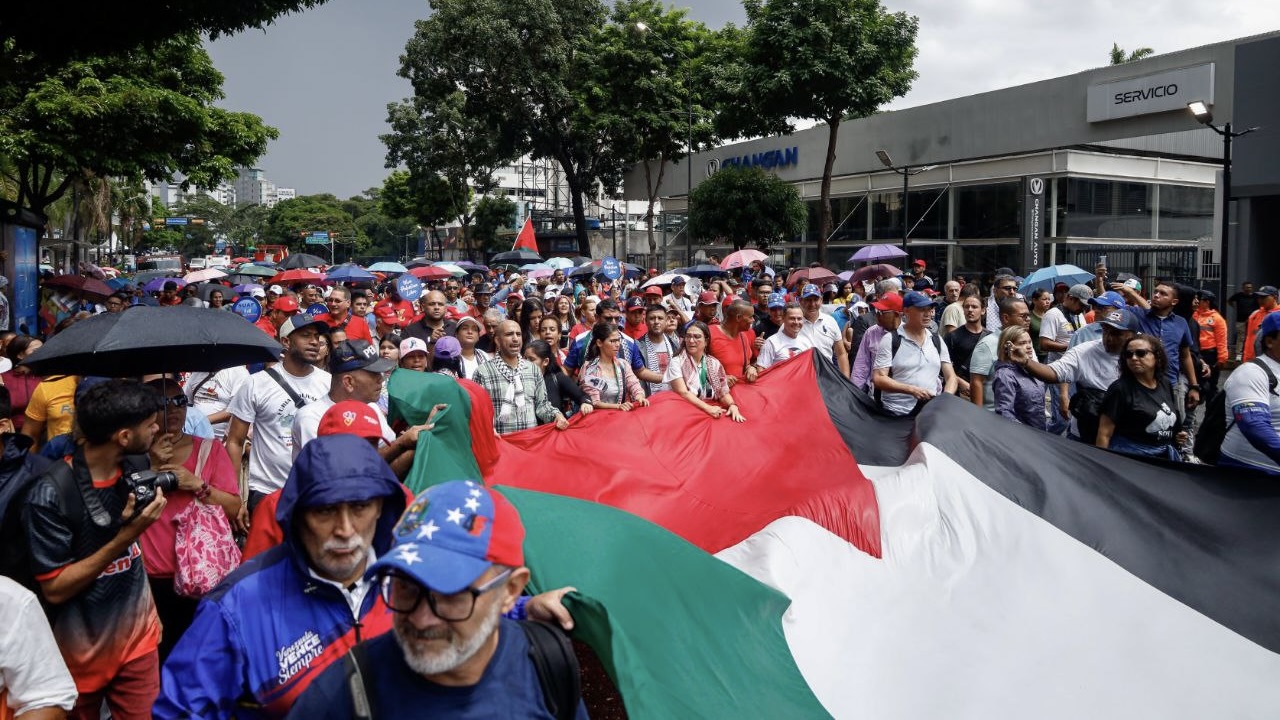
Massive march in Caracas, Venezuela on Saturday October 5, 2024 to commemorate the one year anniversary of Israel’s genocide. Photo: Francisco Trias
Palestinian journalist Aseel Saleh reflects on the US attempts to destabilize nations across the world to achieve its interests, focusing on the current threats on Venezuela, a stalworth supporter of the Palestinian cause.
This brutal machine has continued its lethal operations in subsequent periods, even if not directly, by fueling and igniting proxy wars in West Asia, during the Arab revolts, primarily in Syria and Yemen.
Providing Israel with unwavering military support, has also been a central strategy of the bellicose empire, through which it has tightened its grip on the region, since the Zionist state was established in 1948.
Wherever massacres and mass destruction exist, the US is definitely there. This is reminiscent of the words that Palestinian poet Mahmoud Darwish wrote, decrying the US complicity in the Lebanese civil war (1975-1990).
Despite not apparently having a direct role in the conflict then, the US supplied Israel with aircrafts and cluster bombs, which the latter used to commit horrific war crimes across Lebanon.
Darwish said:
“The US is atop the wall giving each child a cluster-death toy as a gift,
Oh you, the Hiroshima of the Arab lover (Beirut), the US is the plague, and the plague is the US.
We fell asleep, the aircrafts and the US awaken us,
and the US is only for the US,
while this horizon has become a cement for the aerial monster.
We open the sardines can, it gets shelled by canons.
We hide behind the curtains, the building shakes, the doors jump.
The US is behind the door, behind the door is the US.”
From Gaza to Venezuela, the US is still behind the door
The US was, is, and will always be behind the door of any country where it has economic or geopolitical interests. US President Donald Trump has acted like a landlord during his first and second terms, feeling entitled to take over the wealth of whatever nation he chooses, or expand his real estate empire anywhere he finds adequate.
Trump’s avarice has no limits, to an extent that has made his administration not only complicit, but a partner in Israel’s horrendous genocide in the Gaza strip and the deliberate starvation of the population. For him, the killing of over 70,000 Palestinian is insignificant as long as the genocide would make his dream of turning Gaza into “the Riviera of the Middle East” true, due to its distinctive seafront on the Mediteranean.
Perceiving Gaza as a great potential for an illusionary real estate project, does not seem to be the only motivation for Trump to support Israel in its genocidal aggression. Media reports indicate that Gaza is rich with offshore natural gas, valued at up to USD 4 billion per year.
Taking over Gaza and its gas reserves will not be possible with the presence of the Palestinian grassroots and resistance groups, who have confronted the Israeli occupation and its US-supported colonial project in the region. Thus, launching a merciless war against the besieged enclave was the only way for the US to achieve these goals.
It is the same imperialist equation when it comes to the US aggression on Venezuela. Although the Trump administration claimed that it is waging a war against the Latin American country due to its alleged involvement in narcotic trafficking in the Caribbean sea, no evidence has been provided to validate the claim.
The US has repeatedly threatened to take military action directly against Venezuela after failing to subjugate the nation, despite imposing a crushing sanctions regime on it for many years. This was followed by unsuccessful bids to ignite infighting and destabilize the country through a US-guided violent opposition led by María Corina Machado.
Israel has implemented a similar strategy to pressure the Palestinian resistance in Gaza to lay down arms and surrender by imposing a stifling siege on the enclave since 2007, 16 years before it launched its two-year genocidal aggression on October 7, 2023. It has also enhanced the division between the two major Palestinian factions, Fatah and Hamas, to undermine unity and spread chaos between Palestinians.
The Palestinian cause is Bolivarian
Both Palestinians and Venezuelans are fully aware that their struggle is the same in its confrontation with US-led Western imperialist hegemony and fascism. A concept which late Venezuelan President Hugo Chávez had always emphasized not only in words, but with actual continued support to the Palestinian people and their just cause.
“The Bolivarian revolution from day one stood by the side of the Palestinian people in their memorable struggle against the genocidal state of Israel that tramples on, kills and seeks to exterminate the Palestinian people,” Chávez said as he received Palestinian President Mahmoud Abbas in Venezuela’s capital Caracas in 2009.
“The struggle for Palestine is a first-order struggle for the homeland of the Liberator (Simón Bolívar) and the Bolivarian revolution.” He added.
Maduro has maintained Chavez’s legacy of solidarity with the Palestinian cause, which he considers as “the most sacred cause of humanity”. It has also been a daily concern of the Venezuelan people, who hold it deep in their heart.
Therefore, it is time for Palestinians, alongside internationalists and all people of conscience, to unite and rally around Venezuela in defense of its independence and sovereignty, because the defeat of one nation by imperialism undermines the will of all other nations.
Late Palestinian resistance leader Fathi Shaqaqi once said: “It is a war of genocide that has been imposed on us, during which it is a shame to fight dispersedly. It is either that we rise up together, or they will eliminate each one of us individually.”
Donald Fuhrump says that Amerikkka doesn’t bother with crimes or charges anymore, not being 100% Amerikkkan and opposing his real estate intentions is enough.
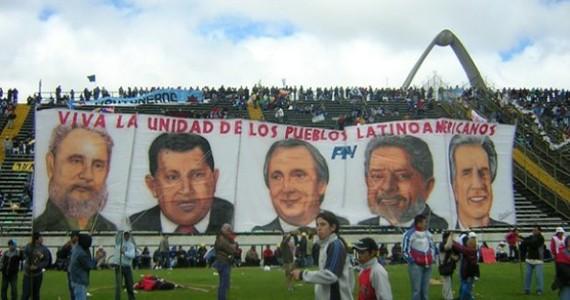
In 2005, in the city of Mar del Plata, the presidents of the brother countries of the Americas, Lula da Silva, Hugo Chávez, Evo Morales, and Néstor Kirchner stood firm against the United States. Photo: X
The meeting in Mar del Plata paid tribute to the moment when several Latin American presidents defeated the US attempt to establish a regional free trade agreement.
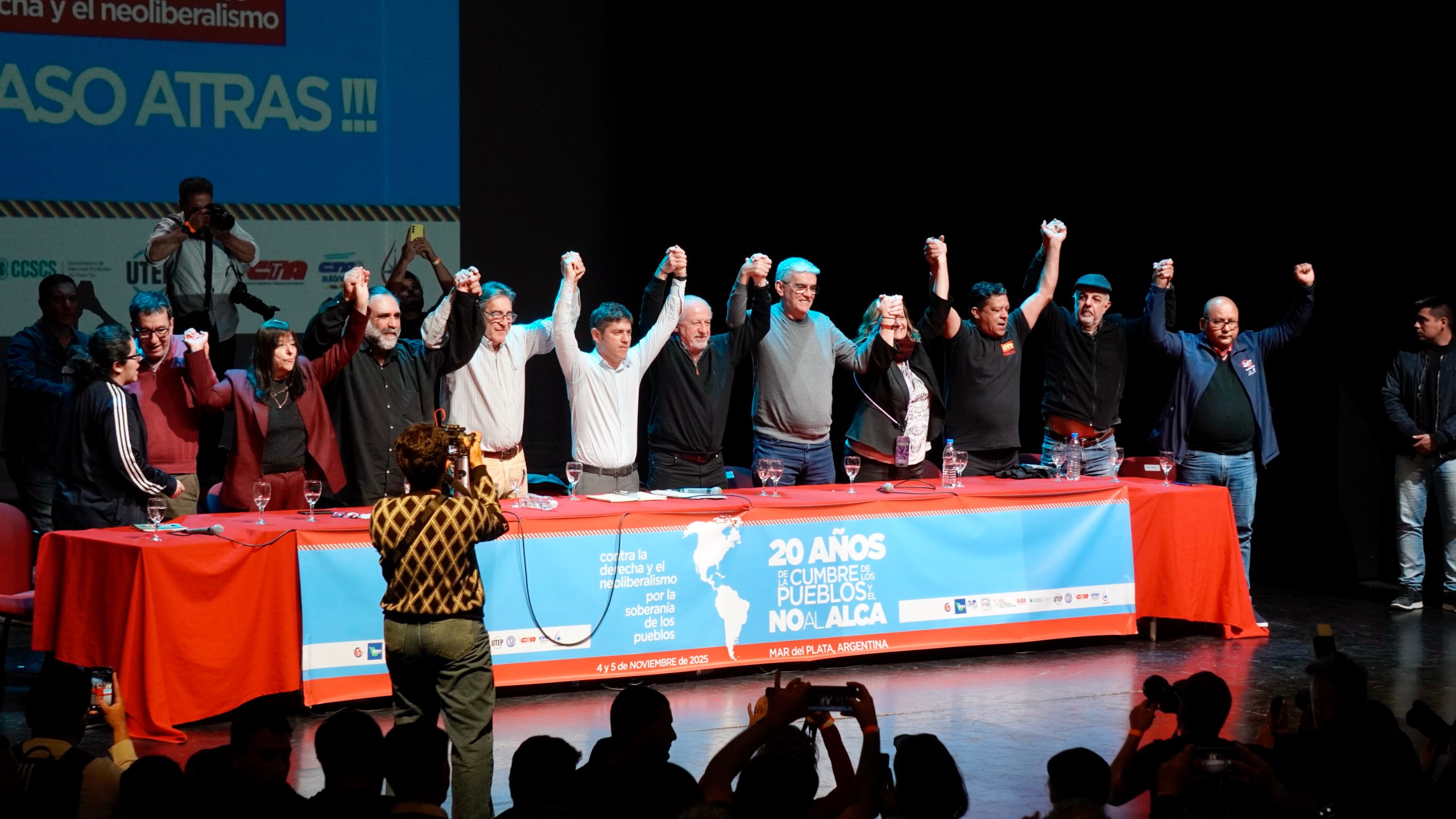
In the same place where the regional free trade project was “buried” two decades ago, 150 delegates from various social movements in Brazil, Uruguay, Bolivia, Cuba, Mexico, Portugal, Haiti, Palestine, Chile, Nicaragua, Peru, and Paraguay gathered to reaffirm the anti-imperialist spirit that led to the regional rejection of the FTAA project, they say.
“The world faces greater levels of inequality, injustice, and authoritarianism, with a growing concentration of financial and technological power that deepens poverty and limits the autonomy of countries in the Global South,” the delegates said in the event’s final declaration.
The meeting was also attended by the governor of Buenos Aires, Axel Kicillof, who stated that the rejection of the FTAA in 2005 was a “new declaration of independence” for Latin American countries. “The rejection of the FTAA was a victory for Latin American sovereignty, voiced by a group of presidents with enormous courage, represented in our country by Néstor Kirchner. Twenty years after that historic milestone, we have a responsibility to continue building unity, because there is no possibility of development for our countries outside the framework of regional integration. We cannot afford not to have a project on behalf of our people, because Argentina and the countries of Latin America are not anyone’s backyard,” Kicillof wrote in X.
Delegates from dozens of Latin American countries reaffirm the anti-imperialist spirit of the “No to the FTAA” summit in 2005.
For his part, the Secretary of Foreign Affairs of the Argentine Workers’ Central Union (CTA), Adolfo Aguirre, stated: “In this very place, in front of the President of the United States, George W. Bush, and before the eyes of the whole world, our peoples, workers, together with leaders such as Néstor Kirchner, Hugo Chávez, and Luiz Inácio Lula da Silva, marked a turning point. We said no to surrender, no to dependence, no to the model that wanted to turn our America into the backyard of economic power.”
Twenty years ago, the anti-imperialist slogan was born
Twenty years ago in Argentina, several political leaders from the Latin American left gathered at a People’s Summit, whose fundamental slogan was the rejection of the Free Trade Area of the Americas (FTAA), an initiative promoted, among others, by the George W. Bush administration. The FTAA sought to significantly reduce customs barriers between American countries.
According to popular and left-wing forces in Latin America and the Caribbean, the agreement would have promoted a regional market in which the United States would have had an enormous advantage over other countries and which, in the long run, would have led to the destruction of the still immature regional industry to benefit the interests of large US companies.
However, the economic and geopolitical project did not prosper due to fierce and coordinated opposition from several Latin American presidents, including Néstor Kirchner (Argentina), Hugo Chávez (Venezuela), and Luiz Inácio Lula da Silva (Brazil), among others. The political maneuver took place in Mar del Plata, during the Summit of the Americas, where Bush and his entourage suffered a severe setback. Thus, the proposal that had been in the works and planned since 1994 in Miami and was definitively defeated.
The Summit of the Americas is considered by several experts to be a turning point in the geopolitical relations of the American continent. New progressive and pro-sovereignty processes joined those of Argentina, Brazil, and Venezuela, giving rise to an attempt at regional integration that to this day is pushed by progressivism and boycotted by Washington’s neoliberal allies.
While the summit was taking place, thousands of people from left-wing and progressive movements and political parties gathered at a parallel conference with the slogan “No to the FTAA,” which was eventually attended by several political leaders. Among them, Hugo Chávez made a statement in his speech that would go down in history: “ALCA (FTAA in Spanish), al carajo! (FTAA, go to hell!)”.
A historic event
The region has undoubtedly changed its political composition. The seemingly unstoppable rise of progressive governments is now fragmented due to the emergence of new right-wing and neoliberal projects, such as those of Javier Milei in Argentina and Daniel Noboa in Ecuador, and the recent victory of the Bolivian right after more than 20 years of left-wing governments, among others.
However, in several countries, progressivism managed to regain government, as in the case of Lula da Silva himself, or managed to remain in power, as in the case of the United Socialist Party of Venezuela. Also, in other countries such as Colombia with Gustavo Petro and Mexico with Andrés Manuel López Obrador and Claudia Sheinbaum, progressive governments took office for the first time in their recent history.
In this sense, the dispute over governments in Latin America remains open, and much of the structure of that dispute can be found in what happened in Mar del Plata 20 years ago, where one regional project was buried and another was established, for almost a decade, as the model for regional integration around a position that, although it had its clear limits, always declared itself sovereign and independent.
Hanne Bosselaers on the “Conscience”. Source: People’s Health Movement
Physician Hanne Bosselaers, from Medics for the People (MPLP-GVHV) and the People’s Health Movement (PHM), was among dozens of health workers aboard the “Conscience” – one of the vessels that recently sailed to break Israel’s illegal blockade of Gaza and draw attention to the targeting of medical and media workers during the genocide. People’s Health Dispatch spoke with Dr. Bosselaers about her experience following her kidnapping by Israeli occupation forces and about why continued mobilization, especially within the medical community, remains essential to the struggle for Palestinian liberation.
People’s Health Dispatch: Let’s begin with your experience on board the “Conscience”: what it was like to travel as part of that mission, and then to go through the violent interception and kidnapping by the Israeli occupation forces.
Hanne Bosselaers: It was a great honor to join the “Conscience”, a large ship with 92 participants. We were mainly medics and journalists because we wanted to emphasize that these are the two professions most targeted during the genocide in Gaza. We wanted to show solidarity with our colleagues there.
Almost all participants had direct links with people in Gaza through humanitarian work or Palestinian NGOs like Awda Association. Several doctors on board had worked in Gaza during the genocide, and many journalists were in touch with Palestinian citizen journalists and local news agencies. We wanted to reach Gaza to report and to offer medical assistance: that was the core message of the “Conscience”.
Normally, in any conflict, humanitarian workers and journalists have access to document conditions and preserve the right to health. Gaza is really an exception, with Israel’s illegal blockade preventing any such access. So we sailed this large ship together with eight smaller sailing boats from the Thousand Madleens mission. This was a second wave of boats, following the Global Sumud Flotilla, the 47 boats that left from Barcelona, Sicily, and Tunis at the end of August.
It was a very positive experience on board. We had a strong sense of team spirit. Life on a large ship had to be organized: we took turns at chores, cleaning, cooking, and doing safety drills several times a day. We were led by four experienced women from the Freedom Flotilla Coalition, including Palestinian-American lawyer Huwaida Arraf, Vigdis Bjorvand, an activist from Norway who had previously sailed on the “Handala”, Zohar Regev a Palestinian-German activist, and Madeleine Habib from Australia, who steered the ship. These four women had all participated in earlier flotillas and prepared us very well. They knew what violent interception and imprisonment could look like because they had already experienced it, and they talked us through every step. Thanks to them, we were ready and united for what was ahead.
We kept our spirits high and held onto the hope of reaching Gaza. At one point, we had a call with my colleagues for Al-Awda. They told us: “This is exactly what we expect from you as Westerners, that you use your privilege to draw attention to our situation and to go as far as you can to reach us.” They deeply appreciated what we were doing.
I felt quite guilty not to make it to the shores of Gaza, but of course that was not in our hands. I think we did everything we could. The objectives of the flotillas were really met – the attention they drew, the participation of thousands, the local actions, the strikes in Italy, the massive demonstrations across many countries – all of this created significant pressure on Israel. I believe this helped bring about the ceasefire. Even if that ceasefire remains insufficient, it’s still a victory for the flotillas and the global movement that stood behind them.
PHD: You mentioned that the “Conscience” had a specific focus, its crew made up mostly of journalists and health workers. As a health worker, how did you experience the conditions during your imprisonment in Israel?
HB: In our case, the Israeli Occupation Forces (IOF) boarded our ship very violently. They came with three helicopters and a large navy frigate. More than 30 armed soldiers stormed our ship against 90 unarmed journalists and medics. It was clearly a show of force. We were still 200 kilometers from the Israeli coast, about 15 hours of full steam sailing from the port of Ashdod. So the interception itself was completely illegal and disproportionate.
During the whole voyage to shore, we were held in a small, confined, and very hot space. Some participants were elderly, the oldest was Isaline Choury, an 83-year-old French woman, the niece of Danielle Casanova, who was a well-known member of the French Resistance. She was experienced but had health problems, and she wasn’t allowed access to her medication for the entire 15 hours. She had to beg just to go outside for a few minutes of fresh air, which was sometimes refused. So even before imprisonment, our treatment amounted to captivity.
Once in prison, it became worse. What we experienced is only a fraction of what Palestinians face, but it was still meant to humiliate. Guards insulted us all the time. They used minor physical violence on me and other women – twisting arms, pulling hair – not severe beatings, but completely unnecessary since no one resisted. You could really feel that this is a society built on hate, racism, and violence.
We were taken to Ktzi’ot prison, the largest in Israel, because between our group and the Global Sumud Flotilla, there were around 500 detainees. The prison itself looks like a concentration camp: massive concrete walls, five to ten meters high, reminding you of the wall in the West Bank, topped with barbed wire, and surrounded by an army of guards.
Access to medical care was extremely limited. You could request to see a medic, but they always made you wait. Some participants who depended on medication didn’t get it until their consular representatives managed to intervene, and sometimes they were only able to visit their citizens after hours of waiting, which is completely illegal. The prison authorities behave as if they are above the law and can do whatever they want.
If this is how they treat Europeans and US citizens, I don’t dare to imagine how Palestinians are treated. The food was scarce and very poor, and we didn’t receive bottled water, only tap water that looked brownish. Some people were isolated. We stayed for 48 hours, but if someone had to stay for months or years, the effects on both mental and physical health would be devastating.
PHD: You mentioned the psychological impact of imprisonment. Could you speak a bit more about what prolonged imprisonment means for Palestinians, what kind of mental health consequences it has, and how health workers like yourself react when hearing about the experiences of Palestinian political prisoners?
HB: They regularly use these tactics to break people mentally. Nothing is regular, nothing is certain. For Palestinians, this begins from the moment of arrest. They are often kidnapped – at work, at home, in the middle of the night – without trial or due process. There’s no chance to say goodbye to family members. Once they’re taken, everything becomes uncertain: the duration of detention, whether they’ll be charged, whether they’ll ever be released. The occupation authorities can prolong imprisonment whenever they want.
What they did with us, I imagine they do with Palestinians all the time: sleep deprivation, psychological manipulation. Every two hours the guards would bang on the door shouting: “You’re going home!” The first time we believed them, so we got up, went to the toilet, waited, but nothing happened. Two hours later, the same again. At this point we knew it was just about making us have less sleep. And when they finally came for real, we didn’t believe them anymore and stayed in bed until they shouted at us to get up. It’s a tactic to exhaust you, to destroy your sense of reality.
I actually had an exchange with the guard who made us enter our cell. She said: “Welcome to your new home. Welcome to hell.” I told her: “No, you are the one staying here. I’m going home soon. You’re the one trapped in this system of violence. I really pity you.” Because that’s what it is – industrial-scale violence.
Imagine the young Palestinians, some as young as fourteen, living under constant threat from these violent, vicious guards. You can see how this leads to psychosis, depression, and other severe mental disorders. There are already many reports documenting this.
To me as a health worker, it’s deeply concerning. We have to keep campaigning for the release of these people – these hostages, because that’s what they are. They’re not prisoners, they haven’t committed any crime, and they should not be in prison at all.
PHD: Before boarding the “Conscience”, you were also preparing to join the Global Sumud Flotilla with Aziz Rhali and James Smith, comrades from the People’s Health Movement. Why is it so important for health workers to take an active role in the struggle for the liberation of Palestine and to express solidarity? How does this connect to your mission as a health worker?
HB: I see a health worker as someone who defends the right to health for everyone, everywhere. And if you look at what has happened to health in Gaza, it’s the worst situation in the world. Every right related to health has been denied: the right to housing, to education, to clean water, food, and of course healthcare itself. These were the first targets of Israel’s attacks.
After October 7, several hospitals were bombed. But even before that, in every Israeli assault on Gaza, hospitals were hit and healthcare workers were targeted. The number of medical workers killed during the genocide is unprecedented: more than 1,500 have been killed, over 300 imprisoned, and many more injured while at work, inside hospitals. Patients have been killed in their hospital beds, and entire hospitals burned to the ground. It’s a genocidal strategy aimed at erasing the entire healthcare system.
Then there’s the blockade. No medicine, medical equipment, or supplies are allowed in. Even humanitarian workers face extreme restrictions. Only a few foreign health workers can enter, and when they do, they can’t bring medical materials, just a few kilograms of personal luggage and a small amount of money enough to sustain themselves, not to share with anyone else. These inhumane restrictions are illegal under international law. There is no other conflict where the destruction of health infrastructure reaches this scale. Of course, there are other very cruel conflicts – in Sudan, in the Congo – but there, at least some minimal humanitarian access and healthcare structures exist. Gaza is different. The healthcare sector has been a primary target.
And yet, when you look at the response of Palestinian health workers, it’s extraordinary. In Al-Awda, they continue to build and sustain field hospitals, expand capacity, and help their people. They’ve grown from 400 to over a thousand volunteers working in makeshift hospitals and camps. Their courage and resilience are deeply inspiring.
So as a defender of the right to health, standing with Palestine is not only a moral obligation, it’s also an act of professional solidarity. Palestinian health workers show us what it truly means to uphold dignity, even in completely inhuman conditions. They refuse to abandon their patients. They’ve said: “We will stay until the last unit of blood, until the last pill.”
These health workers are unique. They’re my greatest source of inspiration, and I feel honored to dedicate much of my activism to them. They deserve liberation, rights, and the full realization of the right to health for their entire people. For me, standing by them is not difficult, it’s the easiest and most natural thing to do.
PHD: It was really moving to see Dr. Ahmed Muhanna return to Al-Awda the other day, and to hear the speech he gave. It’s been impossible to ignore the incredible work Palestinian health workers have done over the past two years, it’s truly inspiring.
HB: Absolutely. That video made me cry with joy. Honestly, I had feared he wasn’t alive anymore, we hadn’t heard any news for such a long time. I wasn’t expecting to see him again. When I did, he looked physically exhausted, he’d lost so much weight, but the strength of his words, his spirit, was incredible. It was deeply inspiring.
PHD:At the same time, we see the mainstream media and much of the political establishment in Europe talking about Donald Trump’s so-called peace plan. But even in the first hours and days after it was announced, Israel violated the ceasefire. For health workers, for Palestinians, and for those standing in solidarity with them, the struggle clearly continues. As someone who has been involved in this movement for a long time, what do you see as the most important priorities for activists in Europe and around the world in the coming weeks?
HB: You’re right, Israel is already violating the ceasefire agreement. I asked this morning [October 17] whether any of the supplies that entered Gaza had actually reached people, and the answer was no. There has been no scaling up of humanitarian aid, and the crossings are still closed. So Israel is already violating the most important parts of the agreement.
On the other hand, the fact that Gaza still stands and that there are talks about reconstruction is itself a kind of victory. It may seem small, and the situation remains a massive violation of rights, still colonization, but we shouldn’t underestimate it. We can’t expect anything good from Netanyahu, Trump, or Blair, but their plan was to create a “Gaza Riviera,” to completely cleanse the Strip, and they failed. They didn’t manage to empty Gaza of its people, and that’s also because of the global movement, the resistance, and partly the flotillas, which showed that we would not let that happen.
Gaza will stay, and this is the moment to scale up mobilizations and to fight for Palestinians’ right to self-determination over their land and to lead their own reconstruction. There’s a big danger now that all kinds of colonial NGOs will move in and take control of reconstruction efforts. Yes, there will be funding from Arab countries and others, but this process must be led by Palestinians, according to their own priorities.
We want to listen to our partners there, the grassroots Palestinian NGOs and community groups who know best what their people need. They must lead decisions about what is rebuilt and how. So right now, direct solidarity with Palestinians in Gaza and their organizations is absolutely essential. We’ll continue to speak about this, to show what they’re doing, and to raise support and mobilization in Belgium and across the world.
That’s also what we, as participants of the flotillas, agreed on: this ceasefire is not an end. It’s the beginning, a small but real moment of hope. And we need to nurture that hope and keep going.
PHD:You’ve already touched on what lies ahead, but maybe there’s more to add on how we can help ensure reconstruction and health justice?
HB: Yes, there’s an unimaginable amount of work to be done. Even just clearing the rubble and unexploded devices to make space for people to return to their land will be an enormous operation that takes a lot of time. But as I’ve said, this work must be in the hands of Palestinians. They are the ones best equipped to rebuild. They don’t need Western paternalism – and it’s Israel that must pay for what it destroyed.
That’s something we really need to fight for: accountability. You can’t just destroy the homes of two million people without any consequence. Israel must be held responsible and pay reparations for the devastation it caused. It hasn’t happened after previous assaults, but this time it must be part of the conversation within the solidarity movement. And of course there will be a need for international support, but we have to avoid a new wave of NGO colonialism. Organizations that stand in true solidarity with Palestinians should take the lead, not by flying in to “rebuild” or by constructing fancy projects nobody asked for, but by supporting Palestinians’ own initiatives and priorities. We can fund, assist, and advocate, but the leadership has to remain local.
So when we speak of health justice, it means full justice: ending Israel’s impunity and the ongoing violations of all rights. There can be no right to health under apartheid and occupation. We have to break both, or any talk of health in all Palestine will remain meaningless. Because we have to remember that the West Bank is also severely affected by settler colonial violence, home demolitions, and mass arrests. We often focus on Gaza, but we must not forget the daily displacement and repression in the West Bank. It’s all part of the same system.
PHD:Thank you, Hanne. Is there anything you’d like to add before we close?
HB: Just that the flotillas have been incredibly inspiring for people all over Europe. You could really feel how this collective effort awakened and motivated so many who had never been involved before. For Medics for the People (MPLP-GVHV), joining the “Conscience” was a collective decision. We felt it was important for our organization to take part directly, to build international connections and send a clear message of solidarity. And it worked: people in Belgium who had never thought much about Palestine suddenly started to care and to learn.
Interview slightly edited for length.
People’s Health Dispatchis a fortnightly bulletin published by thePeople’s Health Movementand Peoples Dispatch. For more articles and subscription to People’s Health Dispatch, clickhere.
Genocide denier and Current UK Prime Minister Keir Starmer is quoted that he supports Zionism without qualification. He also confirms that UK air force support has been essential in Israel’s mass-murdering genocide. Includes URLs https://www.declassifieduk.org/keir-starmers-100-spy-flights-over-gaza-in-support-of-israel/ and https://youtu.be/O74hZCKKdpAKeir Starmer objects to criticism of the IDF. He asks how could anyone object to them starving people to death, forced marches like the Nazis did, bombing Gaza’s hospitals and universities, mass-murdering journalists, healthworkers and starving people queuing for food, killing and raping prisoners and murdering children. He calls for people to stop obstructing his genocide for Israel.Orcas discuss Genocide-supporting and complicit Zionists. Donald Trump, Keith Starmer, David Lammy, Rachel Reeves, Angela Rayner and Wes Streeting are acknowledged as evil genocide-complicit and supporting cnuts.
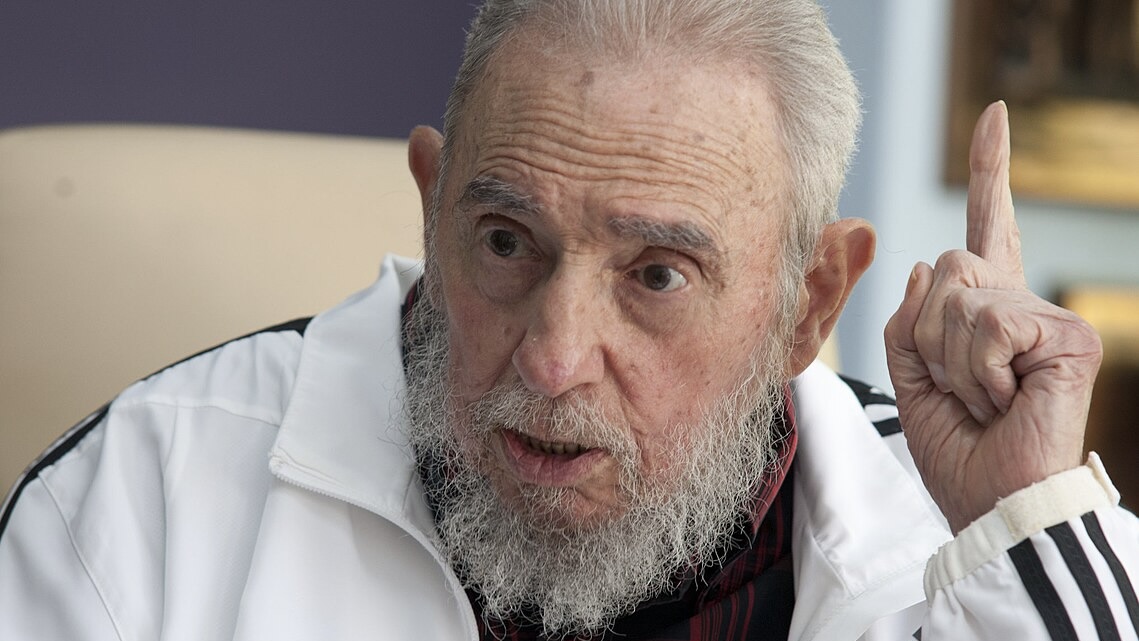

 Jeremy Corbyn, with Zarah Sultana (not pictured) speaking at a discussion on Your Party, their new political party, at The World Transformed conference, at Niamos Radical Arts Centre in Hulme, Manchester, October 10, 2025