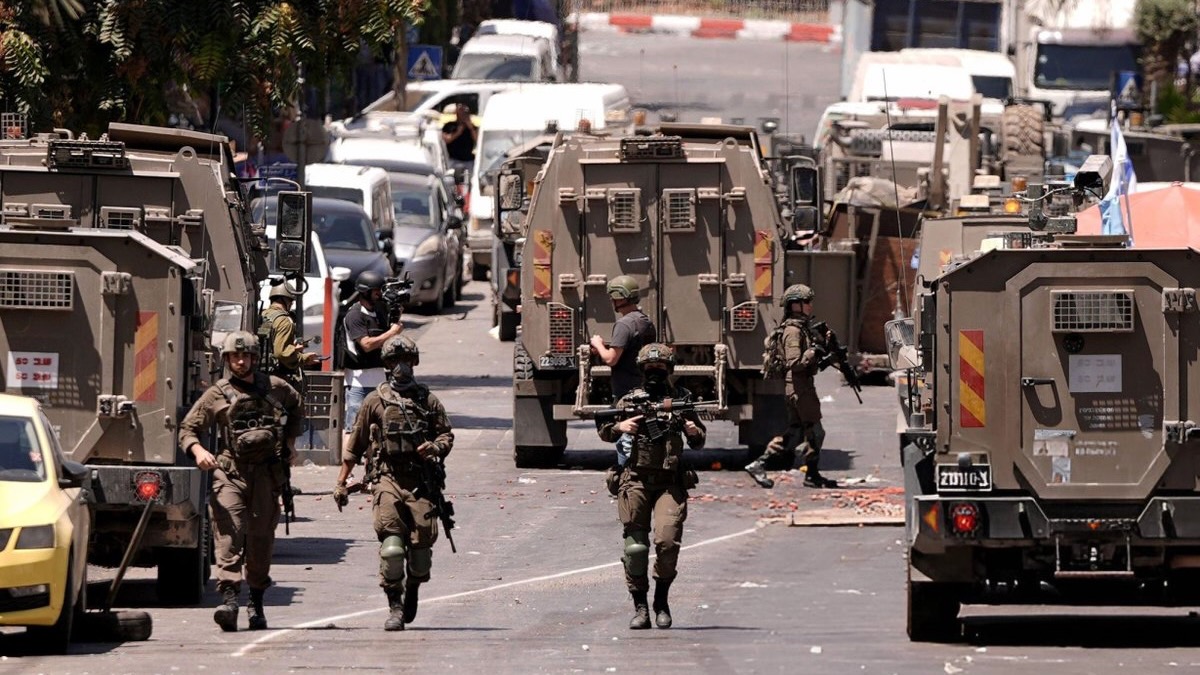
58 Palestinians injured in IOF raid on Central Ramallah. Photo: Andalou Agency
The offensive is considered a major escalation as it took place in Ramallah, the political and administrative hub of the Palestinian Authority.
Daily raids carried out by the Israeli Occupation Forces (IOF) have for decades been routine for Palestinians living in the occupied West Bank. However, Ramallah city center has been relatively safe compared to other areas, largely since the second intifada ended in 2005.
This isn’t to say that such relative calm extends to the entire governorate of Ramallah and Al-Bireh; it applies exclusively to the few square kilometers surrounding the Palestinian Authority (PA) headquarters near the center of the city.
Although this particular part of the city was previously subjected to IOF raids, such offensives happened rarely, for a brief time and usually not during daytime.
In a major escalation, the IOF stormed Ramallah city center on Tuesday, August 26, at rush hour in the afternoon, shooting at passersby and a journalist’s vehicle. Eyewitnesses and media workers reported the use of live ammunition, rubber-coated steel bullets, and gas canisters during the raid.
Those taking part in a sit-in to commemorate the National Day for the Recovery of the Bodies of Slain Palestinians, a day when families demand the return of their martyrs’ bodies, 700-1500 of which are reportedly held by Israel, were also suppressed by Israeli military personnel when they raided the area.
At least 58 Palestinians were wounded in the assault, which lasted for hours, including a 13-year-old boy, who sustained an injury to his abdomen.
The IOF also arrested three people from a money exchange shop, and confiscated around 1.5 million Israeli Shekel (USD 447,000), over allegations that the shop was transferring money to Hamas.
The IOF continues its military operations across the West Bank
On Wednesday, August 27, the IOF raided the city of Nablus in the northern West Bank, and imposed a siege on its Old City.
Dozens of Palestinians were reported injured in the attack, which lasted 14 hours. Palestinian citizens also told Turkish news agency Anadolu that the IOF turned a number of houses in the city into military barracks.
The spokesperson for the Palestinian Presidency Nabil Abu Rudeineh condemned and rejected the IOF’s intensified military operations in cities, villages, and refugee camps across the West Bank on Wednesday.
Abu Rudeineh called the latest Israeli military actions in the West Bank a “dangerous escalation”. He also held the Israeli government responsible for the escalating assaults of the IOF, and the terrorist acts of illegal Israeli settlers against the Palestinian people.
The Palestinian official warned Netanyahu’s government that continuing with these policies will lead the region to further tension and instability.
He also reiterated his call for the US administration to pressure Israel to stop these dangerous policies, which violate the resolutions of international legitimacy and international law, and to oblige it to end the war and other acts of aggression.
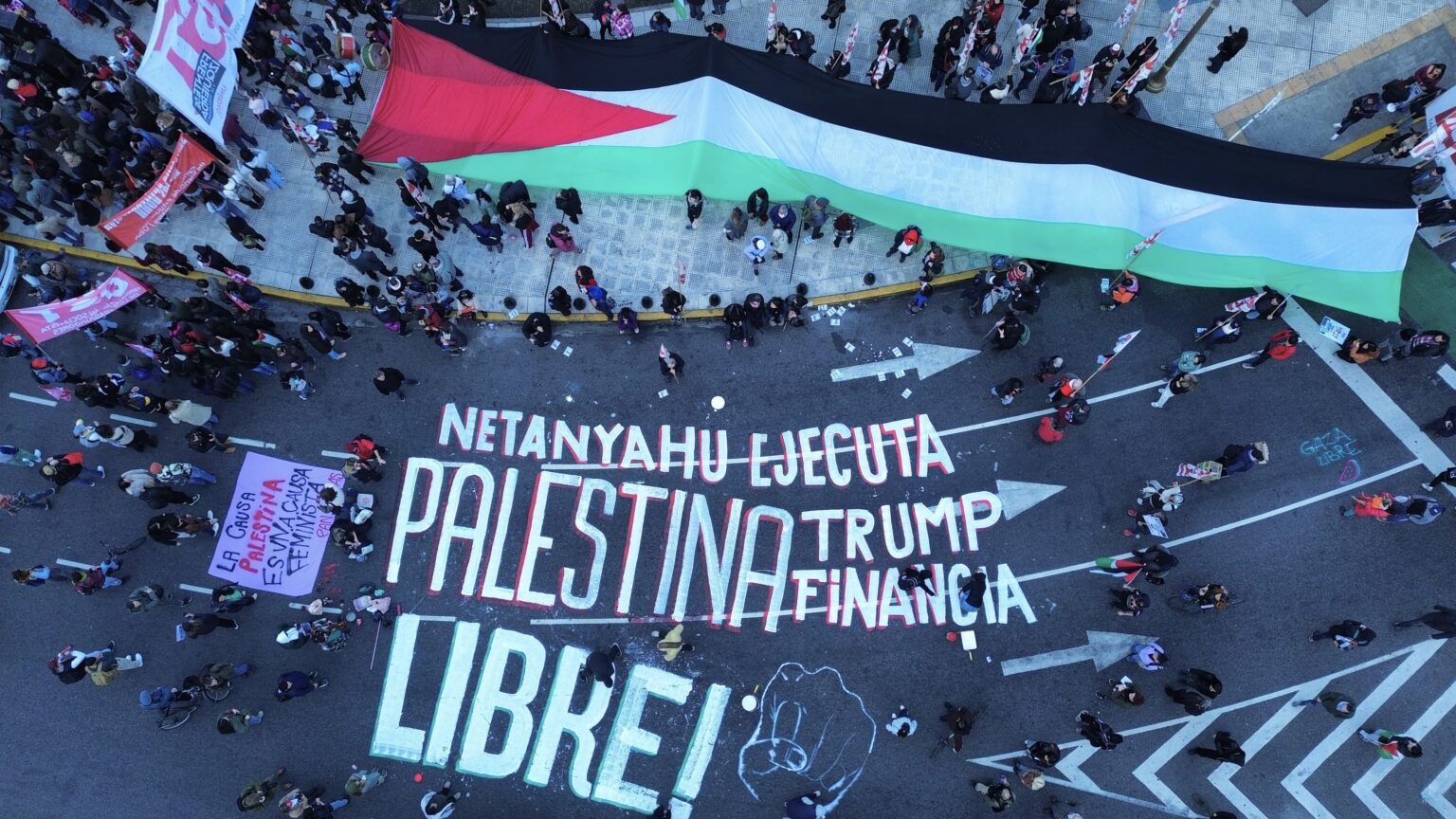
Buenos Aires march on Saturday, August 9. Photo: Argentine Committee for Solidarity with the Palestinian People
Protesters on Saturday also denounced the very close relationship between the governments of Milei and Netanyah
On August 9, thousands of Argentines took to the streets of the capital, Buenos Aires, demanding an end to the genocide being committed in Gaza, Palestine Israel. The slogan of the march was “We are all children of Gaza”.
The protesters denounced the indiscriminate attacks and forced starvation that, they claimed, Israeli forces are perpetrating against the civilian population.
The demonstration ended at Plaza de Mayo, where, according to some media outlets, more than 10,000 people demanded an end to the repressive actions in Palestine: “ Gaza is starving, time is up!” and “Palestine will prevail from the river to the sea” were some of the slogans chanted by the protesters as they waved Palestinian flags.
The march brought together human rights organizations, left-wing political parties, and various social movements, which declared that the only solution to any conflict in Palestine is peace, respect for sovereignty, and a dignified life for those who live there.
“We are facing genocide, which is confirmed by Israeli leaders themselves when they openly say that it is lawful to starve and dehydrate the entire population of Gaza, including its children. This genocide must be denounced relentlessly,” said Gabriel Solano, one of the leaders of the Left Front, during the mobilization.
For its part, the Palestinian Embassy in Argentina posted on X: “THANK YOU ARGENTINA, WE WILL NEVER FORGET! An impressive demonstration took place on Saturday, August 9, in Buenos Aires to denounce the genocide being carried out by the state of Israel against the Palestinian people.”
A close relationship between the governments of Argentina and Israel?
The demonstration also criticized the close ties between the Argentine and Israeli governments, which Argentine President Javier Milei (who recently traveled to the occupied Palestinian territories) has never denied. One of the slogans heard at the march was: “Milei, Zionist, you are the terrorist”.
Milei has announced that in 2026, he will relocate the Argentine embassy in Israel from Tel Aviv to Jerusalem, a move that Palestinians and several governments around the world have heavily criticized. For his part, Israeli Prime Minister Benjamin Netanyahu confirmed that he will soon come to Argentina on an official visit, a move that various Argentine political movements and parties have strongly denounced.
In addition to Buenos Aires, demonstrations against the genocide in Palestine took place in other Argentine cities, such as San Carlos de Bariloche, El Bolsón, Trelew, Comodoro Rivadavia, Ushuaia, Río Grande, San Salvador de Jujuy, Salta, San Miguel de Tucumán, San Juan, La Rioja, Catamarca, Mendoza, Santa Fe, Concepción del Uruguay, Córdoba, Cosquín, Alta Gracia, Villa Dolores, La Plata, Bahía Blanca, Mar del Plata, Neuquén, and Viedma.
Solidarity with Palestine continues to grow
“The last three demonstrations have grown due to the news about the genocide taking place in Gaza,” Gabriela B., an activist with Nuestramérica and member of the Argentine Committee for Solidarity with the Palestinian People, told Peoples Dispatch. For her, there is a significant increase in support for the cause, “If there was ever a belief that people could ignore the situation in Palestine without it affecting their humanity or without their stance being noticed, that idea has been shattered.”
She also pointed out the importance of Israel in Argentina: “In Argentina, the situation is very difficult. As a colleague mentioned, Argentina is considered the capital of Zionism [in Latin America], which means that the mainstream media only broadcasts voices that cover up the genocide. Furthermore, any action or complaint related to Palestine is framed within the concept of anti-Semitism, making solidarity and questioning of the situation even more difficult. The silence is already unsustainable, and Netanyahu’s possible visit, as well as the famine in Gaza, have triggered acts of repudiation. This resulted in posts on the accounts of famous artists during the week and in the large march that took place not only in Buenos Aires but in 30 other locations throughout the country, including cities and provinces.”
Regarding the demands made by the protesters, Gabriela said: “The main demand was a call to stop the genocide and famine, and to reject the possible visit to Argentina by Israeli Prime Minister Benjamin Netanyahu.” Other demands included:
The withdrawal of Israeli troops from Palestine, Syria, and Lebanon.
Ending diplomatic relations with Israel. Cancelling the Mercosur-Israel agreement (a Free Trade Agreement between Israel and a bloc of South American countries).
Stop the persecution of those who show solidarity with the Palestinian people.
In Argentina, two prominent political figures are currently being persecuted for tweeting about the genocide in Gaza: Vanina Biasi and Alejandro Bodart.
When asked about the criticisms raised during the march against Milei’s close relationship with Netanyahu, Gabriela B. said that in the last month, key political and progressive movements have begun to join the movement in support of Palestine and rejecting Israel’s actions. After Saturday’s march, momentum has continued to build, “various complaints were filed after Saturday by trade unions and human rights organizations, demanding Netanyahu’s arrest if he visits Argentina. The same complaint alleges that Netanyahu committed ‘genocide and war crimes’ against the Palestinians (presented by the secretary general of ATE Buenos Aires, Daniel ‘Tano’ Catalano, and the representative of the H.I.J.O.S. group, Verónica Castelli).”
She added: “However, as far as Milei and the ruling party are concerned, nothing has happened. No media outlet, except for alternative ones, has reported on the large march. The only news that managed to break through the media blockade and name Israel as a murderer was the news of the six journalists who were killed on Sunday. This march has served to denounce the Zionist alliance that the government maintains and to continue raising awareness among our people.”
Genocide denier and Current UK Prime Minister Keir Starmer is quoted that he supports Zionism without qualification. He also confirms that UK air force support has been essential in Israel’s mass-murdering genocide. Includes URLs https://www.declassifieduk.org/keir-starmers-100-spy-flights-over-gaza-in-support-of-israel/ and https://youtu.be/O74hZCKKdpAKeir Starmer objects to criticism of the IDF. He asks how could anyone object to them starving people to death, forced marches like the Nazis did, bombing Gaza’s hospitals and universities,mass-murdering journalists, healthworkers and starving people queuing for food, killing and raping prisoners and murdering children. He calls for people to stop obstructing his genocide for Israel.
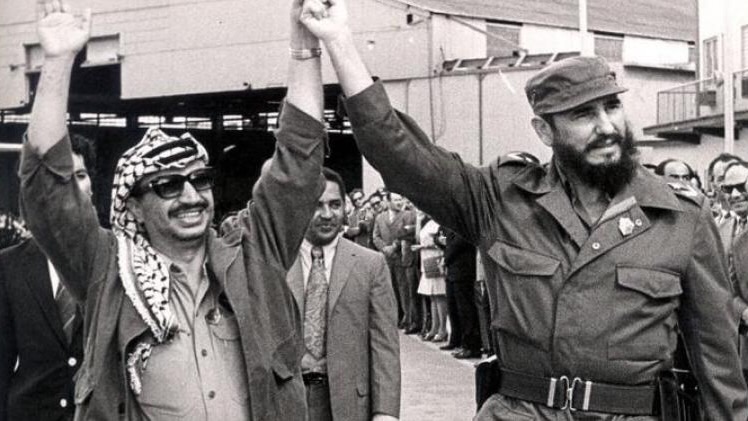
Palestinian leader Yasser Arafat and Cuban President Fidel Castro. Photo: Cuba Sí
On the 99th anniversary of Fidel Castro’s birth, we remember the revolutionary government’s support for Palestine, especially its condemnation of the genocide of the Palestinian people.
In a famous speech, Fidel Castro, the supreme leader of the Cuban Revolution, stated that medical, civil, and military support for the Angolan people was provided without expectation of any material reward. He pointed out that this way of thinking exposes an imperialist ideology, according to which one country supports another, always expecting to benefit materially in some way. “Revolutionaries expect nothing, which means that revolutionaries must devote themselves totally to a cause, to their ideas, to their noble goals, without expecting anything in return.”
This was the same principle that Fidel applied in supporting the Palestinian people’s struggle almost from the beginning of the revolutionary process he led since 1959. It is no coincidence that one of the most renowned Palestinian leaders, Yasser Arafat, visited the Caribbean Island eight times, on the personal invitation of Castro.
On October 12, 1979, at the United Nations Assembly, Fidel denounced before the world Israel’s process of territorial expansion, supported by the United States, at the expense of Palestinian territory. “The basis for a just peace in the region begins with Israel’s total and unconditional withdrawal from all occupied Arab territories and for the Palestinian people, the return of all their occupied territories and the restoration of their inalienable national rights, including the right of return to their homeland, self-determination, and the establishment of an independent state in Palestine, following General Assembly Resolution 3236,” Fidel said.
Castro acknowledged that this expansion was achieved through the killing of Palestinians, thus becoming one of the first world leaders to speak of “genocide” against the Palestinian people: “We repudiate with all our strength the ruthless persecution and genocide that Nazism unleashed against the Jewish people in its time. But I can think of nothing more similar in our contemporary history than the eviction, persecution, and genocide that imperialism and Zionism are carrying out today against the Palestinian people. Stripped of their lands, expelled from their homeland, scattered throughout the world, persecuted and murdered, the heroic Palestinians are an impressive example of self-sacrifice and patriotism, and they are the living symbol of the greatest crime of our time.”
Fidel also recognized that there are geopolitical interests that do not want peace to be established in the Middle East: “Can anyone be surprised that the Conference (of the Non-Aligned Movement) was forced, for reasons that do not stem from any political prejudice but from an objective analysis of the facts, to point out that US policy plays a fundamental role in preventing the establishment of a just and comprehensive peace in the region, by aligning itself with Israel, supporting it, and working to obtain partial solutions favorable to Zionist objectives and guaranteeing the fruits of Israeli aggression at the expense of the Arab people of Palestine and the entire Arab nation?”
“More than just rhetorical support, it was tangible support”
As historians point out, Fidel’s support for Palestine was not purely rhetorical, but also diplomatic. In 1974, Arafat arrived in Cuba and was received with the honors of a head of state, even though Palestine was not yet “officially” recognized as a state. Fidel’s message was clear: Palestine should be recognized by the international community as a state, and Arafat as its leader. In addition, Arafat was awarded the Playa Girón National Order, Cuba’s highest recognition for citizens “who have excelled in the struggle against imperialism, colonialism, and neo-colonialism, or who have done great deeds for peace and progress of mankind”.
The relationship between Cuban revolutionaries and the Palestine Liberation Organization (PLO) dates to the beginning of the Cuban Revolution. In 1959, Raúl Castro and Ernesto “Che” Guevara traveled to the Gaza Strip, disobeying the doctrine of hemispheric alignment whereby all Latin American countries, except for Cuba, supported Israel.
Thus, in 1964, thanks to Che Guevara’s tremendous efforts, Cuba recognized the PLO as soon as it was founded, becoming one of the first countries to do so. But its support went beyond official documents, according to Mansour Tahboub, former acting director of the Arafat Foundation: “Cuba has always been a strong supporter of Palestinians in all realms: political, military, vocational training. The Cubans trained Palestinian cadres, and Fidel himself was a staunch advocate of the Palestinian quest for freedom and independence.”
The truth is that one of the core principles of Castro’s administration was to support anti-imperialist and anti-colonialist struggles, wherever they took place. In a 1977 interview with French Weekly, Fidel stated: “The Palestinian movements have shown their ability to resist imperialist … aggression … [The Palestinian cause] will prevail sooner or later despite the betrayal by Arab reactionaries, imperialist maneuvers and Israeli aggression.”
That is why Cuba, along with Nicaragua, were the only two Latin American countries to condemn Israel’s actions after the Six-Day War. In 1973, Cuba severed diplomatic relations with Israel following the Non-Aligned Movement meeting in Algeria.
According to Abdel Majeed Sweilim, professor of political science at Al Quds University, the PLO also benefited from the relationship between Cubans and Palestinians, thanks to the political training of Palestinians on Cuban soil.
Today, despite the economic blockade imposed by the United States, which causes a perpetual economic crisis on the Caribbean Island, the Cuban government has reserved funding in the form of academic scholarships so that each year, 150 Palestinians can study medicine, engineering, and other professions at Cuban universities.
In his final years, Fidel continued to support the Palestinian cause. Thus, after resigning from his political posts, Castro signed an international manifesto in support of Palestine in 2014, which demanded Israel’s withdrawal from the Gaza Strip, the West Bank, and East Jerusalem, as well as respect for the resolutions passed by the United Nations regarding the conflict.
Arafat’s recognition of Cuban support
These and other measures have led countless Palestinians to see the revolutionary government of Cuba as an unwavering ally. Arafat himself acknowledged this when he stated: “I consider, Your Excellency President Fidel Castro, this demonstration of firmness and unwavering friendship that has taken place in Havana, as a strong and effective message from a beloved world leader who enjoys great international prestige among all the peoples and countries of the world, to mobilize them quickly to put an end to the suffering of the Palestinian people as a result of the Israeli occupation of their homeland, and the intensification of military, economic, and financial actions and blockades against our cities, villages, towns, farms, and water wells, and the closure of international border crossings by land, air, and water.”
In addition, the historic leader of the PLO said: “Every Palestinian today holds in their heart and conscience this glorious image of Your Excellency with the Palestinian hatta on your shoulders, which is irrefutable evidence of the justice of our cause and the magnitude of the injustice committed by the Israeli aggressors against our people. Have full confidence, Your Excellency President Castro, so beloved by our people and by all peoples, that our people, as resilient as the Palestinian mountains, take from your position and example, which makes us proud, more courage and determination to continue the struggle, the resistance, and the Intifada to remove the Israeli occupiers from our country, Palestine.”
In this way, Cuba continues to unreservedly support the demands for sovereignty, self-determination, and peace made by the Palestinian people in the face of the previous and most recent attacks by the Israeli government on their territory. This support, since 1959, is not given with the expectation of anything in return, but because of the anti-imperialist and anti-colonialist principles that guide the Cuban Revolution and that Fidel helped to establish as principles of the Cuban state itself.
Genocide denier and Current UK Prime Minister Keir Starmer is quoted that he supports Zionism without qualification. He also confirms that UK air force support has been essential in Israel’s mass-murdering genocide. Includes URLs https://www.declassifieduk.org/keir-starmers-100-spy-flights-over-gaza-in-support-of-israel/ and https://youtu.be/O74hZCKKdpAKeir Starmer objects to criticism of the IDF. He asks how could anyone object to them starving people to death, forced marches like the Nazis did, bombing Gaza’s hospitals and universities,mass-murdering journalists, healthworkers and starving people queuing for food, killing and raping prisoners and murdering children. He calls for people to stop obstructing his genocide for Israel.
This work by Middle East Monitor is licensed under a Creative Commons Attribution-NonCommercial-ShareAlike 4.0 International License.
Israel’s far-right National Security Minister Itamar Ben-Gvir leads a large group of illegal settlers in a provocative march and mass incursion into the Al-Aqsa Mosque compound, coinciding with the Jewish commemoration of Tisha B’Av in East Jerusalem on August 3, 2025. [Gazi Samad – Anadolu Agency]
Saudi Arabia on Sunday strongly condemned repeated Israeli provocations at the Al-Aqsa Mosque compound in occupied East Jerusalem, following an intrusion by far-right National Security Minister Itamar Ben-Gvir to the flashpoint site, Anadolu reports.
Ben-Gvir led a large group of illegal settlers in a mass incursion into the mosque complex early Sunday to mark the Jewish holiday of Tisha B’Av.
“These repeated provocative practices by officials of the Israeli occupation government at Al-Aqsa Mosque only serve to fuel conflict in the region,” the Saudi Foreign Ministry warned in a statement.
The kingdom stressed that such actions “violate international laws and norms” and undermine peace efforts.
Riyadh reiterated its “continued demand that the international community stop the practices of Israeli occupation officials” and called for urgent international intervention.
Al-Aqsa Mosque is the world’s third-holiest site for Muslims. Jews call the area Temple Mount, claiming it was the site of two Jewish temples in ancient times.
Israel occupied East Jerusalem, where Al-Aqsa is located, during the 1967 Arab-Israeli War. It annexed the entire city in 1980 in a move never recognized by the international community.