Meanwhile, police officers criticised for searching campaigners’ coach and ‘undermining their right to protest’
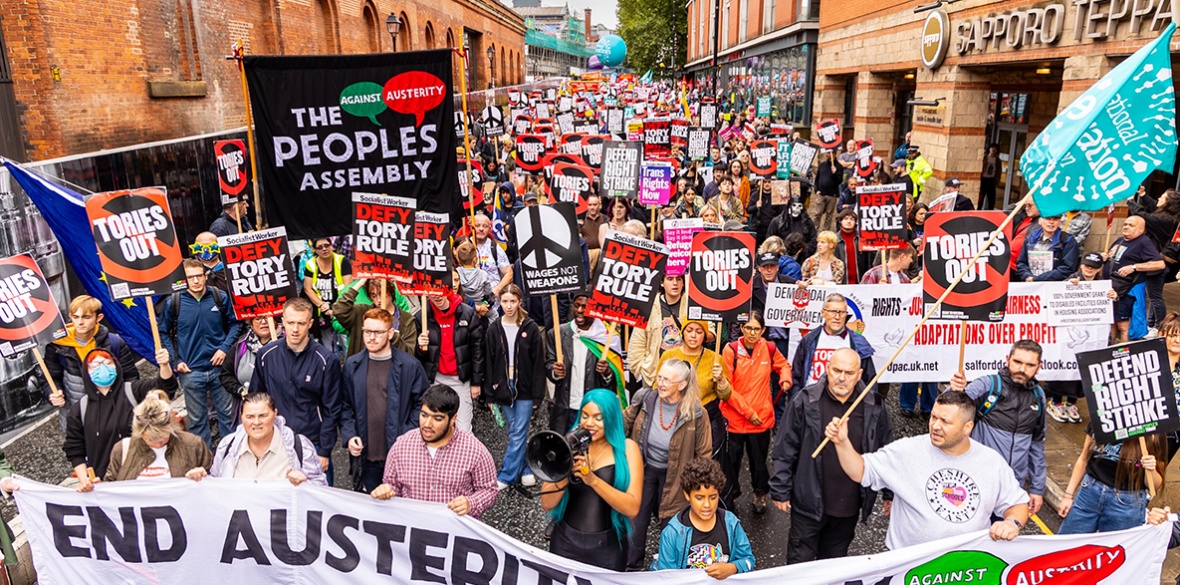
A huge protest against the Tories in Manchester, October 1, 2023 Photo: Neil Terry / Neil Terry Photography
THOUSANDS of people marched through the streets of Manchester today telling delegates to the Tory Party conference there that they are not welcome.
Headed by the banner of the Manchester People’s Assembly, which organised the march with the national People’s Assembly, the protesters represented trade unions and a huge diversity of campaign groups expressing their anger at the destruction wrought across society by the Tories.
Disabled people, peace activists and dozens more groups marched noisily through the city centre.
…
Protesters from all across the country took coaches to attend the march.
One coach transporting protesters from London was stopped by the police, who signalled the bus to follow them to Knutsford in Cheshire where it was searched by around 30 officers.
The protesters were late as a result. Activists said it undermined their right to protest and was a waste of police time and money.
Lorraine Douglas, from the Communist Party, said: “The sergeant came on and said they’d received intelligence that there were people on the bus set on doing criminal damage and they were going to search the bus for equipment that could cause criminal damage.”
The police went on to read a section of the Public Order Act.
“They refused to say what the intelligence was, and they got us all off the bus and searched the bus, found one flare and it looked like they had some magic markers or pens,” Ms Douglas said.
Saturday, September 9 at 12:00 noon is the moment of the Big One: we will demonstrate for the eighth time on the A12. And also for the last time. Because no matter what the Hague municipal council allows the police to do, we will stay or come back day in and day out. Until the government meets our demand: an immediate end to all fossil subsidies. Together we can do this. Get involved and join us!
The most recent IPCC report is clear: continuing on the current path will lead to between 2.2 and 3.5 degrees of warming. Even now, the situation in the Global South is extreme: hundreds of thousands of people die every year as a result of the climate and ecological crisis. In 2022, 43,000 people died in Somalia alone due to drought. Yet our government stimulates the fossil industry with up to 30 billion euros in fossil subsidies every year . Bizarre policy with devastating consequences!
Participate? Which can! Good preparation is important. Take an Action Training so that you know how to take peaceful civil disobedience action and join the Telegram group A12StopSub
Around 2,000 arrests during first day of A12 blockade, new A12 blockade tomorrow at 12:00 noon
09/09/2023
Extinction Rebellion will keep coming back, every day at 12:00 noon, until fossil subsidies are abolished
Today, on Saturday September 9, about 25,000 people demonstrated on and next to the A12 , in the blockade and the support demo . From 1:30 p.m., the police deployed water cannons and peaceful demonstrators were also frequently beaten with batons. Around 2,000 people were arrested for demonstrating peacefully on the A12 between the Ministry of Economic Affairs and Climate Policy and the temporary House of Representatives building. A large number of these demonstrators will be back on the A12 tomorrow at 12:00 noon to demand an immediate end to all fossil subsidies. If they are removed again by the police, they will return the next day and every day after that, always at 12:00 noon.
Tessel Hofstede, spokesperson for Extinction Rebellion and recently sentenced to 30 hours of community service for ‘incitement’: “On the first day of the permanent A12 blockade, many thousands of people showed that all fossil subsidies must now end. Every day around the world, and especially in the Global South, people die from climate disasters that our government helps pay for. This must stop now. That is why we will keep coming back, every day at 12:00 until all fossil subsidies are abolished.”
37.5 billion euros annually: the amount is correct
On Tuesday, September 5, Rob Jetten admitted to the Financieel Dagblad that ‘the amount is correct’.[1] He was referring to the annual 37.5 billion euros in fossil subsidies from research by SOMO, Oil Change International and Milieudefensie.[2] He further indicated that the government is still busy ‘mapping’ the size. A striking fact since the Balkenende cabinet already determined in 2009 that fossil subsidies had to be phased out[3], a process that should have been completed in 2025.
Mozart on the A12
XR Musicians was present with 180 musicians and a choir. They opened the demonstration with the Dies Irae from Mozart’s Requiem. Dies Irae means ‘Day of anger’. Cellist Sanne Bijker: “Anger is appropriate today, because the government is still investing in fossil subsidies at the expense of the Global South and future generations. Anger is also an emotion that sets you in motion, anger makes you get up and take action. We hope to get more people moving with this music.”
Professors in gowns [Scientists’ white coats?]
Scientist Rebellion demonstrated with dozens of scientists, including a number of professors, many of whom were wearing gowns. “Climate change requires radical system change towards a society that does everything it can to keep this planet livable and healthy for people, animals and nature,” said Patrick Huntjens, professor of governance of Sustainability Transitions, Maastricht University. “As long as there are 37.5 billion euros in fossil subsidies, the government is part of the problem and the main obstacle on the way to a sustainable and just society.”
“This is the fourth time I have participated in the A12 blockade with Scientist Rebellion,” said Julia Schaumburg, professor of Econometrics, VU Amsterdam. “I am here as a scientist, but also, more importantly, as a citizen terrified of a future of continued global warming and environmental degradation.”
Broad support for professional groups
All kinds of professional groups also demonstrated on the A12, including XR Civil Servants, XR Teachers, XR Healthcare Professionals, XR Therapists and the green farmers of
Spokesperson Margarita Vossen of XR Zorgprofessionals: “This is bad news, further health damage must be prevented urgently. An emergency in the hospital is also not postponed, our planet is in need and we must take action now.”
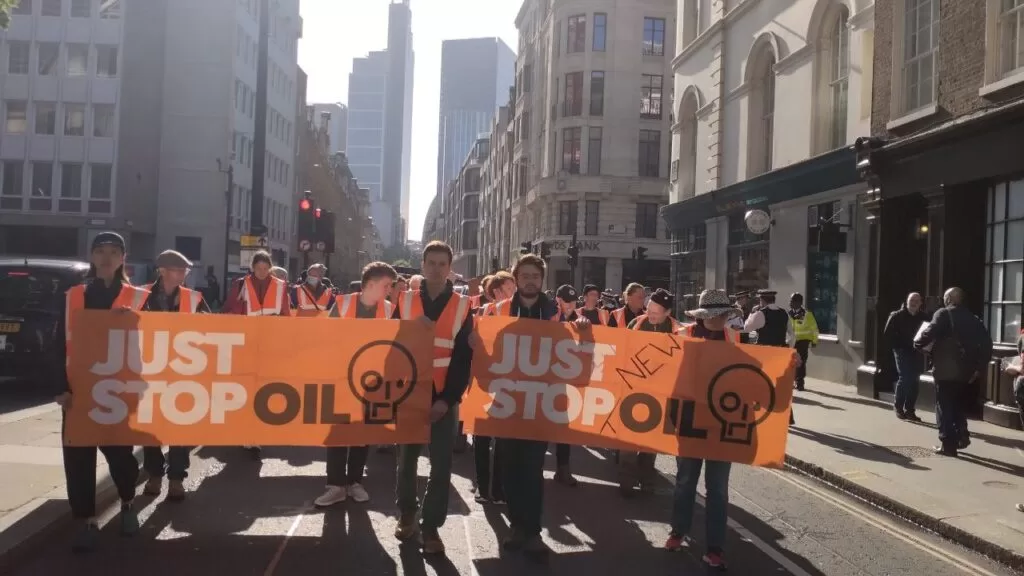
Suella Braverman forced through new anti-protest laws after slow-marching demonstrations from Just Stop Oil activists in London
At midnight last night, the right to protest in England and Wales became a matter of police discretion.
Yesterday, the police could restrict or stop a protest to prevent it causing either “serious public disorder, serious damage to property, or significant and prolonged disruption to the life of the community”.
Those powers already allowed plenty of room for interpretation, but from today the threshold is even lower. This week, home secretary Suella Braverman forced through new laws in a way never seen before in the UK. Here’s what you need to know.
What are the new police powers targeting protests?
Changes to the Public Order Act mean police can now restrict or stop a protest if they believe it could cause “more than minor disruption to the life of the community”. They have the power to arrest anyone taking part in a protest, or even anyone encouraging others to take part.
Officers are also now required to consider “cumulative disruption” from protest, even if the protests in question are organised by different people and about different issues. And the definition of “community” has been changed to include anyone affected by a protest, not just people who live or work in the area it’s happening in.
“The regulations also say the police will be required to take into account all relevant disruption. For example, if there are regular traffic jams in the area, that would have to be taken into account [when the police decide whether to ban a protest], even if it had nothing to do with the protest”, Jodie Beck, policy and campaigns officer at Liberty told openDemocracy.
Braverman argued the new laws were needed to target slow-marching protests from climate activists Just Stop Oil and Extinction Rebellion.
What do they mean?
In reality, the police could find a way to argue that any protest meets the threshold for imposing restrictions, if they wanted to. The new law, says Beck, is a “huge expansion of police powers” that could also lead to police allowing some protests to go ahead while imposing restrictions on others, simply based on how the officers felt about the message behind them.
While the government has focused on one particular type of protest – slow-marching – all protests are potentially impacted.
Beck gives the example of striking railway workers and their supporters holding a rally outside a train station. The police “could decide that means a more than minor disruption to people’s travel,” and so ban the gathering, and arrest anyone taking part.
It could even be that police officers rule that a picket line causes “more than minor” disruption to the workplace it is picketing – after all, that’s the point.
But it’s not just the new laws which have shocked experts. It’s also how they came about this week.
How did the new laws restricting protests get passed?
Originally, Suella Braverman tried to sneak the new legislation into the Public Order Act, which passed earlier this year and came into effect just before the coronation. Rather than allowing these changes to face the usual scrutiny in the House of Commons, the home secretary had them added as last minute amendments to the bill in the House of Lords, after MPs had already voted on it. Her attempt failed – the Lords thought these measures were too draconian and voted them down, though they approved the broader new bill.
Undeterred, Braverman turned to a constitutional trick that’s never been used before. Because while new bills – known as ‘primary legislation’ – require line-by-line scrutiny in both houses, various laws already on the statute book give ministers powers to make small changes via something called ‘secondary legislation’. And secondary legislation doesn’t get nearly as much scrutiny, with both the Commons and Lords simply voting for or against.
The home secretary argued that another act passed last year by then-home secretary Priti Patel – the Police, Crime, Sentencing and Courts Act – already gave her the power to make these changes via secondary legislation. So that’s what she did this week, making it the first time ever that a government has used secondary legislation to push through a measure that had already been voted down by parliament.
The secondary legislation passed through the Commons on Monday, with the Tories taking full advantage of their majority. In the Lords, Green peer Jenny Jones filed a highly unusual fatal motion, a rare procedure used to try and kill off the passage of a bill. Normally, because it’s an unelected house, the Lords tweaks legislation passed by the Commons, but doesn’t ultimately vote it down. Jones argued that, because the government was bringing back a law which had already been voted down by parliament through a route which requires almost no scrutiny, this should be an exception.
Labour, although they complained about Braverman’s shenanigans, refused to back Jones, and abstained on the motion, meaning it passed. Police, Crime and Fire minister Chris Philp then enacted the new measures from midnight last night (secondary legislation doesn’t need royal assent). And so now, the police can shut down any protest they like.
The story doesn’t end there. Liberty is taking the government to court, calling the move “unlawful” and arguing that it broke many of the basic principles of the British constitution.
What do human rights campaigners say?
Katy Watts, a lawyer at Liberty, accused the government of “putting itself above the law” and said the move gives police “almost unlimited powers to stop any protest the government doesn’t agree with”.
And Beck believes we need to see this in the context of a much broader attack on our democratic rights. Noisy protests have been banned. The government is already attacking the right to strike, making it easier for bosses to sack people who vote to withdraw their labour. They’ve made it harder to vote, and harder to challenge them in the courts.
“Even if you’ve never been to a protest, you never know when you might need to,” she said.
With the new laws, there is a growing chance you’ll be arrested if you do.
Police officers carry a cardboard box to a vehicle during a raid in Berlin, Germany, Wednesday, May 24, 2023.
GERMAN authorities raided 15 properties across the country and seized assets in an investigation into the financing of protests by the Last Generation climate activist group, prosecutors said today.
Munich prosecutors said they were investigating seven people on suspicion of forming or supporting a criminal organisation.
They launched the inquiry following numerous criminal complaints they received since mid-2022.
Members of Last Generation have repeatedly blocked roads across Germany in an effort to press the government to take more drastic action against climate change.
In recent weeks, they have brought the traffic to a halt on an almost daily basis in Berlin, glueing themselves to busy intersections and highways.
Over the past year, they have also targeted various artworks and exhibits.
Shortly before sunrise on Tuesday, about 40 supporters of the civil resistance campaign against fossil fuel production blocked the entrance to the Nustar Clydebank terminal, locking themselves together and climbing on tankers.
Fourteen more activists made their way inside, with three scaling a storage silo and the rest climbing into pipework distributing fuel around the site, halting operations.
…
Just Stop Oil, which is calling for the government to promise a moratorium on new fossil fuel projects, said the action was prompted by plans for new oil and gas fields in the North Sea, off Scotland’s coast.
Chief Superintendent Lynn Ratcliff said on Tuesday evening protesters were asked to leave and that a “number of people who decided not to cooperate have subsequently been arrested”.
Four people have been charged following climate protests at two motorway service stations on the M25 in Surrey.
On Thursday Just Stop Oil said 35 of its supporters blocked petrol stations at Cobham and Clacket Lane services.
…
The two men and two women have been charged with causing criminal damage of more than £5,000. A further four people have been released under police bail.
An additional 27 people are still under investigation, Surrey Police said.