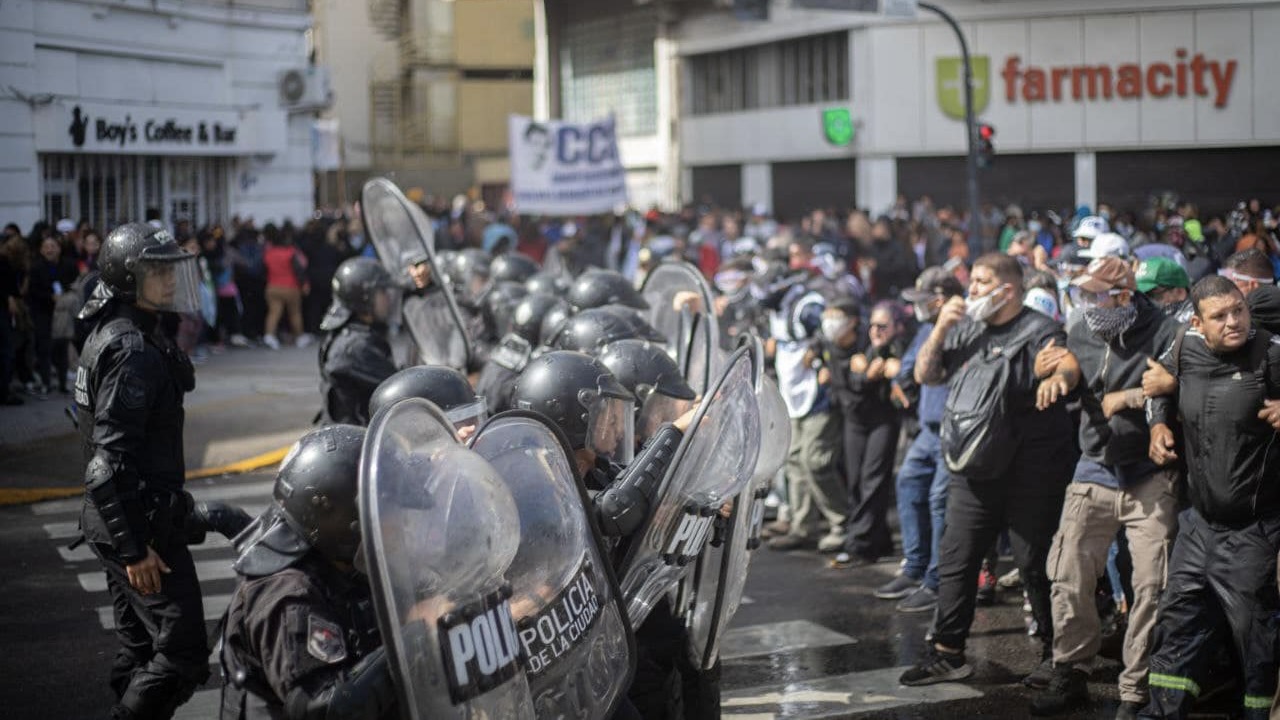
Police attacked the protest organized by UTEP in Buenos Aires. Photo: UTEP
Police cracked down on a protest of thousands of workers in the capital who demanded the government listen to its demands to send food to the community kitchens and address the growing hunger in the country
On Wednesday April 10, the Federal Police and the Police of the city of Buenos Aires violently evicted and repressed a peaceful demonstration on 9 de Julio Avenue in the center of the capital. The mobilization organized by the Union of Workers of the Popular Economy (UTEP) was one of many which took place in cities across the country to raise awareness to the critical situation faced by workers in the popular, or informal, economy in Argentina.
Organizations part of UTEP claim that the national government has suspended programs providing food to community kitchens and has also refused to dialogue with organizations who have repeatedly denounced the suspension and now, are unable to provide food to the thousands of families that they previously worked with. Many poor families across the country have also suffered from a freezing and arbitrary reduction of their “Social Complementary Salary”, a government program which provided supplementary economic aid to workers of the popular economy.
In Buenos Aires, thousands of protesters attempted to march to the Ministry of Human Capital when they were violently attacked by police with gas, water cannons. Over 10 were arrested in the brutal police repression and several were injured, including one protester who was dragged down the street and hit against the asphalt. Additionally, a journalist with the outlet Crónica TV driver was hit with a rubber bullet in the face.
The Ministry of Human Capital is a creation of the Milei government as a part of his promise to cut the majority of ministries and secretaries and create “super ministries”. It is the combination of the former Ministry of Labor, Ministry of Employment and Social Security, Ministry of Education, Ministry of Culture, and the Ministry of Social Development. This move, in addition to massively reducing the number of people working for the ministry, also saw severe cuts be made to the dozens of social programs run by those areas.
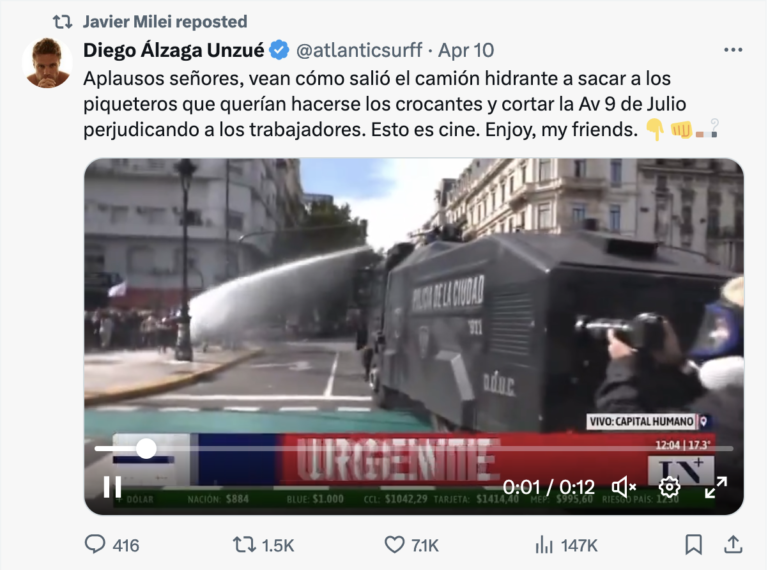
Milei, who was in Miami visiting with zionist and far-right US leaders such as Ben Shapiro, celebrated the repression of the protesters who were demanding government action against hunger amid unprecedented levels of poverty in the country. Milei reposted a publication from user Diego Álzaga Unzué on X which said: “Applause, gentlemen, see how the fire hydrant truck came out to remove the picketers who wanted to get dirty and cut off 9 de Julio Avenue, harming the workers. This is cinema. Enjoy, my friends.”
His Minister of Security Patricia Bullrich declared: “Law and order” in her post praising the “effective” crackdown on the mobilization through her “anti-picket protocol”.
Following the repressive operation, UTEP wrote in a statement: “We tried to create a channel of dialogue by all possible means, but once again the only response to the social and economic crisis is batons, gas and bullets. We denounce the violent actions of this Government, which the only thing it proposes for the people is planned misery. Our fight plan will continue to deepen to get food for our community kitchens, work and projects in our working class neighborhoods and social wages for the workers of the popular economy.”
Liberty’s lawyers say police feedback was ‘directly incorporated into the final text’ of Braverman’s anti-protest laws | Richard Baker / In Pictures via Getty Images
High Court told government only sought feedback from people it knew would agree with its controversial changes
Only police were consulted on anti-protest laws before they were forced through by the UK government, according to human rights lawyers suing the home secretary.
Campaign group Liberty has been in court this week challenging James Cleverly over amendments to the Public Order Act that were pushed through by his predecessor, Suella Braverman, last year.
Liberty was given permission to take legal action against Braverman in October after she used secondary legislation – subject to less parliamentary scrutiny – to strengthen police powers to shut down protests that cause “more than minor disruption to the life of the community”.
The group says Braverman’s actions amounted to a “serious overreach” and that she acted unlawfully because the changes to the law had already been rejected in the House of Lords.
And Liberty has labelled a consultation on the proposed laws in 2022 as “one-sided” and “unfair” – because the Home Office only consulted police. The government gave the Met, Staffordshire Police, Essex Police, the National Police Chiefs’ Council, and the College of Policing opportunities to give their views on the legislation, but did not seek input from anyone who might be impacted by the laws.
Liberty argued: “The [home secretary] voluntarily embarked upon a process of consultation about the contents and drafting of the regulations but then only consulted a narrow group of stakeholders in support of the amendments rather than an even-handed group representative of all those whose interests may be adversely impacted.”
Its lawyers also say police feedback was “directly incorporated into the final text” of the amendments to the Public Order Act, including on the definition of “serious disruption to the life of the community”.
The new powers have been criticised by Liberty and other human rights groups due to the vagueness of the new language, which campaigners say allows police to shut down almost any protests. The changes forced through by Braverman mean officers can interfere with and arrest anyone taking part in protests that they believe will cause “more than minor disruption to the life of the community”.
Police feedback on “cumulative disruption” was also included in the final amendments to the act. Under this law, officers must take into account all “relevant cumulative disruption”, regardless of whether or not your protest is related to any other protest or disruption in the same area. Before this amendment, there was no explicit requirement for police to consider this.
While the government held multiple meetings with police representatives in December 2022 to seek input and “refine policy”, Liberty argues that the fact that no rights groups or members of the public were consulted is rooted in “procedural unfairness” and that the changes must be reversed.
Katy Watts, Liberty’s lawyer leading the case said: “The government has shown it’s determined to put itself above the law, avoid scrutiny and become untouchable – so it’s no surprise it only consulted people it knew would agree with its new law.
“Our democracy exists to make sure a government can’t just do whatever it wants, and an important part of that is consulting a wide range of voices on new laws – especially those likely to raise reasonable concerns. This improves government decision making and helps to make our laws better. The government’s failure to do this is just one of the ways it acted unlawfully when it forced these powers though.”
The laws were initially brought in to clamp down on protests by climate activist groups like Just Stop Oil, Insulate Britain, and Extinction Rebellion, but other protesters are now also being targeted.
The government has accused pro-Palestine protesters of “hijacking legitimate protests”, “shouting down and coercing elected representatives”, and has also called them “un-British” and “undemocratic”.
In a new ‘defending democracy policing protocol’ released this week, the government pledged £31m of additional funding to protect MPs after safety fears were raised.
The Home Office said it wants to “protect the democratic process from intimidation” but according to its own policy paper, only met with police representatives from the National Police Chiefs Council, the Association of Police and Crime Commissioners, and the College of Policing.
The Home Office did not respond to a request for comment.
The two-day hearing ended yesterday and Liberty’s lawyers expect a decision could take up to three months.
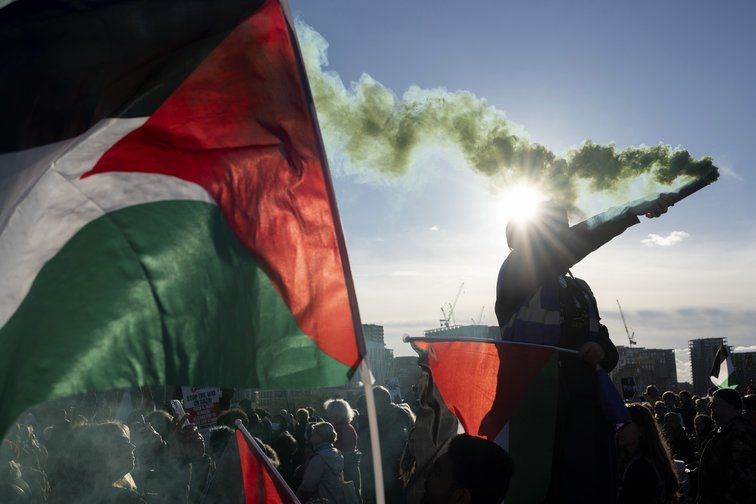
11 November 2023, hundreds of thousands gathered in London to call for an end to the Israeli bombing of Gaza | Richard Baker / In Pictures via Getty Images
The police watchdog has been called in over claims a Met Police officer “shoved” a nine-year-old boy at the Palestine solidarity march on Armistice Day.
The force referred the complaint to the IOPC on Friday, hours after being contacted by openDemocracy about the incident.
The boy and his parents were leaving the march for Palestine on 11 November when an officer allegedly pushed the child, leaving the boy and his parents distraught. His parents, Abu and Saheema – who asked us not to use their surname, shared a video of the aftermath of the incident with openDemocracy last week. In it, Abu can be heard asking the officer: “Why did you push a child?”, to which he replies: “You brought your child to a violent protest… think about what you’re doing.”
The Met said: “We are aware of the social media post and have received a public complaint. We are keen to fully investigate the matter and have urged the complainant to pass on any relevant footage. Due to the level of public interest, we have voluntarily referred the matter to the Independent Office of Police Conduct (IOPC). It would not be appropriate to discuss further at this time.”
A spokesperson for the IOPC confirmed that the watchdog received a voluntary complaint referral from the Met on Friday and said: “We are currently assessing the referral and will decide whether any further action is required from us”.
The boy’s mother told openDemocracy she hopes the watchdog assesses the family’s claim “promptly and in an unbiased manner”.
The incident happened as the family walked over Vauxhall Bridge on their way home from the march. Their tired son was walking a few paces ahead of his parents and sat down on the kerb.
Noticing officers walking in his direction, he got up – and it’s at this point that his parents say he was “shoved” out of the way by an officer who told him to move.
Saheema told openDemocracy the “force and aggression” used by the officer had their son “in absolute bits, crying and holding his shoulder”.
The child was taken to hospital after the incident where – according to Abu and Saheema – a children’s specialist confirmed that he suffered a soft-tissue injury on his shoulder.
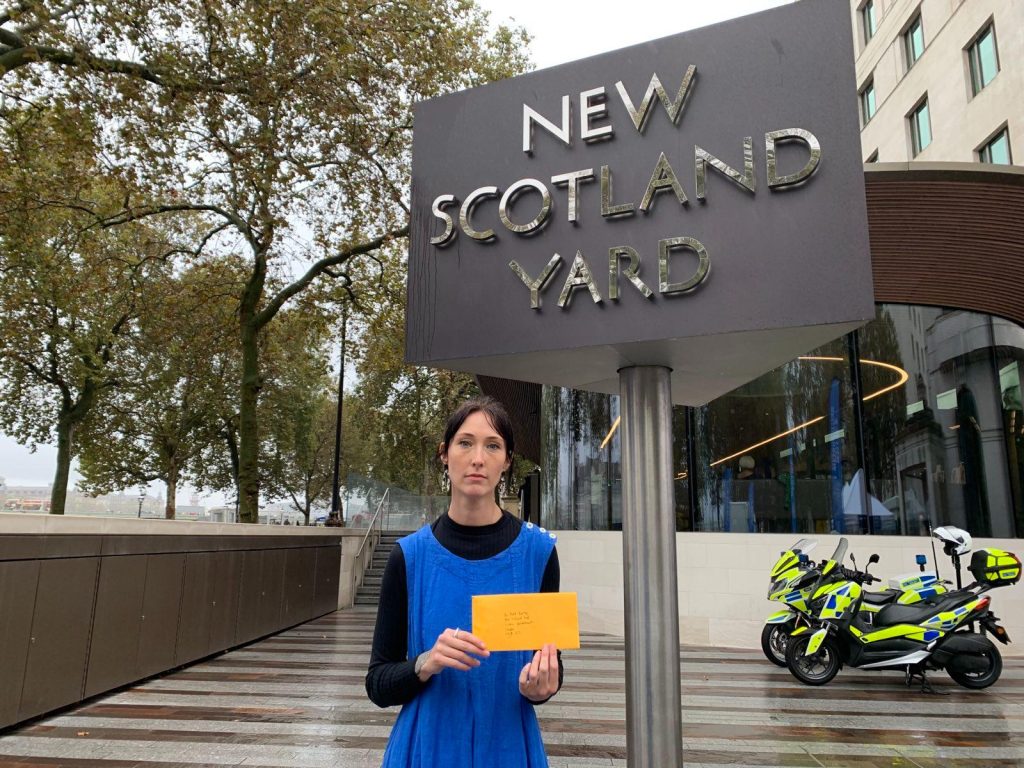
Just Stop Oil delivers an open letter to the Metropolitan Police urging them to prosecute politician climate criminals and to investigate others. Image: Just Stop Oil assumed.
Climate activist group Just Stop Oil have delivered an open letter to the Metropolitan Police calling for the prosecution of politician climate criminals.
Just Stop Oil supporters will remain in civil resistance until you prosecute the criminals responsible for crimes against humanity and acts of genocide
The facts are clear. New oil and gas licensing in 2023 will kill hundreds of millions of people, adding to the already mounting global death toll from climate breakdown. It will push our climate, oceans and the living world beyond the point of no return, triggering runaway global heating and setting in motion an unstoppable process of global societal collapse. To know these facts and still encourage drilling for UK new oil and gas is reckless and immoral. There can be no greater crime.
Of course, the politicians planning to max out the UK’s oil and gas reserves are not directly seeking mass death, neither are those executives signing off on plans to drill for new oil and gas or finance and insure new oil exploration. The primary aim of their support for fossil fuels is profit and power. To them, it’s an inconvenient side effect that millions and eventually billions of people will die when carbon emissions from new oil and gas cause heat waves, drought and crop failure.
But under International Criminal Law, this is no mere side effect: it is murder by oblique intent. Under Article 30 of the Rome Statute of the International Criminal Court, death or harm doesn’t have to be a primary intention for someone to be held criminally responsible. They simply have to be ‘aware that it will occur in the ordinary course of events’.
Since 2021 when the International Energy Agency (“IEA”) declared that there could be no new oil, gas or coal if we want an even chance of limiting global temperature rise in line with the Paris Agreement, it has been abundantly clear that new oil and gas will lead to mass death.
In 2022 you received a dossier of evidence requesting you investigate and charge five top British politicians for crimes against humanity and genocide. You have declined to do so.
We say to you now that you already have all the evidence you need to prosecute those politicians and to launch an investigation into those executives signing off on plans to drill for new oil and gas or to finance and insure new oil exploration. If you are uncertain who they are, Just Stop Oil will be publishing a list on Sunday 29th October to assist in your enquiries.
Failure to act will force Just Stop Oil into full non-compliance with the police and judicial system and we will remain in civil resistance until such time as you launch an investigation and bring charges.
As Metropolitan Police Commissioner you promised to police “without favour or prejudice”. We are asking you now to uphold your oath and uphold the law: it is a matter of life and death.
The conflict in the Middle East has led British political actors to try and redefine what is ‘acceptable speech’
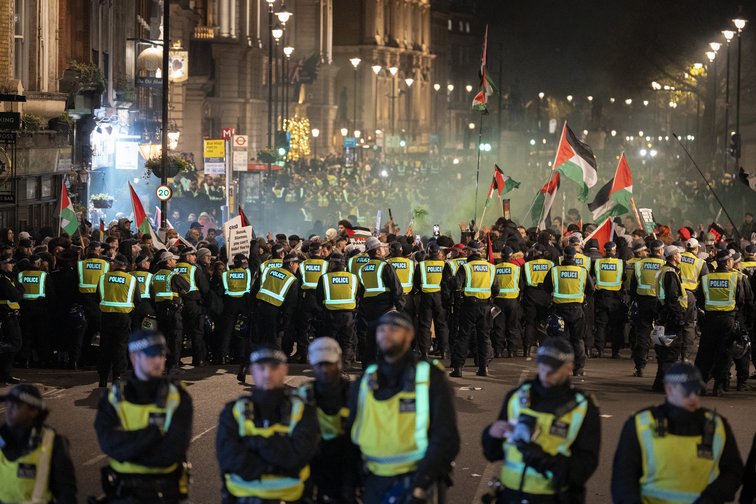
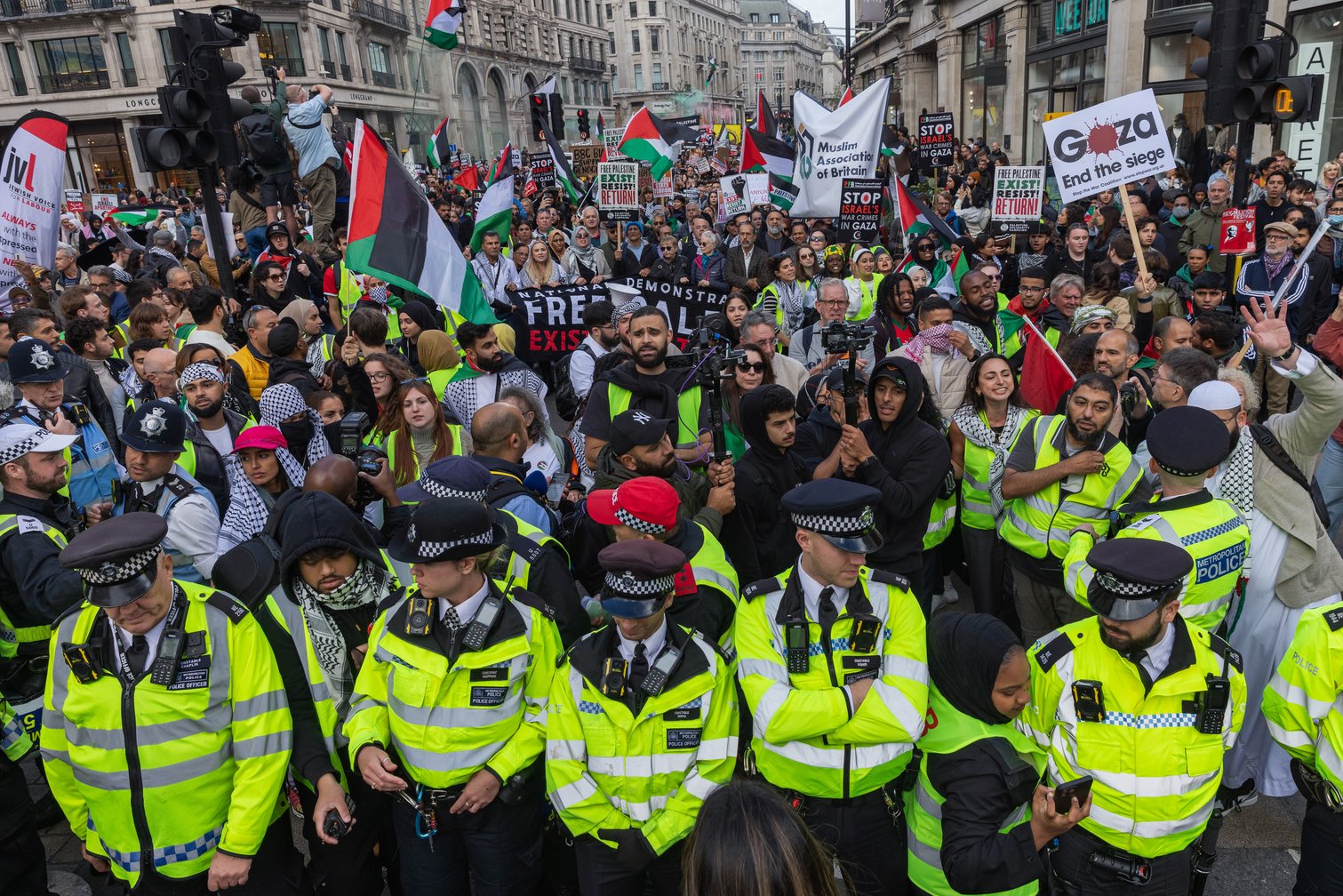
Police and protesters at the March for Palestine in London on Saturday | Mark Kerrison/In Pictures via Getty Images
As a humanitarian crisis unfolds in the Middle East, the UK government and its backers in the media have sought to marginalise and silence dissenting voices by targeting protest movements showing solidarity with the Palestinian cause.
Hundreds of people in Israel were killed, just over a week ago, in a brutal attack by Hamas. In response, Israel has moved swiftly against Hamas and the Palestinian population living in the Gaza strip. It has cut off their electricity and prevented the entry of food, water and medical supplies as it commences a devastating bombardment of homes and civilian infrastructure, leaving hundreds dead.
The reaction to these unfolding events in Britain has been one of shock and anger. Amongst the political class, a closing of the ranks has occurred, shoring up support for Israel as it strikes against the Palestinian population. And as part of this, political actors have sought to demarcate new boundaries on what is acceptable speech in the UK.
Foreign secretary James Cleverly on Tuesday urged pro-Palestinian protesters to stay at home. And home secretary Suella Braverman wrote to police chiefs asking them to take action against acts of protest that – in whose eyes it was not clear – might indicate support for Hamas.
She singled out the waving of the Palestinian flag in particular as being illegitimate “when intended to glorify acts of terrorism”, and asked that the police “consider whether chants such as: ‘From the river to the sea, Palestine will be free’ should be understood as an expression of violent desire to see Israel erased from the world” and therefore a “racially aggravated” crime.
The Telegraph has also reported that Robert Jenrick, the immigration minister, has commissioned officials in the Home Office to consider how they could revoke visas and expel foreign students who “praise Hamas”.
There are undoubtedly circumstances in which the use of particular chants or imagery could be inflammatory or even threatening. But the purpose of these statements is not to protect British communities (that much is clear from Braverman’s failure to issue a similar letter warning against attacks on Muslim or pro-Palestinian groups). The purpose is rather to intimidate would-be protestors and delegitimise criticism of Israel by aligning it with criminality.
The government’s views on acts of protest are mirrored by the official opposition: a diktat sent out by Labour Party general secretary David Evans warned members, councillors and MPs against attending pro-Palestine demonstrations. Labour has gone further still by also forbidding debate on Israel-Palestine in local party branches – a censorship not even attempted by Tony Blair during the lead-up to the Iraq war.
The results of Braverman’s provocation can already be seen. On Wednesday, Greater Manchester Police arrested four people for breaching the peace “during events… marking the Hamas-Israel conflict”, later de-arresting three of them. A video taken at the scene of the arrest and posted online shows a young man being led into a police van, a Palestine flag wrapped around his shoulders, as concerned onlookers shout at officers: “He has done nothing wrong,” and: “Freedom of speech.”
The Metropolitan Police Service itself appears to have ruled out any crackdown on people waving the Palestinian flag. But on Thursday night, the Palestinian Literature Festival was forced to cancel a book launch for Jewish American journalist Nathan Thrall’s latest book ‘A Day in the Life of Abed Salama: A Palestine Story,’ “after the Metropolitan Police Service contacted the host organisation and asked that it be cancelled ‘due to security concerns’.”
And at London’s ‘March for Palestine’ demonstration on Saturday, legal observers from Black Protest Legal Support witnessed the police make arrests of protesters who had refused to remove the ‘keffiyeh’ – a chequered black and white scarf that is symbolic of Palestinian nationalism and is traditionally worn around the head. In a statement, the Met Police confirmed four arrests for failing to remove face coverings that concealed the arrestee’s identity – at least one person has been subsequently charged, whilst others have been referred to youth offending teams.
These events (and the statements that preceded them) should be of concern not just to advocates of the Palestinian cause, but to anyone concerned about the erosion of democratic norms: here is the government using the murder of Israeli civilians abroad to attack free speech and the right to protest here in the UK.
One lawyer who spoke to openDemocracy this week linked Braverman’s crackdown on Palestinian flag-waving to the Public Order Act. That piece of legislation (which received royal assent in May 2023) was intended to break the backs of the climate movement, making it far easier for police forces to deem acts of protest illegal and criminalise those in attendance or organisers, for even minor disruption.
And last year, the Met Police used the spectre of Covid to target and criminalise those protesting against police brutality at a vigil for Sarah Everard, who was murdered by police officer Wayne Couzens.
Each crisis – climate, Covid, war – is seized upon by the state, government and media, as an opportunity to stifle dissent and curtail free speech. And it is through this framing that we can understand the response of the political and media establishment in the UK to Israel-Palestine: not simply as solidarity with the Israeli people but as an opportunity to attack our rights.
Attacks on freedom of speech relating to Palestine are not new. Palestinians in Britain have long experienced marginalisation and silencing, especially when giving voice to views on the “Palestinian experience of colonialism”.
This has been seen in particular within academia, which has become a battleground over acceptable speech on Israel-Palestine. In British schools, pupils have been sanctioned for expressing vocal support for Palestine, including with detentions and suspensions. Fear about reprisals, including referrals to the government anti-extremism programme Prevent, has been described as having a ‘chilling effect’ on engagement of students with the topic of Palestine.
This is part of a broader effort by the UK Home Office to identify protest movements and left-wing struggles as being outside of acceptable debate, with recent changes to the training on Prevent categorising “socialism” and “anti-fascism” under the heading “terrorist ideologies”. This process of delegitimisation is often backed by the media. In recent days attacks on free speech on Palestine have intensified.
On Wednesday, a report in the Times was published that “identified a dozen academics at Oxbridge and Russell Group universities who have posted statements appearing to justify the weekend’s attacks on Israel”. In one case, an academic had simply called for solidarity with the Palestinian struggle.
Much of the right-wing press has also chosen this moment to campaign for the BBC to refer to Hamas as a terrorist organisation, a term the BBC says does not meet impartiality rules – with the front page headline of Thursday’s Daily Mail eschewing proclamations on the outbreak of war and instead asking: “The King Calls Them Terrorists, Why Can’t The BBC?”. Defence secretary Grant Shapps also criticised the BBC on Radio 4 over the decision in a combative interview. The prominence this demand has been given raises questions about the priorities of the British press at such a high stakes moment.
Gaza is already partially reduced to rubble by Israeli airstrikes. More than two million people are experiencing total siege, bombardment and the removal of all basic human rights. Chemical weapons have now been confirmed as being in play and preparations are underway for a ground offensive by Israeli troops, with the 1.1 million Palestinians living in the most populated area of Gaza given 24 hours to move further south. This will almost certainly mean further atrocities.
The government and opposition both stand steadfastly behind Israel. Number 10 has said the UK will send surveillance aircraft and two Royal Navy ships to the eastern Mediterranean in plans “to support Israel”. The foreign secretary, James Cleverly, has himself travelled to Israel to “underline UK’s unwavering solidarity in the face of terror”. And both the leader of the opposition, Keir Starmer, and his shadow attorney general, Emily Thornberry, have refused to criticise Israel’s actions in Gaza or describe the “collective punishment” of civilians as a war crime.
This shocking complicity must be loudly challenged. Yet, as with the arrival of any shocking event, the political class moves quickly to turn the dial down ever further on legitimate speech.
If a ceasefire does arrive, without dissenting voices, the missing context – the dislocation of Palestinians in 1948, the occupation of the West Bank since 1967 and the 16-year blockade of Gaza – will continue not to be heard. As long as this silencing act continues, both the Palestinian and Israeli people will continue to suffer.