Deputy Labour Party Leader Angela Rayner calls for police to kill and harass innocent people.
There are news reports that Jeremy Corbyn and Diane Abbott have been urged to apologise for backing gangster Chris Kaba after criticising police following his death. [ed: uncertain that he should be called a gangster.]
He was unarmed and police didn’t know who he was when he was killed. There were claims following his inquest that he had shot somebody 6 days previous to him getting killed by police. He was never tried of this alleged crime of course because he was dead. You can’t retrospectively justify his killing when an unarmed, unknown man was killed by armed police.
Mainline media are being fundamentally dishonest in presenting the killing of Chris Kaba. There is a concerted attempt to further excuse armed police from killing people, that is what it’s about. For example, a hard traffic stop is presented as a traffic stop. A hard traffic stop is an intentional crash to sandwich a car between 2 others front and back. If I was subjected to a hard stop, I would then expect to be killed by armed men (police or army) and it’s certainly not unreasonable or unexpected to try to escape.
Deputy Labour Party Leader Angela Rayner calls for police to kill and harass innocent people.
You already don’t need to be armed to be killed by armed police in UK. It helps no end if you’re black but I’ve know people to be killed because of their names. I don’t regard myself as black but can get a very deep tan. My father was once told to “Get back to where you came from” to which he replied “What, Ely?”. Ely is an area of Cardiff.
It’s not that difficult to ram hard into the back of the car in front – it happens many times every day.
Helen Lumuanganu the mother of Chris Kaba hugs friends alongside Prosper Kaba (second from right) the father of Chris Kaba outside the Old Bailey, central London, October 15, 2024
CAMPAIGNERS were left outraged today after the police marksman who shot and killed Chris Kaba was cleared of his murder.
Martyn Blake, 40, had been on trial at the Old Bailey in London since October 2 after shooting the 24-year-old black man through the front windscreen of his car in Streatham in 2022.
The jury deliberated for about three hours today to clear Mr Blake as the family of Mr Kaba listened to the verdict in silence.
…
Campaign group Save Our Citizenship called the verdict “another prime example of the extent of how deep-rooted racism manifests within the British injustice system.”
And the Women’s Equality Party said it is “both terrifying and outrageous to hear politicians say the police should be scrutinised less after they kill unarmed members of the public.”
Since 1990 there have been 1,904 deaths recorded by campaign group Inquest in or following police custody or contact.
In that time only one officer has been found guilty of manslaughter, in 2021, and none for murder.
In the 34 years, a total of 83 people were fatally shot by police in England and Wales.
Only three murder or manslaughter prosecutions were made, none with a guilty verdict.
Labour Deputy Leader Angela Rayner will be pleased that an innocent, unarmed man has been killed by police. That’s what she was calling for unless there’s a hidden meaning to her statements. [ed: That’s what she was calling for even if there is a hidden meaning to her statements.]
Deputy Labour Party Leader Angela Rayner calls for police to kill and harass innocent people.
It’s disappointing that mainline media is promoting the idea that the killed man was a dangerous gunman. He was unarmed and trying to escape before he was killed by armed police.
Wind turbines at Loftsome Bridge, East Yorkshire, with Drax Power station in the distance
ACTIVISTS slammed the police today for diverting resources away from tackling racist riots and targeting peaceful climate protesters instead.
Protesters opposing Drax power station, Britain’s largest carbon emitter, were due to set up a protest camp today.
But police pre-emptively arrested 22 activists under public order offences, including conspiracy to interfere with key national infrastructure.
Police seized tents, toilets, a track for wheelchairs and other equipment to make the peaceful protest safe and accessible, organisers Reclaim the Power said.
The Silver Commander for the police operation, Supt Ed Haywood-Noble, admitted that police resources were “stretched nationally,” but still thought it was “essential” that the operation go ahead.
He claimed: “Policing is not anti-protest, we are anti-crime, and we are here to protect the public.”
The protest organisers hit back at the force for making the “unfathomable decision” to divert resources away from communities under attack in the racist violence sweeping Britain.
They accused the police of prioritising the arrest of peaceful protesters over “locating and arresting people who are actually organising far-right riots with bricks, knives and other weapons.”
I’m wondering why the police are seizing “tents, toilets, a track for wheelchairs and other equipment to make the peaceful protest safe and accessible”. Is that part of their job too?
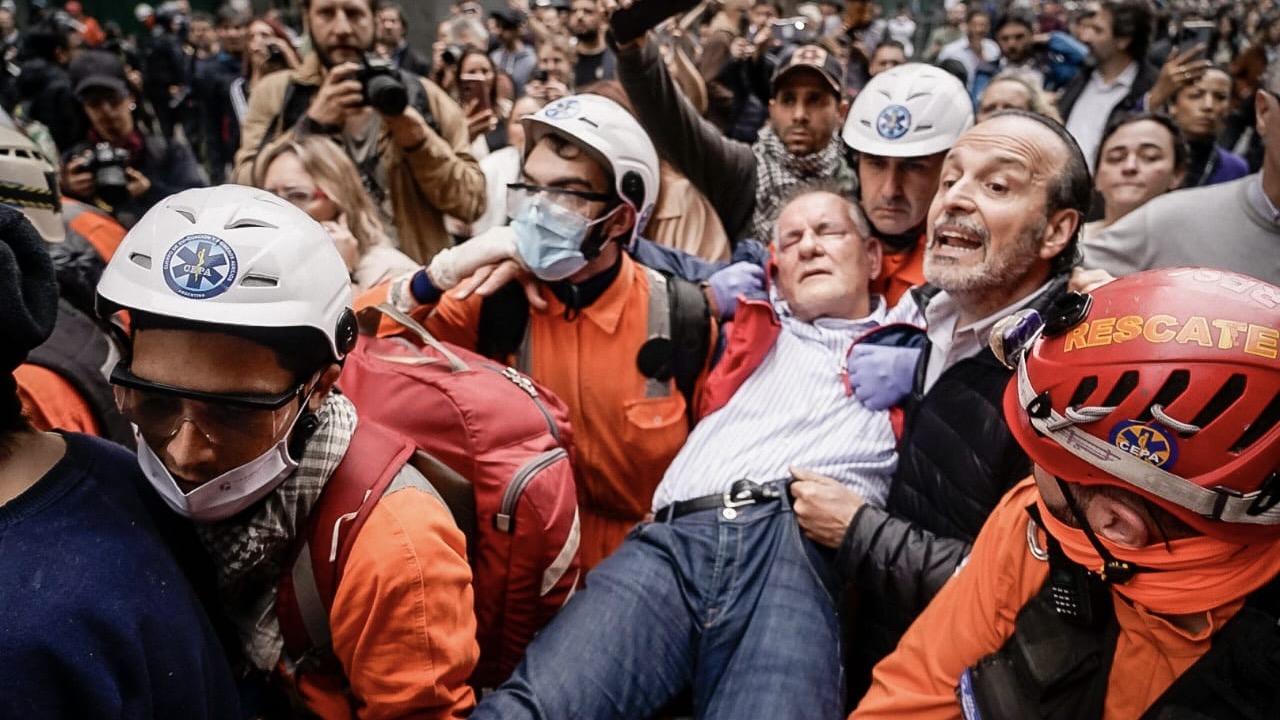
Police in Argentina brutally repressed a mobilization against Milei’s controversial economic reforms. Photo: UP Diputados
Over 30 people were detained in Buenos Aires during the brutal repression of the protests against Milei’s economic reform law
Last week, the Argentine Senate debated the bill called “Law for Bases and Starting Points for the Freedom of Argentines” (Ley Bases), a set of economic and political reforms proposed by the far-right government of Javier Milei. While the Executive sought the necessary votes in the Senate to pass the law, thousands of demonstrators gathered around the legislature to demand that the law be shelved.
The protests were called by several social organizations and trade unions, including the country’s largest trade union confederations, the General Confederation of Labor (CGT), the Argentine Workers’ Central Union, and the Argentine Workers’ Central Union (Autonomous).
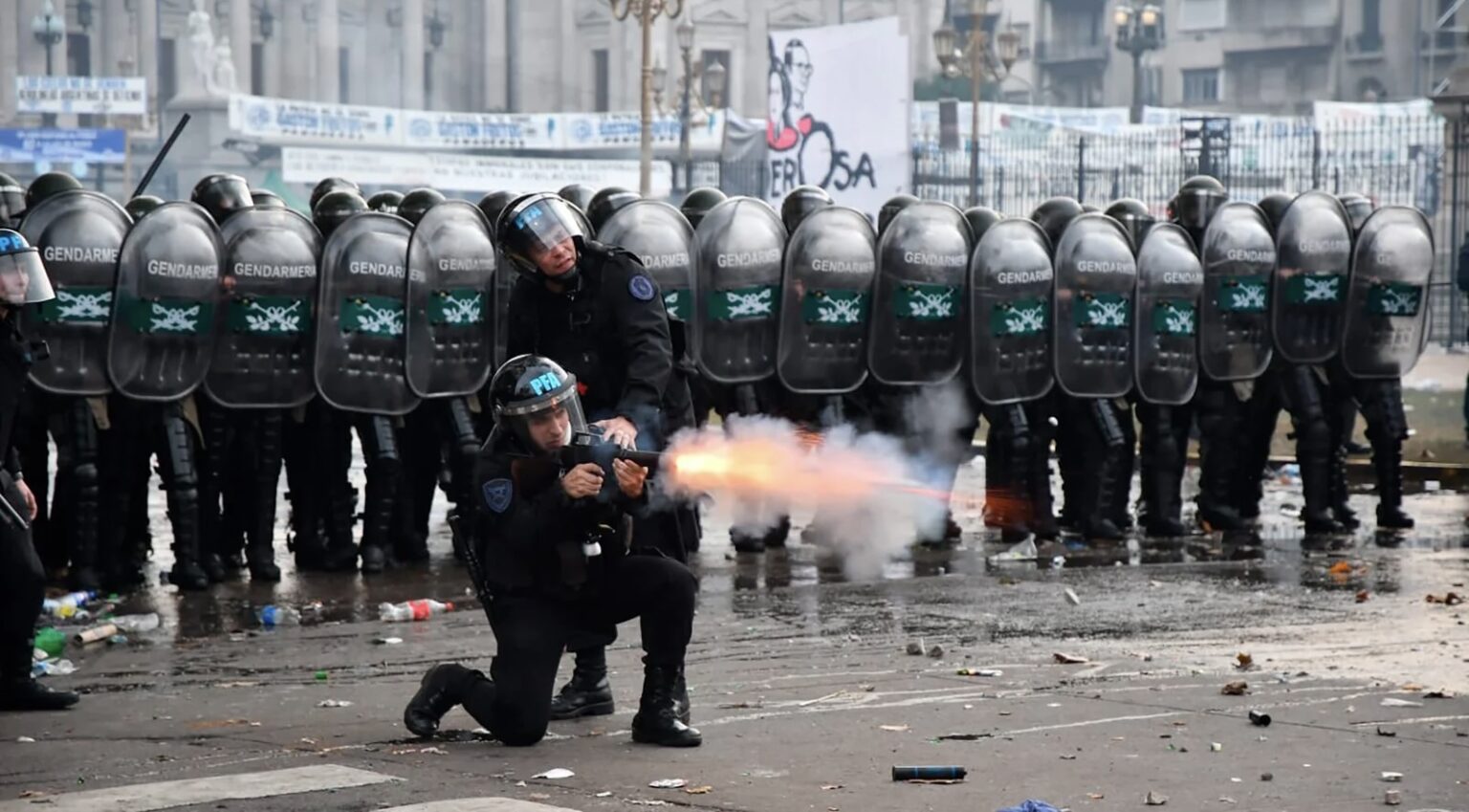
The action of the police, under the orders of the Minister of Security, Patricia Bullrich, was excessive and brutal. Even lawmakers were not spared the violent repression. Peronist legislators, Eduardo Valdés, Carlos Castagnetto, Leopoldo Moreau, Juan Manuel Pedrini, Carolina Yutrovic and Luis Basterra, denounced that they were beaten by the security forces. In addition, several detainees told press that “they were stripped naked and that pepper spray was thrown at them”.
Martin Dirroco, a worker detained during the protests, recounted: “We were in Congress and we began to feel the tear gas, our throats began to burn and we began to leave. We heard more and more shots fired; we could see the repression. […] Suddenly a lot of people started to come, we tried to leave and seven motorcycles appeared. The one on the back of the motorcycle was pointing a gun at us. They got off the motorcycle and told us to stay still. They shooted and shouted ‘everybody against the wall’. They started pushing and shoving, holding me and throwing me to the ground. […] We had to sleep in a courtyard with handcuffs on”.
On Wednesday, June 12, 33 people were arrested, with many held for several days. Carlos Lopez, a left Argentine political leader, told Peoples Dispatch that as of today there are still five people detained on alleged charges of “public intimidation” and “arson”. Lopez comments that some people were even arrested 15 blocks from the Senate, far away from the events for which they are accused. “They are trying to sow terror from the government, the State, so that the population feels fear and shuts its mouth”. In addition, López continues, the detainees did not have adequate access to water and food; some spent more than 15 hours in a police patrol car and many could not speak to their lawyers: “There was intimidation, torture and threats […] We ask for everyone’s solidarity so that this type of action does not happen again,” said López.
Police launching tear gas canisters at protesters on Wednesday June 12 in Buenos Aires. Photo: Somos Telam
The President’s Office celebrated the approval of the law and called the demonstrators “terrorists”: “Starting from 38 deputies and 7 senators, with terrorist groups attacking the Congress, having to deploy the Security Forces in defense of democracy, with the political caste resisting and operating until the last moment, and having to resort to the tie-breaker of the Vice President of the Nation, Victoria Villarruel, tonight’s is a triumph of the Argentine people and the first step towards the recovery of our greatness, having approved the most ambitious legislative reform of the last forty years.”
Several human rights organizations, such as the Grandmothers and Mothers of the Plaza de Mayo, the Permanent Assembly for Human Rights, the Relatives of the Disappeared and Detained for Political Reasons, among others, called for a demonstration on Tuesday June 18 to demand the release of the 16 people that were still detained (including several students and professors) accused of “terrorism”. During a press conference, various relatives of the detainees denounced the injustice of the accusations against the prisoners and affirmed that they are not terrorists and demanded their immediate release.
Milei’s “Ley Bases”
At the end of the debate last Wednesday, the law was approved thanks to the vote of Vice President Victoria Villarruel, who broke the tie. The controversial law must be approved a second time in the Chamber of Deputies.
The reforms of the “Ley Bases” propose a paradoxical transformation of the functioning of the Argentine State. At the same time that they seek to diminish the State’s capacity to control the economy, they strengthen the President’s political power to make economic and political decisions, which will no longer have to be approved by the legislative branch. In other words, the intention is to build a weaker but more agile State to execute President Milei’s neoliberal plan.
One of the most controversial changes is the creation of the “Incentive Regime for Large Investments” (RIGI, for its initials in Spanish). The purpose of this regime is to reduce the State’s control over large companies that invest more than USD 200 million in the country. The government promises these big companies a reduction in taxes, privileges in the project approval process, and protection of capital from state control for 30 years. RIGI seeks, among other things, the exploitation of natural resources by major companies.
According to the “Ley Bases”, the President may have “extraordinary powers” for one year if he declares a public emergency in the economic, financial, and energy fields. In this sense, Milei would have several powers that currently only the Legislative has. To achieve its approval in the Senate, the Executive committed itself not to interfere with 15 public agencies, such as the National Service of Food, Health and Quality (SENASA), the National Bank of Genetic Data (which has information on those who disappeared during the last dictatorship), among other institutions. However, the government will be able to legislate through expeditious decrees, which implies, in general, the first great legislative victory for its political project.
In addition, the “Ley Bases” authorizes the privatization of Intercargo, a state-owned company dedicated to provide services to air travel companies, and Energía Argentina S.A., which is in charge of the extraction and exploration of hydrocarbon deposits, their transportation, and storage. Although Milei wanted to privatize more than 40 public companies, the negotiations forced him to limit his aspirations. Nevertheless, Milei’s major project in this regard seems to be aimed, at first, at the privatization of the mining, energy and fuel sectors.
Finally, the “Ley Bases” seeks to make a discreet, although controversial, labor reform, as it proposes, among other things, to eliminate penalties for companies that use informal workers, which is currently sanctioned by law.
While the Executive celebrates its neoliberal legislative victory, the families of the prisoners continue to pressure the justice system to free the detainees and drop the serious charges that could mean several years in prison.