Climate Researcher Threatened With Termination for Taking a Stand Against Flying

Spread the love

Original article by JULIA CONLEY republished from Common Dreams under Creative Commons (CC BY-NC-ND 3.0). 
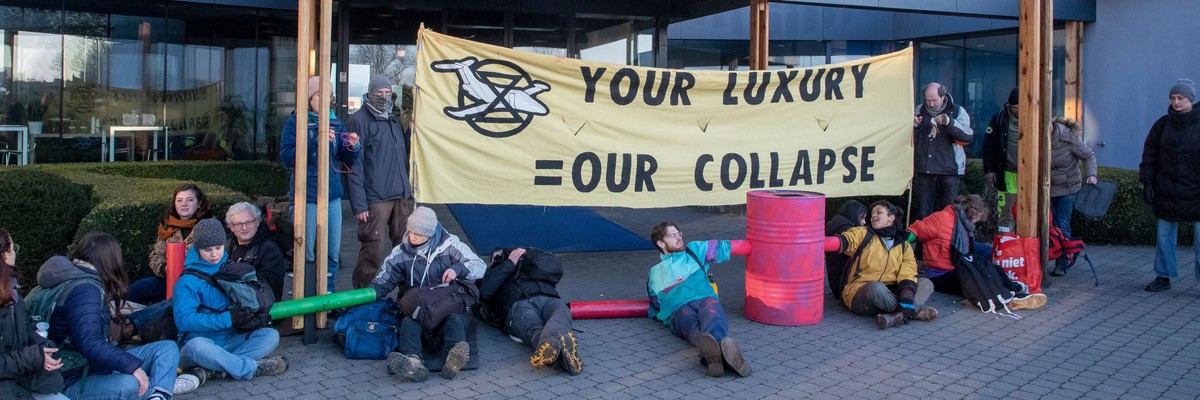
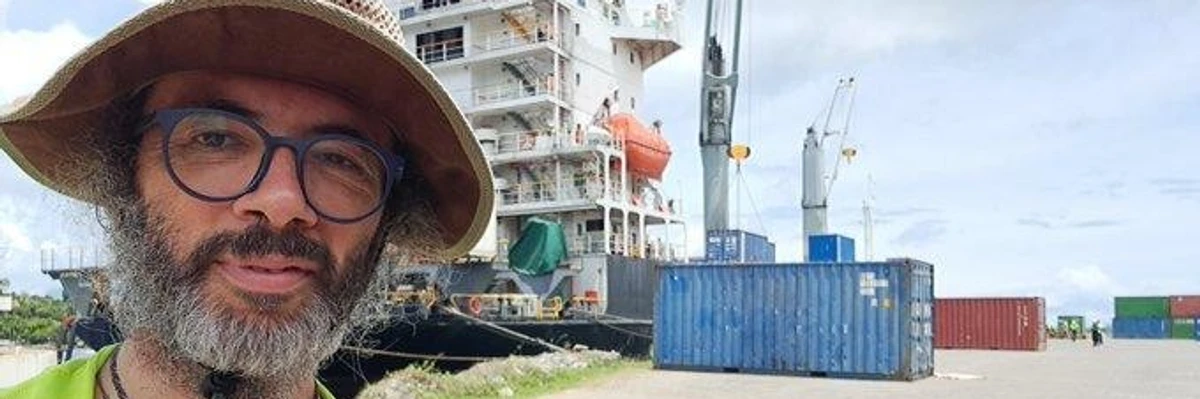
Gianluca Grimalda, a researcher with the Kiel Institute for the World Economy in Germany, has refused to fly home for a meeting on October 2, 2023 from his field trip in Papua New Guinea, citing the fossil fuel emissions generated by aviation. (Photo: Scientist Rebellion)

“I am prepared to pay this price, if it helps raising awareness among the public and the societal leadership on the desperate situation we are in,” said Giancarlo Grimalda.

A climate researcher based in Kiel, Germany said Monday that he was prepared to lose his job at a globalization think tank, after his employer gave him an ultimatum and demanded he go against his climate-based objection to aviation travel in order to return to his place of work—a requirement at least one critic said was rooted in retaliation for the scientist’s activism.

Gianluca Grimalda has been working on a field assignment in Papua New Guinea for the past six months, studying the relationship between globalization, climate change, and social cohesion for his employer, the Kiel Institute for the World Economy (IfW). He traveled to Papua New Guinea without the use of airplanes and has planned to get back to Germany the same way, boarding cargo ships, ferries, trains, and coaches to avoid 3.6 tonnes of carbon emissions.

Grimalda was originally scheduled to be finished with his work on September 10, but said in an essay on Monday that he received permission from the head of his department to remain in Papua New Guinea after wrapping up the project and noted that he is able to complete his work while traveling.

Nevertheless, on Friday the president of IfW informed Grimalda that he was required to be back in Kiel on Monday, which would require him to board a plane—a demand that he said ignores the climate impact of aviation travel and the effects already being felt by communities across the globe, including in Papua New Guinea.

“Traveling by plane would produce around four tons of carbon dioxide—the greenhouse gas responsible for global warming,” wrote Grimalda. “In my outbound journey, I limited my emission to two tons by traveling over land and sea for 35 days over 16,0000 of the 22,000 kilometers. In my inbound journey I plan to cover the entire distance without catching a plane, which would limit carbon dioxide emissions to 400 kilograms—ten times less than traveling by plane.”

By resolving to carry out his “slow-travel” plans instead of flying back to Kiel, Grimalda said he is risking his job.

“I know that most people would swallow the bitter pill, take a plane, and go ahead with their work—both as a professional and as an activist,” wrote Grimalda. “With this job, I have enough economic stability and spare time to pursue environmental causes. Nevertheless, I believe that we have reached the point where instrumental rationality is no longer applicable. The most recent scientific evidence says that we have transgressed six out of nine planetary boundaries and that several ecosystems are close to collapse (or likely past their point of collapse) because of temperature rise—in turn caused by greenhouse gases emissions.”

Grimalda acknowledged that his individual refusal to support the airline industry is no match for the continued emissions of the sector as well as fossil fuel giants, industrial farming, and other corporate actors.

“My decision not to catch a plane will mean close to nothing for the protection of the environment,” he wrote. “‘That plane will fly even if you have not boarded it,’ many people have already told me. This is true, but giving less money to the aviation industry may mean fewer planes in the future. In any case, all the science I know, all the evidence I see, point to the fact that we are in [an] emergency. In [an] emergency, extraordinary actions should be taken. That is why, with enormous sadness, I have decided not to take a plane and face all the consequences this will lead to.”

“I am prepared to pay this price, if it helps raising awareness among the public and the societal leadership on the desperate situation we are in,” Grimalda added. “It is my act of love to the current and future generations, to the animal species under threat of extinction, to the idea of humanity that I instinctively and undeservedly abide by.”

Grimalda and direct action group Scientist Rebellion went public with the researcher’s dilemma on the same day the Institute for Policy Studies (IPS) in the U.S. released a report on private jet travel out of Laurence G. Hanscom Field near Boston, the largest private aviation field in New England.

Constrasting with Grimalda’s commitment to reduce his support for carbon-intensive activities, IPS found that over 18 months, private jet owners and operators were responsible for an estimated 106,676 tons of carbon emissions, with half of those flights used for recreational or luxury travel. More than 40% of the flights were less than an hour long.

Climate groups in the area are currently pushing to ensure developers don’t expand Hanscom in order to avoid even more planet-destroying emissions.

Grimalda told Scientist Rebellion that IfW has withheld his pay for the month of September without notice.

Julia Steinberger, a lead author of the latest report by the International Panel on Climate Change—which reiterated that “human activities, principally through emissions of greenhouse gasses, have unequivocally caused global warming” and warned that “approximately 3.3 to 3.6 billion people live in contexts that are highly vulnerable to climate change”—said it was “extraordinary that a research institute threatens to dismiss a researcher for doing his job too diligently and for avoiding flying during a climate emergency.”

She added that she believes IfW aims to “retaliate for Gianluca’s past participation in civil disobedience on climate change with Scientist Rebellion.”

Grimalda has taken part in actions such as a blockade of the entrance of a biofuel refinery controlled by Eni, Italy’s energy company.

The researcher expressed hope that his latest action “will sound yet another alarm bell to the ears of an inactive political leadership.”

“As a scientist, I feel I have the moral responsibility to be proactive in sounding such alarms,” Grimalda wrote. “It is true that thus far hundreds, if not thousands, of protests have all but gone unheard and have changed very little. Nevertheless, ‘social tipping points’ have existed for much progressive social change and things have changed rapidly for the good after a critical mass of support has been garnered.”

Original article by JULIA CONLEY republished from Common Dreams under Creative Commons (CC BY-NC-ND 3.0). 

Continue ReadingClimate Researcher Threatened With Termination for Taking a Stand Against Flying

Rishi Sunak considers weakening key green policies

Spread the love

Madness, Driving in My Car

https://www.bbc.co.uk/news/uk-politics-66857551

Rishi Sunak is considering weakening some of the government’s key green commitments in a major policy shift.

First, the government would push the ban on the sale of new petrol and diesel cars – currently set to come into force in 2030 – back to 2035. The 2030 date has been government policy since 2020.

Second, the government would significantly weaken the plan to phase out the installation of gas boilers by 2035, saying that they only want 80% to be phased out by that year.

Third, homeowners and landlords would be told that there will be no new energy efficiency regulations on homes. Ministers had been considering imposing fines on landlords who fail to upgrade their properties to a certain level of energy efficiency.

Fourth, the 2026 ban on off-grid oil boilers will be delayed to 2035, with only an 80% phase out target at that date.

In addition, Britons will be told that there will be no new taxes to discourage flying, no government policies to change people’s diets and no measures to encourage carpooling.

Mr Sunak is also likely to rule out what he sees as burdensome recycling schemes.

https://www.bbc.co.uk/news/uk-politics-66857551

Continue ReadingRishi Sunak considers weakening key green policies

Rishi Sunak vows to keep using chopper as he’s too special to get train like rest of us

Spread the love
UK Prime Minister Rishi Sunak and Energy Security and Net Zero Secretary Grant Shapps.
Prime Minister Rishi Sunak and Energy Security and Net Zero Secretary Grant Shapps. Credit: Simon Dawson / 10 Downing Street, CC BY-NC-ND 2.0

https://www.dailystar.co.uk/news/latest-news/rishi-sunak-vows-keep-using-30597927

Prime Minister Rishi “Biggles” Sunak says it’s absolutely fine for him to use a chopper instead of getting a train because he’s “running the country”

Climate change activists say Rishi’s jetsetting is unnecessarily pumping harmful CO2 into the atmosphere.

Liberal Democrat transport spokesman Wera Hobhouse raged: “The Prime Minister just cannot help himself. He should catch a train for once to see what the rest of us have to put up with.

“When you catch private flights to Southampton and Dorset, you know you have a problem.”

https://www.dailystar.co.uk/news/latest-news/rishi-sunak-vows-keep-using-30597927

Continue ReadingRishi Sunak vows to keep using chopper as he’s too special to get train like rest of us

Scottish Greens call for super-tax on private jets

Spread the love
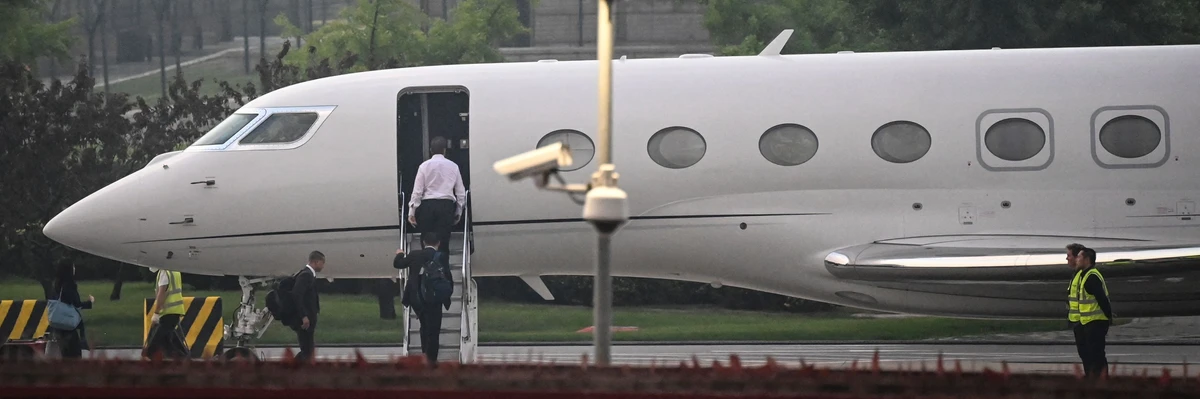
Tesla CEO Elon Musk boards his private jet before departing from Beijing Capital International Airport on May 31, 2023.

https://morningstaronline.co.uk/article/b/scottish-greens-call-for-super-tax-on-private-jets

THE Scottish Greens have called on the SNP-Green Scottish government to levy a “super-tax” on private jets.

The demand for a £1,000 per passenger levy on the more than 10,000 Scottish private flights, comes as carbon emissions in the sector have been rising in recent years.

dizzy: The article continues saying that the powers to impose such a tax are not devolved. Perhaps Scotland could refuse permission to land or divert them to the Faroe Islands instead? Permission to land please Edinburgh. Sorry, can’t do it, you’ll have to divert to Faroe, Norway or Scilly Isles or maintain a holding position for 16 hours ;)

https://morningstaronline.co.uk/article/b/scottish-greens-call-for-super-tax-on-private-jets

Continue ReadingScottish Greens call for super-tax on private jets

‘Time to Ground These Fat Cats’: Markey Proposes Tax Hike on Private Jet Travel

Spread the love

Original article by Jake Johnson republished from Common Dreams under Creative Commons (CC BY-NC-ND 3.0).

Tesla CEO Elon Musk boards his private jet before departing from Beijing Capital International Airport on May 31, 2023.

“Billionaires and the ultra-wealthy are getting a bargain, paying less in taxes each year to fly private and contribute more pollution than millions of drivers combined on the roads below.”

U.S. Sen. Ed Markey announced legislation on Wednesday that would hike fuel taxes for private jet travel and transfer the revenue to a new federal fund aimed at bolstering clean public transportation and other climate initiatives.

The bill, titled the Fueling Alternative Transportation With a Carbon Aviation Tax (FATCAT) Act, would add a $1.73-per-gallon surcharge to the current fuel tax for private jet travel, which is around $0.22 per gallon. Markey’s new surcharge would amount to the equivalent of roughly $200 per metric ton of a private jet’s carbon emissions, according to the senator’s office.

Private jet flights—a significantly more polluting form of travel than commercial flights or trains—surged during the coronavirus pandemic. One recent study by the Institute for Policy Studies (IPS) and the Patriotic Millionaires estimated that private jets’ planet-warming emissions jumped by more than 23% during the Covid-19 crisis.

Elon Musk, Tesla’s billionaire CEO, is the most frequent private jet flyer in the U.S., helping produce more than 2,100 tons of carbon emissions last year while paying minimal taxes, according to IPS and the Patriotic Millionaires. The groups pointed to research showing that just 1% of the world’s population is responsible for half of all aviation emissions.

“The 1 percent can’t free ride on our environment and our infrastructure at a discount,” Markey (D-Mass.) said in a statement. “Billionaires and the ultra-wealthy are getting a bargain, paying less in taxes each year to fly private and contribute more pollution than millions of drivers combined on the roads below. It’s time to ground these fat cats and make them pay their fair share so that we can invest in building public transportation that communities across the country and our economy desperately need.”

Rep. Nydia Velázquez (D-N.Y.) introduced companion legislation in the House.

“Working families shouldn’t subsidize the ultra-wealthy to fly private and destroy our environment,” said Velázquez. “If billionaires want to travel on private jets, they should pay similar taxes to those flying commercial. It’s time for the rich to pay for their pollution so we can fund environmental justice initiatives and affordable public transportation across the country.”

Climate campaigners have been targeting private jets with growing frequency in recent years as research has more closely examined their impacts on the planet. The European group Transport & Environment found that private jets are five to 14 times more polluting than commercial planes and 50 times more polluting than trains.

In May, dozens of climate activists and scientists disrupted Europe’s largest private jet sales fair to demand a total ban on the planes. IPS and the Patriotic Millionaires estimated that the median net worth of a full private jet owner is $190 million.

“Sales of private jets are skyrocketing, and with them the one percent’s hugely unfair contribution to the climate crisis—while the most vulnerable people deal with the damage,” Klara Maria Schenk of Greenpeace’s Mobility for All campaign said during the May protest. “It is high time for politicians to put a stop to this unjust and excessive pollution and ban private jets.”

This story has been updated with additional details about the bill.

Original article by Jake Johnson republished from Common Dreams under Creative Commons (CC BY-NC-ND 3.0).

Continue Reading‘Time to Ground These Fat Cats’: Markey Proposes Tax Hike on Private Jet Travel