France, German states use wiretaps, GPS to track activists
Bavaria tries to stop protests with preventative detention
Berlin police spend more than 400,000 hours on climate cases
France outlaws one group, German states consider ban
BERLIN, Aug 10 (Reuters) – Simon Lachner had plans to glue himself to a German city thoroughfare in June to call public attention to climate change. Instead, he ended up in police custody before he’d even left his home.
Lachner, 28, is one of thousands of activists caught up in a European crackdown on a wave of direct action protests that gathered pace last year demanding urgent government action against climate change.
Roadblocks on major motorways in Britain have caused traffic chaos, protests at oil installations in Germany have disrupted supplies, and in France, thousands of activists and police clashed over water usage, leaving dozens injured.
Determined to prevent such protests from strengthening further, states in Germany and national authorities in France are invoking legal powers often used against organised crime and extremist groups to wiretap and track activists, Reuters found, based on conversations with four prosecutors, police in both countries and more than a dozen protesters.
In Berlin alone, police have spent hundreds of thousands of hours working on more than 4,500 incidents registered against the “The Last Generation” and “Extinction Rebellion” groups, according to previously unreported data from police.
State authorities in Germany are widely using preventative detention to stop people from protesting, including holding at least one person for as long as 30 days without charge, which is permissible under Bavarian law, the prosecutors consulted by Reuters said.
Lawmakers passed new surveillance and detention laws in France in July and in Britain in May, with Britain making it illegal to lock, or glue, yourself to property.
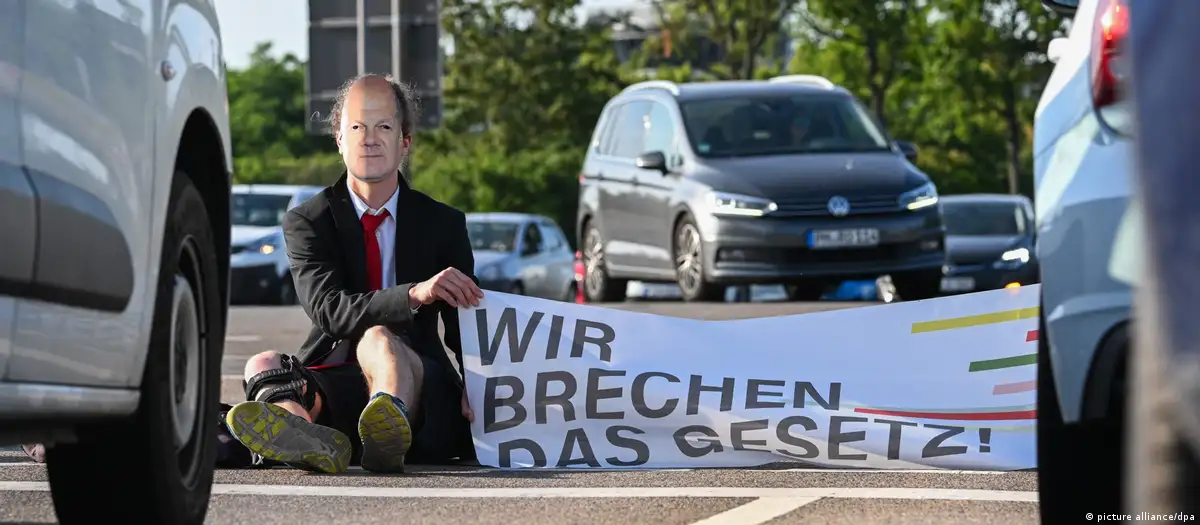
Masked climate activists blocked traffic in Berlin, claiming the government has broken the law. The group defended protests a day earlier that blocked airport runways.
The protesters claim the government is breaking the law and not acting fast enough on climate change
Image: picture alliance/dpa
Activists from Germany’s Last Generation climate protest group protested at one of Berlin’s most iconic intersections during the morning rush hour on Friday, with other actions planned across the city and the rest of Germany.
The campaigners, who claim the government has broken its own laws on climate change, wore masks depicting senior politicians.
…
Further actions across the capital were planned on Friday, including one at Berlin’s main train station. Police also said protesters had blocked traffic near Germany’s Reichstag parliament building and the Brandenburg Gate.
Last Generation said 36 sit-ins were planned Friday in 26 cities across Germany.
However, Last Generation spokeswoman Lina Johnsen said the protests were out of necessity because the government had been breaking its own rules.
“It is the responsibility of politicians to protect what we need for life. And they are knowingly not doing that by continuing to break their own climate protection goals,” said Johnsen.
“The arrests of these activists are a clear attempt to silence dissent and suppress opposition to the EACOP,” said one organizer.
Climate campaigners around the world on Wednesday urged Ugandan authorities to drop charges against four climate activists arrested and jailed overnight after peacefully protesting a highly controversial oil pipeline under construction in the region.
Bob Barigye, Mutesi Zarika, Naruwada Shamim, and Nalusiba Phionah were violently arrested Tuesday in the capital Kampala for protesting the environmental and social impacts of the East African Crude Oil Pipeline (EACOP). The activists—who were later released on bond—were charged with inciting violence.
However, the #StopEACOP coalition—which said the protesters were “unjustly” arrested and jailed—argued that photos and videos from the demonstration show that it was peaceful.
“The arrests of these activists are a clear attempt to silence dissent and suppress opposition to the EACOP,” the coalition’s campaign coordinator, Zaki Mamdoo, said in a statement. “We call upon the international community and civil society organizations to join us in condemning these arrests and demanding justice for those detained.”
Video: Today morning @stopEACOP activists had a peaceful demonstration in Kampala. Unfortunately police disrupted them & arrested them. The arrested are @bobbarigye1, Mutesi Zarika, Naruwada Shamim & Nalusiba phionah. We call upon police to release them unconditionally. pic.twitter.com/R1AQaMttH1
Samuel Okulony, director of the Environment Governance Institute, said that “it is not a crime to voice opposition to the controversial EACOP project or to advocate for the government and project proponents to explore alternative, sustainable solutions.”
“Peaceful protest and dialogue are fundamental pillars of a democratic society, and these rights must be protected and upheld,” Okulony added.
Charity Migwi, the African regional campaigner for U.S.-based 350.org, condemned the arrests “in the strongest terms possible.”
“These activists were exercising their democratic right to peacefully protest against a project that they believe will have devastating consequences for the environment and the people of Uganda and beyond,” she said, urging the Ugandan government to “drop all charges against them.”
“The arrests of these activists are a clear attempt to silence dissent and suppress opposition to the EACOP. We call upon the international community and civil society organisations to join us in condemning these arrests…” #StopEACOPhttps://t.co/hY2VNfCxrW via @NatureGuardian
This isn’t the first time anti-EACOP activists have been arrested for peacefully protesting the pipeline. Last October, nine student leaders were arrested by police and subsequently charged with inciting violence for holding a Kampala demonstration in support of a European Parliament resolution condemning the project’s human rights and environmental violations. Four more anti-EACOP activists were arrested last December.
Barigye, a 34-year-old biology teacher and climate activist, was arrested in January for anti-EACOP organizing despite having police permission to protest. Barigye toldAfrican Arguments earlier this year that he was held for four days, during which time he was “psychologically tortured” by police.
“They threatened my life and family,” he said. “They dragged me into a filthy cell, made me starve… I could not sleep as they would interrogate me at any time of the night.”
Happy to get temporary freedom on police bond. Together with other 3 women Rights activists,we were violently arrested as we peacefully matched against the Construction of @EACOP_ Fossil fuels have No future & Harassment won't stop us from demanding for a clean energy transition. pic.twitter.com/UGrUc99E7p
“We are looked at us the enemies of the state,” Barigye said of the anti-EACOP activists. “The police now prefer psychological torture because physical torture will create bad publicity around the oil pipeline project, which could push away investors and insurers… The government doesn’t want to be in the international spotlight for the wrong reasons.”
If completed, the $3.5 billion, nearly 900-mile EACOP would transport up to 230,000 barrels of crude oil per day from fields in the Lake Albert region of western Uganda to the Tanzanian port city of Tanga on the Indian Ocean.
Earlier this week, Human Rights Watch published a report detailing how EACOP has devastated the lives and livelihoods of tens of thousands of people in its path while exacerbating the climate emergency.
I said very recently that I’ll be reviewing Rishi Sunak’s cabinet’s climate credentials. I’d better look at the shadow cabinet’s too and pull my finger out X
Our system is killing us. The root of the wreckage we see around us is a broken democracy, not a broken climate. Climate chaos is just a symptom of the endless greed of the powerful – who won’t stop until they’ve trashed even what they need to survive.
This reality is so terrifying that we all want to believe it’s not true. Surely our lives are in good hands, minus a few bad apples. But for more and more people, these last shreds of comfort are going up in wildfire smoke. We’re told to watch the world burn while politicians license new oil – and still obey?
If that makes your head and heart explode, there’s only one place to go: Civil Resistance. It’s the step we take when we definitively turn our backs on the criminals in power, refusing to give them one more second of our time and respect.
All over the world, this is happening. A Glasgow community spontaneously gathers to save neighbours from deportation. The Stop Cop City movement in Atlanta refuses to let the police raze the forest for a vast training complex. People block the subway in New York, in rage and defiance, after homeless black man Jordan Neely was murdered. Just Stop Oil’s partners in the A22 network send shockwaves across Europe – blocking roads, throwing paint over private jets, turning fountains black.
Like these sister movements, Just Stop Oil is clear about what civil resistance means: we no longer consent to a system that doesn’t care if we live or die. A system so dysfunctional it’s willing to sacrifice us to a clique of criminals profiting from shortened lives, hunger and despair. Resistance means we no longer cooperate with a state that holds us in utter contempt, lies to us and treats us as worthless. If the State has no regard for us, we owe it nothing in return.
The good news amongst all this darkness is that civil resistance works. It’s not a miracle cure by any means, but the balance tips decisively in its favour. It’s got rid of dictators like Serbia’s Slobodan Milosevic, brought down segregation in the US, won votes for women, removed the British from India, and helped Polish trade unionists free themselves from Soviet oppression. Just Stop Oil could be just months away from joining this roll of honour.
The techniques of civil resistance can include strikes, boycotts, blockades, cultural disruption and occupations. Its results are just as varied. Civil resistance sometimes wins by sparking mass mobilisation, compelling people to leave the sidelines and join in. Sometimes by dividing the State against itself, winning over police and the judiciary. Victory can also come from raising the costs of keeping a system going – until it’s easier for the oppressor to give way. But behind all these tactics and objectives is the absolute withdrawal of consent from a system that’s failing in its duty to provide protection, care and justice for ordinary people like us.
Here, this failure is stark. Our government takes our hard-earned money, via taxpayer subsidies, and pours it into new oil and gas projects, which will lead to misery, deprivation, suffering and death. It breaks its own climate targets, marching us towards social, economic as well as environmental collapse. It lies to us and gaslights us – telling us new oil will cut our energy bills when we all know it’s going to be sold for profit on the global market, at a global price. As one of our spokespeople, Emma Brown, put it so clearly in an interview: ‘The British public isn’t silly.’ We know we’re being lied to. We know we’re being thrown to the wolves.
If you can’t un-know these horrifying truths, join us in civil resistance before it’s too late. Policy and legislation can’t get us the change we need. They can codify the progress we make – but that will come afterwards. Now is the time to resist and that means all of us. The method will work its magic, but not without you.
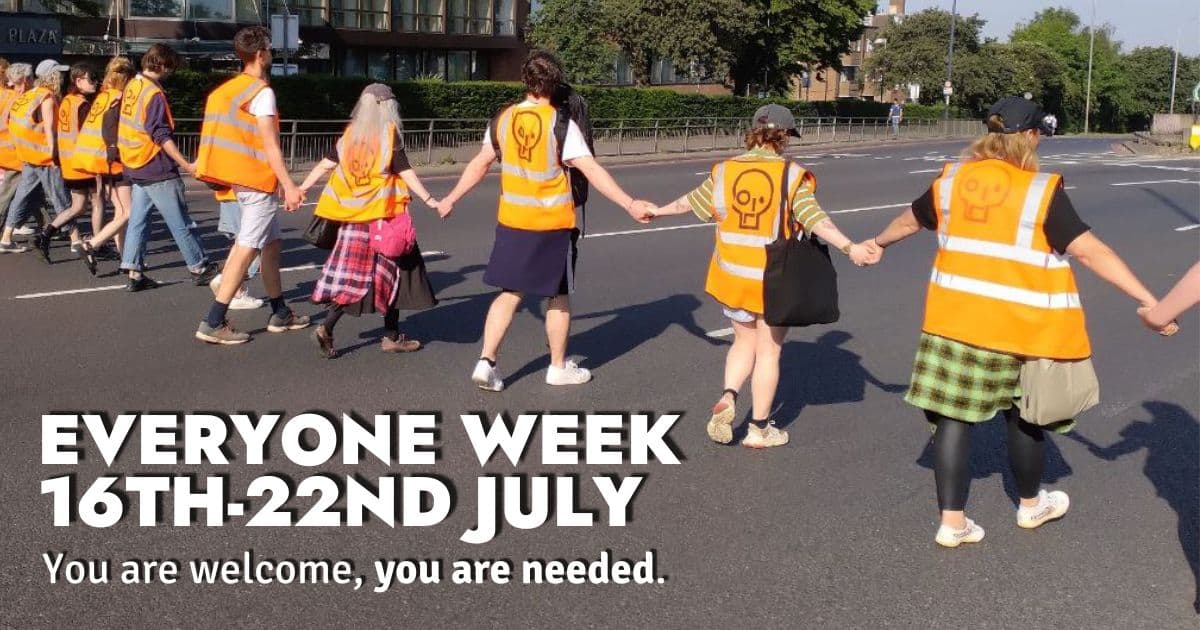
Join Just Stop Oil on a slow march at midday every Saturday, at Parliament Square until we win.
Reading list
1. This is an Uprising, Paul Enger & Mark Engler
2. Blueprint for a Revolution, Srdja Popovic
3. The End of Protest: A new blueprint for Revolution, Micah White
4. Don’t think of an Elephant, George Lakoff
5. From Dictatorship to Democracy, Gene Sharp ( PDF Available free online)