The sun was shining on the capital as thousands of pro-EU supporters gathered in Central London on September 23, for the second National Rejoin March (NRM).
Protesters, waving, not just EU flags, but flags from across Europe, including Spain, Ireland, France, and Wales, congregated on Park Lane, where they made their way to Parliament Square.
Speakers from six countries took to the stage, in an event that was supported by 70 affiliated partner organisations. Orators included former Belgian prime minister Guy Verhofstadt, who said there is an absolute need for the UK to rejoin the EU and it is always welcome back. Terry Reintke, MEP, said the growing citizens movement for rejoin is being followed very closely in Brussels, where Britain is ‘missed a lot.’
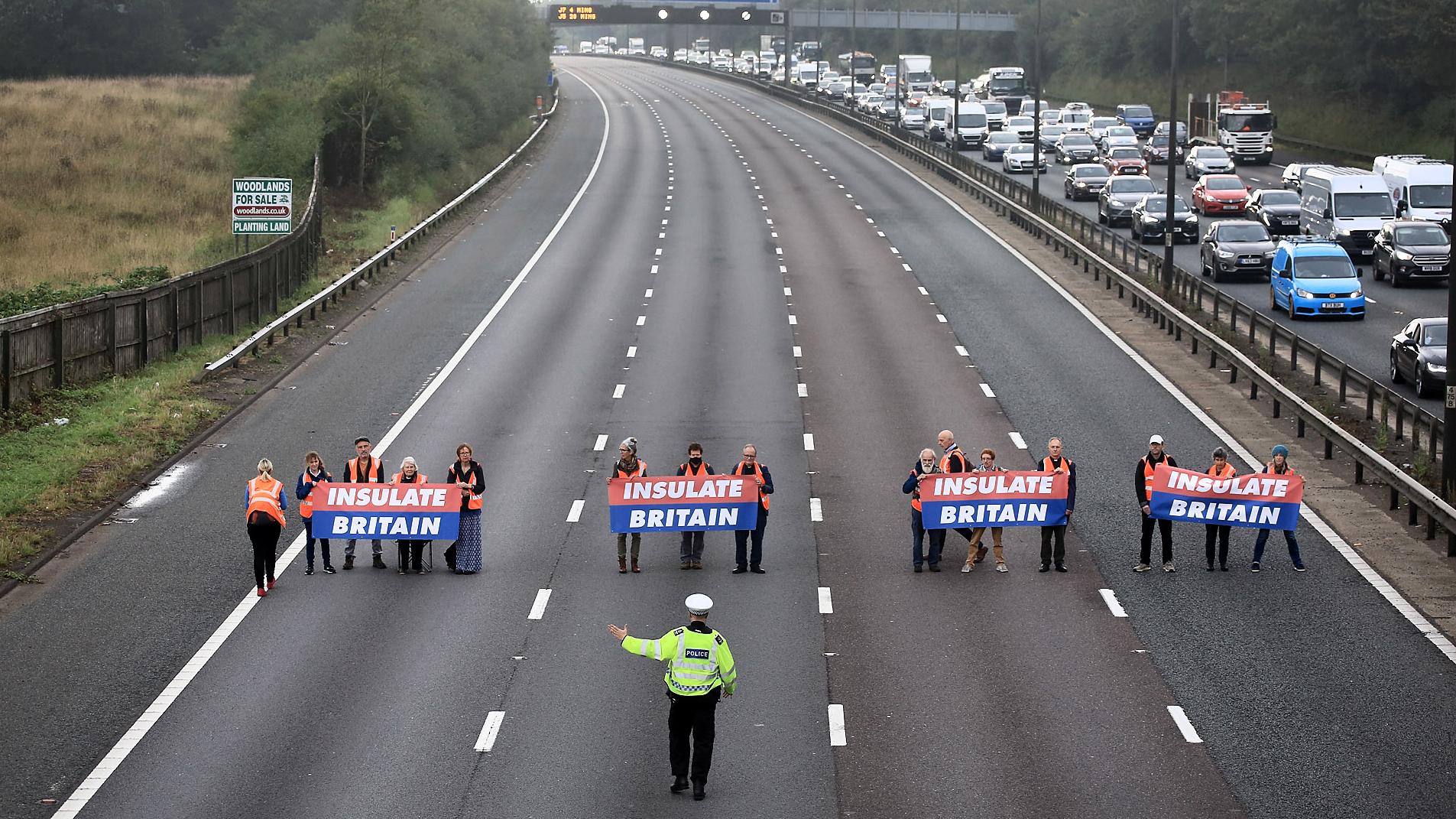
Protesters facing criminal convictions are being punished twice as National Highways and TfL seek costly injunctions
Climate activists have told openDemocracy they are being hit with “crippling” bills totalling thousands of pounds because of legal action brought by government and public bodies to prevent protests.
Injunctions – orders issued through civil courts, usually to ban something – are increasingly being used to crack down on climate demonstrations, activists say, in what they believe is an attempt to silence dissent.
Both National Highways and Transport for London (TfL) have named supporters of environmental campaign groups Insulate Britain and Just Stop Oil on injunctions intended to stop protests on certain roads in recent years. One person named on a TfL injunction told openDemocracy they have never even protested in London.
Breaching an injunction can lead to a contempt of court conviction, which is punishable by up to two years’ imprisonment, an unlimited fine and the seizure of assets.
One Just Stop Oil protester said they had been warned by their lawyers that those who go to trial to fight an alleged breach and lose could be made to pay up to £150,000 to £200,000 in legal fees, while accepting a breach could incur costs of between £5,000 and £20,000.
The protester told openDemocracy that the costs could leave defendants vulnerable to “the kinds of debts which could cripple you and potentially make you homeless”.
Raj Chada, a partner at law firm Hodge Jones & Allen who represents a number of Insulate Britain supporters, said the way injunctions are now being used is “astonishing” and something he’s never seen before in 15 years of working with protesters.
“The injunctions that are currently being used have always been there but it has never been the case that National Highways Agency or TfL would seek injunctions to completely prevent protests in certain areas,” he said.
Yesterday, it was reported that Rishi Sunak is considering weakening the government’s net-zero commitments, including by delaying a ban on the sale of new petrol and diesel cars, watering down the phasing out of gas boilers, and scrapping plans for new energy-efficiency targets for private rented homes.
Such actions are likely to lead to increased environmental protests. Climate activists say the use of injunctions is one way the government has been cracking down on such protests in recent years, alongside new police powers to shut down demonstrations deemed too disruptive, and existing public nuisance laws that can see people imprisoned for up to ten years for taking part in civil resistance.
Chada agrees, saying: “This government in particular doesn’t like being challenged by groups such as Just Stop Oil or Extinction Rebellion.”
Hefty fees
National Highways is a government-owned company responsible for operating, maintaining and improving motorways and major A-roads in England.
According to a court document seen by openDemocracy, National Highways initially sought costs of £727,573 for legal fees incurred in securing injunctions blocking protests on and around the M25. Split between more than 130 climate activists it named on its injunctions, this would have worked out at more than £5,000 per person.
Those named in an interim injunction must go to court to negotiate its full terms, or to try to have their names removed or the injunction overturned. During this process, which can take years, the terms of the interim injunction – which can be harsher than the final parameters – are binding.
In the National Highways case, the court granted a final injunction against 24 people who were found in contempt of court for breaching the interim injunction. It also issued an anticipatory injunction against a further 109 people, meaning they were injuncted in anticipation of potential wrongdoing.
The court ruled that the 109 people who weren’t found in contempt of court should pay £1,500 in interim payments towards National Highways’ legal fees, while the remaining 24 will pay £3,000. The full extent of the costs will be determined at a later hearing.
Labour councillor Giovanna Lewis, an Insulate Britain supporter who has been fighting the National Highways injunction on behalf of all defendants, says the financial consequences are far-reaching. Some of the 133 people injuncted have had to set up payment plans to pay legal fees. Missed payments could result in a visit from bailiffs.
Annie, a 66-year-old retired grandmother from Dorchester, is among those paying off the £1,500 ordered by the court. She believes the government is “trying to squash” protesters.
After being left feeling “shocked” and “horrified” to hear of people dying of cold in their own homes, Annie took part in three road-blocking Insulate Britain protests in the south of England in September 2021. She was arrested and charged with wilful obstruction of the highway, a criminal offence. Thinking that was it, the injunction issued days later came as a shock.
“We were suddenly getting these people in black knocking on the door and trying to deliver massive letters to us,” she said. “This is both National Highways Ltd and TfL. I’ve kept everything, it’s all in a box and there’s between 10 kilograms and 12 kilograms of mail.”
Annie described feeling hounded by lawyers trying to deliver injunction documents. “It came to a point where if I knew that I was making arrangements with friends, I’d ask them not to knock on the front door and come around the back. I just stopped answering,” she said.
A spokesperson for National Highways said people were added to the injunction due to evidence that they “had previously been engaged in protests on or near our roads shortly before or after the injunction order was made, and therefore posed a risk of breaching the injunction in future”. They added that such evidence typically came from the police after arrests.
A spokesperson for TfL also said the names of protesters it included on an injunction that it sought due to “continuing threats of disruptive protests from Just Stop Oil and Insulate Britain” were disclosed by the Metropolitan Police.
‘Anxious and vulnerable’
Organisations applying for an interim injunction don’t have to prove any of the claims they make, according to Green and Black Cross, a grassroots project that helps protesters with legal matters. Companies can name specific people, wider groups, or ‘persons unknown’ who have protested against the organisation or are believed to be likely to do so.
Insulate Britain and Just Stop Oil supporters told openDemocracy that those who are named are being forced to front expensive legal fees to fight the injunction. The hourly rate for a solicitor in London with more than eight years’ experience is £512, according to government guideline figures.
If they lose the case and are injuncted against, the activists can also be made to pay the legal fees of the winning side. The court has discretion over how much they should pay.
They try to impoverish people so that they’re more concerned about earning to pay things off than campaigning on the climate crisis
Mya, who is also the subject of multiple injunctions, was arrested in November 2022 after attempting to climb a gantry over the M25 with Just Stop Oil. She told openDemocracy that costs for people who admit to breaching a National Highways injunction range from £5,000 to £20,000.
These figures were described as “broadly correct” by National Highways, though they said the amount would “vary from person to person, taking into consideration individual circumstances, the severity of the breach and the number of breaches”.
Mya said: “I think the injunctions are there to try and deter people. And then they’re there to also keep people caught up in all these legal proceedings and to try to impoverish people so that they’re more concerned about trying to earn money to pay things off, rather than trying to campaign on the climate crisis.”
As well as the hefty financial costs, Chada told openDemocracy that the human impact of the injunctions has left people feeling “concerned, anxious, vulnerable and fearful of what the cost of their actions will now be”.
“It really is just quite astonishing – the chilling effect of what all of this could be,” he said.
A National Highways spokesperson said: “Our primary concern is always safety – protesting on the strategic road network is extremely dangerous to the protesters and motorists.
“It’s right that dangerous and reckless protesters who disrupt our strategic road network should face the necessary consequences; anyone intending to protest on these roads should know that they run the risk of imprisonment and/or an unlimited fine. People rely on the strategic road network for so many things and they have a right to expect it to operate as it should.”
TfL said it is “doing all it can to ensure that London’s road network operates safely and efficiently and that vital emergency service vehicles are able to move freely through the city”.
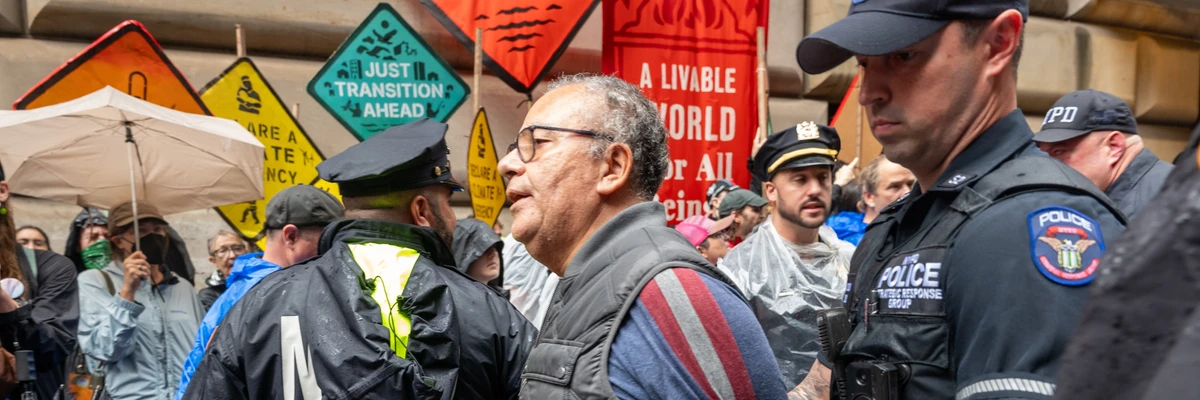
A protester is led away by a New York City police officer during a September 18, 2023 climate protest in Lower Manhattan. (Photo: Spencer Platt/Getty Images)
The activist group Climate Defiance asked: “Why are we getting handcuffed while people who literally torch the planet get celebrated for their ‘civility’ and their ‘moderation’?”
A day after tens of thousands of climate activists marched through Manhattan’s Upper East Side demanding an end to oil, gas, and coal production, thousands more demonstrators hit the streets of Lower Manhattan Monday, where more than 100 people were arrested while surrounding the Federal Reserve Bank of New York to protest fossil fuel financing.
Protesters chanted slogans like “No oil, no gas, fossil fuels can kiss my ass” and “We need clean air, not another billionaire” as they marched from Zuccotti Park—ground zero of the 2011 Occupy Wall Street movement—to pre-selected sites in the Financial District. Witnesses said many of the activists attempted to reach the New York Stock Exchange but were blocked by police.
“We’re here to wake up the regulators who are asleep at the wheel as they continue to let Wall Street lead us into ANOTHER financial crash with their fossil fuel financing,” the Stop the Money Pipeline coalition explained on social media.
Local and national media reported New York Police Department (NYPD) officers arrested 114 protesters and charged them with civil disobedience Monday after they blocked entrances to the Fed building. Most of those arrested were expected to be booked and released.
“I’m being arrested for exercising my First Amendment right to protest because Joe Manchin is putting a 300-mile-long pipeline through my home state of West Virginia and President [Joe] Biden allowed him to do it for nothing in return,” explained Climate Defiance organizer Rylee Haught on social media, referring to the right-wing Democratic senator and the Mountain Valley Pipeline.
As she was led away by an NYPD officer, a tearful Haught said Biden “sold us out.”
“He promised to end drilling on federal lands, and he’s selling out Appalachia’s future for profit,” she added.
Stop scrolling. Stop scrolling. Our organizer Rylee just got arrested at the New York Fed. It is morally outrageous that Rylee is being taken away in handcuffs while climate criminals get honorary Harvard degrees and Davos keynotes. It is morally outrageous. pic.twitter.com/vIjNcbeFr3
Responding to the “block-long” line of arrestees, Climate Defiance asked: “Why are we getting handcuffed while people who literally torch the planet get celebrated for their ‘civility’ and their ‘moderation’?”
Alicé Nascimento of New York Communities for Change toldWABC that the protests—which are part of Climate Week and are timed to coincide with this week’s United Nations Climate Ambition Summit—are “our last resort.”
“We’re bringing the crisis to their doorstep and this is what it looks like,” said Nascimento.
At least a thousand End Fossil Fuels protesters have surrounded the Federal Reserve on NYC Wall Street protesting the financing of fossil fuels. Several dozen arrests thus far. pic.twitter.com/25mbZidLna
As they have at similar demonstrations, protesters called on Biden to stop approving new fossil fuel projects and declare a climate emergency. Some had a message for the president and his administration.
“We hold the power of the people, the power you need to win this election,” 17-year-old Brooklynite Emma Buretta of the youth-led protest group Fridays for Future told WABC. “If you want to win in 2024, if you do not want the blood of my generation to be on your hands, end fossil fuels.”
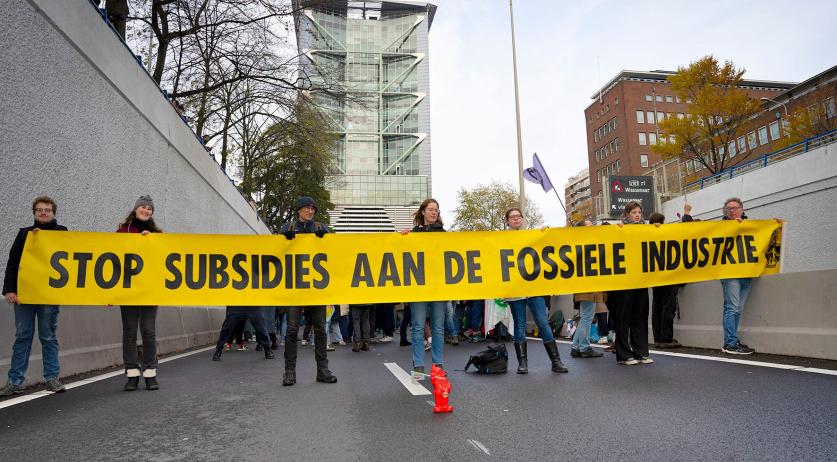
Extinction Rebellion NL activists block the Utrechtsebaan of the A12 highway in The Hague, 26 November 2022 Hague. They are calling for an end to fossil fuel subsidies by government. Image: Extinction Rebellion.
Extinction Rebellion (XR) plans to block the A12 highway in The Hague again today in protest against the government’s support for the fossil fuel industry. Unlike with previous protests, the climate activists plan to keep this one going until the government stops all its subsidies to the fossil industry. If the police remove or arrest activists, new ones will replace them.
…
According to the XR spokesperson, many civil rights have been obtained through these “disruptive actions,” including safe cycle paths and the 40-hour work week. “It’s a proven strategy,” she said. “In addition, petitions have been signed, and climate marches have been taking place for 50 years. We have had climate diplomacy for 30 years. It has not achieved nearly enough.”
She acknowledged that the highway blockade will inconvenience people and that they’ll find it annoying. “But the nuisance of a flood or a forest fire is many times greater.”
Vanaf 9 september om 12:00 uur blokkeren wij met duizenden de A12. Zolang de uitstoot van broeikasgassen niet stopt, wordt de aarde steeds heter. Toch steekt de regering nog altijd tot 30 miljard in fossiele subsidies! Dit moet stoppen!
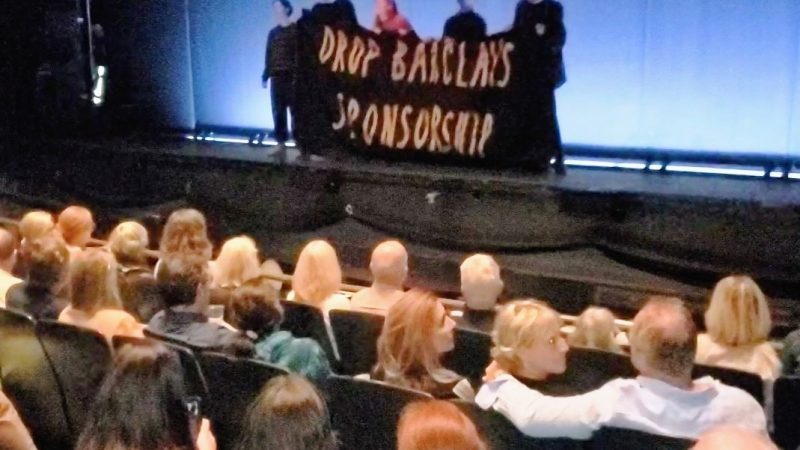
Fossil Free London climate protestors protest Barclays sponsorship of the arts at Saddlers Wells.
A ballet performance of Romeo and Juliet at Sadlers Wells faced significant disruption on Thursday evening after climate activists stormed the stage to protest the theatre’s Barclays sponsorship.
Five member of the campaign organisation Fossil Free London hijacked the stage after the interval holding a banner that read “Drop Barclays Sponsorship”, whilst two others held placards and chanted “oily money out” from the wings.
Sadlers Wells includes Barclays bank as one of its sponsors. Barclays has continued to fund new oil and gas projects, investing over $190 billion in fossil fuels since 2016.
…
BREAKING: We’ve just disrupted a performance of Romeo and Juliet at Sadler’s Wells theatre, telling them to drop @Barclays dirty oil sponsorship! It’s time to get #OilyMoneyOut of our arts, our city and our futures 🚫 pic.twitter.com/NU9hQjUpou
Barclays also invests in the oil company Equinor who are pushing forward controversial plans for the Rosebank oil and gas field in the North Sea. They are currently waiting on the approval of their environmental report by the government, due in October.