This work by Middle East Monitor is licensed under a Creative Commons Attribution-NonCommercial-ShareAlike 4.0 International License.
Iraqi national flag in Baghdad on 10 January 2019 [AHMAD AL-RUBAYE / AFP / Getty]
An attack targeted military facilities in Iraq last week, including Chinese-made air defence systems and ammunition depots reportedly recently delivered from Iran for Shiite militias in the country, Iraqi sources said, with suspicions that Israel was behind the strike.
Saudi media quoted two Iraqi sources as saying that authorities in Baghdad had indications pointing to Israel’s involvement, but had yet to determine how the attack was carried out or whether it involved warplanes or drones.
The attack wounded five people, who sustained minor injuries, according to the sources. Iraqi authorities are still investigating the circumstances surrounding the incident.
The developments come amid previous reports of possible Israeli military activity inside Iraq. About six months ago, US media reported that Israel had established a secret military base in Iraq, housing special forces and serving as a logistical hub for the Israeli air force, in coordination with the United States, according to sources cited in those reports.
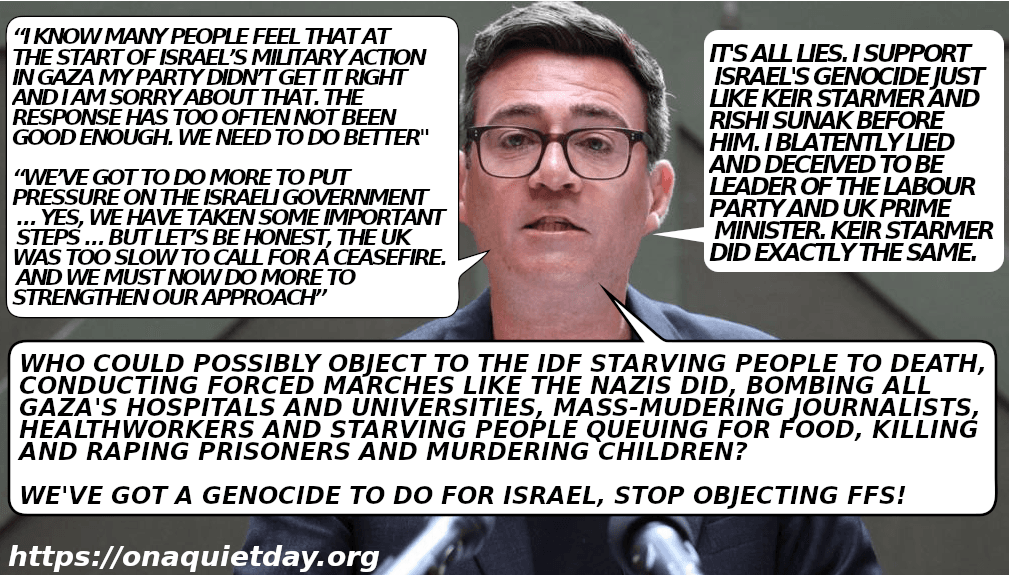
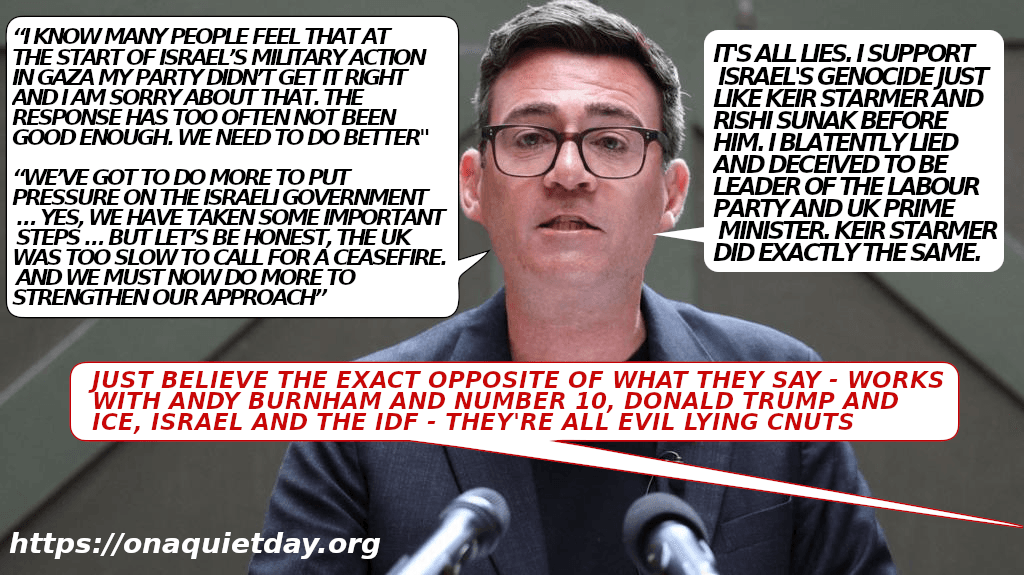
UK Prime Minister Andy Burnham admits to blatently lying and engaging in deception to become leader of the UK Labour Party and Prime Minister. He asks who could possibly object to the IDF starving people to death, conducting forced marches like the Nazis did, bombing all Gaza’s hospitals and universities, mass-murdering journalists, healthworkers and starving people queuing for food, killing and raping prisoners and murdering children. He says they’ve got a genocide to do for Israel and to stop objecting.Ed Miliband says that he and the Labour Party are full of shit criminalising people holding signs as terrorists despite anything he says.
This work by Middle East Monitor is licensed under a Creative Commons Attribution-NonCommercial-ShareAlike 4.0 International License.
Posters of former Israeli Chief of General Staff and Yashar Party leader Gadi Eisenkot (right) and Prime Minister and Likud Party leader Benjamin Netanyahu (left) are seen as election campaigns intensify two days before the vote as campaign posters of candidates are displayed on billboards and buildings across the streets ahead of the Knesset elections scheduled for October 27, in Tel Aviv, Israel, on October 25, 2026. [Nir Keidar – Anadolu Agency]
Israelis head to the polls Tuesday in a closely contested parliamentary election that could end Prime Minister Benjamin Netanyahu’s long rule or leave the country facing another political deadlock, with neither major bloc projected to secure a governing majority, Anadolu reports.
The vote will be Israel’s first general election since the Oct. 7, 2023 attacks and the subsequent Israeli offensive on the Gaza Strip, as well as military confrontations with Lebanon and Iran.
It will also be the first Israeli general election held on schedule since 1988, following decades in which successive governments collapsed before completing their four-year terms.
Around 7.3 million people are eligible to vote, including approximately 1.2 million Palestinian citizens of Israel.
Voting will take place at 12,018 polling stations, with approximately 18,000 ballot boxes deployed nationwide.
Most polling stations will open at 7 am (0500GMT) and close at 10 pm (2000GMT). Election day is a public holiday.
Thirty-seven parties and electoral lists are competing for seats in the 120-member Knesset, where a governing coalition requires the support of at least 61 lawmakers.
Under Israel’s proportional representation system, voters choose parties rather than individual candidates. Parties must secure at least 3.25% of valid votes to enter parliament.
No party has ever won an outright Knesset majority, making coalition negotiations decisive in determining who becomes prime minister.
Eisenkot’s party leads final polls
Final surveys published by Israel’s three main television broadcasters put former military chief Gadi Eisenkot’s centrist Yashar party narrowly ahead of Netanyahu’s Likud.
Yashar is projected to win 22 to 23 seats, compared with 19 to 21 for Likud.
The B’Yachad, or Together, alliance led by former prime ministers Naftali Bennett and Yair Lapid is projected to finish third with 14 or 15 seats.
Other opposition parties include the Democrats, led by former general Yair Golan, and former Defense Minister Avigdor Lieberman’s Yisrael Beytenu.
The three surveys project Netanyahu’s right-wing and religious bloc winning 50 seats, while the opposition bloc is forecast to secure between 52 and 56.
Palestinian-led parties are projected to win a combined 14 to 16 seats.
The figures suggest that neither Netanyahu nor Eisenkot has a clear path to the 61-seat majority needed to form a government.
Winning the largest number of seats does not automatically determine who becomes prime minister.
President Isaac Herzog will consult the elected parties before assigning the task of forming a government to the lawmaker considered most likely to command a parliamentary majority.
Netanyahu, 77, is seeking another term after serving as prime minister for more than 18 years across three separate periods.
His campaign has focused heavily on national security, portraying his experience and military policies as essential to confronting regional threats.
However, he faces criticism over his government’s failure to prevent the Oct. 7 attacks, its handling of subsequent conflicts and its opposition to establishing an independent state commission of inquiry into the security failures.
Netanyahu is also standing trial on corruption charges, which he denies, and faces an International Criminal Court arrest warrant over war crimes and crimes against humanity in Gaza.
His potential coalition partners include far-right parties led by National Security Minister Itamar Ben-Gvir and Finance Minister Bezalel Smotrich, alongside the ultra-Orthodox Shas and United Torah Judaism parties.
Ben-Gvir and Smotrich have advocated expanding illegal settlements in the occupied West Bank, rejected Palestinian statehood and encouraged Palestinians to leave Gaza.
The ultra-Orthodox parties have meanwhile faced mounting criticism over demands to preserve military-service exemptions for religious students as the Israeli military struggles with personnel shortages after years of conflict.
Eisenkot offers change in leadership, no major shift in security issues
Eisenkot, 66, served as chief of the Israeli military from 2015 to 2019 and joined Netanyahu’s emergency government following the Oct. 7 attacks.
He later left the government after criticizing Netanyahu’s management of the Gaza offensive and the absence of a clear political strategy.
His son was killed while serving with the Israeli military in Gaza in December 2023.
Eisenkot has campaigned on government accountability, political stability and restoring public confidence in state institutions.
He supports establishing an official inquiry into the Oct. 7 security failures and ending broad military-service exemptions for ultra-Orthodox men.
Despite positioning himself as an alternative to Netanyahu, Eisenkot maintains similar positions on several major security issues.
He opposes establishing a fully sovereign Palestinian state under current conditions and says Hamas’ military capabilities and rule in Gaza must be dismantled.
The election therefore presents voters with competing approaches to leadership, governance, judicial independence and relations with far-right parties, even as the two leading candidates share positions on key security issues.
The Joint List and Ra’am, the principal parties representing Palestinian citizens of Israel, could play a decisive role if neither major bloc secures 61 seats.
Polls project the Joint List winning around nine seats and Ra’am securing between five and seven.
An Eisenkot-led government could require support from one or both Palestinian-led parties, either through formal coalition participation or outside parliamentary backing.
Such an arrangement would face political obstacles.
Lieberman has rejected joining a government dependent on Palestinian-led parties, while other opposition figures have been reluctant to commit to such an agreement.
Netanyahu has repeatedly invoked the possibility of Palestinian-led parties influencing the next government to mobilize right-wing voters.
Coalition scenarios, possible deadlock
Several possible outcomes could emerge from Tuesday’s vote.
Netanyahu could form another government if his bloc secures enough additional seats or attracts lawmakers from outside his existing alliance.
An Eisenkot-led coalition would likely depend on an agreement involving Palestinian-led parties, defections from other camps or difficult compromises among ideologically divided opposition leaders.
A unity government involving Likud and major opposition parties is another possible arrangement, although Eisenkot and several allies have ruled out serving under Netanyahu.
If neither side assembles a majority, Netanyahu could remain caretaker prime minister during prolonged coalition negotiations, potentially leading to another election.
The performance of smaller parties polling near the 3.25% electoral threshold could prove decisive. Parties that fail to meet the threshold win no seats, potentially weakening their political allies and shifting the balance of power between the competing blocs.
Exit polls are expected immediately after voting ends at 10 pm local time Tuesday.
Initial official results will begin emerging overnight, although counting ballots from military personnel, hospitals, prisons and other special voting arrangements could take several days.
Official results are scheduled to be published by Nov. 4, after which coalition negotiations could continue for weeks.
UK Prime Minister Andy Burnham admits to blatently lying and engaging in deception to become leader of the UK Labour Party and Prime Minister. He asks who could possibly object to the IDF starving people to death, conducting forced marches like the Nazis did, bombing all Gaza’s hospitals and universities, mass-murdering journalists, healthworkers and starving people queuing for food, killing and raping prisoners and murdering children. He says they’ve got a genocide to do for Israel and to stop objecting.Ed Miliband says that he and the Labour Party are full of shit criminalising people holding signs as terrorists despite anything he says.
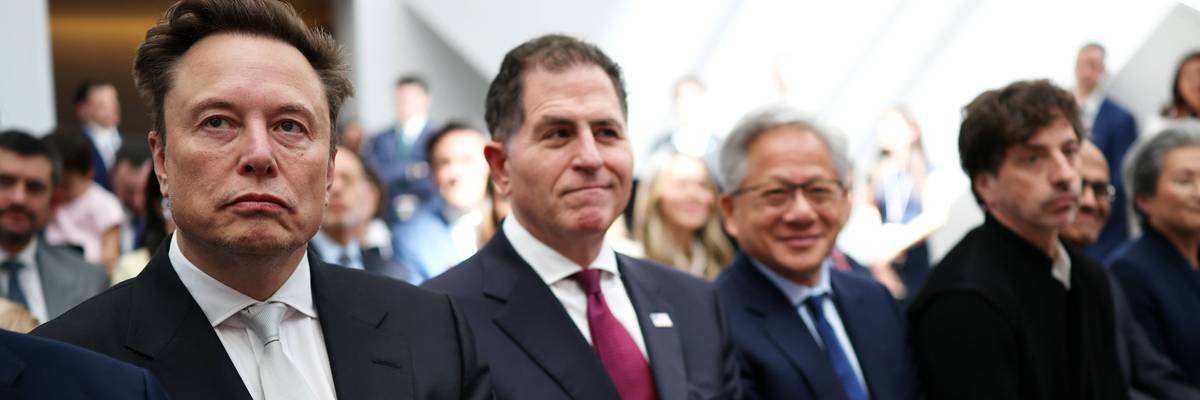
SpaceX CEO Elon Musk, CEO of Dell Technologies Michael Dell, Nvidia CEO Jensen Huang, and co-founder of Google Sergey Brin attend the Golden Age of American Innovation Summit on October 8, 2026 in Washington, DC.(Photo by Win McNamee/Getty Images)
“Trump and his anti-AI regulation posture is dragging the party to a politically suicidal place,” said one Democratic strategist.
American voters’ antipathy toward Big Tech companies has become a central theme of campaigns in the 2026 midterm elections, according to an analysis published by The Guardian on Thursday.
The Guardian noted that hundreds of midterm campaign ads attacking data centers have aired over the past two months, with both Republicans and Democrats accusing one another of being pawns of the artificial intelligence industry.
“And it’s not only data centers,” The Guardian added. “The public anxiety over AI and distaste for the billionaires developing it, as well as backlash over encroaching tech like surveillance cameras, has turned the tech industry into a ubiquitous villain this election cycle.”
Silicon Valley has become a punching bag for politicians even as Big Tech moguls have been throwing record sums of money to elect politicians sympathetic to their needs.
Super political action committees (PACs) “funded by tech billionaires are among the top spenders in this election cycle,” The Guardian explained. “Leading the Future, formed by OpenAI president Greg Brockman and venture capitalist Marc Andreessen, has raised more than $75 million to back tech-friendly candidates. [SpaceX CEO] Elon Musk has sunk $366 million into Republican causes, more than he spent on the 2024 presidential election.”
Much of the Big Tech money has been going toward Republican candidates this cycle, even though the industry has traditionally had close ties with elected Democrats.
Texas Democratic US Senate candidate James Talarico in recent days has been trying to turn Big Tech money being spent against him into an advantage, highlighting in particular the outsize role that Musk is playing funding the campaign of his Republican rival, Texas Attorney General Ken Paxton.
After Musk on Wednesday used his platform X to declare that “there is something deeply wrong with Talarico,” the Texas Democrat quickly returned fire.
“There is something deeply wrong with a political system,” Talarico wrote, “that allows one trillionaire to buy his own personal US senator.”
A report published by The Atlantic on Monday examined how the tech industry’s embrace of President Donald Trump during his second term has given Democrats an incentive to pummel the industry, particularly when polls show a bipartisan hostility to AI data centers.
In fact, Democratic strategists told The Atlantic that data centers have proven to be a top wedge issue capable of getting normally loyal GOP voters to think twice before voting for a Republican candidate.
“Trump and his anti-AI regulation posture is dragging the party to a politically suicidal place,” Democratic strategist Rob Flaherty told The Atlantic. “They are grabbing the wrong side of an 80–20 issue at exactly the wrong time.”
Democratic strategists started pushing the party to take a more populist approach toward the tech industry when polling data “showed surprising concern about AI” even in traditionally conservative rural districts, The Atlantic reported.
Rishi Bharwani, US director of tech regulation advocacy group Reset Tech, said much has changed since Democrats under former President Barack Obama embraced the industry as a positive force for society.
“What we all experienced was a ton of growth in the tech sector, the creation of numerous new billionaires, and even the world’s first trillionaire,” said Bharwani, “and a bunch of working families basically recognizing that they’re not sharing. These tech companies are actually undermining their economic security and their safety.”
Orcas discuss rotting brain, front Orca says Sundown Syndrome is a dead givaway and he wishes someone would Lock Him UpClimate science denier Donald Trump confirms that he knows nothing about democracy and that more liquid gold is being secured according to his policy of global privateering.Orcas discuss Donald Trump and the killer apes’ concept of democracy. Front Orca warns that Trump is crashing his country’s economy and that everything he does he does for the fantastically wealthy.
This work by Middle East Monitor is licensed under a Creative Commons Attribution-NonCommercial-ShareAlike 4.0 International License.
French President Emmanuel Macron at the Elysee Palace in Paris, France on October 13, 2026. [Mustafa Yalçın – Anadolu Agency]
Emmanuel Macron’s phrase landed like a cracked whip in the stale air of Western politics. “As unacceptable as they are stupid.” The target was not immigration policy, but a lie — the claim, amplified by Donald Trump and a chorus of right-wing figures, that Muslim migrants had set France alight. The protests that swept Paris, Lyon and Marseille were not a civilisational invasion.
They were a cry about grocery bills, overcrowded classrooms and a state that had cut 4,000 teaching posts while fuel prices climbed. Macron’s fury was therefore more than a defence of immigrants. It was a rejection of the most durable political technology of the age: the conversion of economic failure into cultural panic.
The mechanics are almost elegant in their cynicism. When wages stagnate, and public services buckle, the scapegoat is not the tax code or the corporate margin. It is the most visible minority. Trump told Macron to “close your borders and take control before it is too late”. The facts said otherwise.
More than half a million people marched — students, trade unionists, farmers — against the cost of living and the decay of public provision. The violence was real, but the culprits were not a religious category. They were a political economy that has spent four decades redistributing risk downward while protecting wealth upward.
The digital architecture of 2026 has made this old manoeuvre infinitely more potent. AI-generated images of an elderly couple “stripped and robbed,” of a Palestinian flag atop the Eiffel Tower, of “hordes” storming French streets, accumulated millions of views in hours. Macron named the mechanism precisely: foreign leaders, some mid-election campaign, “naively repeat AI-generated content or spread narratives that certain circles are clearly trying to promote”.
The grammar of the “Muslim threat” is centuries old; the delivery system is new. What once required a pamphlet or a tabloid now requires a prompt and an algorithm optimised for outrage.
Against this manufactured panic sits an empirical reality that is almost impolite to state.
The OECD findsthat 77 per cent of immigrants across its member states are economically active, and that migration attenuates labour shortages in ageing societies.
Bruegel’s 2025 analysis is blunter still: with fertility rates unlikely to rebound, “continuingly high positive net-migration levels” are the only route to mitigate the economic effects of ageing, and inward migration can deliver a positive net contribution to public finances.
In Spain, the net annual fiscal contribution of the average immigrant has been estimated at some €1,600 more than the native-born, while costing the treasury 32 per cent less. The scapegoat, in other words, is subsidising the very state that is being told to fear him.
France’s security apparatus tells a more troubling story about how the panic is institutionalised. The FSPRT file — the register of suspected Islamist radicalisation — contained some 15,800 individuals as of late 2024. The database does not measure crime; it measures risk, and risk is a category that expands to fill the political demand for it. When a state can see a population through the lens of pre-emptive suspicion while remaining structurally blind to the socioeconomic composition of a protest, it has perfected a form of strategic unknowing.
The Muslim is legible as a suspect, illegible as a citizen with a grievance. That asymmetry is not a bug in the liberal state. It is a feature of how the liberal state has learned to govern insecurity.
This is where the global conversation must resist the imported script — and recognise that the script is no longer imported at all. It is written simultaneously in every major democracy.
In the United States, Gallup found in June 2026 that 73 per cent of Americans still see immigration as a good thing, and that the share wanting less immigration had fallen from a peak of 55 per cent in 2024 to 30 per cent — yet the political class continues to behave as if the opposite were true.
In Europe, the Transatlantic Trends survey records that 47 per cent of Europeans and 50 per cent of Americans see immigration as more of a problem than an opportunity, with the divide sharpest among those without a secondary education and those who have no personal contact with migrants. In Berlin, where 85 per cent of households rent, advertised rents have nearly doubled since 2014, and the far-right AfD has converted the housing crisis into an argument for restricting immigration, reaching around 17 per cent in city polling.
In Canada, Nanos Research found 52 per cent of respondents favour admitting fewer immigrants and temporary residents, with housing shortages, strained public services and the cost of living cited as the drivers — even as population growth slowed sharply. The proximate grievances are real and material: housing scarcity, wage stagnation, underfunded hospitals and schools.
But the moment those grievances are translated into a cultural threat narrative. These solutions might actually work — denser cities, a functioning care economy, a tax base that funds public infrastructure, sectoral bargaining that lifts wages — are displaced by a politics of exclusion that leaves the underlying failure untouched and the underlying distribution of power intact. The scapegoat is not a misunderstanding of the crisis. It is a substitute for solving it.
The far-right playbook now travels with a translation layer. The Guardian documented nationalist parties from the National Rally to Vox to Chega seizing on the same European unrest, each converting a housing or cost-of-living protest into evidence of “anarchic immigration” or an “uncontrolled influx”. The script is modular. Only the cast changes.
Macron’s own record is compromised. His governments have passed anti-separatism laws that Muslim civil society experienced as a targeted gaze, and his defence of French Muslims against foreign slander sits awkwardly beside domestic policies that have often treated Islamic practice as a problem to be administered. That contradiction matters, because it reveals the deeper trap.
The liberal centre condemns the crudest scapegoating while maintaining a softer, more respectable version of the same logic: integration as cultural erasure, security as a permanent suspicion. The choice is not between Trump’s panic and Macron’s laïcité. It is between a politics that names the real sources of anger and one that keeps looking for a minority to absorb it.
The lesson is not that immigration is costless or that every grievance is economic. It is that the political economy of scapegoating is now more profitable than the political economy of repair. A party that blames a migrant for a hospital queue need not explain why the hospital was starved of capital. A leader who warns of an Islamist takeover need not account for the energy shock, the fiscal squeeze or the algorithmic amplification that turned a local protest into a civilisational melodrama.
The costs of that evasion are not borne by the scapegoater. They are borne by the Muslim family in a Paris banlieue, the asylum seeker in a Mediterranean detention centre, the working-class neighbourhood in Ohio or Saxony told that its neighbours are the cause of its decline. They are borne by every community invited to trade solidarity for suspicion, and by every democracy that discovers, too late, that the anger it mobilised cannot be contained by the institutions it hollowed out.
Macron’s word — stupid — was undiplomatic and precise. It named an intelligence failure disguised as a political strategy. The task for policymakers is to make that strategy expensive. That means provenance and transparency in digital information, so that fabricated images carry a cost. It means fiscal and industrial policy that makes migration’s contribution visible in the public ledger, not merely in think-tank working papers. It means a security architecture capable of distinguishing suspicion from citizenship.
And it means a political language that treats the cost-of-living crisis as a crisis of distribution, not of demography. The scapegoat is a substitute for argument. The only antidote is the argument itself — conducted with the courage to name who actually benefits when the crowd is pointed at the wrong gate.
This work by Middle East Monitor is licensed under a Creative Commons Attribution-NonCommercial-ShareAlike 4.0 International License.
Israeli forces install road barriers and erect barbed wire fences surrounding the town of Sinjil, near Ramallah, West Bank, Palestine on October 19, 2026. [Issam Rimawi – Anadolu Agency]
Israel has declared about 183 dunums (45 acres) of land in the towns of Battir, Sa’ir and al-Shuyukh in the occupied West Bank districts of Bethlehem and Hebron as “state land”, the Colonization and Wall Resistance Commission said on Monday.
The government body said in a statement that the two declarations were issued on 18th October and signed by the official responsible for government and abandoned property in the Israeli occupation’s “Civil Administration”. It said the measures were linked to settlement expansion and efforts to legalise settlement outposts.
Declaring land “state land” allows Israeli authorities to take control of it and manage and dispose of it under the laws and procedures they apply, preventing its owners from using it or benefiting from it.
The first declaration, named Bar Kokhba, covers 64.06 dunams belonging to Battir, in land-registration basins 12 and 13, the commission said.
It added that the declaration was linked to a settlement project previously known as Nahal Hiltz, which developed from the agricultural outpost of Neve Ori. The Israeli government approved the establishment of a settlement at the site in June 2024, before the project was later renamed Bar Kokhba, it said.
Keir Starmer objects to criticism of the IDF. He asks how could anyone object to them starving people to death, forced marches like the Nazis did, bombing Gaza’s hospitals and universities, mass-murdering journalists, healthworkers and starving people queuing for food, killing and raping prisoners and murdering children. He calls for people to stop obstructing his genocide for Israel. New Labour UK Prime Minister Andy Burnham continues Labour party policy of active support and complicity in Israel’s genocide.UK Prime Minister Andy Burnham admits to blatently lying and engaging in deception to become leader of the UK Labour Party and Prime Minister.Ed Miliband says that he and the Labour Party are full of shit criminalising people holding signs as terrorists despite anything he says.