Israeli army detains at least 70 Palestinians across West Bank, 8 injured in attack by occupiers

Spread the love

This work by Middle East Monitor is licensed under a Creative Commons Attribution-NonCommercial-ShareAlike 4.0 International License.

Israeli soldiers block the road leading to Nablus Hospital, after raiding the hospital and detaining a wounded Palestinian, and his sibling in Nablus, West Bank, Palestine on July 24, 2026. [Nedal Eshtayah – Anadolu Agency]

Israeli forces detained at least 70 Palestinians in raids across the occupied West Bank on Saturday, while eight others were injured in a separate attack by occupiers, according to Palestinian media and the Palestinian Red Crescent Society, Anadolu reports.

The official Voice of Palestine radio said Israeli forces arrested more than 40 young Palestinian men in an ongoing raid on the town of Tell, west of Nablus in the northern part of the occupied territory.

Israeli troops seized a house in the town and converted it into a field interrogation center, the broadcaster said.

It added that Israeli forces were carrying out extensive raids on homes across the town while surrounding it from all directions.

On Friday, Israeli Premier Benjamin Netanyahu and Defense Minister Israel Katz ordered a “wide-scale military operation” in Palestinian villages across the West Bank following an attack near the illegal Havat Gilad settlement that killed two Israeli soldiers and wounded three others.

According to sources and witnesses, Israeli occupiers later attacked several Palestinian communities in the Nablus governorate, setting fire to Palestinian homes and other property.

Four Palestinians were killed on Friday in an attack by Israeli occupiers and Israeli forces on the town of Tell, according to the Palestinian Health Ministry.

READ: Netanyahu orders ‘wide-scale’ military offensive in occupied West Bank villages

Meanwhile, the official Palestinian news agency Wafa reported that Israeli forces launched widespread raids before dawn in the city of Jenin and several towns and villages across the governorate.

Troops also searched a number of homes and detained five Palestinians, while military operations continued in several parts of the governorate, according to local sources cited by the agency. Separately, Israeli forces detained three Palestinians in the Bethlehem governorate.

In another incident, the Palestinian Red Crescent Society said eight Palestinians were injured, including six who were shot with live fire, in an attack by Israeli occupiers on the village of Farata, east of Qalqilya in northwestern West Bank. The organization did not immediately provide further details on the attack or the condition of the injured.

In northern West Bank, the Israeli army detained at least six Palestinians during extensive raids across neighborhoods and towns in Jenin, amid a heavy military deployment and continued troop movements.

The Israeli army also raided the city of Tubas and the Al-Far’a refugee camp in northern West Bank, launching a large-scale campaign of raids on Palestinian homes.

In the central West Bank, the army detained 13 Palestinians from various areas across the Ramallah and Al-Bireh governorate.

In the southern West Bank, Israeli forces raided Hebron and detained eight Palestinians.

This work by Middle East Monitor is licensed under a Creative Commons Attribution-NonCommercial-ShareAlike 4.0 International License.
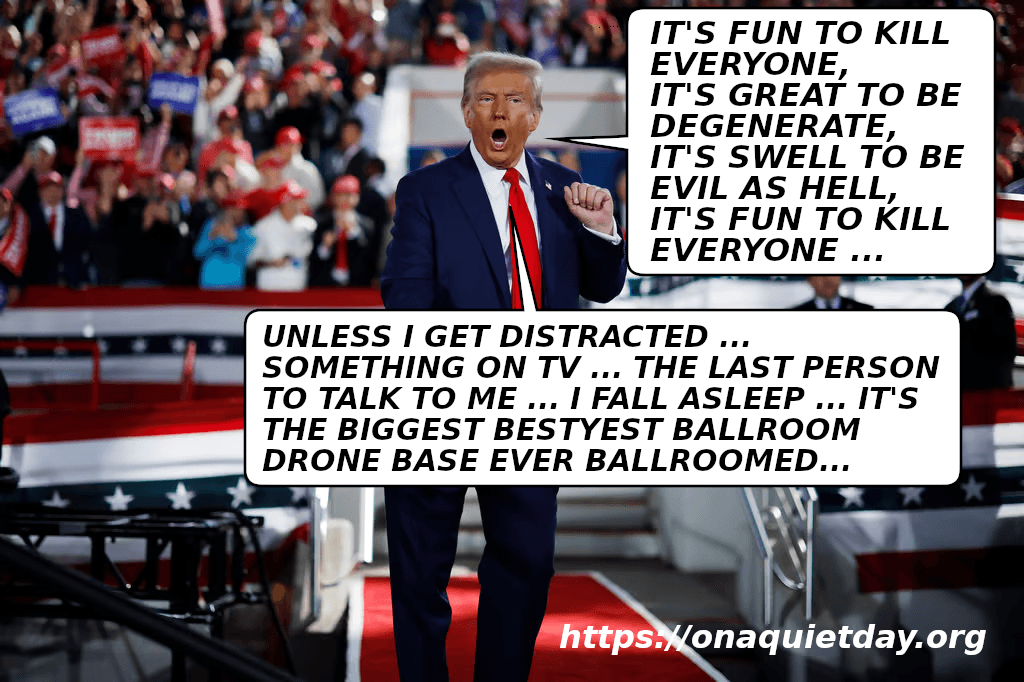
Donald Trump sings and dances, says that it's fun to kill everyone ... unless he gets distracted or falls asleep.
Donald Trump sings and dances, says that it’s fun to kill everyone … unless he gets distracted or falls asleep.
Orcas discuss rotting brain, front Orca says he wishes someone would lock him up, small Orca speaks bluntly.
Keir Starmer objects to criticism of the IDF. He asks how could anyone object to them starving people to death, forced marches like the Nazis did, bombing Gaza's hospitals and universities, mass-murdering journalists, healthworkers and starving people queuing for food, killing and raping prisoners and murdering children. He calls for people to stop obstructing his genocide for Israel.
Keir Starmer objects to criticism of the IDF. He asks how could anyone object to them starving people to death, forced marches like the Nazis did, bombing Gaza’s hospitals and universities, mass-murdering journalists, healthworkers and starving people queuing for food, killing and raping prisoners and murdering children. He calls for people to stop obstructing his genocide for Israel.

Continue ReadingIsraeli army detains at least 70 Palestinians across West Bank, 8 injured in attack by occupiers

Lebanese president says time has come to end war permanently after ‘fruitful’ Trump meeting

Spread the love

This work by Middle East Monitor is licensed under a Creative Commons Attribution-NonCommercial-ShareAlike 4.0 International License.

President Donald Trump (L) greets Lebanese President Joseph Aoun (R) upon his arrival at the White House in Washington, D.C., United States, on July 21, 2026. [Mehmet Eser – Anadolu Agency]

Lebanese President Joseph Aoun said Friday that his meeting with US President Donald Trump was “fruitful,” adding that the time had come to end the war permanently, according to the Lebanese Presidency, Anadolu reports.

In a statement, the presidency said Aoun made the remarks while receiving EU Ambassador Sandra De Waele, along with a delegation of ambassadors and chargés d’affaires.

Lebanon remains committed to the path of reforms and will continue working to achieve its goals despite the war, Aoun said.

“The continued presence of the UN Interim Force in Lebanon (UNIFIL) remains the best option for the coming phase,” he said, adding that if this was not possible, an alternative force should be created to replace it.

READ: 2 paramedics among 3 injured by Israeli fire in Lebanon despite framework agreement

Aoun called on the EU to support the implementation of the “framework formula,” saying Lebanon’s stability would reflect positively on the stability of countries across the region.

For her part, De Waele said Lebanon stood at a crossroads and was at the beginning of a new chapter, adding that the EU supported its path toward security, stability and reforms.

Since March 2, 2026, Israel’s offensive on Lebanon has killed 4,329 people and injured 12,233 others, according to Lebanon’s Health Ministry, while Israel continues to occupy areas in the south despite the agreement.

Israel occupies areas in southern Lebanon, some for decades and others since the 2023-2024 confrontations, and advanced more than 10 kilometers (6.2 miles) into Lebanese territory during the current offensive.

READ: Lebanese parliament speaker says success of Aoun-Trump meeting depends on results on the ground

This work by Middle East Monitor is licensed under a Creative Commons Attribution-NonCommercial-ShareAlike 4.0 International License.

Donald Trump sings and dances, says that it's fun to kill everyone ... unless he gets distracted or falls asleep.
Donald Trump sings and dances, says that it’s fun to kill everyone … unless he gets distracted or falls asleep.
Orcas discuss rotting brain, front Orca says he wishes someone would lock him up, small Orca speaks bluntly.
Keir Starmer objects to criticism of the IDF. He asks how could anyone object to them starving people to death, forced marches like the Nazis did, bombing Gaza's hospitals and universities, mass-murdering journalists, healthworkers and starving people queuing for food, killing and raping prisoners and murdering children. He calls for people to stop obstructing his genocide for Israel.
Keir Starmer objects to criticism of the IDF. He asks how could anyone object to them starving people to death, forced marches like the Nazis did, bombing Gaza’s hospitals and universities, mass-murdering journalists, healthworkers and starving people queuing for food, killing and raping prisoners and murdering children. He calls for people to stop obstructing his genocide for Israel.

Continue ReadingLebanese president says time has come to end war permanently after ‘fruitful’ Trump meeting

Iran is turning into the sort of ‘forever war’ that Donald Trump promised to avoid

Spread the love
Savvapanf Photo#Shutterstock

Bamo Nouri, City St George’s, University of London and Inderjeet Parmar, City St George’s, University of London

When Donald Trump returned to the White House, he promised to avoid another Middle Eastern “forever war”. After the costly experiences of Iraq and Afghanistan, that pledge resonated with an American public weary of prolonged military intervention.

For a brief moment, it appeared that this promise might be realised. The memorandum of understanding (MoU) signed by the US and Iran on June 17 seemed to offer a pathway away from escalating confrontation. Markets stabilised, regional tensions eased and there was cautious optimism that Washington and Tehran had stepped back from the brink.

That optimism has proved remarkably but unsurprisingly short-lived. US military strikes have resumed and Iran has retaliated against American and its allies across the Gulf. Iran’s proxy allies, the Houthis, have declared themselves ready to close the Red Sea chokepoint at the Bab-el-Mandeb Strait, which has provided an alternative transit route for some oil exports, particularly from Saudi Arabia.

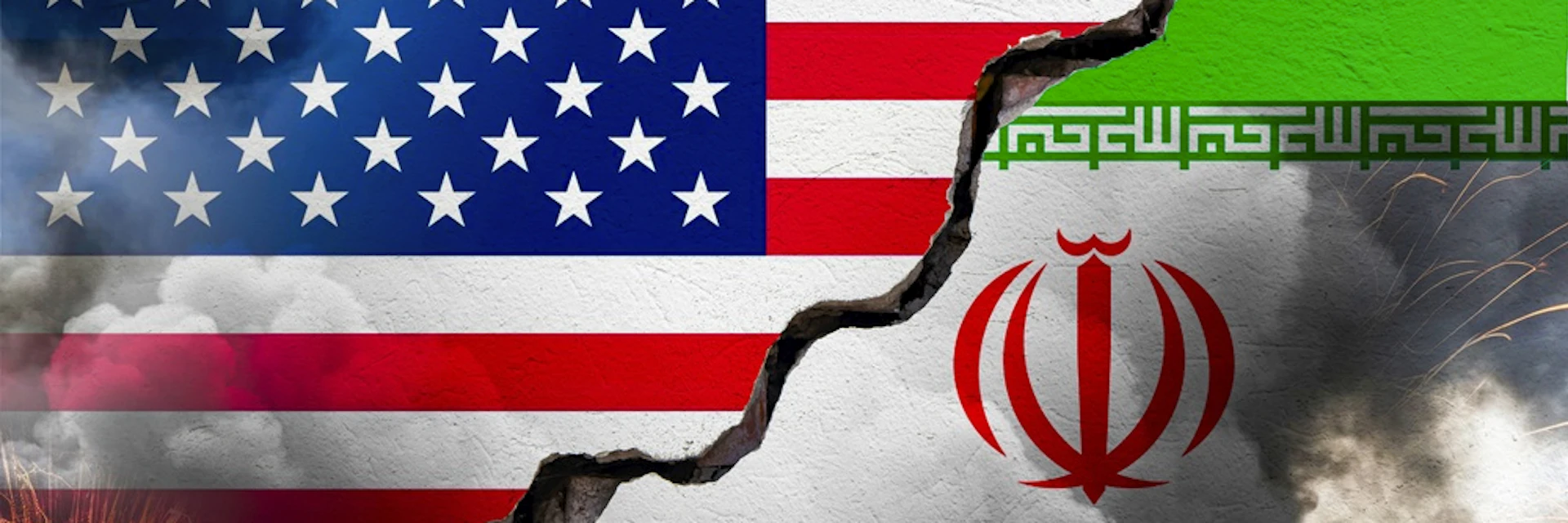
Washington continues to combine military pressure with calls for renewed negotiations. But rather than representing the collapse of an isolated peace initiative, these developments may confirm the reality of grey zone conflict – where diplomacy manages war rather than ends it.

When Americans think of forever wars, Iraq and Afghanistan understandably dominate the discussion. Those conflicts were characterised by invasions, prolonged occupations, attempts at nation-building and the deployment of hundreds of thousands of troops over many years. Their enormous political, financial and human costs eventually became impossible to sustain.

The confrontation with Iran is fundamentally different. It is unlikely to require occupation of territory and no serious or sustained attempt directly to remake the Iranian state. Instead, it is fought through air strikes, cyber operations, sanctions, maritime confrontation, intelligence activity and proxy warfare. Military escalation is followed by diplomacy, diplomacy gives way to renewed confrontation, and each episode is presented as a separate crisis.

Viewed collectively, these episodes are better understood as the latest phase of a strategic confrontation that began with the 1979 Iranian Revolution rather than as isolated crises. The conflict has evolved over the years through sanctions, proxy warfare, covert operations and cyber conflict into a more direct military confrontation.

The repeated breakdown of de-escalation efforts is often attributed to mistrust or diplomatic failure. Both undoubtedly matter, but they do not fully explain why the MoU has unravelled so quickly.

Many of its core provisions have become sources of dispute. Israel has continued military operations in Lebanon, despite expectations that regional hostilities would subside. Washington initially signalled greater economic flexibility towards Iran, including easing restrictions on oil exports and discussions surrounding Iranian assets. Yet sanctions have subsequently expanded and further economic measures have been introduced.

From Tehran’s perspective, these actions represent a breach of the spirit – and, in some cases, the letter – of the agreement. From Washington’s perspective, they are responses to continued Iranian activity that it considers destabilising.

The Strait of Hormuz illustrates how quickly ambiguity can become renewed confrontation. Article 5 of the MoU envisaged Iran facilitating the safe passage of commercial shipping through the waterway. Commercial traffic initially increased following the agreement.

But disagreement soon emerged after Oman – in coordination with the International Maritime Organization and with US backing – established a temporary maritime corridor closer to the Omani coast. Tehran viewed this as inconsistent with the agreed framework and argued that it undermined Iranian responsibility for administering safe passage. Washington rejected that interpretation, maintaining that additional security measures were necessary to protect international shipping.

The competing interpretations rapidly became another source of escalation.

The conflict itself has also evolved. What began largely as strikes against military infrastructure has increasingly extended to facilities with direct consequences for civilian life. This has included energy infrastructure and desalination plants that are essential to freshwater supplies across parts of the Gulf.

Transport infrastructure, including bridges, has also been targeted. This has prompted debate among military analysts about whether operational objectives are expanding beyond coercive signalling – using limited military force to pressure or influence an opponent’s behaviour – towards broader military aims. It has also raised questions about whether some attacks could violate international humanitarian law and, depending on the circumstances, amount to war crimes.

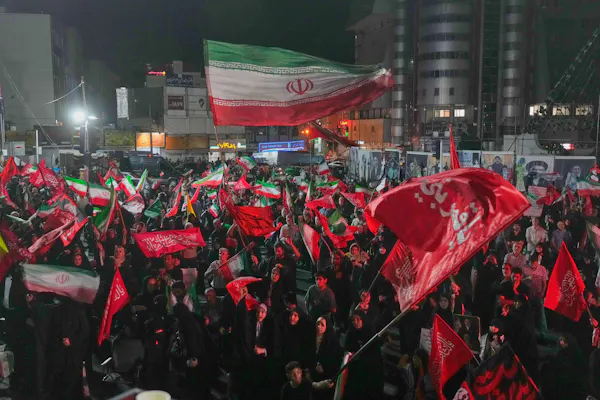
Despite huge anti-government protests in January, the war with the US has prompted many Iranians to rally round the flag. AP Photo/Vahid Salemi

While the expansion of US strikes in this way does not in itself demonstrate that a US ground offensive is imminent, it reflects a widening conflict whose effects increasingly reach civilian populations.

Diplomacy is managing conflict, not resolving it

The deeper problem is that the strategic objectives of main players here remain fundamentally incompatible. The US continues to insist that Iran’s nuclear programme and regional influence must be constrained. Iran regards those same capabilities as essential to its security and deterrence. Israel continues to view a strategically stronger Iran as an unacceptable security threat.

These objectives cannot all be achieved simultaneously. As a result, diplomacy struggles – not because negotiators lack skill, but because they are attempting to reconcile goals that remain at odds. The MoU temporarily reduced tensions, but it did not alter the structural realities driving the conflict.

This has important implications for how the current crisis should be understood. Much of the debate focuses on whether the latest escalation will produce a wider regional war. That possibility cannot be dismissed. Yet another scenario may be equally, if not more, plausible. The US and Iran are settling into a prolonged cycle of calibrated confrontation that lasts far longer than many currently anticipate.

Trump promised to end America’s forever wars. Ironically, his presidency may instead come to symbolise the evolution of a new kind of forever war without a clearly defined beginning or end. The greatest danger may therefore not be another Iraq. It may be the gradual normalisation of an enduring conflict that repeatedly disappears from the headlines, only to return in new forms because the political conditions necessary for genuine peace have yet to emerge.

This is a new normal for a US foreign policy establishment that retains militarist mindsets, a massive global military capacity and footprint, and values global primacy in an age of power shifts towards a more multi-polar world.

Bamo Nouri, Honorary Research Fellow, Department of International Politics, City St George’s, University of London and Inderjeet Parmar, Professor in International Politics, City St George’s, University of London

This article is republished from The Conversation under a Creative Commons license. Read the original article.

Donald Trump sings and dances, says that it's fun to kill everyone ... unless he gets distracted or falls asleep.
Donald Trump sings and dances, says that it’s fun to kill everyone … unless he gets distracted or falls asleep.
Orcas discuss rotting brain, front Orca says Sundown Syndrome is a dead givaway and he wishes someone would Lock Him Up
Orcas discuss rotting brain, front Orca says Sundown Syndrome is a dead givaway and he wishes someone would Lock Him Up.

Continue ReadingIran is turning into the sort of ‘forever war’ that Donald Trump promised to avoid

The UK has a new prime minister, now it must act on Palestine

Spread the love

This work by Middle East Monitor is licensed under a Creative Commons Attribution-NonCommercial-ShareAlike 4.0 International License

People stage a pro-Palestinian demonstration and call on Labour Party leader Andy Burnham, who is preparing to take office as prime minister, to impose comprehensive sanctions on Israel, in London, United Kingdom on July 18, 2026. [Raşid Necati Aslım – Anadolu Agency]

Britain has a new Prime Minister at a moment when history is demanding more than carefully worded statements.

As Andy Burnham enters Downing Street, he inherits a foreign policy crisis that has exposed deep divisions over Britain’s commitment to human rights, international law and the protection of civilian life: Israel’s devastating assault on Gaza.

For Palestinians, this is not an abstract diplomatic dispute. It is a humanitarian catastrophe that has claimed tens of thousands of lives, displaced entire communities and reduced much of Gaza’s civilian infrastructure to ruins.

Many human rights experts, legal scholars and international organisations have warned that Israel’s actions may amount to genocide, with the International Court of Justice currently examining allegations brought by South Africa under the Genocide Convention. The debate over the legal determination continues, but the scale of suffering is undeniable.

The question now facing Britain’s new Prime Minister is whether the UK will continue responding with statements of concern or whether it will finally use its influence to demand meaningful action.

Thousands of people recently marched through London calling on Britain’s new leadership to take stronger action for Gaza, demanding an end to civilian suffering and greater accountability for those responsible. Their message was clear: Palestinians cannot survive on expressions of sympathy alone.

For decades, Britain has presented itself as a defender of international law and human rights.

British governments have condemned abuses committed by states around the world and called for accountability when civilian populations are harmed.

READ: Pro-Palestinian protest in London call on Andy Burnham to impose sanctions on Israel

But principles lose their meaning when they are applied selectively.

The suffering of Palestinian civilians should not be treated as a diplomatic inconvenience or reduced to carefully balanced language. International law exists precisely to protect vulnerable populations, especially during moments of war and political pressure.

If Britain genuinely believes in a rules-based international order, then Gaza is a defining test.

The UK cannot demand accountability from some governments while shielding allies from meaningful scrutiny. Human rights cannot depend on political relationships.

Palestinians Need More Than Words

Humanitarian organisations have repeatedly warned of the devastating conditions facing civilians in Gaza.

Aid agencies have highlighted widespread hunger, displacement, the destruction of medical facilities and the collapse of essential services. ActionAid has called on Britain’s new Prime Minister to take urgent action to protect Palestinians, ensure humanitarian access and uphold international humanitarian law.

Medical Aid for Palestinians (MAP), which provides healthcare support to Palestinians living under occupation and conflict, has called on Britain’s new government to move beyond rhetoric and take concrete steps to protect Palestinian lives.

But humanitarian aid alone cannot address the root causes of this crisis.

The UK must use its diplomatic influence to demand an immediate end to actions that continue to devastate Palestinian civilian life.

This means supporting accountability mechanisms, ensuring British foreign policy does not contribute to violations of international law, and recognising that Palestinians have the same fundamental rights to freedom, safety and dignity as any other people.

Britain’s historical role in the Middle East gives it a particular responsibility.

The consequences of Britain’s decisions in the region continue to shape realities today, including the legacy of the British Mandate for Palestine and the events surrounding the creation of Israel in 1948.

That history does not mean Britain alone can solve the conflict. But it does mean Britain cannot claim neutrality while Palestinians continue to endure immense suffering.

A meaningful foreign policy requires more than managing diplomatic relationships. It requires moral courage.

The UK has significant influence through its diplomatic relationships, its position at the United Nations and its international standing.

READ: Red Ribbons Campaign calls for immediate implementation of Israeli Supreme Court ruling restoring ICRC access to Palestinian hostages and prisoners

That influence should be used to protect civilian lives—not simply preserve political alliances.

For many Palestinians, Muslims and human rights advocates in Britain, trust in Westminster has been severely damaged.

Many feel that Palestinian lives have been treated as less valuable and that the language of human rights has been applied inconsistently.

This is the challenge facing Andy Burnham’s government.

The new Prime Minister has an opportunity to demonstrate that Britain’s commitment to human rights is not selective, and that Palestinian suffering will not be ignored because confronting it is politically difficult.

History often judges governments not only by the crises they inherit, but by how they respond when confronted with injustice.

Gaza represents such a moment.

The question is whether Britain’s new leadership will look away, offer cautious statements, or take the steps necessary to protect Palestinian lives and uphold international law.

Palestinians do not need another government expressing concern while the destruction continues.

They need action.

Britain has a new Prime Minister. Now it must act on Palestine.

The views expressed in this article belong to the author and do not necessarily reflect the editorial policy of Middle East Monitor.

This work by Middle East Monitor is licensed under a Creative Commons Attribution-NonCommercial-ShareAlike 4.0 International License

Keir Starmer explains that UK is actively supporting Israel's genocidal expansion and repeats his previous quotation that he supports Zionism "without qualification". Keir Starmer said “I said it loud and clear – and meant it – that I support Zionism without qualification.” here: https://www.jewishnews.co.uk/keir-starmer-interview-i-will-work-to-eradicate-antisemitism-from-day-one/
Keir Starmer explains that UK is actively supporting Israel’s genocidal expansion and repeats his previous quotation that he supports Zionism “without qualification”. Keir Starmer said “I said it loud and clear – and meant it – that I support Zionism without qualification.” here: https://www.jewishnews.co.uk/keir-starmer-interview-i-will-work-to-eradicate-antisemitism-from-day-one/
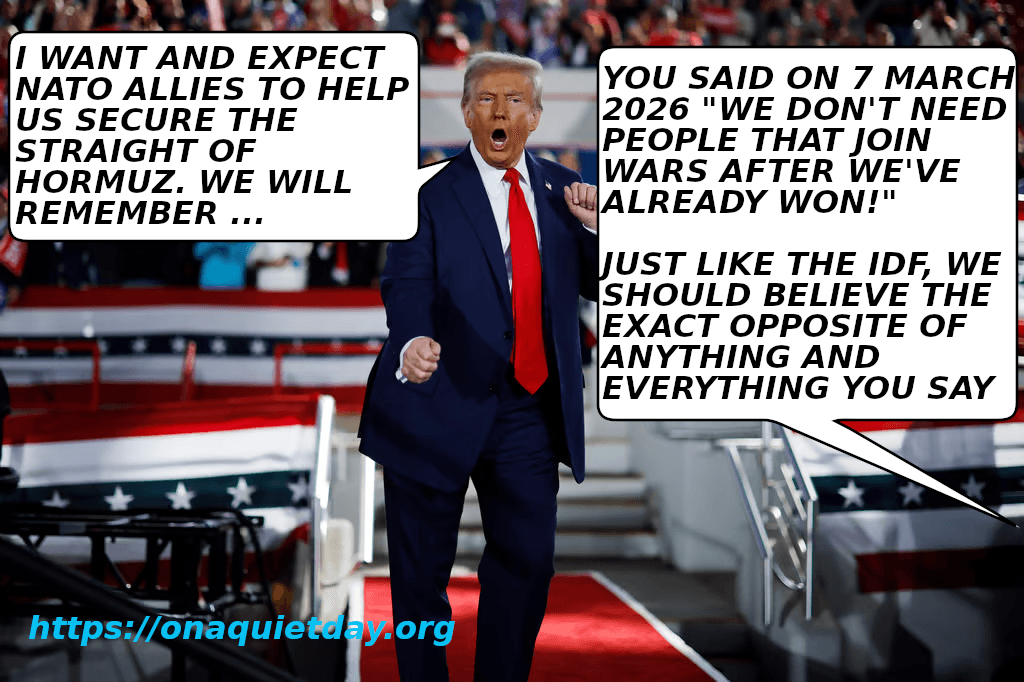
Donald Trump calls for help from NATO allies in securing the Strait of Hormuz despite saying on 7 March 2026 that they don't need people to join wars after they've already won. He's challenged with the claim that he lies as much as the IDF.
Donald Trump calls for help from NATO allies in securing the Strait of Hormuz despite saying on 7 March 2026 that they don’t need people to join wars after they’ve already won. He’s challenged with the claim that he lies as much as the IDF.
Orcas discuss rotting brain, front Orca says Sundown Syndrome is a dead givaway and he wishes someone would Lock Him Up

Continue ReadingThe UK has a new prime minister, now it must act on Palestine

UN warns over ‘escalating’ Israeli occupier attacks against Palestinians in West Bank

Spread the love

This work by Middle East Monitor is licensed under a Creative Commons Attribution-NonCommercial-ShareAlike 4.0 International License

Israeli security forces take measures along the road as Israeli settlers, protected by Israeli forces, block roads leading to Palestinian farmers’ lands in the town of Izna, near Hebron in the West Bank, Palestine on July 10, 2026. [Wisam Hashlamoun – Anadolu Agency]

The UN on Monday warned against the “escalating” Israeli occupiers’ attacks on Palestinians living in the occupied West Bank, saying the violence has continued to cause casualties, property damage and displacement, Anadolu reports.

UN spokesperson Stephane Dujarric, during a news conference, said that “we are warning against escalating Israeli settler attacks against Palestinians as they continue to cause casualties, property damage, and displacement.”

He said the Office for the Coordination of Humanitarian Affairs (OCHA) personnel on the ground have “documented an attack in which two Palestinians were killed, and others injured” in the occupied West Bank on Saturday.

READ: West Bank killings show Israel’s encouragement of ‘ethnic cleansing’ against Palestinians, Israeli rights group says

He stressed that “the Palestinians across the occupied Palestinian territory must be protected,” and added that “the killings and violence must stop, and perpetrators must be held to account.”

In recent years, violent occupier attacks in the West Bank have become a daily phenomenon, with little action taken against the perpetrators.

According to official Palestinian figures, escalating attacks by the Israeli army and occupiers in the occupied West Bank since October 2023 have killed 1,181 Palestinians and injured nearly 13,000 others, while around 24,000 Palestinians have been arrested.

READ: ‘Jewish terrorism’ in West Bank ‘threatens everyone’s security,’ Israeli commander warns

This work by Middle East Monitor is licensed under a Creative Commons Attribution-NonCommercial-ShareAlike 4.0 International License

Donald Trump calls for help from NATO allies in securing the Strait of Hormuz despite saying on 7 March 2026 that they don't need people to join wars after they've already won. He's challenged with the claim that he lies as much as the IDF.
Donald Trump calls for help from NATO allies in securing the Strait of Hormuz despite saying on 7 March 2026 that they don’t need people to join wars after they’ve already won. He’s challenged with the claim that he lies as much as the IDF.

Orcas discuss rotting brain, front Orca says Sundown Syndrome is a dead givaway and he wishes someone would Lock Him Up

This work by Middle East Monitor is licensed under a Creative Commons Attribution-NonCommercial-ShareAlike 4.0 International License

Continue ReadingUN warns over ‘escalating’ Israeli occupier attacks against Palestinians in West Bank