Tag: Scotland

  • Seabirds: 40% of UK species in trouble – bird flu, climate change and overfishing to blame

    Spread the love

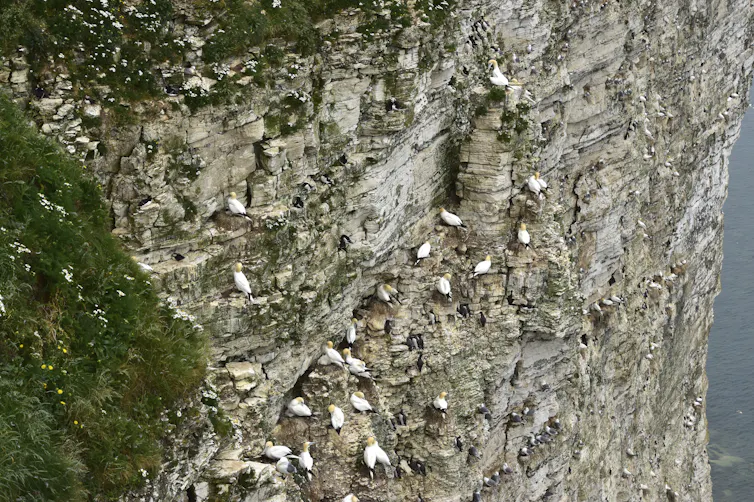
    Nesting northern gannets, guillemots and razorbills at the RSPB Bempton Cliffs reserve on the Yorkshire coast. Robert Simmons

    Richard Gregory, UCL

    A visit to a seabird colony in summer is an assault on the senses. First there’s the noise, then the overwhelming ammonia smell that stains the memory, and then the swirl of colour and activity on the white-washed cliffs.

    When you’re standing hundreds of metres above the crashing sea, there can be hundreds or thousands of breeding seabirds in the air or on the sea below, or precariously perched on poorly made nests or ridiculously narrow ledges.

    In these seabird cities you can spot tender moments, like an auk delicately turning its single egg for incubation while another feeds its oversized youngster. Brutality is never far either: a chick snatched to feed a bigger brood, an incoming parent robbed of its hard-won fish supper by a piratical gull, a dead bird bobbing face down on the sea.

    All life is here in the seabird colony, and the British Isles is particularly rich.

    This string of islands in the North Atlantic is home to nearly 30 species of seabird and hosts large portions of their total populations. Most of the world’s Manx shearwaters (90%), northern gannets (70%) and great skuas (60%) nest here, as do more than 20% of the European population of nine seabird species.

    British people have a special responsibility to protect these birds that are a harbinger of ocean health, sitting as they do at the top of a delicate food chain.

    Sadly, a new scientific assessment has reported alarming declines over the last 25 years in the UK’s seabird populations. Five new species have joined the “red List”, which denotes the highest category of conservation concern: Leach’s storm-petrels, common gulls, great black-backed gulls, Arctic terns and great skuas. These join the already listed kittiwakes, herring gulls, roseate terns, Arctic skuas and puffins, which are all highly threatened.

    On the upside, if there is an upside, two seabirds were judged to be less threatened based on new data. Shags and black guillemots moved to the amber and green list respectively, though both are gradually declining. Nearly 40% of breeding seabirds are now red-listed in the UK – and 73 bird species overall (30% of the UK total).
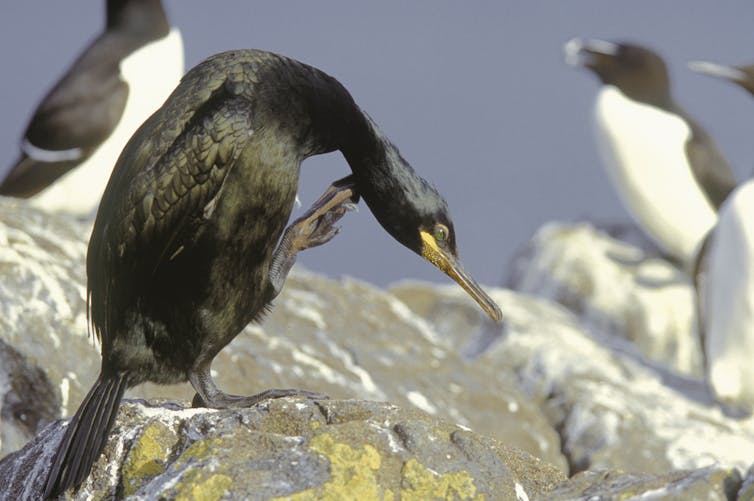
    A large black bird scratching its neck with a webbed foot.
    A silver lining: shags have recovered enough to be removed from the red list. Andy Hay

    Looking down

    Seabirds face many threats. Among the gravest are changes to their food supply linked to overfishing and climate change.

    Ocean warming disrupts and shifts the life cycles of seabird prey, such as sandeels, and the resulting scarcity can cause populations to collapse. Increasingly severe winter storms and summer heatwaves also kill seabirds.

    The broader effects of climate change and the warming of the ocean are difficult to predict, but the associated increase in acidification and lower oxygen levels are certain to upset food webs.

    Entanglement in fishing gear, invasive predators and collisions with offshore turbines present yet more challenges.

    On top of all this came the highly pathogenic HPAI H5N1, a new strain of the avian influenza virus that was first detected in the UK in 2021 and has resulted in the deaths of tens of thousands of seabirds and affected almost every seabird species.

    HPAI H5N1 was first identified in domestic waterfowl in southern China in 1996 and rapidly spread into their wild relatives. Migratory species carried the virus around the world, and still do. Thankfully, human deaths remain extremely rare. The jump into seabirds was unexpected as, until then, it was found mostly in wild waterfowl and domestic poultry.

    Seabirds such as terns, gulls, auks and northern gannets were hit hard but the impact on great skuas was most striking. Their numbers are down by over 70% from the last census, which was taken between 2015 and 2021.
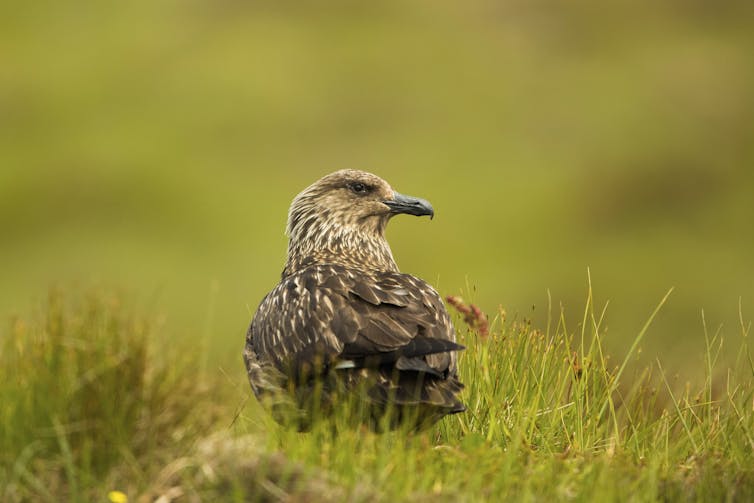
    A large brown seabird.
    A great skua at nest on Handa Island off the west coast of Scotland. Louise Greenhorn

    Seabird lifestyles predispose them to infectious disease and make it hard for them to recover. Seabirds typically produce just a few young (often only one) in a single brood each year. At least these birds are long-lived and can continue to breed throughout their lives. But living in dense, crowded colonies at a few sites that they can fly between means diseases can easily spread and take hold.

    Looking up

    The story is not all doom and gloom – much is happening to aid their recovery.

    The UK and Scottish government decided to close sandeel fisheries in the English North Sea and all Scottish waters from 2024. Many seabirds, including kittiwakes and puffins, depend on sandeels to feed their chicks, and so the moratorium is a positive move that should be sustained.

    Far-sighted projects to remove invasive predators, especially rats, from seabird islands across the UK are also showing great results. The removal of brown and black rats from Lundy Island, Devon, led to the immediate return of breeding Manx shearwaters and puffins after an absence of many years.
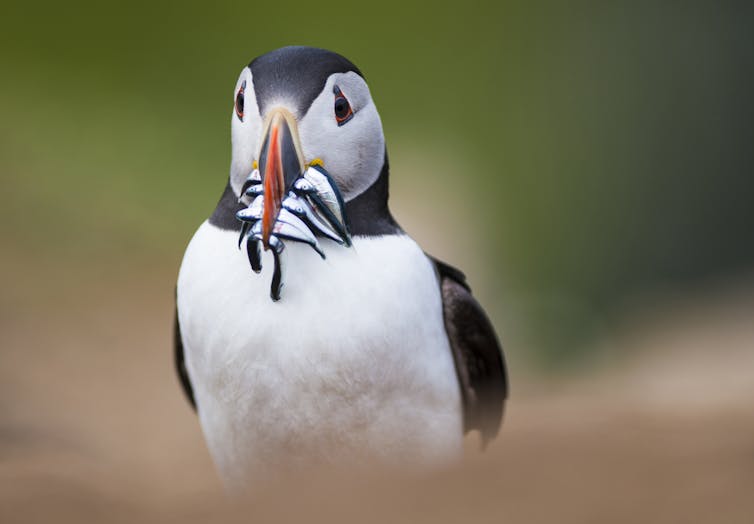
    A puffin with a beak full of sand eels.
    Atlantic puffins remain on the red list, but will benefit from a sandeel fishing ban. Katie Nethercoat

    Marine protected areas such as Lyme Bay on the south coast of England are proof that sustainable fishing and conservation can go hand in hand (even if these sites are typically tiny). Trawlers were excluded from Lyme Bay in 2008 and the area has been managed by the local fishing industry and conservationists. A decade on from the ban, bottom-living seafans, rare corals, shellfish and fishes have all bounced back wonderfully.

    More is needed to reverse the fortunes of seabirds. Well-resourced national seabird conservation strategies should protect colonies from invasive predators, extend and improve the country’s patchwork of marine protected areas, encourage more nature-friendly marine development (including for renewables) and better manage fisheries to ensure there is enough for seabirds to eat and less accidental bycatch in fishing gear, which kills thousands of seabirds in UK waters each year.

    Our seabirds are special in many ways. I’d recommend a visit to a seabird colony, to drink in the spectacle and reflect on the lives of these birds and our responsibilities to them.


    Imagine weekly climate newsletter

    Don’t have time to read about climate change as much as you’d like?
    Get our award-winning weekly roundup in your inbox instead. Every Wednesday, The Conversation’s environment editor writes Imagine, a short email that goes a little deeper into just one climate issue. Join the 35,000+ readers who’ve subscribed so far.


    Richard Gregory, Honorary Professor of Genetics, Evolution & Environment, UCL

    This article is republished from The Conversation under a Creative Commons license. Read the original article.

  • Scottish public at risk as fire services face years of cuts

    Spread the love

    https://morningstaronline.co.uk/article/scottish-public-risk-fire-services-face-years-cuts

    Firefighters from the Fire Brigades Union (FBU) take part in the Cuts Leave Scars rally outside the Scottish Parliament in Edinburgh, calling for an end to cuts imposed on the Scottish Fire and Rescue Service over the last 10 years, October 26, 2023

    YEARS of cuts in fire and rescue services in Scotland have left public safety at risk as emergency response times lengthen and fewer fire appliances can be mobilised.

    The Fire Brigades Union said (FBU) firefighter numbers are the lowest since eight regional fire brigades merged to form the Scottish Fire and Rescue Service (SFRS) in 2013 — down from 4,159 full-time posts to 3,422, a loss of 737 jobs.

    The number of control room staff, who take emergency calls and mobilise crews, fell from 234 to 172.

    Part-time retained firefighters, who cover 80 per cent of Scotland, including rural and island communities, saw 344 front-line jobs go.

    …

    https://morningstaronline.co.uk/article/scottish-public-risk-fire-services-face-years-cuts

  • Scots oppose building of mega-resort in Loch Lomond

    Spread the love

    https://morningstaronline.co.uk/article/scots-oppose-building-mega-resort-loch-lomond

    People walking on Conic Hill, above Loch Lomond at Balmaha

    THE people of Scotland have sent a “loud and clear” message that mega-resort Flamingo Land is not welcome at Loch Lomond, campaigners said today after more than 150,000 people objected.

    The record number of planning complaints against the “damaging and destructive” plan to build in Scotland used a campaign portal set up by the Scottish Greens.

    The Yorkshire-based theme park operator’s proposal would cram 104 woodland lodges, two hotels, a waterpark, a monorail, 372 car parking spaces, shops and more onto the banks of Loch Lomond at Balloch.

    The number of objections put forward makes it the most unpopular planning application in Scotland’s history, more than doubling the previous record held by Flamingo Land’s failed first attempt, opposed by nearly 60,000 people.

    Groups including the National Trust for Scotland, Woodland Trust and Ramblers Scotland as well as the local community council have also opposed the proposals.

    …

    https://morningstaronline.co.uk/article/scots-oppose-building-mega-resort-loch-lomond

  • Scottish government suspends all meetings with Israel

    Spread the love

    Original article republished from MEMO under a Creative Commons Attribution-NonCommercial-ShareAlike 4.0 International License. 

    Flag of Scotland [Getty]

    The Scottish government announced Monday that it had suspended all meetings with Israeli ambassadors until “real progress” is made towards peace in the Gaza Strip and unimpeded access is granted to humanitarian assistance to the enclave, Anadolu Agency reports.

    In a statement, External Affairs Secretary, Angus Robertson, said the Scottish government would not accept any invitation for a further meeting with Israel until there was real progress on the Gaza conflict.

    “This will remain our position until such time as real progress has been made towards peace, unimpeded access to humanitarian assistance is provided and Israel cooperates fully with its international obligations on the investigation of genocide and war crimes,” said Robertson.

    This came after a recent meeting between Robertson and Israel’s Deputy Ambassador to the UK, Daniela Grudsky, about two weeks ago, sparking criticism within the Scottish National Party (SNP).

    The External Affairs Secretary said his view was that, given Grudsky had requested the meeting this was “an opportunity to express the Scottish Government’s clear and unwavering position” on the need for an immediate ceasefire in Gaza. And I did exactly that, “he added.

    OPINION: The gloves come off as two-faced Israel and its lackeys search desperately for friends

    “No one intended that this meeting be presented as legitimising the actions of the Israeli government in Gaza,” he noted, expressing that the Scottish Government has been consistent in its “unequivocal condemnation of the atrocities” in the Palestinian enclave.

    Noting that many had seen the meeting as a sign of normalisation between the Israeli and Scottish governments, Robertson stressed that it was clear that it would have been better to ensure that its agenda was strictly limited to the need for an immediate ceasefire in Gaza .

    “I apologise for the fact that this did not happen,” he said.

    Robertson added that, “going forward, it is clear that, having now spoken directly to the Israeli Government and making them aware of our position on an immediate ceasefire, it would not be appropriate to accept any invitation for a further meeting.”

    Highlighting that this would remain the Scottish government’s position until real progress on a ceasefire is made, he said: “The Scottish Government does not support any normaliation of its relations with the Israeli Government during this period.”

    “The Scottish Government will never hold back in expressing support for an immediate ceasefire in Gaza, the release of all hostages, an end to UK arms being sent to Israel and the recognition of a sovereign Palestinian State within a two-state solution.”

    Former Scottish First Minister, Humza Yousaf, welcomed the statement, saying Robertson has “clearly listened and reflected on the anger and upset” in relation to his meeting with the deputy Israeli ambassador.

    “Crucially, he has made it clear there cannot be normal relations with the Govt of Israel,” Yousaf said on X.

    READ: British Foreign Office official resigns over Israel arms sales, war crimes in Gaza

    Original article republished from MEMO under a Creative Commons Attribution-NonCommercial-ShareAlike 4.0 International License. 

  • History made as UN children’s Rights convention put into Scots law

    Spread the love

    https://morningstaronline.co.uk/article/history-made-un-childrens-rights-convention-put-scots-law

    Minister for children and young people Natalie Don during a visit to TASK Childcare in Glasgow to mark International Women’s Day, March 8, 2024

    THE UN Convention on the Rights of the Child (UNCRC) came into legal force in Scotland today.

    Hailed as a “historic day,” it marks the end of a long journey for legislation first passed unanimously in Holyrood in March 2021 before being struck down in the Supreme Court on the grounds it breached devolution conventions by impinging on UK-wide law.

    After a period of reconsideration and redrafting, the legislation was once backed by all MSPs in the Scottish Parliament last year, this time avoiding a constitutional stand-off and making it onto the statute book.

    The NSPCC’s Joanna Barrett called it “a significant milestone in making sure that all children’s rights are recognised, respected and upheld.”

    …

    https://morningstaronline.co.uk/article/history-made-un-childrens-rights-convention-put-scots-law