People take part in a Believe in Scotland march and rally in Edinburgh, September 2, 2023
SNP is on course to retain power in Holyrood as support for independence hit a four-year high of 54 per cent, according to a new poll.
Despite a year which has seen their former chief executive facing charges related to embezzlement, the loss of a leader, a coalition with the Greens and 38 seats at the general election, research since Wednesday’s draft budget suggests the SNP are on course to win 37 per cent of constituency votes and 32 per cent on the regional lists at the next Holyrood elections in 2026.
Writing in the Sunday Times — which commissioned the Norstat poll — expert Sir John Curtice suggests this would give SNP 59 seats in Holyrood, as Labour plunge to a new low of 20, and Reform win 13.
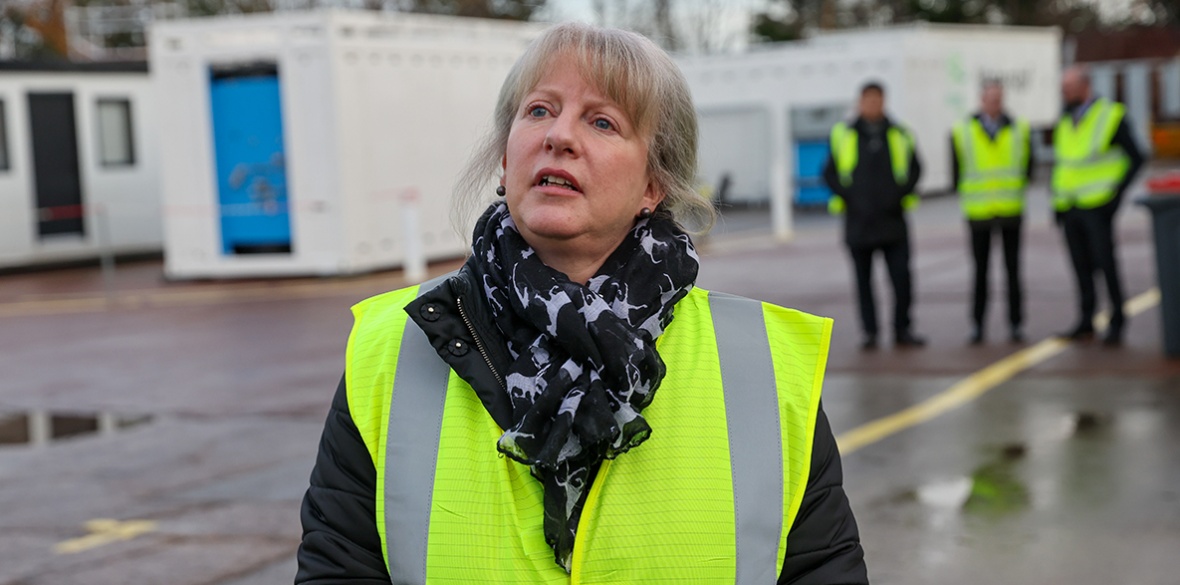
Finance Secretary Shona Robison during a visit to Logan Energy Limited in Edinburgh ahead of the publication of the Scottish Budget, December 4, 2024
SCOTTISH Finance Secretary Shona Robison announced that the two-child cap on benefits will be scrapped in Scotland as she pledged record spending for both the NHS and councils in next year’s Budget today.
The moved to scrap the cap would lift 15,000 children out of poverty, Ms Robison said.
She told MSPs as she outlined her draft Budget plans in Holyrood: “Be in no doubt that the cap will be scrapped.”
Ms Robison slammed the UK Labour government’s inaction on a “pernicious” policy considered to be a key driver of child poverty by organisations such as the Poverty Alliance.
She challenged the UK government to work with them and share the necessary information to “build a system” to mitigate it “as early as we can in 2026.”
King Charles III reads the King’s Speech, as Queen Camilla sits beside him during the State Opening of Parliament in the House of Lords, London, July 17, 2024
THE SNP has vowed to “sabotage” Labour’s “watered-down” House of Lords reforms with a deluge of amendments.
Labour’s House of Lords (Hereditary Peers) Bill, aiming to exclude the last remaining 92 hereditary peers from the legislature, faces its third reading in the House of Commons today.
But SNP MP Pete Wishart has tabled amendments ranging from abolishing the institution altogether to making peers’ £342 daily allowance liable for income tax.
Pointing to the “egregious example” of £18,808 paid to private healthcare tycoon Lord Hameed of Hampstead last year, despite him playing no role and failing to vote even once, Mr Wishart argues that taxing the £20 million paid out in allowances last year could generate over £9m — enough to restore Winter Fuel Payments to more than 22,000 pensioners in Scotland.
Urging Scottish Labour MPs to “at least” back him on taxing allowances, Mr Wishart commented: “That’s the only viable option for anyone who believes in democracy.
…
“The Labour Party has repeatedly broken its promise to abolish the House of Lords for more than a century and, frankly, this embarrassingly limited Bill is 114 years too little, too late.
“The undemocratic House of Lords is an archaic institution of the kind you’d find in a banana republic and it’s second only in size to the Congress of China costing taxpayers more than £200m a year.
No flamingos: Loch Lomond, Britain’s largest lake by surface area
THE Scottish government must pull the plug on Flamingo Land’s exclusive rights to build on the banks of Loch Lomond, the Scottish Greens insisted today.
The demand came after the company’s attempt to build a £40 million holiday resort, comprising two hotels, 100 holiday cottages, a waterpark and a monorail, was unanimously rejected for a second time by the board of the Loch Lomond and Trossachs National Park Authority on Monday.
Objections were received from almost 150,000 people, organisations such as the National Trust for Scotland and the Scottish Environment Protection Agency.
A visit to a seabird colony in summer is an assault on the senses. First there’s the noise, then the overwhelming ammonia smell that stains the memory, and then the swirl of colour and activity on the white-washed cliffs.
When you’re standing hundreds of metres above the crashing sea, there can be hundreds or thousands of breeding seabirds in the air or on the sea below, or precariously perched on poorly made nests or ridiculously narrow ledges.
In these seabird cities you can spot tender moments, like an auk delicately turning its single egg for incubation while another feeds its oversized youngster. Brutality is never far either: a chick snatched to feed a bigger brood, an incoming parent robbed of its hard-won fish supper by a piratical gull, a dead bird bobbing face down on the sea.
All life is here in the seabird colony, and the British Isles is particularly rich.
This string of islands in the North Atlantic is home to nearly 30 species of seabird and hosts large portions of their total populations. Most of the world’s Manx shearwaters (90%), northern gannets (70%) and great skuas (60%) nest here, as do more than 20% of the European population of nine seabird species.
British people have a special responsibility to protect these birds that are a harbinger of ocean health, sitting as they do at the top of a delicate food chain.
Sadly, a new scientific assessment has reported alarming declines over the last 25 years in the UK’s seabird populations. Five new species have joined the “red List”, which denotes the highest category of conservation concern: Leach’s storm-petrels, common gulls, great black-backed gulls, Arctic terns and great skuas. These join the already listed kittiwakes, herring gulls, roseate terns, Arctic skuas and puffins, which are all highly threatened.
On the upside, if there is an upside, two seabirds were judged to be less threatened based on new data. Shags and black guillemots moved to the amber and green list respectively, though both are gradually declining. Nearly 40% of breeding seabirds are now red-listed in the UK – and 73 bird species overall (30% of the UK total).
A silver lining: shags have recovered enough to be removed from the red list. Andy Hay
Looking down
Seabirds face many threats. Among the gravest are changes to their food supply linked to overfishing and climate change.
Ocean warming disrupts and shifts the life cycles of seabird prey, such as sandeels, and the resulting scarcity can cause populations to collapse. Increasingly severe winter storms and summer heatwaves also kill seabirds.
The broader effects of climate change and the warming of the ocean are difficult to predict, but the associated increase in acidification and lower oxygen levels are certain to upset food webs.
Entanglement in fishing gear, invasive predators and collisions with offshore turbines present yet more challenges.
On top of all this came the highly pathogenic HPAI H5N1, a new strain of the avian influenza virus that was first detected in the UK in 2021 and has resulted in the deaths of tens of thousands of seabirds and affected almost every seabird species.
HPAI H5N1 was first identified in domestic waterfowl in southern China in 1996 and rapidly spread into their wild relatives. Migratory species carried the virus around the world, and still do. Thankfully, human deaths remain extremely rare. The jump into seabirds was unexpected as, until then, it was found mostly in wild waterfowl and domestic poultry.
Seabirds such as terns, gulls, auks and northern gannets were hit hard but the impact on great skuas was most striking. Their numbers are down by over 70% from the last census, which was taken between 2015 and 2021.
A great skua at nest on Handa Island off the west coast of Scotland. Louise Greenhorn
Seabird lifestyles predispose them to infectious disease and make it hard for them to recover. Seabirds typically produce just a few young (often only one) in a single brood each year. At least these birds are long-lived and can continue to breed throughout their lives. But living in dense, crowded colonies at a few sites that they can fly between means diseases can easily spread and take hold.
Looking up
The story is not all doom and gloom – much is happening to aid their recovery.
The UK and Scottish government decided to close sandeel fisheries in the English North Sea and all Scottish waters from 2024. Many seabirds, including kittiwakes and puffins, depend on sandeels to feed their chicks, and so the moratorium is a positive move that should be sustained.
Far-sighted projects to remove invasive predators, especially rats, from seabird islands across the UK are also showing great results. The removal of brown and black rats from Lundy Island, Devon, led to the immediate return of breeding Manx shearwaters and puffins after an absence of many years.
Atlantic puffins remain on the red list, but will benefit from a sandeel fishing ban. Katie Nethercoat
Marine protected areas such as Lyme Bay on the south coast of England are proof that sustainable fishing and conservation can go hand in hand (even if these sites are typically tiny). Trawlers were excluded from Lyme Bay in 2008 and the area has been managed by the local fishing industry and conservationists. A decade on from the ban, bottom-living seafans, rare corals, shellfish and fishes have all bounced back wonderfully.
More is needed to reverse the fortunes of seabirds. Well-resourced national seabird conservation strategies should protect colonies from invasive predators, extend and improve the country’s patchwork of marine protected areas, encourage more nature-friendly marine development (including for renewables) and better manage fisheries to ensure there is enough for seabirds to eat and less accidental bycatch in fishing gear, which kills thousands of seabirds in UK waters each year.
Our seabirds are special in many ways. I’d recommend a visit to a seabird colony, to drink in the spectacle and reflect on the lives of these birds and our responsibilities to them.