Tag: UK
openDemocracy’s corruption revelations see UK plunge in global ranking
Original article republished from Open |Democracy under under a Creative Commons Attribution-NonCommercial 4.0 International licence.
Government rule breaches are to blame for UK’s corruption nadir, says Transparency International

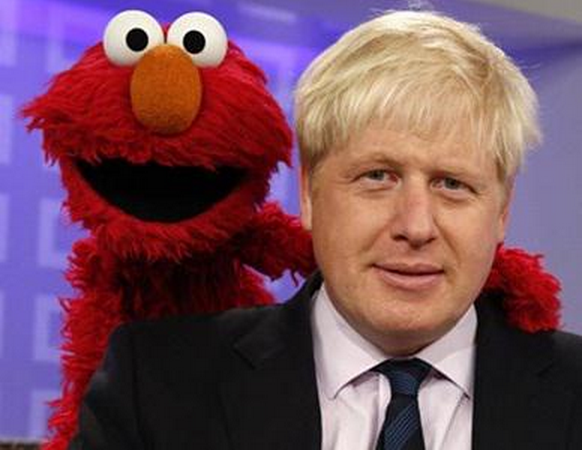
Image of Elmo and former Prime Minister Tory idiot Boris Johnson openDemocracy’s revelations of corruption in UK public life have been cited in a damning new index that ranks perceptions of Britain’s transparency at an all-time low.
A ‘poll of polls’ by Transparency International’s Corruption Perceptions Index (CPI) found industry experts think the UK is more corrupt than ever.
The UK’s CPI score is based on data from eight independent sources including the Economist Intelligence Unit and the World Economic Forum, who surveyed experts and business executives for their views on abuses of public office for private gain and bribery in the UK.
Britain scored 73 this year, down from 78 in 2022, on a scale where zero means a country is perceived as highly corrupt and 100 means it is perceived as very clean. The NGO cited several pieces of journalism by openDemocracy as partial explanation for the slump, which saw the UK tumble in the global rankings from 11th to 18th.
They include revelations in November 2021 that former Tory Party treasurers appeared to be guaranteed peerages so long as they donated more than £3m to the party.
The NGO also pointed to 40 potential breaches of the ministerial code in the last five years that were not investigated as another factor likely contributing to the UK’s fall in the rankings.
openDemocracy was cited as revealing four of these breaches, one of which involved the government keeping large payments to the former prime minister Boris Johnson and other ministers secret for up to eight months.
Other potential breaches discovered by this website include an MP failing to disclose that he owns a private PR company, and the blocking of Freedom of Information requests by a department that was then under Michael Gove’s watch.
Last year, the Cabinet Office insisted it would radically overhaul an ‘Orwellian’ government unit, almost two years after openDemocracy first revealed that it was vetting Freedom of Information requests.
Only five of the 180 countries assessed by Transparency for the 2022 Index saw their year-on-year scores drop by five or more points. The UK (-5) was joined by World Cup 2022 host Qatar (-5), Myanmar (-5), Azerbaijan (-7), and Oman (-8).
The countries perceived to be the least corrupt were Denmark, Finland and New Zealand, while those ranked most corrupt were South Sudan, Syria and Somalia.
Transparency International acknowledged that most countries at the bottom of its index were either currently experiencing conflict or had recently done so. It added that although most Western European countries had been ranked higher than African, Asian and Middle Eastern countries, they in fact played a central role in fostering global corruption.
“For decades, they have welcomed dirty money from abroad, allowing kleptocrats to increase their wealth, power and destructive geopolitical ambitions,” the report said.
Original article republished from Open |Democracy under under a Creative Commons Attribution-NonCommercial 4.0 International licence.
The state of UK’s water industry
The Guardian has a series of articles looking at UK’s water industry. Looks like it’s a cash cow for foreign investors with prices to consumers inflated to service debt and excessive payments to shareholders. Well worth a look (and tofu-eating is not mandatory ;) …
England’s water: the world’s piggy bank
England is one of the few countries in the world where water is fully owned by private companies. These companies answer to investors based thousands of miles away from their customers.
“What we have here is just a crazy system,” said Kate Bayliss, from the department of economics at SOAS University of London and author of several papers on England’s privatised water. “We are managing our water in the interests of offshore investors.”
These offshore investors include private and state-owned international funds, banks, multinationals and billionaires headquartered outside the UK, and they control at least 72% of English water, new Guardian research has found.
Here’s how England’s profitable water system has been sold off around the world:
…
Revealed: more than 70% of English water industry is in foreign ownership
Foreign investment firms, private equity, pension funds and businesses lodged in tax havens own more than 70% of the water industry in England, according to research by the Guardian.
The complex web of ownership is revealed as the public and some politicians increasingly call for the industry to be held to account for sewage dumping, leaks and water shortages. Six water companies are under investigation for potentially illegal activities as pressure grows on the industry to put more money into replacing and restoring crumbling infrastructure to protect both the environment and public health.
More than three decades after the sector was sold off with a promise to the public they would become individual small shareholders or “H2Owners”, control of the water industry has become dominated by overseas investment vehicles, the super-rich, companies in tax havens and pension fund investors. The ownership structure is such that transparency and accountability are limited, according to Dr Kate Bayliss, a research associate with the department of economics at Soas University of London.
…
Down the drain: how billions of pounds are sucked out of England’s water system
…
In the 30 years since England’s water was privatised by Margaret Thatcher, water companies have set up a system in which billions of pounds leave the network in an average year.
It’s money that could have gone towards building a more resilient water system, say academics. Among them, Dieter Helm, an Oxford professor of economic policy specialising in utilities, went as far as saying in 2021 that England’s water system was “a scandal of financial engineering”.
So where is the money going?
…
Just Stop Oil protests and arrests continue at Whitehall
Video report of Just Stop Oil protests at Whitehall by GBNews Just Stop Oil protests and arrests are continuing at the UK Houses of Parliament, Whitehall, London. There were 54 arrests on Tuesday, 25 today. Just Stop Oil are calling on the UK government to end new oil and gas.
Twenty-five supporters of Just Stop Oil have been arrested after blocking traffic in central London, on the sixth consecutive day of protest by the group.
At about midday on Thursday, two groups of protesters with the climate activist campaign walked into the road and stopped traffic at the roundabout by Trafalgar Square.
…
Supporters of Just Stop Oil have vowed to block the streets of Westminster every single day until the government agrees a halt to all new oil and gas projects. The latest arrests bring the number of arrests related to their protests to more than 100 since Sunday.
…
UK must insulate homes or face a worse energy crisis in 2023, say experts
https://www.theguardian.com/money/2022/sep/11/britain-insulate-homes-energy-crisis-2023-heat-loss-houses-subsidising-bills
Britain will be plunged into an even worse energy crisis in a year’s time without an immediate plan to improve leaky homes and dramatically reduce demand for gas, ministers have been warned.
The UK ranks among the worst in Europe for the energy efficiency of its homes, according to new research outlining an urgent need to reduce the amount of heat being wasted. Experts are warning that while Liz Truss has bought the government time with her £100bn-plus package to cap energy bills, similarly expensive and unsustainable schemes will be needed unless substantial plans are introduced to improve homes and reduce demand.
…
Experts believe a serious energy-efficiency programme could have a real impact within a year. The institute pointed to Germany as a success story, where grants, low-interest loans, tax rebates and free expert advice have all been used, resulting in high take-up figures.
…