Tag: UK

  • The United States and Canada Are Among the World’s Top 5 ‘Planet Wreckers,’ New Fossil Fuel Report Contends

    Spread the love

    Original article by Dana Drugmand republished from DeSmog.

    Just ahead of U.N. climate summit in New York City, analysis calls on governments to halt planned gas and oil projects
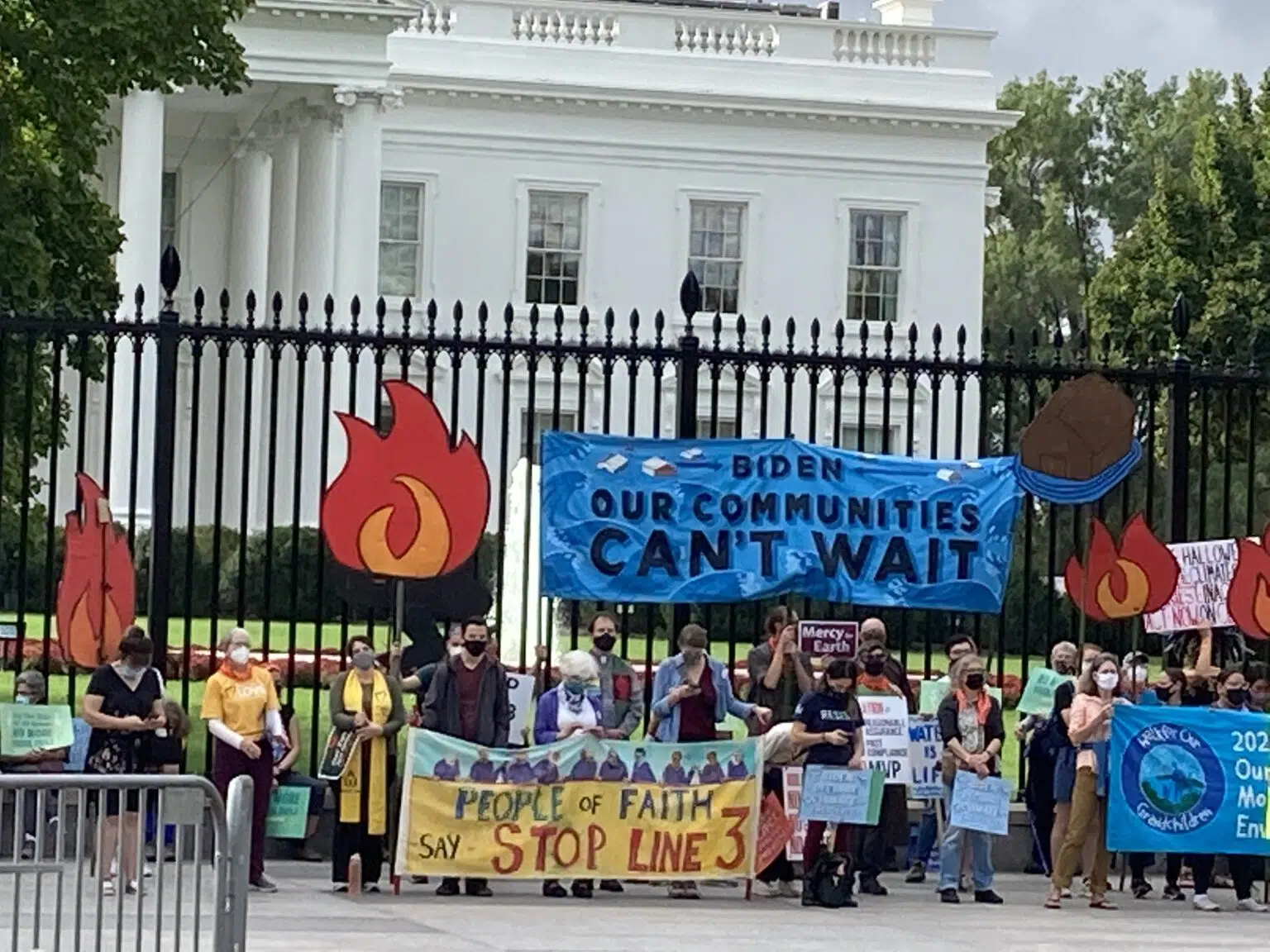
    Climate activists assembled at the White House during the People vs Fossil Fuels week of direct action in Oct. 2021. Credit: Dana Drugmand
    Climate activists assembled at the White House during the People vs Fossil Fuels week of direct action in Oct. 2021. Credit: Dana Drugmand

    United Nations chief António Guterres has called on nations to arrive at September 20’s high-level climate summit in New York City with firm commitments for ending fossil fuel production.

    So far, however, the world’s top 20 oil and gas extractors have enough production planned to generate 173 billion tons of carbon pollution by 2050 — more than enough to blow past their Paris Agreement commitments and heat the world well beyond 1.5 degrees Celsius above historical temperatures. The greatest polluter among them will be the United States.

    Those are some of the findings in a new report from the group Oil Change International, which has found that these 20 countries — dubbed the “planet wreckers” — are going to be responsible for almost 90 percent of the expected carbon emissions from planned oil and gas projects between 2023 and 2050.

    “A handful of the world’s richest nations are gambling our global future by failing to act and ignoring the scientific calls and evidence that we need to rapidly phase out fossil fuels,” said Kelly Trout, co-director of research at Oil Change International, who co-authored the report with colleague Romain Ioualalen.

    “Most countries are unfortunately still moving in the wrong direction,” she said.

    Oil and gas projects already planned by these nations will generate climate-heating CO2 emissions equivalent to 1,082 new coal plants, according to the report.  

    Based on their current plans, just five countries — the U.S. Canada, Norway, Australia, and the UK — will account for 51 percent of all new oil and gas projects through 2050, Trout found in her research.

    “Among all of the countries that we call out in the report, these are the five that have the greatest economic means and capacity to actually be phasing out their oil and gas production the fastest,” Trout said.

    The U.S. is both the largest historical carbon emitter and the world’s top oil and gas producer. Dubbed “planet wrecker in chief” in the report, it is on course to drive the most carbon pollution from planned oil and gas expansion by far. New oil and gas extraction in the U.S. will account for more than one-third of all planned projects over the next 25 years, creating 72.5 billion tons of CO2 emissions through 2050. 

    Canada, which is on track for 18.6 billion tons of cumulative carbon pollution through 2050, came in second. 

    Russia, the world’s second largest gas extractor and third largest oil producer, ranked third with 17.3 billion tons of CO2 expected from new production through 2050. Iran ranked fourth with 9.7 billion tons, and China rounded out the top five at 8.9 billion tons of expected carbon pollution.   

    Trout was not surprised by the outsized role of the U.S. “It’s a reflection of the reality that the oil and gas industry’s expansion has been unchecked for many years now in the United States,” she said. “President Biden has put very few limits on the oil and gas industry, and has even enabled the sort of expansion that we’re warning about in this report.”

    Since the beginning of 2023, the Biden administration has approved construction of multiple liquid natural gas export facilities. 

    Among the moves that have further outraged environmentalists, in March, the administration approved the Willow Project, a major ConocoPhilips oil drilling venture in the National Petroleum Reserve-Alaska, a federal wilderness on Alaska’s North Shore. Estimates put up to 600 million barrels of oil in the area where the project will be located.

    Just two weeks later, at the end of March, the Department of Interior held a large oil and gas lease sale in the Gulf of Mexico, leasing 313 tracts across 1.6 million acres.

    In June, as part of the debt ceiling deal negotiated between congressional Republicans and the White House, federal agencies fast-tracked Mountain Valley Pipeline, which will carry fracked gas about 300 miles from northwestern West Virginia to southern Virginia.   

    President Biden has also resisted calls from climate advocates to formally declare a climate emergency, even as the annual number of billion-dollar climate disasters continues to mount. Among them: Phoenix, Arizona set a new record for enduring 31 consecutive days over 110 degrees Fahrenheit, Vermont suffered its worst flooding in nearly a century, and the Hawaiian city of Lahaina was destroyed by one of the deadliest wildfires in U.S. history. 

    In an August interview on the Weather Channel, Biden said he had “practically” declared a climate emergency, a statement that angered climate activists seeking more concrete action. 

    Against this backdrop, tens of thousands are expected to take to the streets of New York on September 17 for a “March to End Fossil Fuels,” some with the explicit demand that President Biden stop U.S. expansion of oil and gas development. Mid-September actions and protests are also being planned in cities and towns worldwide.

    “Thousands of folks will be marching, not just in New York City but across the world to just say our future is on the line,” Trout said, “and a livable future for us all is completely incompatible with the expansion and continuation of the fossil fuel industry.”

    Original article by Dana Drugmand republished from DeSmog.
  • Scientists march on Parliament to demand MPs listen to no new oil demand

    Spread the love
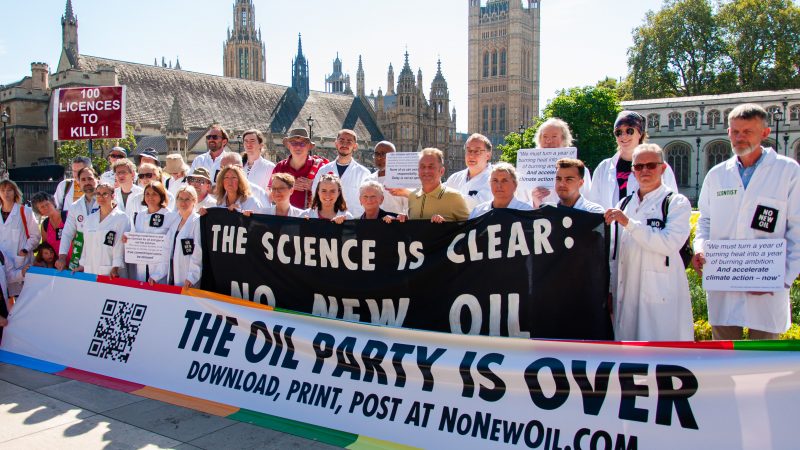
    Scientists protest at UK Parliament 5 September 2023.
    Scientists protest at UK Parliament 5 September 2023.

    https://leftfootforward.org/2023/09/scientists-march-on-parliament-to-demand-mps-listen-to-no-new-oil-plea/

    Over one hundred experts from across the country came together yesterday in the UK’s largest ever climate protest by scientists to demand MPs say no to new oil and gas.

    This July the government approved the licensing of 100 new oil and gas fields, as Rishi Sunak pledged he would “max out” the UK’s oil and gas reserves in a move blasted catastrophic by experts.

    Now climate change experts have left their labs to take to the streets of Westminster to tell the Prime Minister and MPs that the plans are just not feasible, and that they must listen to the science.

    Campaigner and scientist Emma Smart told Left Foot Forward why scientists were taking action, many for the first time.

    …

    “The government isn’t acting on the science- the truth- and the media aren’t reporting it, consequently the public are not aware of the scale or urgency of what we are currently facing”, said Smart.

    “But scientists are acutely aware, even if their discipline isn’t directly climate science. That’s why many are moving from publication to public action, for they feel it is now their duty in a climate crisis to not just write science, but to shout it from the streets.

    “Historically, non-violent direct action has delivered the necessary pressure on these ‘pillars of power’ and now scientists are leaving their labs and taking to the streets to drive the change we so desperately need.”

    She added: “Watch this space – scientists are refusing to be bystanders anymore.”

    …

    https://leftfootforward.org/2023/09/scientists-march-on-parliament-to-demand-mps-listen-to-no-new-oil-plea/

  • Europe cracks down on ‘direct action’ climate protests

    Spread the love

    Insight: Europe cracks down after rise in ‘direct action’ climate protests

    • Summary
    • France, German states use wiretaps, GPS to track activists
    • Bavaria tries to stop protests with preventative detention
    • Berlin police spend more than 400,000 hours on climate cases
    • France outlaws one group, German states consider ban

    BERLIN, Aug 10 (Reuters) – Simon Lachner had plans to glue himself to a German city thoroughfare in June to call public attention to climate change. Instead, he ended up in police custody before he’d even left his home.

    Lachner, 28, is one of thousands of activists caught up in a European crackdown on a wave of direct action protests that gathered pace last year demanding urgent government action against climate change.

    Roadblocks on major motorways in Britain have caused traffic chaos, protests at oil installations in Germany have disrupted supplies, and in France, thousands of activists and police clashed over water usage, leaving dozens injured.

    Determined to prevent such protests from strengthening further, states in Germany and national authorities in France are invoking legal powers often used against organised crime and extremist groups to wiretap and track activists, Reuters found, based on conversations with four prosecutors, police in both countries and more than a dozen protesters.

    In Berlin alone, police have spent hundreds of thousands of hours working on more than 4,500 incidents registered against the “The Last Generation” and “Extinction Rebellion” groups, according to previously unreported data from police.

    State authorities in Germany are widely using preventative detention to stop people from protesting, including holding at least one person for as long as 30 days without charge, which is permissible under Bavarian law, the prosecutors consulted by Reuters said.

    Lawmakers passed new surveillance and detention laws in France in July and in Britain in May, with Britain making it illegal to lock, or glue, yourself to property.

    …

    Insight: Europe cracks down after rise in ‘direct action’ climate protests

  • UK told to prepare for possible 30% increase in uncomfortably hot days

    Spread the love

    https://www.theguardian.com/environment/2023/jul/13/uk-told-to-prepare-for-possible-30-increase-in-uncomfortably-hot-days

    Britain and Switzerland among countries that need to adapt most for heating, says research looking at impact of 2C global rise

    The UK and Switzerland will see a 30% increase in the number of days of uncomfortably hot temperatures if the world heats by 2C, and are two of the countries which need to adapt the most for global heating, scientists have predicted.

    The research, published in Nature Sustainability on Thursday, found that while central Africa will see the most extreme temperatures overall, it is mostly northern European countries that will experience the greatest relative increases in uncomfortably hot days.

    The people and infrastructure in these countries are not prepared for periods of hot weather, the study, based on climate modelling and data from the UK Met Office, predicts. The estimates by researchers at the University of Oxford are conservative, and do not include external factors such as extreme heatwaves, which would come on top of this average increase.

    Norway will also suffer one of the world’s most dramatic increases in days that require cooling interventions, the study finds, with a 28% increase in days with uncomfortably hot temperatures if the world misses the 1.5C target. Eight of the 10 countries with the greatest relative increase in uncomfortably hot days are expected to be in northern Europe.

    …

    https://www.theguardian.com/environment/2023/jul/13/uk-told-to-prepare-for-possible-30-increase-in-uncomfortably-hot-days

  • An ‘extreme’ heatwave has hit the seas around the UK and Ireland – here’s what’s going on

    Spread the love

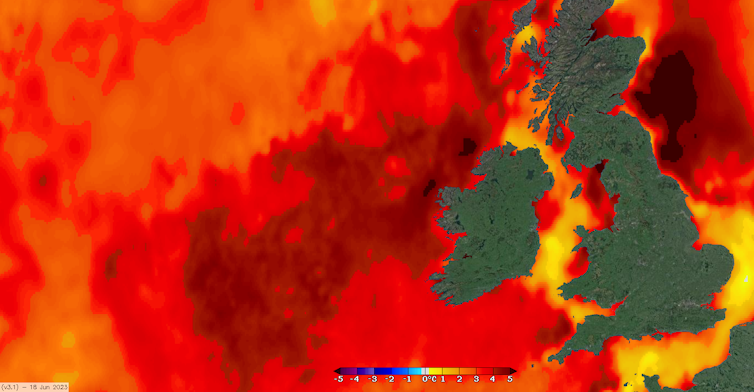
    Sea surface temperature anomaly around the UK and Ireland, June 18 2023. Areas in dark red are 5°C warmer than usual.
    NOAA / Google Maps, CC BY-SA

    Tom Rippeth, Bangor University

    One of the most severe marine heatwaves on the planet is taking place in the shallow seas around the UK and Ireland. That’s according to the US National Oceanic and Atmospheric Administration (NOAA), which has labelled this a “Category 4” heatwave. Rarely used outside of the tropics, a cat 4 heatwave means “extreme” heat.

    Marine heatwaves are classified as “prolonged periods of anomalously high sea surface temperature”, when compared to the long-term average for that time of year. And thanks to measurements made by satellites orbiting the earth we know that, in some areas around the UK, surface water temperatures are 4°C to 5°C above normal for mid June.

    This is extremely unusual: buoys around Ireland and the UK have been recording sea surface temperature for over 20 years, and in that time it has never been this hot this early in the summer.

    The heatwave is strongest in the northern North Sea, northwest of Ireland, and the Celtic Sea between Cornwall and southern Ireland. However, in other areas, such as the southern North Sea, the English Channel and the southern Irish Sea, the surface temperatures are only a degree or so above normal.

    The two regions are very different in oceanographic terms. The latter areas tend to be shallower (30-40 metres) with stronger tidal currents and so the water remains well mixed from the surface to the sea bed, all year around. In contrast, the regions where the heatwave is strongest are deeper (80-100 metres) with weaker tidal currents. As the mixing is weaker these seas “stratify” each summer, with a layer of warmer water overlying the cooler deeper layer.

    In these seasonally stratifying regions the heat from the sun only warms the relatively shallow surface layer, while in the mixed regions the sun’s impact is diluted as its heat is mixed through the ocean from seabed to surface.

    Oceans are slow to warm up and cool down

    The temperature of the atmosphere can vary a lot day to day. You might find yourself wearing a jumper on Monday but shorts and a t-shirt by Wednesday. But oceans are different – their ability to absorb lots of heat means temperature varies slowly and extremes are rare.

    In seasonally stratified regions the stratification starts to develop in late May, with the maximum sea surface temperatures happening in August. At these locations you would still only expect the temperature to vary by 10°C or so over the whole year (in contrast with the atmosphere where such shifts happen in a matter of hours).

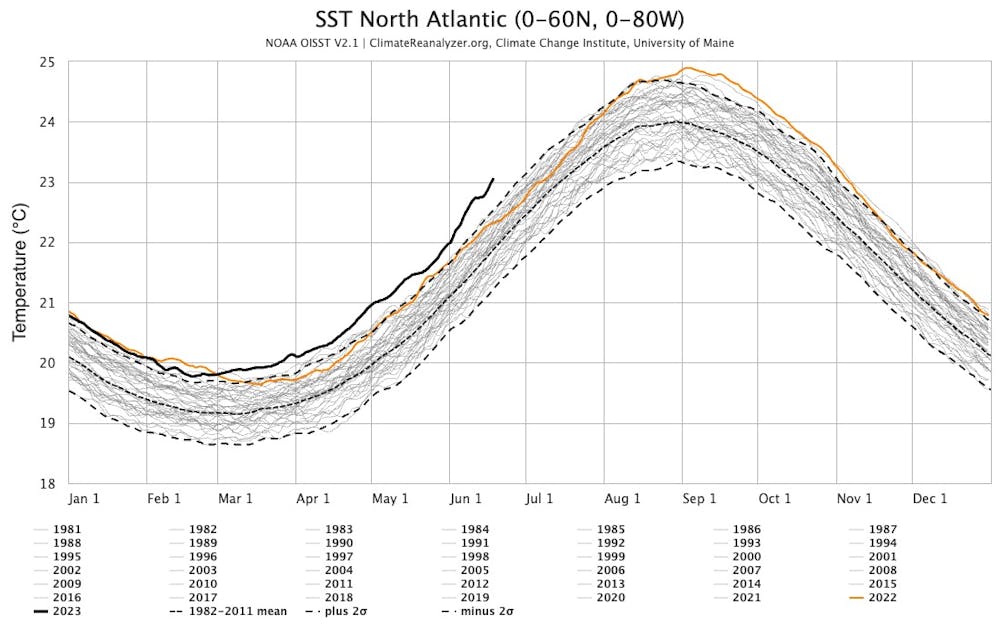
    In this latest heatwave, the sea surface is up to 5°C warmer than normal two months before we’d expect to see the maximum temperatures.

    North Atlantic temperature patterns

    Graph of sea surface temperatures
    Across the North Atlantic, the sea surface is warming faster than ever before (thick black line = 2023; orange = 2022; grey lines = 1981-2019)
    NOAA / climatereanalyzer.org, CC BY-SA

    I would speculate part of the reason for these anomalously high temperatures in stratified seas is that the surface layer is shallower than usual and so the sun’s heat is more concentrated (probably a result of relatively stable weather and lack of Atlantic storms crossing the UK in the past month). As such, these already very warm areas will warm further until a sufficiently strong storm comes along and mixes the heat down into a thicker surface layer.

    Fish may go hungry

    One reason this heatwave is so significant is because those stratified seas on the continental shelf around Britain and Ireland are some of the most biologically productive on the planet. They have long been an important area for fishing cod, haddock, mackerel and other species. Those fish eat smaller fish and crustaceans, which in turn feed on microscopic plants known as plankton.

    At this time of year, these plankton are dependent on nutrients mixed up from the deep water into the surface layer. However, this year, this nutrient supply may be diminished, since the very high surface temperature means there is likely stronger stratification and less mixing.

    A heatwave on the surface could potentially harm the deeper ocean too, and the fish that live there. These continental shelf seas are already suffering from a decline in deep water oxygen, which is partly offset by mixing oxygen-rich water from the surface. However, the fact that the surface temperatures are so high point to a lack of mixing between the layers, and in any case, warmer water contains less oxygen.

    On a slightly longer timescale, we already know that climate change is affecting these seas. Some warm water fish species are appearing in UK waters for instance, and native fish reproduction cycles and those of the plankton they feed on are no longer in perfect sync. This extreme heatwave may be a sign of further changes to come.


    Imagine weekly climate newsletter

    Don’t have time to read about climate change as much as you’d like?

    Get a weekly roundup in your inbox instead. Every Wednesday, The Conversation’s environment editor writes Imagine, a short email that goes a little deeper into just one climate issue. Join the 20,000+ readers who’ve subscribed so far.The Conversation


    Tom Rippeth, Professor of Physical Oceanography, Bangor University

    This article is republished from The Conversation under a Creative Commons license. Read the original article.