Home Farm Road, where L3Harris Factory operates, covered in fake blood with the message ‘L3Harris KILLS KIDS’
ACTIVISTS targeted an arms factory in Brighton which makes parts for fighter jets used by the Israeli military on Thursday.
The protesters sprayed the L3Harris factory with fake red blood and scrawled “L3Harris kills kids” near the entrance.
The firm continues to make bomb release mechanisms for F-35 fighter jets, which were excluded from the government’s embargo on 30 arms licences to Israel last month.
The jets have been used to drop 2,000lb bombs on Gaza and now in Israel’s attacks on Lebanon.
Locals have been campaigning for the factory’s landlord Paxton Access to evict the firm from the premises.
The community-wide campaign, spearheaded by StopL3Harris, has also called on the local council as freeholders of the land to shut it down.
UK Foreign Secretary David Lammy says that UK is suspeding 30 of 350 arms licences to Israel. He also confirms the UK government’s support for Israel’s Gaza genocide.
UK Foreign Secretary David Lammy met with US Secretary of State Antony Blinken in Kyiv earlier this month (Leon Neal/AFP)
Ministers and arms company executives could face indictment and a jury trial if arms transfers continue, two rights groups say
Top British officials have been warned they could face criminal liability if they continue to export UK-made components for F-35 fighter jets that might end up in Israel.
The warning, issued in letters sent on Friday to the foreign, business and defence ministers, comes from two groups threatening fresh legal action in the High Court over the export of these parts.
Al-Haq, a Palestinian human rights organisation, and the UK-based Global Legal Action Network (Glan), told the ministers that they, along with arms company executives, could be indicted for aiding and abetting war crimes if they continue to transfer the components.
…
Shawan Jabarin, Al-Haq’s general director, said Israel has been carrying out “genocidal attacks on Palestinians in Gaza” for nearly a year.
“We know that Israeli air strikes and bombs using F-35 fighter jets have devastated densely populated areas, including shelters for displaced Palestinians,” Jabarin said.
“The insurmountable evidence that Israel is committing violations and international crimes means the UK government can’t feign ignorance.”
UK Foreign Secretary David Lammy says that UK is suspeding 30 of 350 arms licences to Israel. He also confirms the UK government’s support for Israel’s Gaza genocide.
Hedge fund Quadrature Capital has given £4m to Keir Starmer’s Labour – the largest donation in the party’s history | Jack Taylor – WPA Pool / Getty Images
Quadrature’s donation is noteworthy not just for being Labour’s largest-ever, but for its timing ahead of election
The Labour Party’s largest-ever donation came from a Cayman Islands-registered hedge fund with shares worth hundreds of millions of pounds in fossil fuels, private health firms, arms manufacturers and asset managers.
While the £4m donation by Quadrature Capital is the sixth-largest in British political history, it is noteworthy not just for its size, but also its timing.
Electoral Commission records suggest Labour received the donation in the one-week window between former prime minister Rishi Sunak announcing the general election and the start of the ‘pre-poll reporting period’ in which all political donations over £11,180 had to be published weekly, rather than the quarterly norm.
This means that despite being made on 28 May, Quadrature’s generous donation was published by the Electoral Commission only last week, more than two months after Labour won the election.
Neither the Labour Party press office nor No 10 responded to openDemocracy’s questions on whether the timing of accepting this donation was intended to minimise scrutiny and critical coverage during the election.
Paul Holden, an investigative journalist and author of The Fraud, a forthcoming book on Starmer’s leadership, told openDemocracy that the donation’s timing fits the Starmer project’s pattern of delaying the disclosure of potentially sensitive or controversial political donations.
Holden said: “Sir Keir Starmer and the organisations close to him have an unfortunate history of reporting donations in controversial ways.
“During his bid to become leader of the Labour Party, Starmer refused to contemporaneously publish details of who had donated to his leadership campaign. His rivals, Rebecca Long-Bailey and Lisa Nandy, agreed to share details of their donors in real-time, which they published. Starmer, however, decided only to declare his donations via his MP’s register of interests, which created a significant lag between when Starmer accepted his donations and when they were made public.
“Labour members, as a result, had no idea at the time of voting that Starmer had been funded with large donations from the likes of wealthy millionaires like Martin Taylor and Sir Trevor Chinn and Baron Waheed Ali; the latter now at the centre of the furore about Starmer’s acceptance of gratuities.”
Holden also referred to a fine issued by the Electoral Commission to Starmerite think tank Labour Together in 2021 for its failure to declare donations worth more than £800,000 – including £730,000 received while it was under the directorship of Starmer’s key adviser and No 10’s director of political strategy, Morgan McSweeney.
openDemocracy has consistently reported on Labour’s increasingly strong ties with the financial sector in recent years.
The party has received more than £8m from businesses or people linked to the financial industry since Starmer became leader in 2020 and now boasts two multi-million-pound donors from the world of hedge funds; Quadrature and Taylor, who has managed several billion-dollar funds over his career.
While Quadrature had not donated to Labour before May, one of its senior employees has contributed significantly to the party under Starmer. Daniel Luhde-Thompson, a strategic adviser at the firm, has given the party more than £500,000 this year, according to the Electoral Commission.
Transparency campaigners have warned Quadrature’s huge donation raises questions about what the financial sector is getting in return.
Rose Whiffen, senior research officer at Transparency International UK told openDemocracy: “When the public see political parties relying on such large sums of money in donations from private sources, it understandably raises questions as to in whose interest politicians are working and can give the impression our democracy is for sale.
“More must be done to take this kind of big money out of politics. The new government should commit to introducing caps on individual donations to tackle this problem [and] restore public trust in how our democracy functions.”
Green Party co-leader Zack Polanski told openDemocracy that the donation shows Labour now “stands for multi-millionaires and billionaires over our working-class communities”.
Polanski said: “Far from being the party in service of working people, Starmer’s Labour Party seems indebted to the bankers and bosses who profit from pillaging our public services and our planet.
“Simply ‘following the rules’ and declaring donations isn’t enough to cast aside the doubts that the main parties have their loyalties tested by big donors. It’s time to implement strict rules on funding political parties, including a cap on how much any individual or business can donate to politics. Elections should be won by the people with the best ideas, not the parties with the biggest donors.”
Registered in the Cayman Islands
Quadrature Capital has a diversified share portfolio worth around $6bn, according to records filed with the US Securities and Exchange Commission (SEC) last month.
After its donation was made public last week, the firm shared a statement on its website.
It said: “In May 2024, we came to the view that a UK government with a commitment to the green transition of the economy would have the ability to drive change that is so urgently needed. Having analysed commitments set out by each party, we donated £4m to The Labour Party, in support of policies that will deliver climate action while also promoting social equity and economic resilience.
“This was a values-based donation, not a political donation, as Quadrature Capital Ltd remains non-partisan and apolitical. Going forward, our private giving will continue to be led by our values, and any further donations to political parties will depend on the parties’ commitments, track record and alignment with our mission for sustainable and equitable growth.”
Last year, the Guardian reported that despite donating to environmental charities through its climate foundation, Quadrature had holdings in fossil fuel companies worth more than $170m. The paper highlighted three holdings in particular with major polluters: ConocoPhillips, Cheniere Energy and Cenovus Energy.
openDemocracy’s analysis of the firm’s latest SEC filings shows that Quadrature has since increased its holdings in Cenovus, which was this year fined millions for an oil spill that released 250,000 litres into the Atlantic Ocean. Quadrature has scaled back its holdings with the other two firms but has taken up a major $67m stake in ExxonMobil, one of the largest oil and gas producers in the world.
Among Quadrature Capital’s other investments, its largest holding is in Apple, valued at $231m, and among its 10 largest holdings are other ‘bluechip’ stocks like Amazon, Shopify and Costco.
Quadrature also maintains significant holdings in the arms manufacturers Northrop Grumman ($31m) and Lockheed Martin ($6m); US private healthcare companies such as UnitedHealth ($31m) and HCA Healthcare ($16m); some of the largest asset management companies like Blackstone ($22m) and KKR ($7m), who potentially stand to benefit significantly from Labour’s plans to utilise private investment for infrastructure; and tech firms, including Palantir ($71m) and Oracle ($8m).
UK accounts filings for the firm show profits before tax of more than £230m in the financial year ending 31 January 2023, but paid corporation tax of only £5.3m. As is noted in the accounts, had the firm paid the standard rate of UK corporation tax of 19% during that period, this would have amounted to more than £43m.
The UK-based fund paid out £343m in wages last year – an average of £3m for each of its 113 employees – while back in 2021 one of its founders was eyeing a luxury central London penthouse valued at around £110m, according to a report by Bloomberg that cited “two people with knowledge of the transaction”.
openDemocracy can reveal that Quadrature was last year acquired by QC Ventures, a company registered in the Cayman Islands, which is now the 100% shareholder in the firm.
The Cayman Islands is a well-known tax haven, and the transparency requirements for companies registered there are much less than in the UK and most other countries.
Documents obtained by openDemocracy show that when QC Ventures was established in the Cayman Islands back in 2018, its directors were three senior directors at Quadrature and a corporate services provider based in Cayman.
Speaking in the Commons in July, Labour’s foreign secretary David Lammy pledged to tackle individuals and companies taking advantage of offshore tax havens “with full vigour”.
He added: “We were concerned that parts of the last government were turning a blind eye to these issues. I hope to come forward with further proposals in the coming weeks.”
When openDemocracy contacted Quadrature to ask about the donation and the acquisition by QC Ventures, a representative of the firm directed us to the statement on the company’s website. They also said the decision to set up a holding company based in the Cayman Islands to acquire Quadrature was not motivated by, or related to, taxation.
Robert Palmer, director of Tax Justice UK, said that “any company moving to a tax haven like the Cayman Islands has questions to answer” as the islands are “notorious for a lack of transparency and for ultra-low taxes”.
“Ultimately governments need to make sure that everyone is paying their fair share in tax, especially when public services are desperately in need of investment and we need to fund the transition to a greener economy,” he said.
Fran Boait, co-executive director at Positive Money, said: “In taking large donations from financial firms registered in tax havens, we have to question what influence the sector is getting in return.
“Labour’s plans to continue the previous government’s deregulation of the City of London are particularly concerning, especially when it has been shown that an oversized financial sector hinders rather than helps the rest of the economy.
“Labour should be looking at how to weaken the power of big finance in our democracy and economy. Right now it seems they are doing the opposite.”
[dizzy: This article was published April 4, 2024 and refers to the United Kingdom’s previous Conservative government. Since then UK has a new Labour government under UK Prime Minister Keir Starmer. UK violating International law will not have changed since April 2024 and Keir Starmer should be well-aware of legal requirements since he is often referred to as a human rights legal expert.]
The UK government has received internal legal advice that Israel has broken international humanitarian law in its current war on Gaza. The advice was revealed by Alicia Kearns, the Conservative chair of the House of Commons foreign affairs select committee, in a speech to a fundraising event on March 13 and leaked to the UK’s Observer newspaper.
The paper quoted British barrister and war crimes prosecutor Sir Geoffrey Nice as saying: “Countries supplying arms to Israel may now be complicit in criminal warfare. The public should be told what the advice says.”
The Guardian has now revealed that the prime minister, Rishi Sunak, has since received a letter signed by 600 lawyers and academics, including three former supreme court justices – among them Baroness Hale, the court’s former president – as well as former court of appeal judges and more than 60 KCs, warning that UK arms sales to Israel are also illegal under international law.
But what does international law actually say on this issue, and what are the UK’s (and other nations’) legal obligations in relation to the ongoing assault on Gaza?
In recent months, a number of countries have announced they are suspending arms exports to Israel. These include Canada, Belgium, Italy, Spain and the Netherlands, as well as the Japanese company Itochu Corporation. Germany and the US – by far the biggest suppliers of arms to Israel – have not as yet signalled intentions to follow suit.
Neither has the UK. But with arms exports amounting to £42 million in 2022, it is not one of Israel’s major suppliers.
Suspending arms exports to Israel indicates not only political concerns, but also fear over the legality of continuing to support Israel militarily in its assault on Gaza. The Netherlands court of appeal ruled in February that the Dutch government must discontinue its sales of F35 fighter jet parts on the basis of its obligations under the UN arms trade treaty. A similar lawsuit is currently pending in Denmark which exports F35 parts to the US, which then sells the finished jets to Israel.
In the UK, the high court dismissed an attempt to challenge the government’s continued licensing of arms exports to Israel. But this was because the particular procedural hurdle that applicants in such cases have to get over is notoriously high. The judgment said nothing definitive as to Israel’s (or the UK’s) compliance with international law.
Following this, 130 MPs and peers from across party lines recently signed a letter to the foreign secretary calling on the government to suspend arms exports to Israel.
Arms trade treaty
So what is the position under international law of countries, such as the UK, that support Israel militarily? There are many specific and general rules of international law that are relevant here.
The most obvious, and the one emphasised in the British MPs’ letter, is found in the UN arms trade treaty, to which the UK is a party. Article 7 requires a risk assessment for all weapons transfers, and prohibits exports where there is an overriding risk that the weapons could be used to commit serious violations of international humanitarian law (the law of armed conflict).
The only objective test we have for determining risk of future violations is to examine whether there is evidence of a pattern of past violations by Israel. UN reporting of past serious violations is one of the key considerations that the UK’s own policy points to in determining future risk. In 2019, the UK court of appeal suspended arms exports to Saudi Arabia based on the government’s failure to assess whether past violations of international law had likely been committed in Yemen.
The available evidence suggests there have been countless examples of Israeli actions in Gaza that appear, on their face, to be inconsistent with international humanitarian law. Among the most recent examples are the Israeli attack on an aid convoy on April 1, the destruction of Gaza’s hospitals, and the well-documented famine that now engulfs the territory.
The Hague court of appeal that ordered the Dutch government to suspend arms exports to Israel relied on reports from Amnesty International and the UN when it listed multiple examples of apparent violations of the law of armed conflict in Gaza.
And in the long-awaited UN security council resolution adopted on March 25, with the US abstaining, the security council condemned “all attacks against civilians and civilian objects, as well as all violence and hostilities against civilians”, and demanded the flow of humanitarian assistance into Gaza, in line with international humanitarian law.
This suggests a pattern of past serious violations and thus a clear risk of continuing violations. So, signatories to the arms trade treaty continuing to supply weapons to Israel likely do so in breach of article 7.
Geneva conventions
Yet all nations have other obligations that take on particular importance in relation to Gaza. One of these is the obligation to prevent genocide under article 1 of the Genocide convention (which was the focus of the letter to the prime minister referred to above).
This is especially relevant since the International Court of Justice (ICJ) determined in January that there is an imminent risk of irreparable harm to the rights of Palestinians in Gaza under the Genocide Convention.
But it also includes article 1 of the 1949 Geneva conventions, which requires states to “ensure respect” for international humanitarian law. There is overwhelming support for the view that this requires all states not only to avoid aiding or assisting violations (for example, through arms exports) but to take proactive steps to ensure warring parties comply with their obligations under international law. They can do so via diplomatic channels or by imposing sanctions.
On March 1, Nicaragua instituted proceedings before the ICJ against Germany (the second-biggest arms exporter to Israel), in part alleging that it is violating article 1 of the Geneva conventions due to its support for Israel.
In this way, all countries are legally obliged to ensure that others comply with international humanitarian law. If the catastrophic destruction, massive civilian death toll and immense suffering of those still alive in Gaza is not enough to pull Israel’s allies into line over their continuing arms sales, it is difficult to conceive of any situation that ever could.
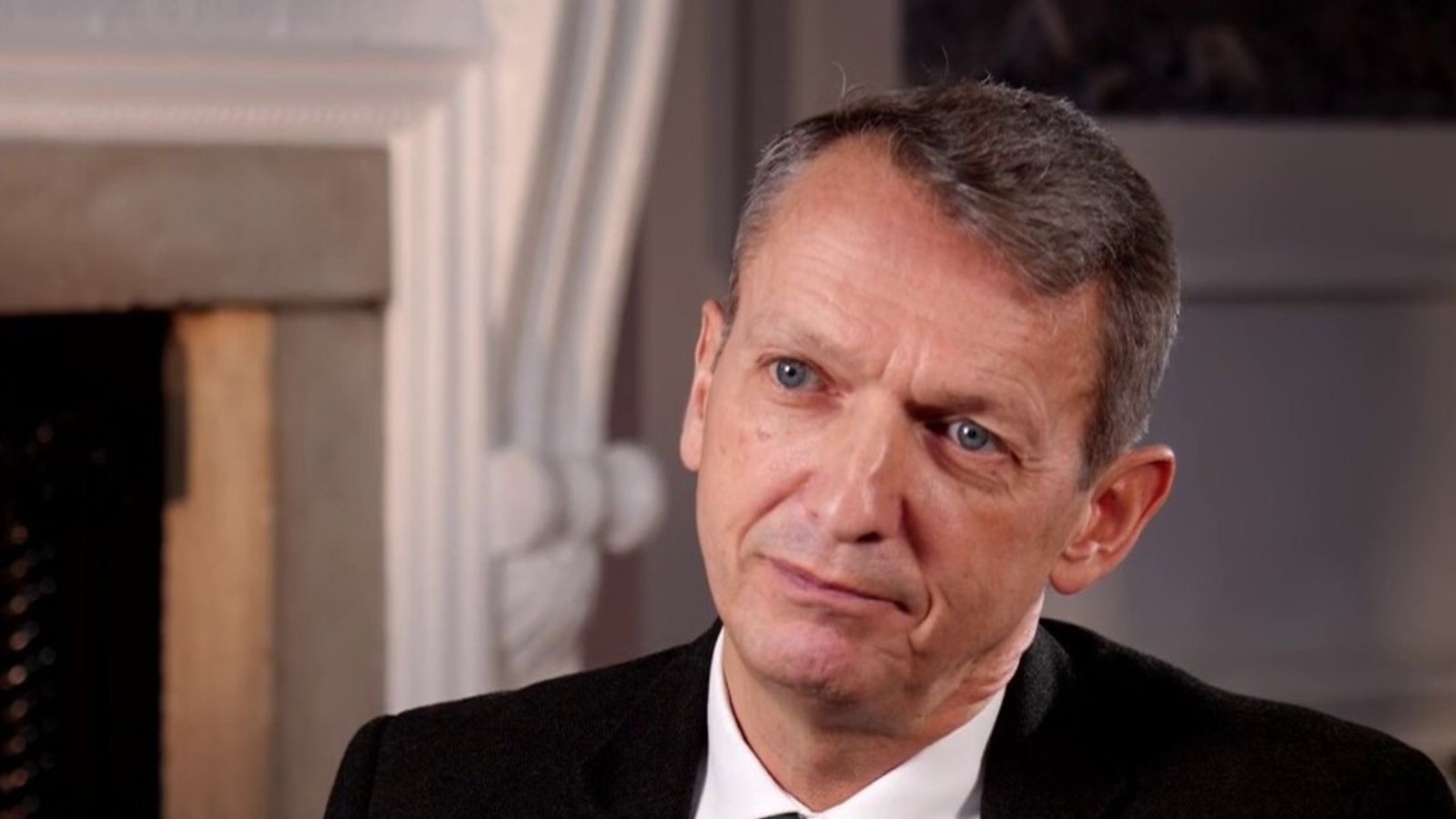
Former senior economist Andy Haldane told Sky News that Rachel Reeves’s comments earlier this summer had spooked consumers, businesses and investors.
The chancellor’s claim of a £22bn “black hole” in government finances was “unnecessary and probably unhelpful economically”, a former Bank of England chief economist has said.
Andy Haldane told Sky News’ Politics Hub with Sophy Ridge that Rachel Reeves’s statement in July was a “bad idea” because it generated a sense of “fear and foreboding” just when there was a new-found confidence in the UK.