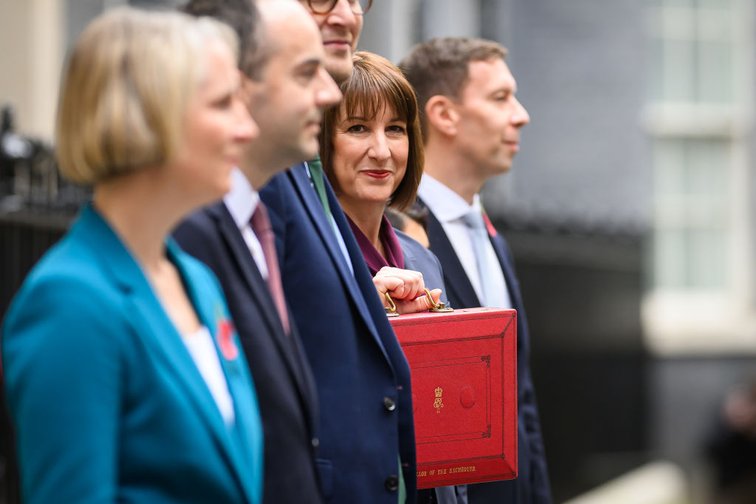
The Treasury is at the centre of a move to refocus the government’s agenda on ‘growth at all costs’ | Leon Neal/Getty Images
Exclusive: Government is inviting lobbyists and their clients to play a major role in the deregulatory agenda
“Growth comes from business, not the government.”
That was the message a government minister delivered to hundreds of corporate lobbyists, including those representing banks, arms companies and pharmaceuticals, during a webinar this morning.
Lord Livermore, the financial secretary to the Treasury, made the comments at the online event, which was the first in a series aimed at encouraging lobbyists to play a major role in the government’s ‘growth at all costs’ agenda.
In the call, which openDemocracy attended, Livermore made clear that Number 10 sees this agenda as being driven by corporations, while the government is a secondary actor that “work[s] in partnership with business”.
Also present among the 700 attendees were lobbyists representing tech firms, energy giants and consultancies, and those working for agencies including Hanbury, Headland, Lexington, Brunswick, Cavendish and Grayling.
These people and their clients are a “huge and important part” of the government’s plans, Livermore said, stressing that ministers are “really keen to draw on… the expertise that exists within your organisations and your clients”.
He added that the government’s focus is on getting rid of “stifling regulation that has for too long held business back” and “removing barriers to growth that we, in partnership with business, identify”.
The treasury minister also discussed Great British Energy’s role in “derisking investment” and providing capital for public-private partnerships, to make renewable infrastructure investment more attractive to the market.
While the government has been unapologetic about its outreach to business as a means to drive growth, Labour’s critics say an ever-closer relationship with lobbyists only heightens the impression of a government that does not have an agenda of its own.
Speaking to openDemocracy after the call, Green Party deputy leader Zack Polanski said: “With inequality rife, the government should be listening to the people who keep our country running and those suffering, not hosting desperate mass Zoom calls with arms dealers and oil giants.”
Cutting red tape
Setting out the government’s priorities, Livermore put a particular focus on achieving major reform to the planning system to encourage more commercial and infrastructure projects, and getting rid of regulations that “stand in the way of businesses investing”.
Livermore talked up the recent ousting of the head of the competitions regulator and his replacement with a former Amazon executive as evidence that the government is taking seriously its deregulatory agenda.
He also mentioned the recent push for regulators to submit proposals for growth and said Labour’s National Wealth Fund will “help catalyse private investment into sectors where at the moment, perhaps there’s a too high degree of risk”.
“We can use the National Wealth Fund to help derisk some of those investments,” said the minister. Economists describe this process as the state stepping in to improve the private returns on infrastructure assets.
Livermore continued that the fund could be used to “guide investments, particularly into the kind of clean energy investments of the future that we want to see”.
The government-lobbyist calls are being led by a new partnerships team in No 10 fronted by James Carroll, who has previously worked for the party on external relations and business engagement.
Also on the call was a senior executive at Anacta UK, described by The Times as the “first Starmerite lobbying firm”, and a banking lobbyist who is also involved in the running of Labour in the City, a group which convenes Labour supporters who work in financial services.
Lobbyists were able to submit questions during the call. One criticised “some parts of the business community” which have been “vocally critical about the government’s handling of the economy so far,” describing it as “unhelpful”.
They then asked: “How can firms who don’t want to talk down the UK but would rather promote a more positive narrative about the many opportunities open to British businesses best work with the government to do so?”
This prompted Carroll to quip: “I promise I haven’t planted that question.”
Carroll then rounded out the call by reiterating the importance the government places on developing this relationship with lobbyists.
“Just to emphasise,” he said, “your clients [and] your expertise is critical to delivering these ambitious national missions the prime minister has set out and the chancellor reiterated this week.”
Polanski, the Green’s deputy leader, said the plans to derisk investment “amounts to privatising the rewards and socialising the risks”.
He added: “Regulation exists for a reason, Grenfell stands as a towering reminder of lives lost and the total failure of standards.
“This isn’t growth for the many, just more wealth for the super-rich while the rest of us are told to look up at their private jets and wait for the trickle down.”
At large: Benjamin Netanyahu. (Ohad Zwigenberg / Alamy)
International Criminal Court’s stance on Gaza should trigger an end to British military ties with Israel, critics say.
Britain’s ongoing involvement in Israeli military operations in Gaza “opens the UK up to charges of complicity in war crimes”, an opposition politician has told Declassified.
Liz Saville Roberts MP spoke out after seeing UK spy flights continue to surveil Gaza despite Israel’s prime minister Benjamin Netanyahu now being wanted for war crimes.
Flight tracking data shows Royal Air Force surveillance planes over the besieged enclave have not been interrupted by the International Criminal Court (ICC) issuing arrest warrants.
Although ministers claim the flights, which began last year, are solely looking for hostages, Saville Roberts said “there is a clear risk that the information shared with Israel from these flights may have been used in attacks on civilians.”
Labour has also refused to implement a complete arms embargo on Israel. Spare parts for Israel’s most advanced fighter jet, the F-35, can still be shipped to Tel Aviv if they go via the US.
Human rights lawyers say this loophole is “unconscionable”. General Herzi Halevi, the Israeli army’s chief of staff, was even allowed to visit the UK on Monday for talks with military officials.
Sharing intel with war criminals?
UK contact with Israel’s military has come under increasing scrutiny since the ICC issued arrest warrants for Netanyahu and former defence minister Yoav Gallant last week.
Both men are accused by the ICC of “the war crime of intentionally directing an attack against the civilian population” and using “starvation as a method of warfare”.
Britain is sending surveillance flights over Gaza almost every day to gather intelligence for Israel, claiming it could find hostages held by Hamas.
dizzy: Israel’s genocides should be regarded as a joint pursuit involving the United States, the United Kingdom and Israel.
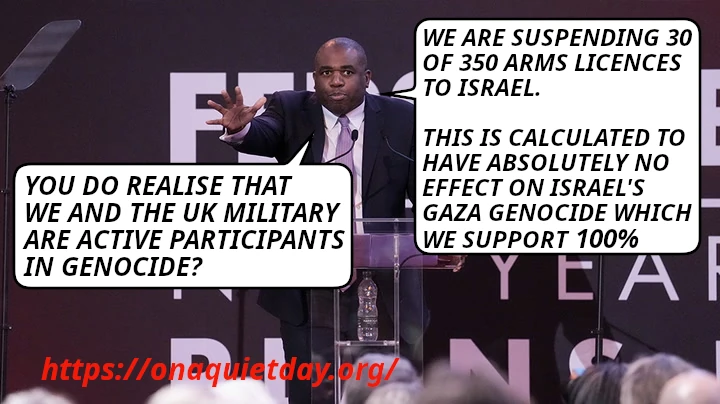
Genocide denier and Current UK Prime Minister Keir Starmer is quoted that he supports Zionism without qualification. He also confirms that UK air force support has been essential in Israel’s mass-murdering genocide. Includes URLs https://www.declassifieduk.org/keir-starmers-100-spy-flights-over-gaza-in-support-of-israel/ and https://youtu.be/O74hZCKKdpAGenocide denying UK Foreign Secretary David Lammy says that UK is suspending 30 of 350 arms licences to Israel. He also confirms the UK government’s support for Israel’s Gaza genocide and the UK government and military’s active participation in genocide.
Israeli prime minister Benjamin Netanyahu and chief of staff Gen.Herzi Halevi visit the Netzarim corridor in Gaza, 19 November 2024 (Credit: Abaca Press/Alamy Live News)
Exclusive: Days after the International Criminal Court issued arrest warrants for Israeli leaders, its top general flew to London.
Israel’s top soldier, Lieutenant General Herzi Halevi, visited Britain earlier this week, the UK government has confirmed to Declassified.
The visit came three days after the International Criminal Court (ICC) issued arrest warrants for Israeli prime minister Benjamin Netanyahu and former defence minister Yoav Gallant for “crimes against humanity and war crimes”.
Those include “the war crime of starvation as a method of warfare; and the crimes against humanity of murder, persecution, and other inhumane acts”, as well as “intentionally directing an attack against the civilian population”.
Halevi was initially reported to have been included in the ICC’s arrest applications for the crime of having “deliberately starved Palestinians in Gaza”. He was also forced to apologise in April after the Israeli military killed seven international aid workers including three Britons in Gaza.
A Ministry of Defence spokesperson told Declassified: “As part of the concerted UK effort, along with allies and partners, to reach a peaceful resolution to the ongoing conflicts in Lebanon and Gaza, the Chief of the Defence Staff hosted his counterparts from Israel and other European partners”.
The spokesperson added: “Discussions included the UK calls for an immediate ceasefire in both Lebanon and Gaza and the need for all parties to comply with international humanitarian law while recognising Israel’s right to security”.
A ceasefire deal to end fighting between Israel and Hezbollah in Lebanon was announced on Tuesday.
Protestors hold a banner outside Canterbury Crown Court to demonstrate against the conviction and sentencing of teenager Ibrahim Bah in February 2024 | Andrew Aitchison/In pictures/Getty Images. All rights reserved
Governments are locking teenagers up in a bid to catch smugglers – and failing vulnerable kids in the process
In December 2022, an inflatable dingy carrying dozens of people across the English Channel capsized. At least four people died. Ibrahima Bah, a teenager from Senegal, was identified by authorities as steering the dinghy and was arrested.
One of the people who died was Ibrahima’s friend. Neither of the friends had money, so Ibrahima initially agreed to steer the boat in exchange for their passage. He tried to back out when he saw the condition of the boat, but the adults organising the passage forced him to continue.
In February 2024, Bah was sentenced to almost ten years in prison for manslaughter by four counts of gross negligence, and for violating immigration rules. Despite Bah saving other passengers’ lives on the journey, mainstream headlines slammed him as a guilty ‘boat pilot’ and described him, wrongly, as an adult man.
Bah is one of dozens of children who have been charged for immigration offences across the UK and Europe. Most of those children are Black teenage boys travelling alone. Most of them were seeking safety and protection.
Accused children and their lawyers have spoken to openDemocracy from Greece, Italy and the UK about these huge miscarriages of justice.
They tell a story of racist and outdated age assessments, a lack of access to legal support and translators, bureaucratic mistakes, biased prosecutors and a fundamental lack of support.
“A dark place”
When he arrived in the UK, Bah didn’t know exactly how old he was. He was given an age assessment and declared to be over 18. Only later did a birth certificate emerge, showing that he was a minor. The courts rejected it and relied on the age assessment instead.
“I think Ibrahima struggles to understand, as do we, how he can possibly be held accountable for those people’s deaths,” says Maddie Harris of Humans for Rights Network, an organisation supporting people subjected to hostile border regimes.
Since June 2022, Humans for Rights Network has identified at least 23 minors prosecuted as adults for immigration offences. All of them are Black Africans, the majority Sudanese or South Sudanese.
“The reality of the child’s experience versus what they are accused of – they’re just not the same thing at all,” said Harris.
Most if not all children travelling irregularly go through a lot on their way to the UK. For more and more children, part of their transit now also includes getting coerced into steering the boats by those arranging the passage, often through violence, threats, or because they cannot afford the fare. Once they’re in the UK, they struggle to understand how the legal system can then paint them as criminals.
“They told me, ‘you are under arrest because you arrived in the UK without a visa,’” said Ameen (a pseudonym), one of those prosecuted children. “A couple of minutes later, they said, ‘you have to go to prison for a couple of days, and then you will go to court.’”
The next three days in the police station were the “darkest days” of his life, Ameen said. “One room, with nothing. A dark place. Nobody talks to you, nobody answers you. Stress. Words are not enough to explain those days. They were bad days, the worst that I have ever had in my life.”
Ameen went on to spend six months in an adult prison.
UK age assessments are “highly subjective”
Child asylum seekers get caught up in this system because of the way authorities determine their ages.
“When people arrive, they have the opportunity to state their age, usually by putting their finger on a number on a piece of paper,” said Vicky Taylor, a researcher at Oxford University and lead author of the 2024 report No Such Thing as Justice Here.
If a child is recognised as under 18, they are put in the care of the local authority. If they say they are a minor but are suspected of being older, they are subjected to further assessment.
“These initial inquiries have been shown to be unreliable,” said Taylor. “People are often in a confused state, having just landed in the UK after a long, dangerous and traumatic journey. They are not offered legal advice, interpreting or support.”
Age assessments tend to have three stages, according to Taylor. First, the young person is asked to recount their own personal timeline – when they left their home country, for instance, or the last birthday they can remember.
“Obviously it can be difficult [to assess] when people are from cultures in which birthdays are not celebrated or marked in the same way,” said Taylor. “Trauma also greatly affects young people’s ability to tell their story in a way that is legible to authorities.”
The second check is physical appearance. Assessors look at the potential child to see if they have beard lines, or to check how hairy their hands are, or how far back their hair line is. These are racialised markers, said Taylor.
Third, a person’s demeanour is assessed – how they engage with officials, react to questioning, and how they carry themselves.
All these checks “are highly subjective,” said Taylor, “and very difficult to ascertain within a ten-to-40-minute assessment.” Children travelling alone, as well as those who have been through difficult and traumatic experiences, are also less likely to present in ways that are obviously child-like.
It’s estimated that over 1,300 children were wrongly assessed as adults by the Home Office from January 2022 to June 2023
Many children who went through this process say they did not understand what they were asked. And for those who came away with a new age assigned to them, the number was often arbitrary.
Age assessments have been widely criticised by rights groups and researchers. An inquiry by the Independent Chief Inspector of Borders and Immigration between 2021 and 2022 described age assessments as “perfunctory” and noted that concerns had been raised at various times about the process.
“[Children’s] experiences include not being provided with the correct interpreter, being called liars and facing inappropriate comments about their physical appearance,” said Labour MP Andrew Western in the House of Commons. “This is unacceptable, and the reason it is so worrying is that the stakes are so high.”
Earlier this year, Refugee Council, Humans for Rights Network and the Helen Bamber Foundation reported that over 1,300 children had been wrongly assessed as adults by the Home Office from January 2022 to June 2023. The charities reported that children as young as 14 were forced to share rooms with unrelated adults, with no safeguards in place, and that children felt “unsafe, scared, and traumatised” by their experiences.
According to Harris, these figures are likely to be an undercount, since not all local authorities responded to requests for information, and some children continue to be prosecuted as adults.
“It’s a sort of conveyor belt,” said Harris. “They continue to prosecute children without adequately resolving their ages.”
Children branded as ‘traffickers’ in Italy
This is not just a problem in the UK. Italy is also taking child migrants to court, said Cinzia Pecoraro, a lawyer in Sicily. Similarly to Britain, outdated and racialised age markers are partly to blame.
Some of the methods Italian authorities use to measure people’s ages date back to the 1950s. One method uses X-rays to examine bone structure, based on samples of an Anglo-Saxon population. Its margin of error is between six months and two years, according to Pecoraro.
The moment I was arrested as a trafficker I was worried, because they accused me of something I didn’t do
Pecoraro represented one child from West Africa who was identified as steering the dinghy he arrived in.
“The moment I was arrested as a trafficker I was worried, because they accused me of something I didn’t do,” said Ola (a pseudonym) over text message.
Ola was originally identified as underage, but the Italian authorities intervened and subjected him to a flawed age assessment. He was moved to adult prison as a result.
“I felt sick, because they gave me an age that is not my age,” Ola said. “I felt it was racism.”
Ola spent a year in adult prison until Pecoraro was assigned to his case. “I realised that this was a child,” she said. “It was obvious.” She eventually got hold of a birth certificate, and after multiple delays his case was sent back to a minors’ court.
Ola is an adult now and the case is still pending. Despite being tried as a minor, he still faces serious consequences for allegedly steering the dinghy. “It’s been nine years,” Ola said. “Let’s hope to finish it soon so I can feel calm, because every moment I think about it.”
Pecoraro is confident Ola will be acquitted, but said he is lucky she was assigned to his case. She has a lot of experience defending minors in his position. “You need a proper defence,” she said. “Without it, they get convicted.”
These convictions are not happening in a political vacuum. The government of Georgia Meloni – who rose to power on the back of anti-immigrant rhetoric – has aggressively sought to reduce numbers of people arriving in Italy.
More and more people have been criminalised for the crime of ‘facilitation’ across the EU, allowed under the soon-to-be-expanded Facilitation Directive. And in Italy, Pecoraro says prosecutors seemed determined to continue.
“It’s common knowledge these journeys do not have a formal crew or driver. They are only passengers, forced to steer the boat,” she said. “This is [well] known, but prosecutors don’t want to surrender.”
Kids caught up in Greece’s hostile system
Thousands of people are likewise in prison in Greece for the crime of ‘facilitation’, with at least one or two people arrested per dinghy arriving. As a result, racialised people serving time for ‘smuggling’ related offences comprise the second largest prison population in the whole of Greece.
Sometimes just being seen by authorities at the rear of a boat is enough for a person to be identified as ‘driving’. Kani (a pseudonym), a young person from an African country, was 19 when he arrived in Greece. He was arrested after being falsely identified for driving the dinghy.
M. E., now 16, is awaiting trial and faces a possible 4,670-year sentence for ‘smuggling’
“I didn’t touch the steering wheel, and I have no idea about driving or anything else,” wrote Kani in a text message. “They took me to prison after that. I had no idea why they took me in the first place. I didn’t even realise that the matter was this serious. I didn’t understand anything. I said to myself, ‘what is happening’? I was literally terrified.”
In 2023, H. E.*, an Egyptian fisherman, was sentenced to 280 years in prison for piloting a dinghy from Libya to Crete. Unable to pay for himself and his teenage son, he had agreed to steer. His son, M. E.*, now 16, is awaiting his own trial and faces a possible 4,670-year sentence for ‘smuggling’.
In reality, M. E. won’t serve a sentence of this length – even if he could live that long. Maria Flouraki, the teenager’s lawyer, said he’ll likely be released before a decade is up. While Greek courts regularly hand out decades or even centuries-long sentences for smuggling cases, sentences are generally capped at 20-25 years, with options for early release.
The crime of ‘facilitation’ – legalese for smuggling – comes from the 2002 EU Facilitation Directive, and is interpreted very widely by Greek authorities. In this case, the child providing his father support while he steered the boat – helping pass out food and water, for instance – was enough to make him legally complicit.
Flouraki said M. E. could not understand why he was accused of being a smuggler. “He was just a kid following his father. He had no other option.”
She is hopeful he will be acquitted once in front of a judge, as is generally the case for minors. Flouraki’s client is not being prosecuted as an adult, but children are sometimes identified and charged as adults.
Dimitris Choulis is a lawyer on the Greek island of Samos. Many of the minors he works with have spent months in adult prison before being released. “To be honest, it’s always been like this,” said Choulis.
One of Choulis’s clients is a child currently locked up in an adult prison. Choulis says he has the birth certificate, and hopes it will help him to get his client out of adult prison and into the minors’ system soon.
Choulis does not believe Greece is deliberately trying to criminalise children. Rather, he thinks that children are getting caught up in a system beset with structural failures. But, he said, such problems could be avoided if the system gave children more time and support.
“They don’t give them the opportunity, and these [children] don’t know what they have to say,” said Choulis. “They are [hearing] a strange language, in a strange country, and they’re in handcuffs. They don’t know what to say, and they haven’t seen a lawyer.”
Whether children are locked up because of embedded racism in age assessments, overzealous prosecutors or bureaucratic errors, the result is the same.
Children are paying the price because the UK and EU governments are more intent on securing their borders than safeguarding the rights of people seeking asylum, said Vicky Taylor. “States are willing to override their obligations to children because they’re preoccupied with the performance of security.”
*Full names have been withheld to protect their identities
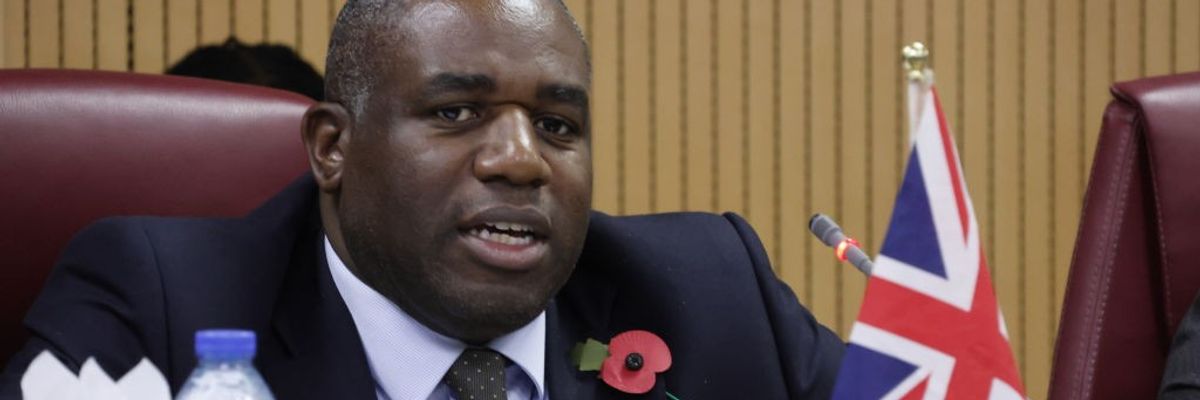
David Lammy, the U.K.’s secretary of state for foreign, commonwealth, and development affairs, signs an agreement during his first foreign visit to Africa in Abuja, Nigeria, on November 4, 2024. (Photo: next24online/NurPhoto via Getty Images)
David Lammy’s recent comment to Parliament, the coalition said, “at best, has injected a deeply troubling ambiguity in respect of these pivotal issues in light of the mass atrocities perpetrated against civilians in Gaza.”
Fallout over remarks that David Lammy, the U.K.’s secretary of state for foreign, commonwealth, and development affairs, recently made to the House of Commons about the Israeli assault on the Gaza Strip continued on Tuesday with a letter from 37 rights organizations.
“We call on the foreign secretary, as a matter of urgency, to make a statement clarifying the government’s understanding of i) genocide in international law; ii) the scope of the U.K.’s international obligations pursuant to the Genocide Convention and Rome Statute; and iii) what steps must be taken to fulfill such obligations,” the coalition wrote.
The groups pointed to an exchange between Lammy, of the Labour Party, and Conservative Member of Parliament Nick Timothy on October 28, when the foreign secretary said that the way words like genocide are being used now “undermines the seriousness of that term.”
Israel faces a South Africa-led genocide case at the International Court of Justice over its 13-month assault on Gaza, which has killed at least 43,391 Palestinians and wounded another 102,347, according to officials in the Hamas-governed enclave. The ICJ initially ordered Israel to “take all measures within its power” to uphold its obligations under the Genocide Convention in January.
Lammy’s response to Timothy last week, “at best, has injected a deeply troubling ambiguity in respect of these pivotal issues in light of the mass atrocities perpetrated against civilians in Gaza,” the coalition argued Tuesday. He “chose to undermine international law and answer in opposition to the International Court of Justice.”
“If Labour is indeed the party of international law, Foreign Secretary David Lammy must align with, rather than undermine, the courts.”
Despite Lammy’s suggestion, the Genocide Convention contains no numerical threshold and “is clear that the crime of genocide is not only perpetrated through mass killing,” the groups noted, highlighting Israeli attacks on food production, water infrastructure, healthcare facilities, and civilian housing, shelters, and camps.
In northern Gaza, “Palestinian civilians are being killed through starvation and dehydration, disease, deprivation of lifesaving medical intervention, and constant bombardment and targeting by weaponized drones,” they wrote. United Nations Secretary-General António Guterres “has warned of the ethnic cleansing of Gaza by Israel while the U.N. Commission of Inquiry has concluded that the Israeli authorities have committed the crime against humanity of extermination of part of the civilian population in Gaza through direct and indirect means.”
“These assessments raise the specter of genocide and support the findings of other experts who have long concluded that genocide is taking place,” the coalition continued. “This makes it imperative for the foreign secretary to revisit his comments and to clarify the government’s understanding of the crime of genocide.”
Amichai Stein, a correspondent for state-owned Israeli broadcaster Kan, said on social media Tuesday that the Israel Defense Forces (IDF) announced “the division of the northern Gaza Strip into two parts has been completed, and we getting closer to the complete evacuation of the northern part from civilians and terrorists: ‘This time there is no intention to allow the residents of the northern Gaza Strip to return to their homes and that humanitarian aid will regularly enter the southern Gaza Strip.’”
In other words, as Drop Site News‘ Ryan Grim put it, “Israeli media reporting that the IDF is declaring northern Gaza effectively ethnically cleansed, not even a hint of pretense now that it’s Election Day” in the United States.
While the U.S. has repeatedly faced global condemnation for arming Israel over the past year, the rights coalition on Tuesday focused on the U.K. government, emphasizing that “to the extent that the ICJ has already ordered provisional measures, the U.K. is on notice that a plausible risk of genocide exists, triggering third-state responsibility.”
Signatories to the letter include ActionAid U.K., Christain Aid, Council for Arab-British Understanding, Democracy for the Arab World Now, Gender Action for Peace and Security (GAPS), Global Justice Now, Jewish Network for Palestine, Medical Aid for Palestinians, Quakers in Britain, and War on Want.
GAPS director Eva Tabbasam told Middle East Eye that the language used to describe the war in Gaza “is essential to recognize the suffering of Palestinians and consider all possible actions the U.K. has to contribute to stopping what is a plausible risk of genocide.”
“If Labour is indeed the party of international law, Foreign Secretary David Lammy must align with, rather than undermine, the courts,” Tabbasam said. “He should have already done so months ago when the court first published this language, but the second best time is right now.”
Separately, War on Want on Tuesday published an analysis detailing how “Israel is committing genocide of the Palestinian people” and arguing that “the U.K. government is failing to uphold international law, and is complicit in Israel’s crimes, as it continues to export weapons and technology used by Israel against the Palestinian people.”
“Palestinians have long struggled for their rights and for justice. During the 1947-8 ethnic cleansing of historic Palestine—the Nakba (Arabic for ‘catastrophe’)—around 750,000 Palestinians were forced from their homes and lands by armed groups, to live under Israel’s system of apartheid,” the group noted. “Israel has carried out its ethnic cleansing of the Palestinian people, unlawful occupation, apartheid, and blockade of Gaza—the ongoing Nakba—with impunity and has now escalated its actions into genocide.”
The London-based organization is also circulating a petition in response to the foreign secretary’s remarks from last week, which says in part: “David Lammy is misleading parliament and the U.K. public. He must tell the truth—that this is genocide—and immediately take action to stop the genocide, and the U.K.’s complicity.”
Other responses to Lammy’s comments have included public criticism from What Is Genocide? author Martin Shaw and dozens of public figures in the Arab British community demanding an apology.
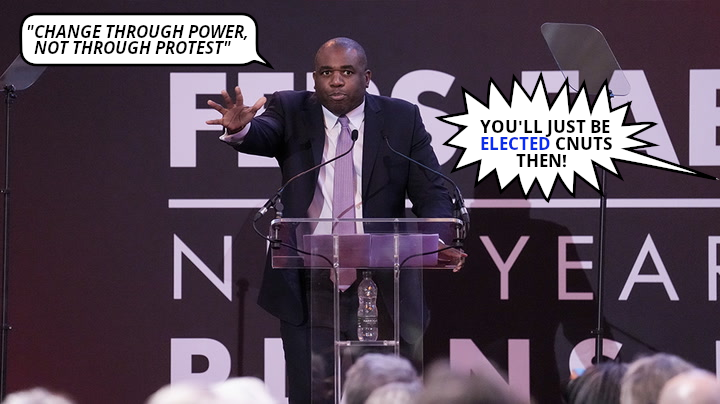
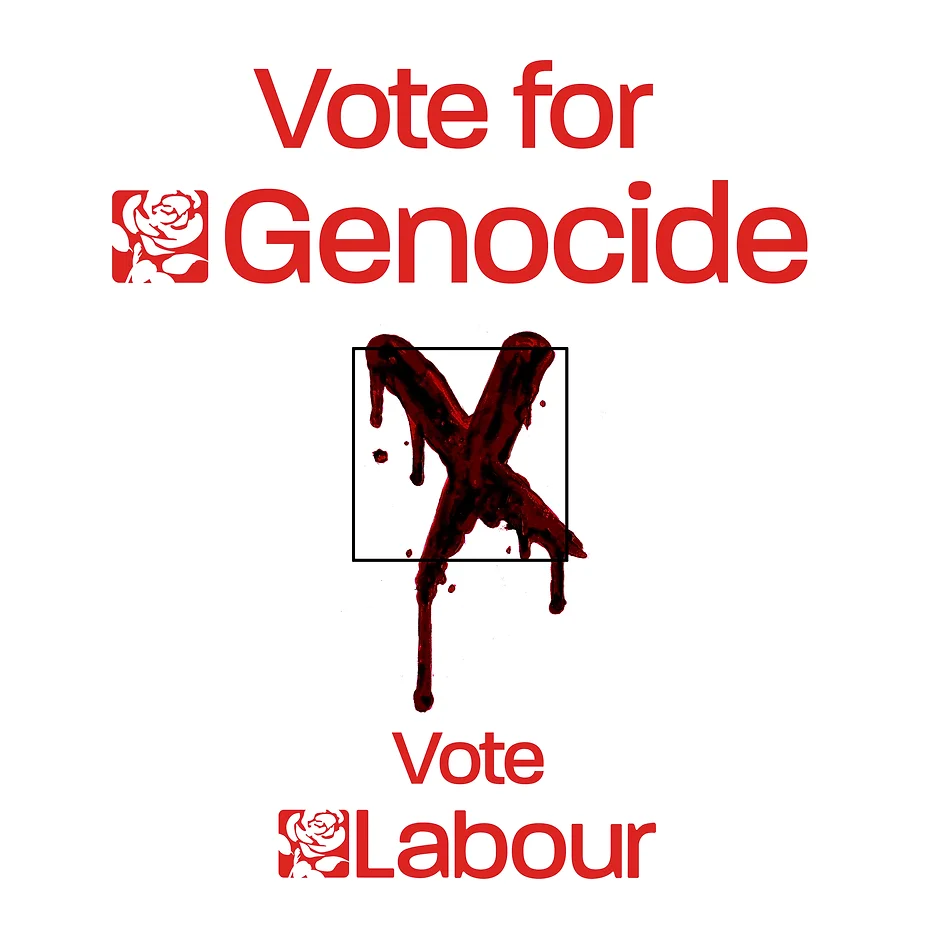
UK Labour Party Shadow Foreign Secretary repeatedly heckled at a speech to the Fabian Society over his and the Labour Party’s support for and complicity in Israel’s genocide of Gaza.UK Foreign Secretary David Lammy says that UK is suspending 30 of 350 arms licences to Israel. He also confirms the UK government’s support for Israel’s Gaza genocide and the UK government and military’s active participation in genocide.Current UK Prime Minister Keir Starmer is quoted that he supports Zionism without qualification. He also confirms that his active support and that of UK’s air force has been essential in Israel’s mass-murdering genocide. Includes URLs https://www.declassifieduk.org/keir-starmers-100-spy-flights-over-gaza-in-support-of-israel/ and https://youtu.be/O74hZCKKdpAVote For Genocide Vote Labour.