As the COP28 climate talks begin today in Dubai, the Green Party has set out three key demands. They are to ‘keep 1.5 alive’; an agreement on the fair and managed phase-out of all fossil fuels; and measures to address ‘climate inequality.’ Greens are challenging the UK government to lead by example and put into practice policies that will help meet these demands.
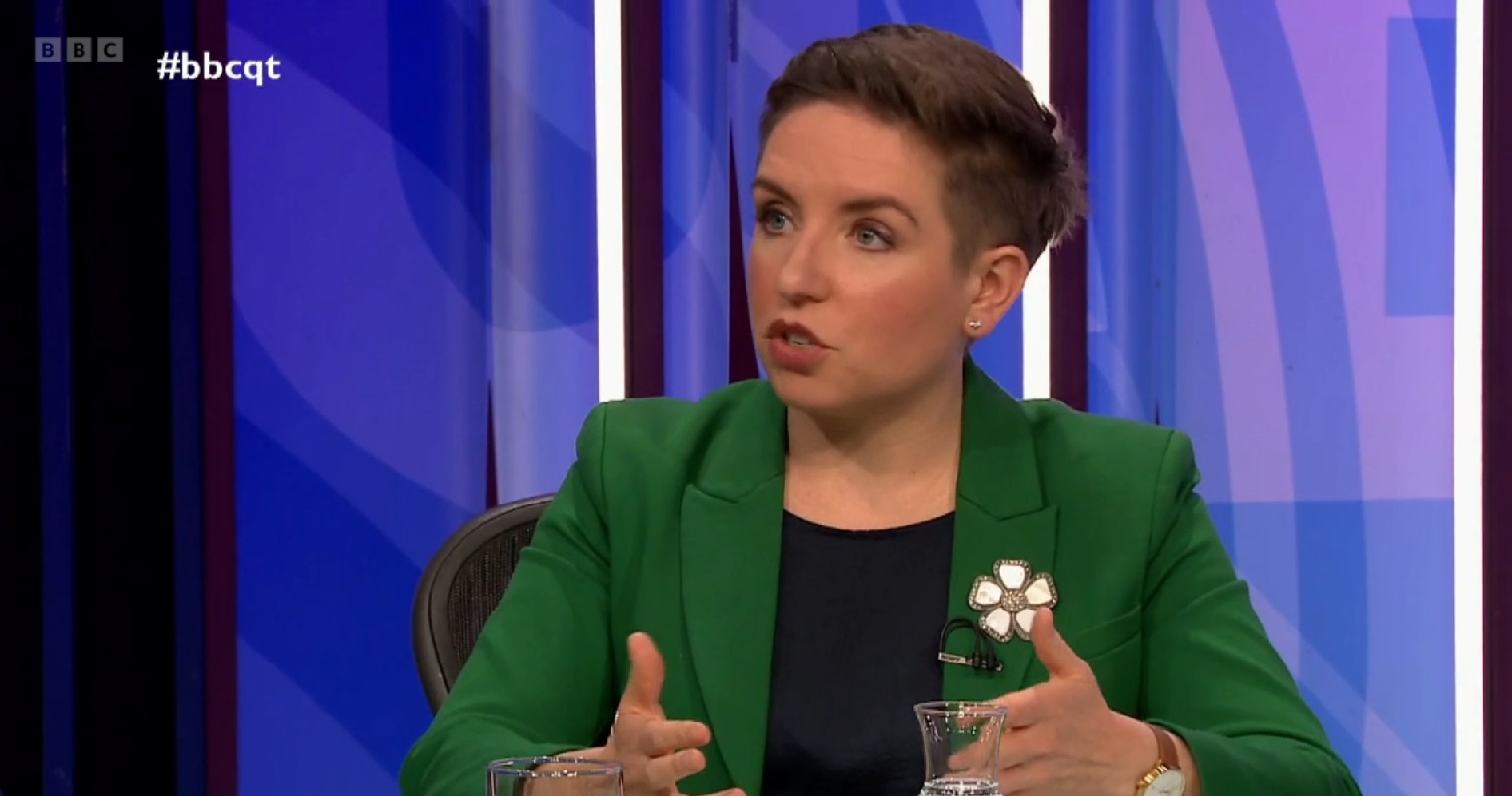
Image of the Green Party’s Carla Denyer on BBC Question Time.
Co-leader of the Green Party, Carla Denyer, said:
“We need to hear a clear unambiguous commitment from the UK government to the 1.5C Paris Agreement target which was signed up to by 196 countries eight years ago at COP21. The government must agree to whatever it takes to get this target back on track. It’s going to require a hugely ambitious strategy, but the massive scaling up of climate action that is now necessary is because of dither and delay by countries like the UK in taking the bold action needed.
“Another vital outcome of COP28 must be the fair and managed phase-out of all fossil fuels. As one of the rich countries most responsible for the climate crisis, the UK must stand on the side of future generations and those on the front line of climate breakdown and agree to urgently move away from fossil fuels. The UK government must resist pressure from the petrostates and others at COP who wish to continue with business as usual and keep the world hooked on fossil fuels. At home this means leading by example with an immediate end to all new oil and gas licences and a rapid acceleration towards renewable energy.
“Thirdly, these climate talks must recognise that it is a super-rich elite who are super-heating the planet. The UK government must be willing to challenge the grotesque inequality driving climate breakdown and reform our tax system to make the polluter pay. This means taxing the wealth of the super-rich and introducing a carbon tax on the most polluting corporations and individuals. Such taxes, introduced globally, could generate the funds needed for a generous new Loss and Damage Fund to finance climate action in the poorest countries – those suffering the most from the impacts of climate breakdown but contributing the least to the crisis.”
Palestinians inspect the damage following an Israeli airstrike on the El-Remal aera in Gaza City on October 9, 2023. Israel continued to battle Hamas fighters on October 10 and massed tens of thousands of troops and heavy armour around the Gaza Strip after vowing a massive blow over the Palestinian militants’ surprise attack. Photo by Naaman Omar apaimages. licensed under the Creative Commons Attribution-Share Alike 3.0 Unported license.
There are 149 states party to the Genocide Convention. Every one of them has the right to call out the genocide in progress in Gaza and report it to the United Nations. In the event that another state party disputes the claim of genocide – and Israel, the United States and the United Kingdom are all states party – then the International Court of Justice is required to adjudicate on “the responsibility of a State for genocide”.
…
There is, at the very least, a strong prima facie case that the actions of the United States and United Kingdom and others, in openly providing direct military support to be used in genocide, are complicity in genocide. The point of Article IV is that individuals are responsible, not just states. So Netanyahu, Biden and Sunak bear individual responsibility. So, indeed, do all those who have been calling for the destruction of the Palestinians.
It is very definitely worth activating the Genocide Convention. A judgement of the International Court of Justice that Israel is guilty of genocide would have an extraordinary diplomatic effect and would cause domestic difficulties in the UK and even in the US in continuing to subsidise and arm Israel. The International Court of Justice is the most respected of international institutions; while the United States has repudiated its compulsory jurisdiction, the United Kingdom has not and the EU positively accepts it.
If the International Court of Justice makes a determination of genocide, then the International Criminal Court does not have to determine that genocide has happened. This is important because unlike the august and independent ICJ, the ICC is very much a western government puppet institution which will wiggle out of action if it can. But a determination of the ICJ of genocide and of complicity in genocide would reduce the ICC’s task to determining which individuals bear the responsibility. That is a prospect which can indeed alter the calculations of politicians.
It is also the fact that a reference for genocide would force the western media to address the issue and use the term, rather than just pump out propaganda about Hamas fighting bases in hospitals. Furthermore a judgement from the ICJ would automatically trigger a reference to the United Nations General Assembly – crucially not to the western-vetoed Security Council.
All this begs the question of why no state has yet invoked the Genocide Convention. This is especially remarkable as Palestine is one of the 149 states party to the Genocide Convention, and for this purpose would have standing before both the UN and the ICJ.
…
Any one of the 139 states party could invoke the Genocide Convention against Israel and its co-conspirators. Those states include Iran, Russia, Libya, Malaysia, Bolivia, Venezuela, Brazil, Afghanistan, Cuba, Ireland, Iceland, Jordan, South Africa, Turkey and Qatar. But not one of these states has called out the genocide. Why?
New areas for oil and gas development on the UK’s North Sea continental shelf are to be made available through annual licensing rounds subject to net zero tests. These proposals by the UK government, outlined in the 2023 king’s speech to parliament, fly in the face of recommendations by the Climate Change Committee – the government’s own independent advisers.
The move should not be summarily dismissed as “political posturing” ahead of a general election, however. It may cause significant damage, not least because it distracts from critical questions surrounding how the UK will transition to low carbon energy.
Licences, under the 1998 Petroleum Act, are how the UK government grants companies exclusive rights “to search and bore for, and get, petroleum”. Companies are invited to bid for access to areas on the UK continental shelf which are pre-selected by the regulator (in consultation with industry).
The government plans to introduce a bill aimed at granting new oil and gas drilling licences in the North Sea. Henk Honing/Shutterstock
Wrong answer, wrong question
The licensing system in place has arguably done the job of allocating access to the UK’s oil and gas. What’s questionable is whether, considering the climate emergency, annual licensing rounds will revive interest in what has long been a declining basin.
Handing out licences on its own is insufficient to attract investment. There is growing recognition among financial analysts of the risks of stranded assets in oil and gas. Shell’s withdrawal from the Cambo oil field northwest of Shetland in 2021 showed licence holders are willing to withhold their final investment decision if deemed economic or politically expedient.
The government’s focus on new licences is a red herring, as the bulk of remaining resources are in areas that are already licensed. It will be regulatory approval of field development plans, via a process known as consents, that will allow these existing licences to actually start producing oil or gas.
The recent decision to approve Rosebank (an oil field first licensed in 2001) is a case in point.
Annual licensing rounds will not ensure the UK’s energy security either. Recent licensing rounds have yielded relatively small volumes of gas that do not substantially add to UK reserves. Any oil and gas developed as a consequence of new licences is unlikely to come to market quickly and will be sold at international market prices. Producing oil and gas domestically has not insulated the UK from high prices.
The energy secretary, Claire Coutinho, has acknowledged that UK production “wouldn’t necessarily bring energy bills down”. The Skidmore Review of the UK’s net zero plans and the Climate Change Committee have made clear that the most effective method of helping households afford energy is to “cut fossil fuel consumption … improving energy efficiency, shifting to a renewables-based power system and electrifying end uses in transport, industry and heating”.
Offshore workers need training and support to transition to green jobs. Kichigin/Shutterstock
The government’s claim that two new “tests” will ensure the compatibility of new licences with the government’s net zero goal, too, does not bear scrutiny.
The first, whether oil and gas imports are projected to be larger than domestic production, is a very weak test as it captures the UK’s default position and will lock in dependence on fossil fuels rather than accelerate the transition.
The second, “that the carbon emissions associated with the production of UK gas [must be] lower than the equivalent emissions from imported liquefied natural gas (LNG)”, ignores the emissions associated with burning gas (known as scope 3 under the international accounting protocol for greenhouse gases).
These scope 3 emissions account for 65%-85% of the total emissions and are often omitted from statements about the lower carbon content of UK gas. Instead of comparing the carbon footprint of UK gas with imported LNG, pipeline gas from Norway would be a more appropriate (and lower-carbon) comparison.
In any case, the UK oil and gas industry’s targets for decarbonisation set out in the North Sea transition deal signed in 2021 have been criticised by the Climate Change Committee as insufficiently ambitious.
The government plan proposes the carbon emissions of producing UK gas be compared with those of imported LNG. The Mariner 4291/Shutterstock
The prominence of oil and gas licensing in the government’s legislative plans is striking. Fossil fuel licensing is a potent political symbol, and not only for campaigners who have worked for years to get licensing onto the agenda. Sunak and Starmer are now harnessing that symbolism for political ends.
A fixation on new licensing, however, is a distraction. It offers comfort in the possibility of conserving oil and gas production through developing new fields, rather than grasping the challenge of a rapid transition.
It leaves untouched the pressing issue of how to phase down oil and gas production from existing licences in a just and equitable way. It deflects from the enormous challenge of decommissioning offshore infrastructures, and the questions that need to be asked about what the North Sea is for and how it can sustain our collective future.
Don’t have time to read about climate change as much as you’d like?
Privacy campaigners are frantically trying to brief MPs about the implications of the data retention and investigatory powers bill (Drip), before it is forced through all of its Commons stages tomorrow.
The more experts look at the bill, the more convinced they’ve become that it provides authorities with the spine of the snoopers’ charter, but without any of the public debate or parliamentary scrutiny which were supposed to accompany it.
The charter – known as the draft communications bill before it was killed off – would have forced internet service providers and mobile operators to keep details of their customers’ behaviour for 12 months.
Analysis of Drip, which was supposed to only extend the government’s current powers for another two years, suggests it forces through many of those requirements on internet firms without any of the political outrage which derailed the earlier effort.
Clause four of the bill appears to extend Ripa – the Regulation of Investigatory Powers Act (basically Britain’s Patriot Act) – so that the UK government can impose severe penalties on companies overseas that refuse to comply with interception warrants. It also lays out situations in which they may be required to maintain permanent interception capacity.
Clause five then provides a new definition of “telecommunications service”, which includes companies offering internet-based services. That seems to drag services like Gmail and Hotmail into the law, and very probably social media sites like Facebook too.
The government insists the extraterritoriality clause merely makes explicit what was previously implicit. It’s tosh. As the explanatory notes for the legislation – released very quietly on Friday night – make clear, overseas telecommunications companies did not believe they were necessarily under Ripa’s jurisdiction.
“Regarding the amendments to Ripa, in view of the suggestion by overseas telecommunications service providers that the extra-territorial effect of Ripa is unclear, it is considered necessary to amend the legislation to put the issue beyond doubt,” it reads.
“This includes clarifying the definition of a ‘telecommunications service’ to ensure the full range of telecommunications services available to customers in the United Kingdom are included in the definition.”
David Cameron, Nick Clegg and Ed Miliband insist Drip merely extends their current powers for two years. That’s nonsense. These two clauses, which have nothing to do with the purported aim of the bill, provide the spine of the snoopers’ charter.
They also appear to provide a legal basis for programmes like Tempora, the project revealed by Edward Snowden to allow GCHQ to tap into transatlantic fibre-optic cables and stored data.
Notably, Privacy International, Liberty and others are taking the government to a tribunal this week on whether Tempora is legal, even though the government won’t even admit its existence. Drip could make the tribunal ruling irrelevant.