Original article by Vicky Taylor Melissa Pawson republished from Open Democracy under a Creative Commons Attribution-NonCommercial 4.0 International licence.
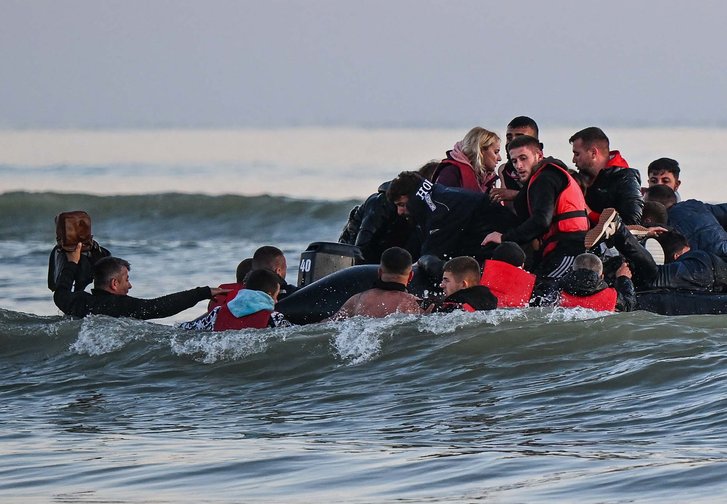
| Denis Charlet/AFP/Getty Images. All rights reserved
New series: UK and EU governments are targeting people crossing borders in the name of ‘counter-smuggling’
On 1 June 2019, Samyar Bani boarded a small dinghy with five other people. Looking out at the expanse of the English Channel, he said he felt afraid, but knew he had to continue. Just a few miles more and he would be in the UK. At that point, he never expected to still be journeying, still seeking safety, two years after fleeing persecution in his hometown of Shiraz, Iran.
Bani and his companions had purchased the dinghy together to avoid smugglers’ fees. He hoped the boat would keep them safe as they crossed the water, because he didn’t know how to swim. It was a dangerous last step, he knew that. But, given the limits of the UK’s resettlement routes and the tightness of its visa regimes, he saw this as his best chance for reaching sanctuary.
Bani hoped he’d be welcomed on the other side of the Channel, and that his request for asylum would be accepted. He had no idea that placing his hand on the tiller of the boat would land him in prison, cause him to plead his case before a jury at trial, and tie him up in an appeal process for two and a half years.
He never expected to lose contact with his wife and daughter, or for them to spend three years mourning the death of their husband and father. He never expected to have his picture put online, or to be branded as a ‘dangerous people smuggler’.
All of this happened to Bani because he helped to buy a boat, and helped to steer it to safety.
A new normal has crept in. Over the last few decades, crossing borders without permission – sometimes called ‘irregular migration’ – has become a criminal offence in many countries. Among those prosecuted are people in search of asylum, fleeing war and persecution.
These migrants and refugees, as well as solidarity actors like rescue workers, are also increasingly at risk of being labelled as ‘smugglers’ for the purposes of prosecution.
Governments are widening the nets of who they consider criminal as they respond to calls from the far-right to crack down on immigration. In doing so, states justify measures which racially profile, control and contain people on the move. These measures have been shown to make no tangible difference to immigration numbers, and instead cause immense harm to the very people they purport to protect.
In this new series, 12 authors do a deep dive into the criminalisation of migration and solidarity in the UK and Europe. Some of the contributors to this series have been accused of espionage, people smuggling, and facilitating ‘illegal entry/ arrival’. Some were crossing borders, and others were acting in solidarity with those crossing borders. Contributors also include policy experts and journalists working to expose those injustices.
Over the next two weeks, we’ll examine the hidden corners of global anti-migration structures set up in the name of ‘anti-smuggling’. We’ll be looking at: the detention of rescue workers in Italy; the imprisonment of children under ‘smuggling’ charges in the UK; the repeal of EU-enforced smuggling laws in Niger; how the EU is putting pressure on migrants’ rights groups in North Africa; the lucrative policing contracts in the ‘digital fight’ against smuggling; and the far-reaching influence of anti-mafia and counter-terror policies on counter-smuggling.
Widening the definition of ‘smuggling’
People fleeing wars, occupations or persecution often have no choice but to travel without documents or visas. Many must leave quickly and under dangerous circumstances, and in any case most countries of destination don’t make any practical legal routes available to them.
In recognition of these circumstances, refugees are protected from “penalties on account of their illegal entry or presence” by the 1951 Refugee Convention, which the UK and all EU countries are party to. But their protected status has, in recent years, been eroded by anti-immigration and counter-smuggling policies. What used to be considered ‘irregular’ movement for asylum has increasingly been redefined as ‘illegal’.
Many countries, for example, now target the people steering the boats carrying people on the move – people like Samyar Bani – regardless of whether they were involved further in ‘smuggling’ activities or not. Organisations and researchers have documented this practice in Greece, Italy, Spain, Indonesia, and, most recently, in the UK.
Soon after people started arriving in the UK in ‘small boats’ in greater numbers in late 2018, the Conservative government began to arrest, charge, and convict those identified as steering the dinghies. These arrests were accompanied by media briefings labelling the people arrested as ‘smugglers’ responsible for crossings.
Yet even those tasked with identifying the ‘smugglers’ questioned the logic. Border Force officers told inspectors, “there were no organised crime group members onboard the boats, although one of the migrants might have agreed with the facilitators to act as a ‘chaperone’ for a reduced fee.”
A series of successful appeals in 2021 overturned these early convictions. Lawyers argued that people intending to arrive at ports and claim asylum are not guilty of the offence of ‘illegal entry’, since they are simply arriving irregularly, and then entering as an ‘asylum seeker’.
The legislation effectively made all irregular arrival, even for the purposes of claiming asylum, a criminal offence in the UK
In response, the UK government used the 2022 Nationality and Borders Act to expand the criminal offences that can be applied against people crossing borders irregularly. This legislation introduced a new offence of ‘illegal arrival’ and increased the maximum sentence to four years imprisonment. For the crime of ‘facilitation’ – in other words, assisting arrival or ‘smuggling’ – the maximum sentence was increased to life in prison.
This legislation effectively made all irregular arrival, even for the purposes of claiming asylum, a criminal offence in the UK.
Across Europe, states are also working on expanding the definition of ‘smuggling’ to increase the number of prosecutions. Member states can currently charge people for offences relating to crossing borders, or for defending the rights of those crossing borders through the EU’s 2002 Facilitation Directive.
Just like in the UK, the directive has allowed states to prosecute people for steering boats even if no other evidence of ‘smuggling’ activities is presented. In 2021, a Greek court sentenced M. Hanad Abdi to 142 years in prison for “transporting” 33 people to the country. The decision was made despite Abdi having been forced “at gunpoint” to helm the boat, and despite him saving 31 of his co-passengers’ lives on the way.
His lawyers appealed the sentence, and it was reduced to eight years in 2023. Responding to the decision, Abdi’s lawyer, Alexandros Georgoulis wrote: “The law is completely obsolete. We now know that smugglers no longer approach the Greek coast to avoid arrest, and let the migrants guide the boats on their own.”
And yet, the European Commission is seeking to strengthen its powers even further through a new, expanded facilitation directive. This is despite migrants’ rights groups and the UN Special Rapporteur on Human Rights Defenders raising concerns about the implications this will have.
The new EU directive is likely to “dramatically increase” the criminalisation of migration and solidarity in Europe, according to migrants’ rights organisation PICUM. It will introduce longer prison sentences, broaden provisions for criminalising NGO workers, and continue to allow smuggling charges to be brought against people simply for crossing borders with their children.
Hundreds already serving sentences
As the UK and EU expand the legislation which allows them to criminalise those crossing borders or those standing in solidarity with them, hundreds are already caught in the web of the system.
According to PICUM, 117 people were subject to criminal proceedings for their solidarity work with people crossing borders in Europe, and 76 people were charged for crossing borders in 2023. Most of them faced charges of migrant smuggling or facilitation of entry, transit or stay, allowed under the 2002 EU directive. These numbers are most likely an undercount, since charges across the entire bloc are hard to track.
In the UK, 189 people were arrested for their ‘illegal arrival’ in dinghies in 2022, 109 of them for their role in steering the boats. In 2023, 244 people were charged for ‘illegal arrival’, 86 of whom were alleged to have steered the boat. The latest data obtained from the Home Office indicated that 38 people were charged with ‘illegal arrival’ for steering dinghies in the first six months of 2024.
Those branded as ‘smugglers’ are made convenient scapegoats for the real, unaddressed failures of UK and EU governments
The vast majority of these people were crossing borders to seek sanctuary and a better life. Some were victims of trafficking and torture. And at least 22 of those charged in the UK are age disputed, meaning that they were charged as an adult despite stating their age as under 18.
In courts across Europe and the UK, those arrested often explain how they drove the boats under duress, or because they could not otherwise afford the passage. Individuals – some of them teenagers like Ibrahima Bah or the El Hiblu 3 – explain how they were only seeking a place of safety.
Yet they have been declared ‘smugglers’ and labelled as solely responsible for any harms that occurred at sea. This placement of blame entirely obscures the structural responsibility of states who close alternative routes to safety while continuing to invest in border security infrastructure.
And Europe isn’t only criminalising people on its own shores. Years of policies to offshore its border control, for example to countries on the other side of the Mediterranean, have resulted in people being targeted for migrating or for solidarity work before they even reach European soil.
EU countries have handed billions to Turkey, Libya, Tunisia, Egypt, Mauritania and Morocco in deals to control and curb migration. Many of those deals hand funds to authoritarian regimes – and, in Libya’s case, facilitate human rights abuses on and off its shores.
Erosion of rights for everyone
Criminalisation policies cause immense harm to people. NGO workers are targeted for supporting people on the move and are forced to uproot their work and their lives. People migrating are forced to take even more dangerous routes to evade arrests, through deserts and in unseaworthy boats – and if they do make it to safety, they face spending years or decades in prison.
All the while, those branded as ‘smugglers’ are made convenient scapegoats for the real, unaddressed failures of UK and EU governments: soaring poverty and homelessness, declining public services, a rising cost of living and crises in the healthcare systems.
Experts have long called for safe routes to be made available to people seeking sanctuary. But governments seem intent to plough on with harmful criminalisation policies instead, all the while increasing the risks people are forced to take at borders.
Since being released from prison, Samyar Bani has been granted leave to remain in the UK. The scars of his experiences are far from healed: he still suffers flashbacks from his time in prison, is still struggling to get a job due to his criminal record, and has had his application to bring his wife and daughter to the UK rejected.
But he’s not giving up on building a life in safety. He’s working on his English so he can go back to work, and he’s appealing the decision on his family reunification application. “Humans need life,” said Bani at the end of our interview together. “My country wasn’t safe for me, so I came to the UK.”
He paused. “Police understand who a smuggler is, and they don’t sit in the boat. They just do this so they can close the border to refugees.”
Original article by Vicky Taylor Melissa Pawson republished from Open Democracy under a Creative Commons Attribution-NonCommercial 4.0 International licence.