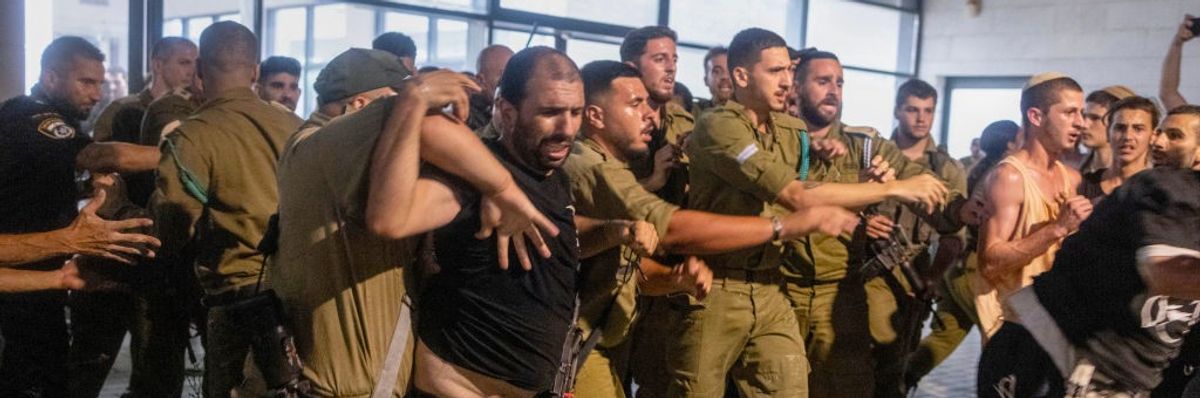
Israeli soldiers and police clash with a far-right mob that invaded the Beit Lid army base in Kfar Yona on July 29, 2024. (Photo: Oren Ziv/AFP via Getty Images)
Several Israeli lawmakers and one minister took part in the attempt to free the nine reservists, who were hailed as heroes by multiple Cabinet members.
Far-right Israelis including government officials stormed two military bases late on Monday, sparking clashes with troops and police over the arrest of Israel Defense Forces reservists who allegedly gang-raped a Palestinian prisoner.
Hundreds of protesters broke into the notorious Sde Teiman base in the Negev Desert in an attempt to stop the detention of nine reserve troops accused of sodomizing a Palestinian jailed there. According to the Israeli newspaper Haaretz, the victim is hospitalized with severe injuries and is unable to walk.
The nine suspects were then taken to the Beit Lid army base, which was also mobbed by at least dozens of demonstrators.
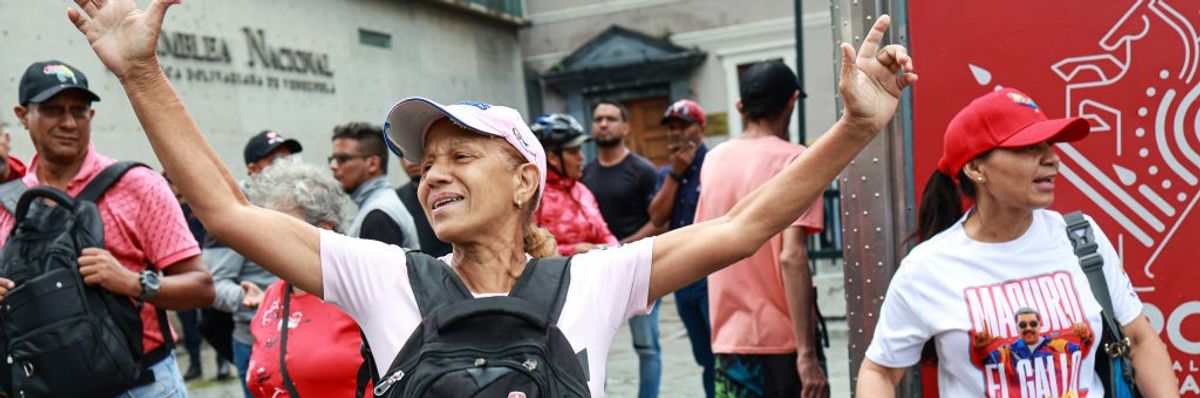
Supporters of president-elect Nicolas Maduro celebrate his proclamation as president-elect in the vicinity of the CNE headquarters during the ceremony to deliver the majority of the vote Certificate at CNE Headquarters on July 29, 2024 in Caracas, Venezuela. (Photo by Jesus Vargas/Getty Images)
Shortly before midnight on 28 July, Venezuela’s National Electoral Council (CNE) announced that — with 80 percent of the over 20 million votes counted — the trend was irreversible: Nicolás Maduro had been re-elected president of Venezuela.
According to the CNE, Maduro received 51.2 percent of the vote, while his primary opponent, the little-known Edmundo Gonzales, received 44.02 percent. With that result, it was clear that the Venezuelan majority chose to continue the project of Bolivarian socialism introduced by Hugo Chavez at the end of the nineties. Recognizing the economic turn-around of the last two years and proud of their achievements in building 5.1 million housing units, securing food sovereignty, and deepening communal democracy, Venezuelans re-elected Maduro for a third six-year term.
A former ambassador to Argentina, the opposition candidate Gonzales replaced far-right leader Maria Corina Machado as the candidate of the Unity Platform after Machado was disqualified from running. Machado has long been an outspoken critic of Chavismo, supporting US sanctions and advocating foreign intervention in the country. In 2018, she asked Benjamin Netanyahu for military assistance in dismantling the Maduro government. Machado has close ties in the United States. In 2009, she was a Yale World Fellow. On June 23, 2024 she spoke at a National Endowment for Democracy awards ceremony in Washington, DC. She has been nicknamed the new “iron lady” after her idol Margaret Thatcher. In contrast, Maduro supports the Palestinian liberation struggle, linking it to the struggle of the indigenous peoples of Venezuela against colonial genocide.
Venezuela’s far-right opposition is doubling down on its refusal to accept defeat in the country’s presidential election amid simmering unrest and violence in the streets of Caracas, sparking warnings of another coup attempt in a nation that has long faced interference from the United States and other Western powers.
Led by María Corina Machado, who was disqualified from running in Sunday’s election, Venezuela’s opposition claimed that its candidate—ex-diplomat Edmundo González—defeated President Nicolás Maduro with over 70% of the vote, contradicting the official results announced by the Consejo Nacional Electoral (CNE).
Machado, who once urged Israeli Prime Minister Benjamin Netanyahu to back an effort to topple Maduro’s elected government, pointed Venezuelans to a website the opposition is using to assemble its own vote counts.
“So far, she hasn’t presented any evidence [of fraud],” Caracas-based reporter Andreína Chávez Alava said in an appearance on Democracy Now! Tuesday morning. “In past elections they have also said they have evidence that they won and they never actually showed any proof.”
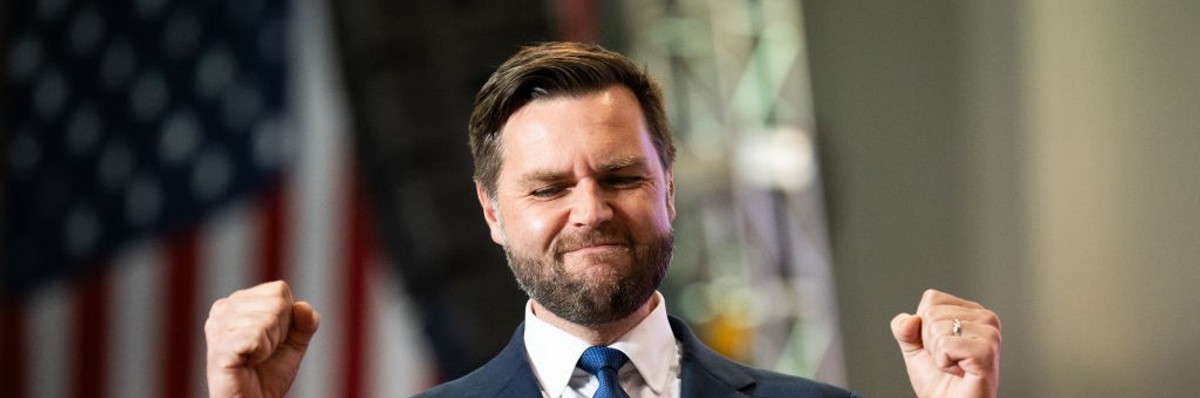
Republican vice presidential nominee U.S. Sen. J.D. Vance (R-OH) arrives to speak during a rally with running mate U.S. Republican Presidential nominee former President Donald Trump at Herb Brooks National Hockey Center on July 27, 2024 in St Cloud, Minnesota. (Photo by Stephen Maturen/Getty Images)
The former Republican president, despite all his allegedly populist rhetoric, has a deeply anti-worker record from his first term. Vance’s record is no different and he’s no better.
“These attempts to create the appearance of distance between Trump and Project 2025 are happening because Americans are starting to learn about this extreme takeover plan,” said one Democratic congressman.
At least 140 people who worked in the Trump administration—including six former Cabinet secretaries—have been involved with Project 2025, according to a CNN analysis published earlier this month. Among them is the outgoing director, Paul Dans.
“Dans served in the Trump administration as chief of staff at the U.S. Office of Personnel Management where he managed the federal agency in charge of human resources policy for the more than 2 million federal workers,” according to his profile on the Heritage website.
Closing campaign rally of Nicolás Maduro in Caracas. Photo: Zoe Alexandra
Numerous international media outlets have stepped up attacks against Nicolás Maduro in a seemingly scripted manner with key messages that they seek to establish as the truth
On Sunday, the people of Venezuela will head to the polls to elect their next president. The 21 million eligible voters in Venezuela have the opportunity to pick between 10 candidates from a broad range of political parties and currents. The two projected front runners however, are from completely opposite ends of the spectrum: incumbent President Nicolás Maduro and candidate for the right-wing Unitary Democratic Platform, Edmundo González.
As election day comes closer, and international mainstream media pays more attention to what is happening in the Caribbean country, several dominant patterns have emerged in the discourse and messages of these outlets.
First of all, several media outlets have carried profiles of the leading candidates, and presented a very stark dichotomy. Maduro is authoritarian, González is democratic. Maduro is oppressive, González is free. In these profiles, when talking about Maduro, they will talk about the alleged amount of money and properties that he owns, but when profiling González, no such questions are asked.
When speaking of González, another type of framing is used, namely, that of the chosen one who was able to bring about the unity of an opposition that has historically had enormous difficulties in reaching minimum agreements. In this way, they want to present a worn out, questioned and “possibly” corrupt candidate (Maduro), while on the other hand, they want to show a peaceful, conciliatory, and ethically pristine candidate (Gónzález). This framing also erases the other eight opposition candidates who are running in these elections who also represent important political sectors. This has a very clear political intention, although not explicitly stated.
It goes without saying that there is almost no mention of the ferocious hybrid war which Venezuela has been subjected to for the last decade and how the Maduro government has endured coup attempts, assassination attempts, a near complete blockade on the country’s economy and oil production, and attempted invasions by paramilitary groups. In this situation of an almost constant political and economic siege, Maduro and his party United Socialist Party of Venezuela (PSUV) have not only been able to initiate remarkable economic recovery, but also have forged unity amongst the diverse political progressive tendencies which are under the broad umbrella of Chavismo. During the last several months, the socialist candidate has traveled to dozens of cities and towns across the country to meet with the people, listen to them, and hear their demands of the government and the Bolivarian process. These multitudinous rallies and meetings have received almost no media attention.
Qué impresionante fue ver a mi gente de Valencia y La Victoria en la calles, donde cantamos, bailamos y entregamos obras para el Pueblo. El 28 de julio vamos a triunfar y colocaremos la canción profunda: Viva #Venezuela, mi Patria Querida. ¡Viva la #patria! ¡Viva Carabobo y… pic.twitter.com/6NicWbDrah
Another type of premise that hegemonic media outlets have tried to establish is that of an almost certain electoral fraud if the candidate of the PSUV wins. At the same time they state that if the opposition wins, Maduro will not recognize the results (even though the government has repeatedly publicly stated that it will respect the results, whatever they may be).
That is to say, the media perspective acquires the structure of an informal fallacy called “false dilemma”, in which, according to the hegemonic narrative, either the opposition wins and Maduro ignores the results, or Maduro wins but only through electoral fraud.
For almost a month, these media outlets have also sought to express that the so-called opinion polls (carried out by corporate, right-wing pollsters) give such a wide advantage to González that Maduro will be unable to subtract such difference, implicitly stating that, for almost a month, the election has already been decided. This fatalism also relies on the false premise that election results are absolute and defined several weeks before voting day – completely undermining the people’s will and sovereignty to decide their future.
Furthermore, it is intentionally not said that other polls have put Maduro ahead in terms of voting intentions, thus reinforcing their message that either González wins overwhelmingly or that Maduro carries out electoral fraud. Hence, it is justified, in a somewhat bizarre way, when far-right opposition leaders like María Corina Machado that are backing the candidacy of González, say that the only result they will accept is the victory of their candidate. These figures continue to denounce that Chavismo would only accept a victory of its own. Ironically, only the PSUV has affirmed that it would accept the result, whatever it may be.
This type of Manichean media attitude provokes an evident polarization and increases the tension in a country that already suffered right-wing political violence and tensions after electoral processes.
With all eyes on Venezuela this Sunday, these predetermined media narratives are important to identify and debunk. It will not be the mainstream media outlets like the New York Times, CNN, InfoBae, Voz de América and others that will determine Venezuela’s future, it will be the Venezuelan people.
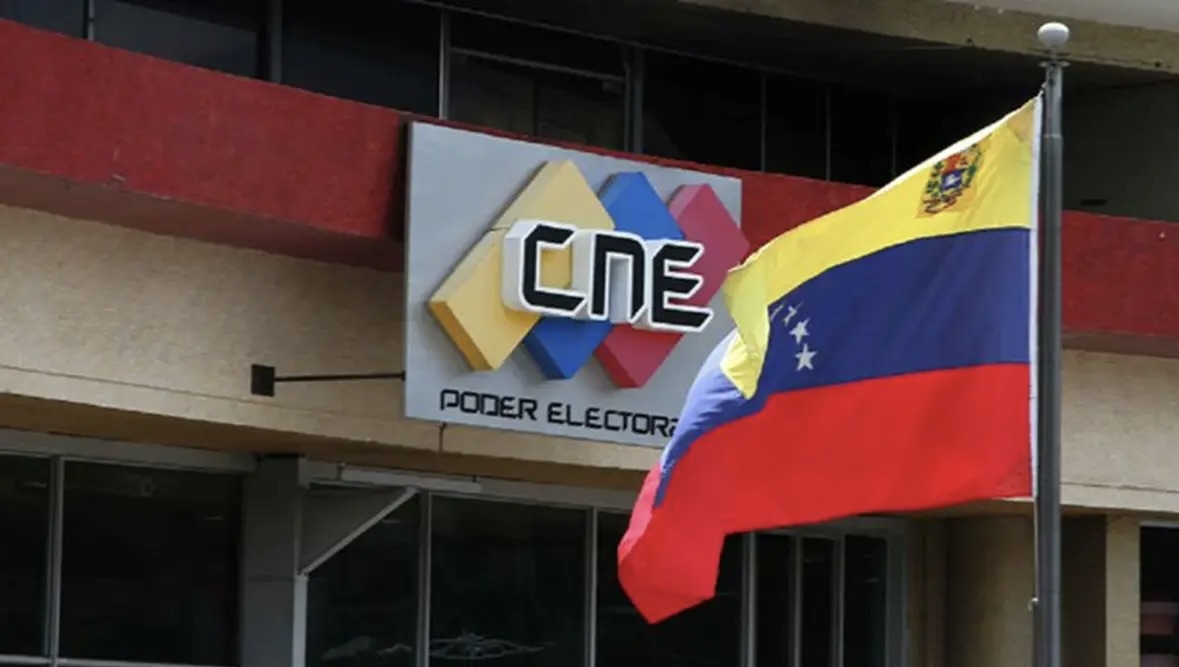
The National Electoral Council’s headquarters in Caracas, 2024. Photo: teleSUR
In the week ahead of Venezuela’s presidential elections, the National Electoral Council met with international electoral observers and representatives from all political parties
The Venezuelan National Electoral Council (CNE) announced on Monday July 22 that all the electoral machines that will be used in the elections on Sunday, July 28 have been distributed. With this, the president of the CNE, Elvis Amoroso assured that the machines that will be used in Sunday’s elections have been reviewed by representatives of the political organizations.
“Witnesses from political organizations were present at the event to verify the operation of each of the telecommunications devices involved in the process of transmitting results and ensuring the network used by the CNE,” said Amoroso, at a press conference.
Amoroso also said that the representatives of the political parties that will participate in the elections were able to verify the security codes as well as the functioning of the software to be used by the machines. The CNE thus seeks to guarantee the integrity of the elections and to safeguard the decision of the voters of the Caribbean country.
On the other hand, in its eagerness to cover the election with greater international confidence, the CNE accredited several international observers such as the Carter Center of the United States, the Council of Electoral Experts of Latin America, and the UN Panel of Experts, among others.
Even though an international media campaign tried to popularize the idea that the presidential candidate and current president would not recognize the results, Maduro said in a political rally that “nobody is going to stain the name of Venezuela or the electoral process; rain, thunder or shine, on Sunday there will be free elections in Venezuela. And we will recognize and defend the results”.
Similarly, Jorge Rodríguez, deputy of the Venezuelan National Assembly and an important leader of the United Socialist Party of Venezuela (PSUV) said in an interview with El País, that “we will recognize the results of the National Electoral Council”, and that if the ruling party were to lose the elections, there would be a “peaceful transition”.
On the other hand, the political team of the right-wing candidacy of Edmundo González Urrutia has repeatedly refused to affirm that it will accept the result of the presidential elections if its candidate were to lose in the elections of Sunday, July 28. María Corina Machado, head of the Venezuelan opposition, said a few weeks ago to the newspaper La Opinión that “The only way for Nicolás Maduro to win is with a monumental fraud”.
This political uncertainty promoted by the right-wing keeps Venezuela on high alert in the face of possible allegations of electoral fraud that, according to Jorge Rodriguez, are already being planned from abroad: “The violent people are trying to deny reality, they have a center in Miami where they will chant fraud on the afternoon of July 28…On Sunday, we will take to the streets, to celebrate the triumph of President Nicolas Maduro!”.
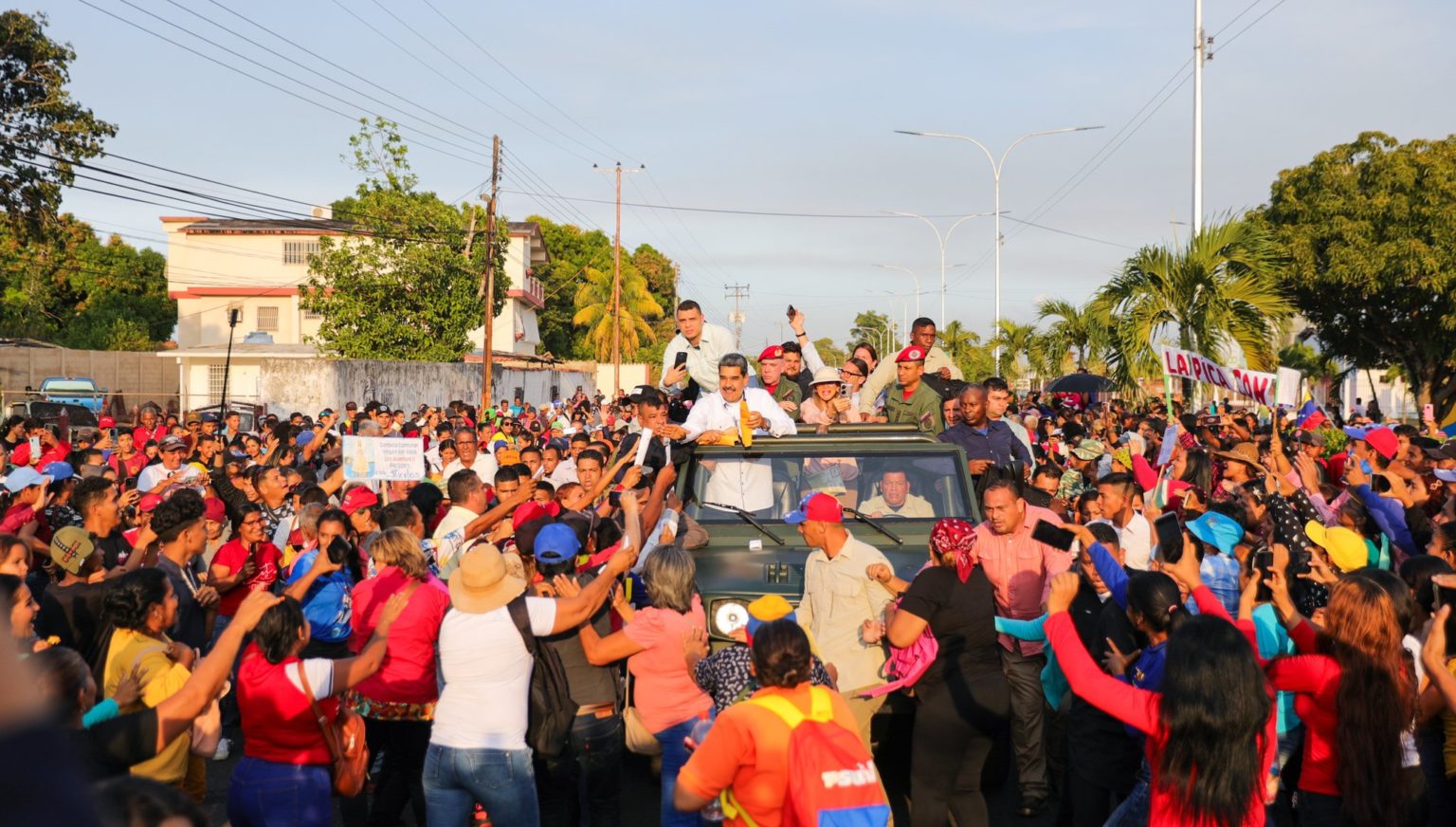
Nicolás Maduro received by thousands in the city of Maturín. Photo: Nicolás Maduro/ X
As Venezuela prepares to head to the polls in July, the US has already started drumming up suspicion and doubt around the electoral process.
Twenty-five years after Hugo Chávez took office and began the Bolivarian Revolution in Venezuela, US officials have still not tired of dreaming up new plots to overthrow the country’s government. Five years ago, following the last presidential election, they attempted to install Juan Guaidó—a politician most Venezuelans had never even heard of—as the country’s head of state. And now, with the date for the next presidential election officially set for July 28, the Biden administration is gearing up for the biggest regime-change push since the Guaidó coup attempt.
Venezuela has long been a target for US intervention because of its efforts to build an alternative model to the neoliberal capitalism pushed by institutions like the IMF and World Bank. First theorized and implemented under the leadership of Chávez, the Bolivarian Revolution in Venezuela puts forward a new model that emphasizes using the country’s resources, such as its oil revenue, to fund crucial missions. These then guarantee rights such as education, food, housing, transportation, culture, and sports to historically excluded majorities, to decrease longstanding socioeconomic inequality. A central part of the Bolivarian Revolution is the political and cultural transformation of the people through the promotion of Venezuelan national culture, internationalism, anti-imperialism, and the empowerment of all people as political subjects with rights and responsibilities. It is a project in direct contradiction to US interests in the oil-rich country and the region Washington considers its backyard.
The 2024 elections
President Nicolás Maduro is running for re-election as the candidate of the United Socialist Party of Venezuela (PSUV) and the broader Great Patriotic Pole coalition. He has built his campaign around a program referred to as the “Seven Transformations,” proposing major new initiatives in the fields of economic modernization, asserting national sovereignty, safety and security, ensuring social rights, political participation, the environment, and geopolitics. These aim to maintain the pro-poor, socialist orientation of the country’s development model while enacting reforms to stimulate greater economic activity and counteract the impact of crippling US sanctions.
The opposition is divided into several different camps. The largest coalition of opposition parties is called the Unitary Platform and consists of parties or factions of parties controlled by the Venezuelan elite who were displaced from positions of power as a result of the Bolivarian Revolution. The Unitary Platform has taken part in several rounds of negotiations with the government over the past year leading up to the elections and signed an agreement last October known as the “Barbados Agreement.”
In this agreement, the opposition was granted concessions on issues related to the organization of the electoral process, and in exchange, the United States agreed to loosen some sanctions relating to Venezuela’s oil and mining industries. The Barbados Agreement stipulated that only opposition figures who are eligible according to existing laws would be permitted to run. At this stage, the Unitary Platform has not chosen a candidate.
The specifics of how the electoral process will be carried out, regulations on campaigning on media platforms, participation of electoral observers, and the updating of electoral rolls were outlined in an agreement signed on February 28. The agreement was the product of dialogue among over 150 political and social organizations and was based on over 500 proposals. Ninety-seven percent of the political parties registered with the National Electoral Council participated.
Nonetheless, US officials have presented this electoral process, subject to such extensive deliberation and approved with such wide support, as an attack on democracy.
María Corina Machado and the fraud narrative
The approach of the US government follows a familiar script—wage a campaign in the media and through international organizations to cast doubt on the integrity of the electoral process so relentlessly that the result can be presented as fraudulent no matter what the actual evidence is on election day.
The key piece of the “electoral fraud” narrative is already in place and revolves around the disqualification of the opposition figure María Corina Machado.
Machado is the oldest daughter of Henrique Machado Zuloaga, who was an executive of Sivensa. One of Venezuela’s largest steel companies, Sivensa was nationalized in 2008 under Hugo Chávez. Since the start of the Bolivarian Revolution, Machado has been active in the right-wing opposition and has gone so far as to support destabilization campaigns and attempts to overthrow Venezuela’s democratically elected governments. She served as a member of Venezuela’s National Assembly from 2011-2014.
In July 2015, the Venezuelan comptroller general’s office announced that Machado was barred from holding public office for a period of one year after neglecting to disclose the extent of her earnings while she held public office.
The investigations into Machado continued. In July 2023, opposition deputy José Brito requested an update on Machado’s eligibility for holding public office given the upcoming presidential election and her stated intention to run. The comptroller general’s office responded, confirming that the disqualification of Machado was maintained and constituted a 15-year ban due to her support of regime change plots.
Though she initially refused to participate in the process, Machado appealed her ban through the Barbados Agreement procedure, which also stated that all candidates must defend Venezuela’s independence and reject violent actions against the government. In January 2024, the Supreme Court of Venezuela issued a sentence rejecting Machado’s appeal of the ban.
The Biden administration immediately sought to use economic coercion to undermine this decision by an institution of Venezuela, a sovereign state. As part of the Barbados Agreement, the US government issued licenses to certain oil companies permitting them to resume operations in Venezuela despite the sanctions. At the end of January, the State Department announced that the sanctions waivers issued to these companies would not be renewed once they expire on April 18.
At the same time, there is endless media reinforcement of the position that an election without Machado cannot be considered legitimate. On January 30, a few days after the Supreme Court rejected her appeal, Machado went on the television network CNN and was presented to viewers as “Venezuela’s main opposition leader.” An earlier Washington Post article is also typical of this narrative, headlined, “She’s the front-runner in the race to oust Maduro. He’s out to block her.” This combination of economic and political pressure is what has led to explosions in right-wing street violence in the past, following the 2013 presidential election when Maduro was first elected.
Machado: Regime change operative?
In 2002, following the short-lived coup d’état against Chávez, Machado signed the decree which established an unelected government under chamber of commerce head Pedro Carmona. In 2005 she met with former US president George W. Bush at the White House to discuss “democracy” (i.e., the overthrow of the Venezuelan government) More recently, she has been a key supporter and leader of the numerous right-wing plots to overthrow the democratically elected President Nicolás Maduro. These include the 2014 and 2017guarimba protests which saw extreme violence against security forces and chavista supporters, as well as the destruction of infrastructure.
In 2014, Machado was removed from her post in the National Assembly after she attended a meeting of the Organization of American States (OAS) in the place of the Panamanian representative in order to testify about 2014 protests, to speak out against the government, and to call for foreign support for her cause. The move was widely condemned as a violation of both the Venezuelan constitution and Panamanian law, and in response, Panamanian civil society and movement organizations filed a lawsuit against her for usurping a public post.
Machado has also celebrated the effectiveness of the illegal sanctions regime imposed on Venezuela in applying political pressure for regime change, and on several occasions, has called for even more sanctions. The sanctions have had devastating consequences for the Venezuelan people, well documented by different UN bodies and rapporteurs, human rights organizations, and think tanks. United Nations special rapporteur Alena Douhan noted that “[t]he announced purpose of the ‘maximum pressure’ campaign—to change the Government of Venezuela—violates the principle of sovereign equality of states and constitutes an intervention in the domestic affairs of Venezuela that also affects its regional relations.”
In 2019, Machado supported the push by Juan Guaidó’s parallel, fictitious government to request that the OAS apply the Inter-American Treaty of Reciprocal Assistance (TIAR) against Venezuela to end the “usurpation of power” by Maduro. The activation of TIAR would have provided a legal justification for foreign military intervention, (more) economic sanctions, and a commercial blockade.
An examination of the actual facts of Machado’s political career shows how the truth is much more complicated than the mainstream narrative about a government baselessly repressing an opponent.
After years of political instability caused by right-wing plots to overthrow the democratically elected government and even assassinate the leader, the Venezuelan government has pursued a straight-forward principle: political forces of any ideological variety can participate in elections as long as they do not conspire with foreign powers to undermine the independence of Venezuela or its sovereign institutions. This is in line with practices around the world. In the United States, for instance, there has been a great deal of public attention to the clause of the 14th Amendment that bars those guilty of insurrection from public office.
As the July 28 elections approach, tensions between the disparate elements of the Venezuelan political scene are bound to intensify. But the Biden administration is bound to be guided by the same overarching goal that has animated the policy decisions of Democratic and Republican administrations alike—remove from power one of the most long-standing opponents of Washington’s dominant role in the western hemisphere.
Zoe Alexandra is the co-editor of Peoples Dispatch.
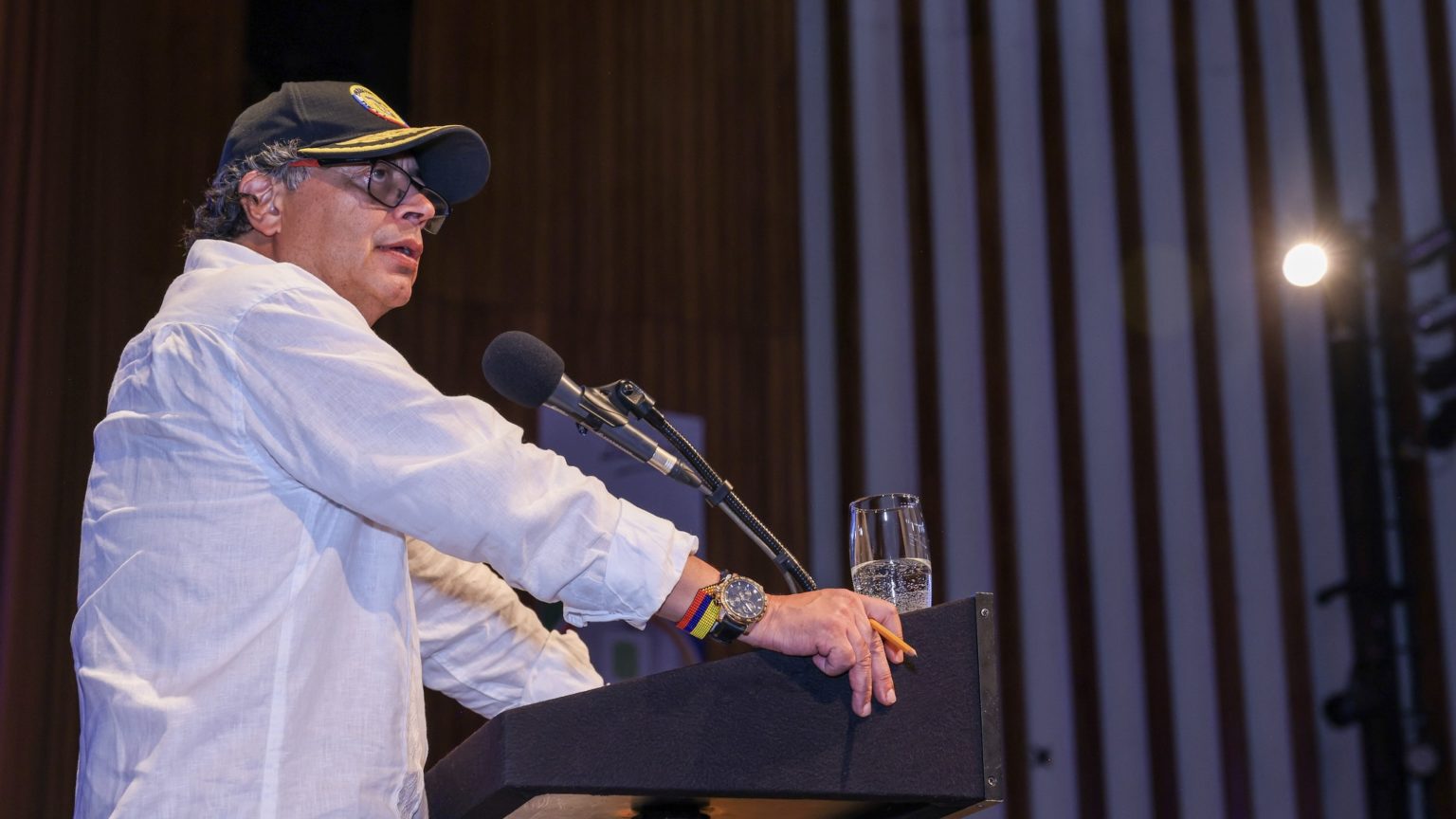
Colombian President Gustavo Petro speaking on February 13 from the Industrial University of Santander in Bucaramanga. Photo: Presidencia Colombia
The delay in the election of the Attorney General at the center of the ongoing tensions with the right, was highlighted by the United Nations Human Rights office and IACHR
Colombia’s Supreme Court will convene on February 22 to elect the country’s Attorney General (AG). The Supreme Court had already convened on two occasions, January 25 and February 8, for the same purpose but was unable, or as some allege, unwilling, to elect one of the three candidates proposed by President Gustavo Petro for the post back in August. The court’s refusal to elect one of Petro’s candidates for the post, has been at the center of what some have termed a “soft coup” or a destabilization campaign against the left-wing president’s government.
Petro himself said on February 2 that the court’s refusal to move forward was “institutional rupture that has reached its most desperate point, because the mafia does not want to control the entire sections of the Attorney General’s office that I have put in danger for having presented a shortlist of decent women.”
The Attorney General in Colombia is part of the judicial branch of power and has the role of investigating and accusing those who are alleged to be responsible for committing crimes.
On Monday February 12, the mandate of former AG Francisco Barbosa expired. Barbosa was appointed by former far-right president Iván Duque who is also his close friend from university. The AG has had open conflict with the current president, telling Blu Radio in May 2023 “I think Gustavo Petro is irresponsible” when Petro had warned of possible foul play in the AG’s investigation of members of Petro’s Historic Pact party.
On January 25, the same day that the Supreme Court was first set to elect his replacement, Barbosa ordered a raid of the Bogotá office of the Federation of Colombian Educators (FECODE) over allegations of improper contributions to Gustavo Petro’s presidential campaign. The move was widely condemned by social movements and trade unions in the country as being politically motivated.
With his term up, Barbosa’s deputy prosecutor and close ally, Martha Mancera, has taken up the post in the interim – until the Court makes its decision. Mancera has been named in different scandals, including an alleged cover up of an agent from the Attorney General’s investigative body who was involved in drug trafficking and arms trafficking.
On Wednesday February 14 at an event in the Industrial University of Santander in Bucaramanga, Petro said, “The government doesn’t agree that the Attorney General should be handed over to people with dubious reputation, that could have links, it seems and according to media investigations, with organized crime.”
International bodies such as the Inter-American Commission on Human Rights (IACHR) also expressed concern over the delay in the Supreme Court’s deliberations. In a statement published on February 13, the body said that a further delay in the selection of an AG, “could weaken the Colombian justice system” and that the Supreme Court must “fulfill its constitutional duty”.
On February 14, the UN Office of Human Rights in Colombia also declared that it was closely following the AG election process. In its statement, it highlighted the role the AG plays in “guaranteeing access to justice, democratic consolidation, and Rule of Law”, and as such, it “encourages the Supreme Court to conclude the process of selection of the AG in the shortest time possible”.
Both statements by the IACHR and the UN alluded to allegations by the right-wing that the citizen protests in dozens of cities across Colombia on February 8 to demand that the Court carry out its constitutional obligation, were an attempt by Petro to subvert rule of law and disrupt the Supreme Court’s process. The allegations are based on a video from a protest in Bogotá which depicts a couple of demonstrators attempting to rush the barricade at the gates of the Court while other protesters are leaving the site. Many analysts have stated that those depicted in the video were seemingly right-wing infiltrators.
Nevertheless, right-wing media has launched full scale attacks on protesters and Petro, and the Attorney General’s office claimed “possible crimes were committed” and opened up a special investigation.
Added to the growing pressure on Petro’s administration, is the direct attack on his foreign minister, Álvaro Leyva, who is under investigation by the Ombudsman and suspended from his position for three months over allegations of irregularities in the bidding process for passport processing. In reality, Leyva had taken steps to confront a private firm, Thomas Gregs and Sons, that had a major contract with the state for processing passports and had control over a significant amount of the population data in the country.
Petro had said that renowned jurists called the suspension of the foreign minister unprecedented and he termed it “institutional rupture”.
With growing pressure on the court to fulfill its constitutional mandate, the Supreme Court’s session on February 22 is set to be an important date, while the movements and social organizations that mobilized and campaigned to put Petro’s government of change in office have vowed to defend it at all costs.