Tag: Venezuela

  • Western Media Accept Trump’s Plundering of Venezuelan Oil as Business as Usual

    Spread the love

    Article by Ricardo Vaz republished from FAIR under a Creative Commons Attribution-NonCommercial-NoDerivs 3.0 Unported License.
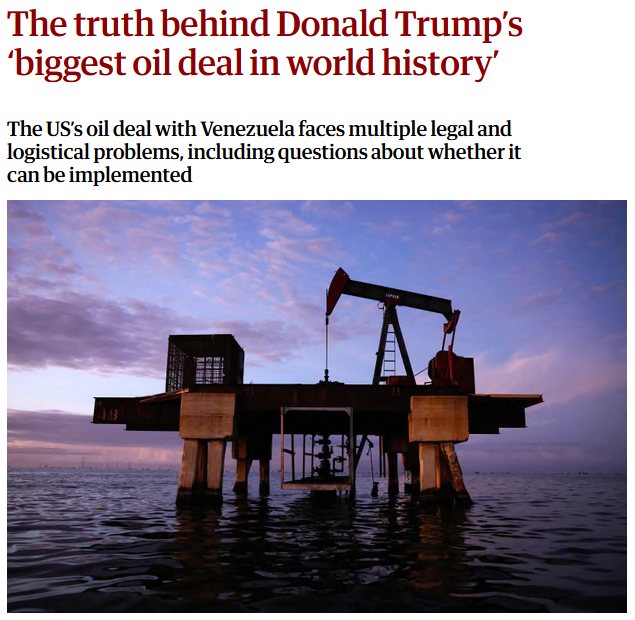
    Guardian: The truth behind Donald Trump’s ‘biggest oil deal in world history’

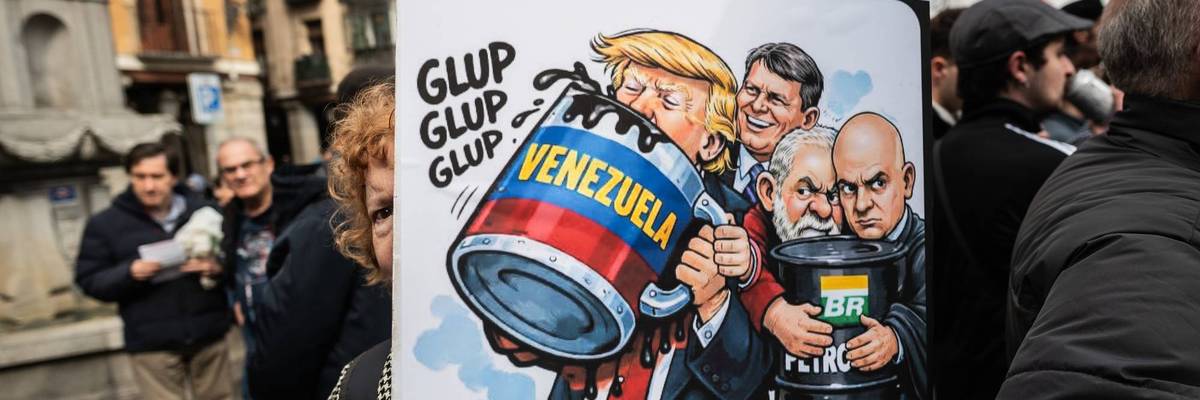
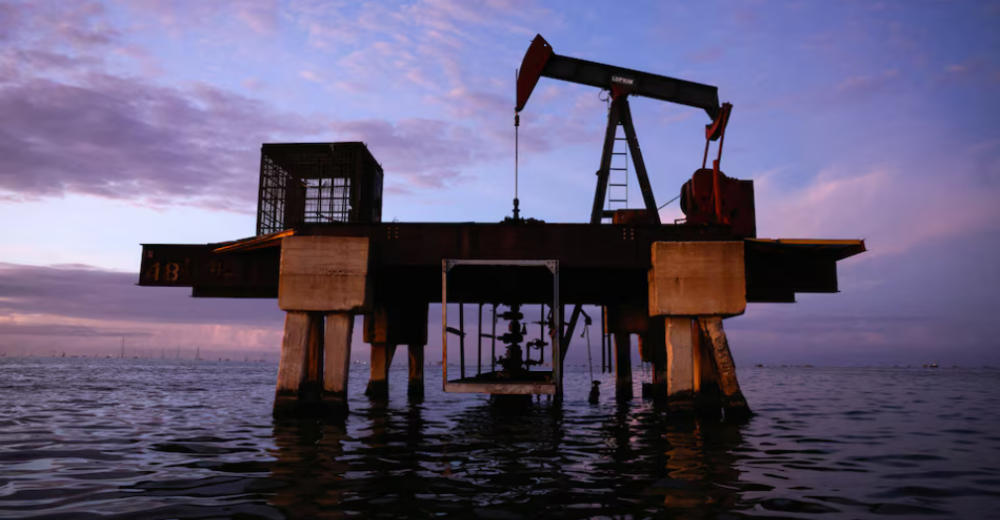
    Guardian (9/26/26): “Donald Trump has long coveted the oilfields of other nations.” [26/9/26]

    Since the January 3, 2026, military strikes and kidnapping of President Nicolás Maduro, the Trump administration has imposed semi-colonial rule over Venezuela, forcing dramatic shifts in the country’s domestic and foreign policies.

    The capstone of the new tutelary regime is an oil deal announced in late August that Trump called “the biggest in history.” The agreement turns over 17 prime oilfields, holding over 20% of the country’s reserves, to a Pentagon-controlled corporation tasked with supplying cheap fuel to the US war machine for decades to come.

    After spending years manufacturing consent for US-sponsored regime change in Venezuela (e.g., FAIR.org, 6/4/21, 1/11/23, 2/12/25), having a government in Caracas subservient to Washington represented a new scenario for the corporate media. The novel conditions have raised few significant qualms for Western outlets. Tactical objections notwithstanding, there is no fundamental disagreement with the US running the affairs of a Global South country.

    Not ‘stealing Venezuela’s oil’
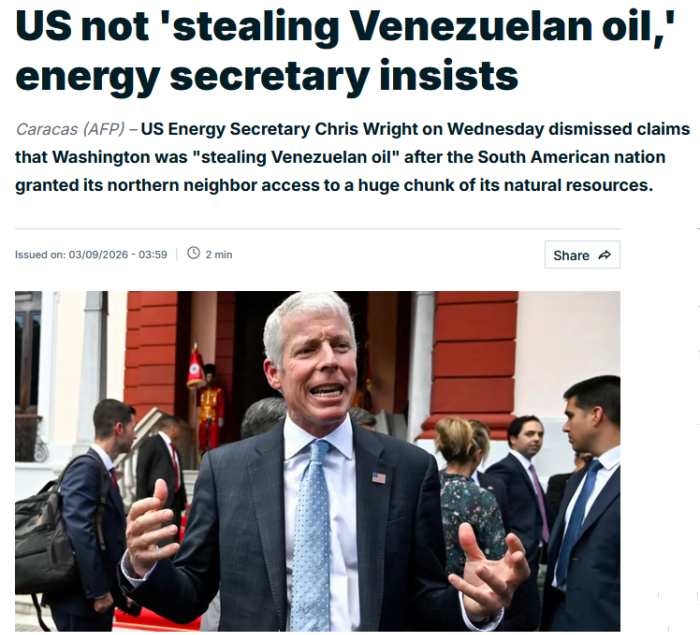
    France 24: US not 'stealing Venezuelan oil,' energy secretary insists

    Energy Secretary Chris Wright (France 24, 3/9/26): “I’ve seen those headlines. ‘We’re Stealing Venezuelan Oil.’ Of course, that’s not true at all.”

    Working hand in glove with the Trump administration, the acting Delcy Rodríguez government has overhauled Venezuela’s hydrocarbon legislation (Venezuelanalysis, 7/13/26) to offer what oil experts consider a business environment more favorable to foreign capital than at any point in the country’s history. The new oil agreement with the White House manages to go even further.

    The 17 oilfields in question will be taken over by North American Blue Energy Partners (NABEP), a private company in which the Pentagon’s Office of Strategic Capital (OSC) will get a 35% stake while investing nothing—and wielding veto power over its board.

    Furthermore, according to the White House, the US State Department will secure 20% of NABEP’s output at cost, and have a right of first refusal over the remaining 80%. On top of this, Venezuelan officials have already suggested Washington would be given an additional “sales discount”  (Venezuelanalysis, 9/9/26).

    In summary, Trump is looking to secure cheap crude supplies at a time when his disastrous Iran debacle has thrown global energy markets into upheaval. The agreement is so blatantly skewed that US Energy Secretary Chris Wright felt he needed to clarify that Washington was not “stealing Venezuela’s oil” (AFP, 9/3/26).

    Nevertheless, Western media outlets were largely unfazed by such an obvious oil grab, euphemistically referring to the deal as “highly unusual” (New York Times, 8/29/26) or “remarkable” (BBC, 9/1/26), at most as “contentious” (Guardian, 9/1/26).

    Corporate journalists did raise objections over the central role played by NABEP owner Alejandro Betancourt, a shady Venezuelan businessman who faced multiple money-laundering probes before the Trump administration intervened, and pressured judicial authorities at home and abroad to drop the investigations (BBC, 9/2/26; CNN, 9/4/26; New York Times, 9/4/26).

    But media seemed satisfied with Trump’s state and energy secretaries Marco Rubio and Chris Wright pledging that US oversight will keep proceedings honest (Reuters, 9/2/26; New York Times, 9/4/26), despite the fact that billions in Venezuelan oil revenues, controlled by the US Treasury Department since January, are unaccounted for (Council on Foreign Relations, 6/3/26; Financial Times, 7/22/26).

    Procedurally transparent plunder
    NYT: Trump Promised Transparency in Venezuela, but Oil Secrets Linger

    The New York Times (5/5/26) wrote positively of “a new era of accountability” in which “the United States would control Venezuelan oil sales” and “Venezuela would submit monthly budgets to the White House.”

    Objections to the Venezuela/NABEP/Pentagon venture were mostly procedural and out of concern for appearances, not driven by any principled opposition to US imperialist predation. Faced with outright colonial plunder of Venezuela, the political and media establishment only demands “accountability” and “transparency” (New York Times, 5/5/26; Financial Times, 9/18/26).

    For months, the White House has controlled Venezuelan oil export revenues, with Trump officials openly calling them “one of the largest assets ever to go on the US balance sheet,” and a source of “leverage” over Caracas. Yet Trump’s Democratic opponents have found no issue with seizing another country’s income, raising only questions about the allocation of the funds in reference to alleged corruption on the part of Caracas and Trump insiders (The Hill, 9/30/26; Washington Post, 9/17/26). This despite the fact that the Venezuelan government has to submit a “monthly budget” to access its own funds (New York Times, 1/28/26) and is subjected to US-imposed auditors (Reuters, 4/27/26).

    The other source of disappointment with Trump stomping all over Venezuelan sovereignty, but prioritizing oil over regime change, is impatience for the restoration/recovery/return of “democracy” to Venezuela (Politico, 9/2/26; Guardian, 8/30/26; CBC, 9/3/26). Despite  widely acknowledgement that Trump is eroding democracy at home (New York Times, 8/20/26, 10/14/26; Guardian, 10/8/26), somehow pundits expected him to prioritize it in an oil-rich foreign country.

    In the establishment’s consensus, “democracy” does not mean a political system that meaningfully reflects the Venezuelan people’s collective will, but simply one that empowers opposition figures that have been groomed for years, like far-right María Corina Machado, their undemocratic credentials notwithstanding (FAIR.org, 10/23/25).

    Eager to stay in power, Rodríguez has over-complied with every US demand, going as far as adopting language about Venezuela undergoing a “democratic transformation.” Her pliancy has earned her favorable corporate media profiles that completely contrast with the demonization of Maduro.

    After securing an exclusive interview, Time (7/30/26) described the acting leader as a “disciplined operator” who “advocate[s] for greater economic openness,” in contrast to the “authoritarian” Maduro, who oversaw “economic collapse.” Along the same lines, the Guardian (9/12/26) presented Rodríguez as a “a pragmatic, witty and intelligent workaholic,” unlike her “authoritarian” and “incompetent” predecessor in the presidential palace.

    Nevertheless, given the broad Beltway consensus for comprehensive regime change, it is unlikely that the Rodríguez administration’s subservience to Trump will secure any leeway in determining its political path forward, free from outside meddling—especially if, as is anticipated, the GOP lawmakers most likely to be impressed by such obsequiousness lose power in the US’s upcoming midterm elections (Axios, 9/23/26; Financial Times, 10/9/26).

    Please think of the corporations!
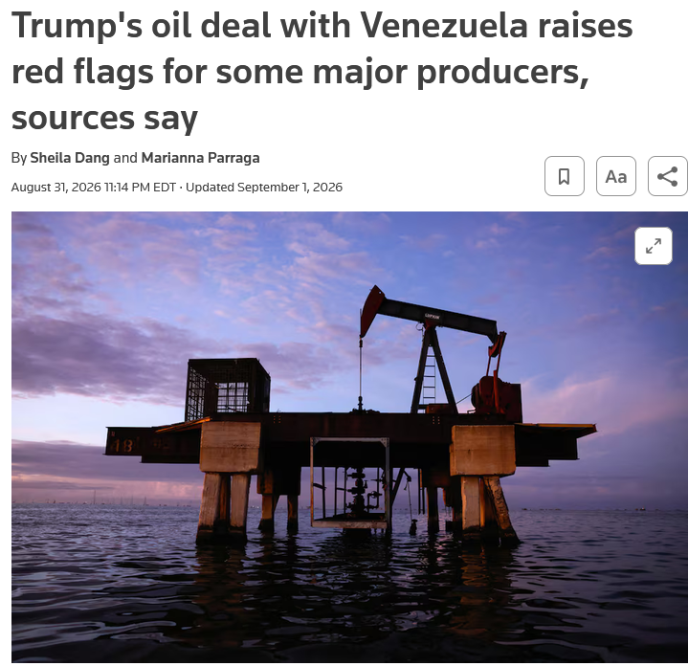
    Reuters: Trump's oil deal with Venezuela raises red flags for some major producers, sources say

    Reuters (9/1/26): ExxonMobil and ConocoPhillips “have repeatedly said that their requirements of legal certainty and contract sanctity ‌have not ⁠yet been met.”

    Alongside their exceptionalist expectations about “democracy,” legacy outlets also focus on those they consider the true victims of Trump’s neocolonial offensive in Venezuela: multinational oil corporations.

    According to Reuters (9/1/26), the recent oil deal “raises red flags for major producers,” who fear having their reputation sullied by being “seated at the same table with Betancourt,” as well as the prospect of the US government becoming a “competitor.”

    Bloomberg (8/30/26) raised concerns that the agreement “reprises [the] neocolonial past” of Venezuela’s oil industry. The warning stems not from apprehension that the Venezuelan people’s future is being determined by a foreign nation, but from fear that the US’s “out-sized power” might lead to “popular unrest.” This could create conditions for what the business mouthpiece views as a catastrophic outcome: the nationalization of foreign-owned oil assets.

    “The troubled history of Venezuela’s oil offers a cautionary tale,” Bloomberg’s Kevin Crowley and Patricia Garip wrote:

    The country was once dominated by US and European operators and was among the world’s largest producers. But assets owned by ExxonMobil Holdings Corps. and ConocoPhillips were seized and nationalized during political upheaval in the 2000s.

    Corporate media present companies that made massive profits in Venezuela for decades as victims, because the Chávez government wanted them to comply with new laws and accept minority stakes in joint ventures.

    The New York Times (9/1/26) complains that the two corporations “have spent years trying to get the country to repay them for their seized assets, with little success.” The statement conceals the fact that the Venezuelan government, when it enacted the 2007 decree imposing state majority in all Orinoco Oil Belt projects, offered to compensate ExxonMobil and ConocoPhillips for their transition to minority partners, or to buy out their assets altogether. However, both corporations rejected the offers in order to pursue international arbitration. The former has already recouped most of what it was granted, while the latter will eventually collect on a significant award.

    Despite the fact that Chevron, BP, Shell and other energy giants have signed deals in recent months taking advantage of the reformed hydrocarbon law (Venezuelanalysis, 9/3/26), pundits complain that ExxonMobil and ConocoPhillips remain “hesitant” (CBS, 8/31/26) and need to be “lured” (Reuters, 9/1/26). Still, the Western corporations are likely to return to the country with favorable deals (Reuters, 9/16/26).

    The victor and his spoils
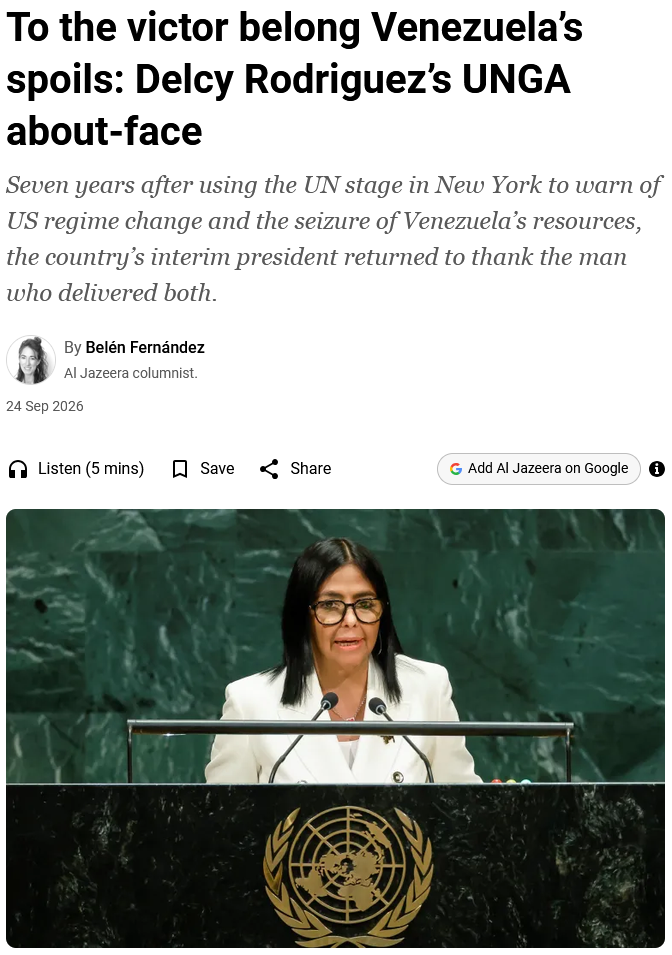
    Al Jazeera: To the victor belong Venezuela’s spoils: Delcy Rodriguez’s UNGA about-face

    Belén Fernández (Al Jazeera, 9/24/26): “You’re not technically supposed to admit that you attacked a country just to get its oil.”

    Faced with strategic defeat in West Asia, Trump has clung to his Venezuela success, stating on multiple occasions that “to the victor belong the spoils,” in reference to the US hijacking the Venezuelan oil industry following the January 3 attacks and presidential kidnapping (Al Jazeera, 9/24/26; Guardian, 9/26/26).

    Furthermore, Trump has not been shy in boasting about the US winning a “war” against Venezuela (Financial Times, 9/18/26; New York Times, 6/26/26). Corporate journalists have rarely pointed out that this stance directly contradicts the administration’s official position that the kidnapping of Maduro and Flores was a “law enforcement” operation (New York Times, 1/6/26; PBS, 1/8/26) in order to justify bypassing congressional approval.

    The US president has likewise claimed to have recovered the costs of the military operation “many times over” (Al Jazeera, 3/3/26; Guardian, 6/28/26), a fact confirmed by Luigi Pisella, a business sector spokesperson with close ties to the acting Rodríguez administration (Venezuelanalysis, 8/10/26). Pisella stated that the US has retained $4.7 billion from the Venezuelan export revenues it controls to cover the costs of its military operation.

    In spite of their ostensible hostility to Trump, corporate outlets have historically been complicit with his Venezuela policies, from whitewashing a deadly sanctions program (FAIR.org, 6/13/22) to endorsing a military buildup over debunked “narcoterrorism” accusations (FAIR.org, 11/19/25). The New York Times and Washington Post went as far as to withhold information in order to not jeopardize the January 3 operation (FAIR.org, 1/13/26).

    Now, with a semi-colonial regime in place, the only concerns are about procedural transparency, democratic appearances and the well-being of multinational corporations. The Venezuelan people always get the short end of the stick.

    FAIR’s work is sustained by our generous contributors, who allow us to remain independent. Donate today to be a part of this important mission.

    Article by Ricardo Vaz republished from FAIR under a Creative Commons Attribution-NonCommercial-NoDerivs 3.0 Unported License.

    Climate science denier Donald Trump confirms that he knows nothing about democracy and that more liquid gold is being secured according to his policy of global privateering.
    Climate science denier Donald Trump confirms that he knows nothing about democracy and that more liquid gold is being secured according to his policy of global privateering.

  • Hegseth says Iran has choice between deal or ‘devastation’

    Spread the love

    This work by Middle East Monitor is licensed under a Creative Commons Attribution-NonCommercial-ShareAlike 4.0 International License.

    United States Secretary of War Pete Hegseth speaks during the press conference held by The United States President Donald Trump in the James S. Brady Press Briefing Room at the White House on April 6, 2026, in Washington DC, United States. [Celal Güneş – Anadolu Agency]

    US Defense Secretary Pete Hegseth said Saturday that Iran faces a choice between abandoning its “nuclear ambitions” and reaching a deal or facing devastating military action, Anadolu reports.

    “Iran’s going to have a choice to make real quick about whether they’re going to give those up at the table or face the kind of devastation that America can bring and will bring swiftly if necessary,” Hegseth told Reserve Officers’ Training Corps cadets and military recruits at the University of Tennessee.

    He accused Tehran of building a large conventional missile arsenal to deter military action while pursuing “nuclear ambitions,” arguing that US military strength was essential to forcing adversaries to negotiate.

    READ: Iran says renewed talks with US require ‘credible guarantees’ against new attacks

    Hegseth also said that Iran “funds the proxies in Hezbollah, funds the proxies in the Houthis in Yemen,” adding that Washington had sought to deter attacks on US forces and shipping.

    The defense chief framed the policy on Iran as part of US President Donald Trump’s wider effort to reassert American power, including confronting drug cartels and limiting the influence of Iran, China and Russia in Latin America.

    Referring to Venezuela, Hegseth said the US operation there would have “generational implications,” describing the country as a strategic partner and highlighting its oil resources.

    He said Washington was seeking to push its rivals out of the Western Hemisphere while strengthening its military presence and partnerships across the Americas.

    READ: Beyond oil: The Gulf crisis is becoming a food security crisis

    This work by Middle East Monitor is licensed under a Creative Commons Attribution-NonCommercial-ShareAlike 4.0 International License.

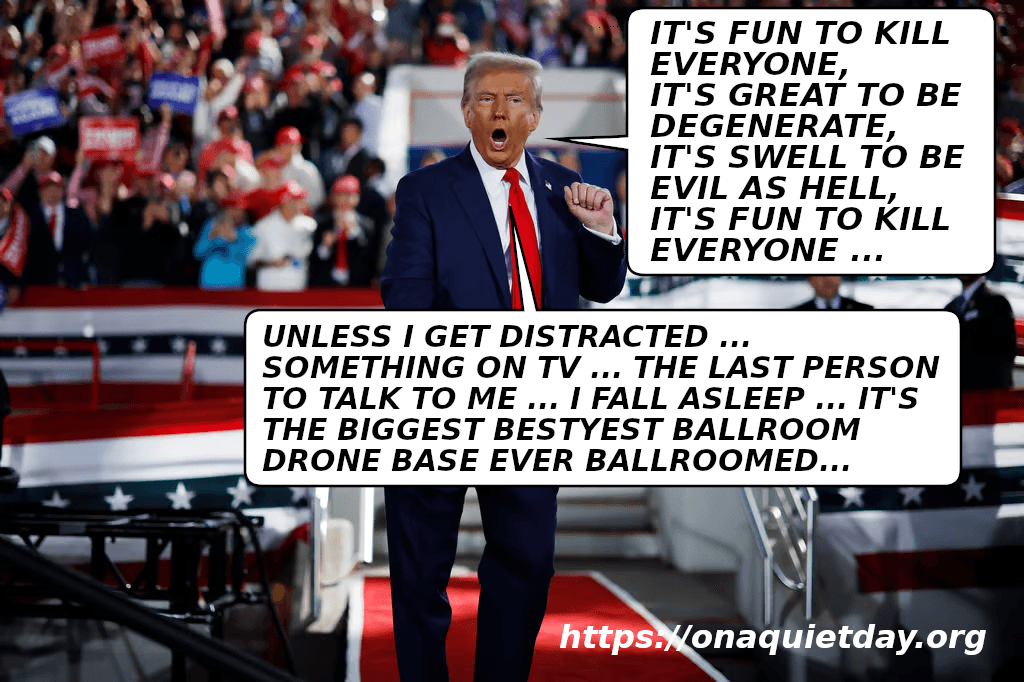
    Donald Trump sings and dances, says that it's fun to kill everyone ... unless he gets distracted or falls asleep.
    Donald Trump sings and dances, says that it’s fun to kill everyone … unless he gets distracted or falls asleep.
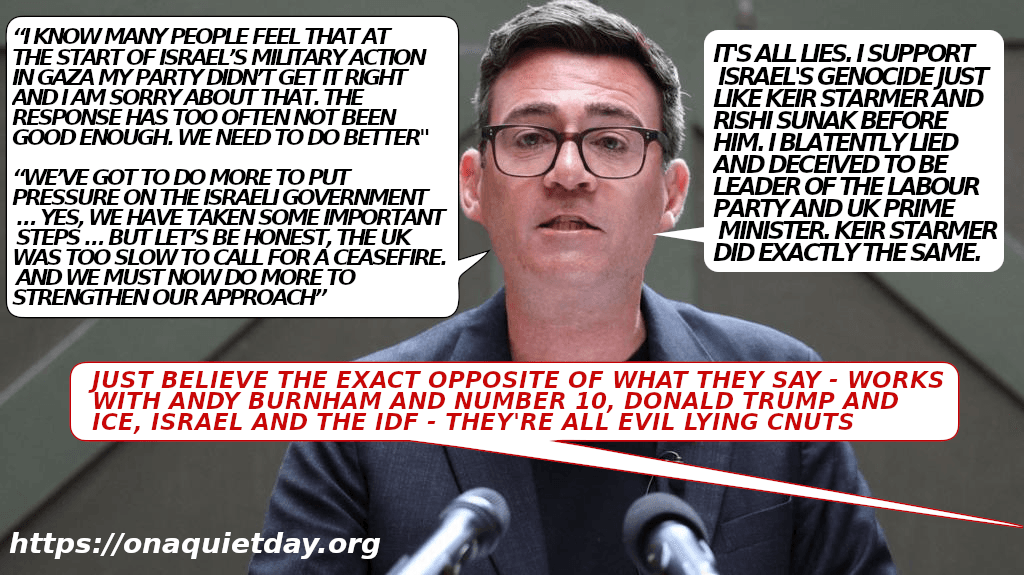
    Keir Starmer objects to criticism of the IDF. He asks how could anyone object to them starving people to death, forced marches like the Nazis did, bombing Gaza's hospitals and universities, mass-murdering journalists, healthworkers and starving people queuing for food, killing and raping prisoners and murdering children. He calls for people to stop obstructing his genocide for Israel. New Labour UK Prime Minister Andy Burnham continues Labour party policy of active support and complicity in Israel's genocide.
    Keir Starmer objects to criticism of the IDF. He asks how could anyone object to them starving people to death, forced marches like the Nazis did, bombing Gaza’s hospitals and universities, mass-murdering journalists, healthworkers and starving people queuing for food, killing and raping prisoners and murdering children. He calls for people to stop obstructing his genocide for Israel. New Labour UK Prime Minister Andy Burnham continues Labour party policy of active support and complicity in Israel’s genocide.
    UK Prime Minister Andy Burnham admits to blatently lying and engaging in deception to become leader of the UK Labour Party and Prime Minister.
    UK Prime Minister Andy Burnham admits to blatently lying and engaging in deception to become leader of the UK Labour Party and Prime Minister.
    Ed Miliband says that he and the Labour Party are full of shit criminalising people holding signs as terrorists despite anything he says.
    Ed Miliband says that he and the Labour Party are full of shit criminalising people holding signs as terrorists despite anything he says.

    Andy Burnham stands with Israel

  • Air Force Major Who Called for Trump’s Impeachment Is in Solitary Confinement 24 Hours a Day

    Spread the love

    Article by Stephen Prager republished from Common Dreams under Creative Commons (CC BY-NC-ND 3.0).

    Air Force Maj. Jason Watson stands on the steps of the US Capitol in Washington, DC, holding a sign calling for the impeachment and removal of US President Donald Trump on July 1, 2026.
    (Photo by The Removal Coalition)

    One law professor told Common Dreams the detention of Maj. Jason Watson was a “blatant case of illegal pretrial punishment.”

    Air Force Maj. Jason Watson was arrested July 1 on the steps of the US Capitol after calling for the impeachment of President Donald Trump. According to his lawyer, he’s now being held in solitary confinement 24 hours a day in what some legal experts say could amount to illegal pretrial punishment.

    The Uniform Code of Military Justice (UCMJ) contains provisions barring officers from engaging in public political activities that are typically protected for civilians, including criticizing the president and other elected officials.

    RECOMMENDED…

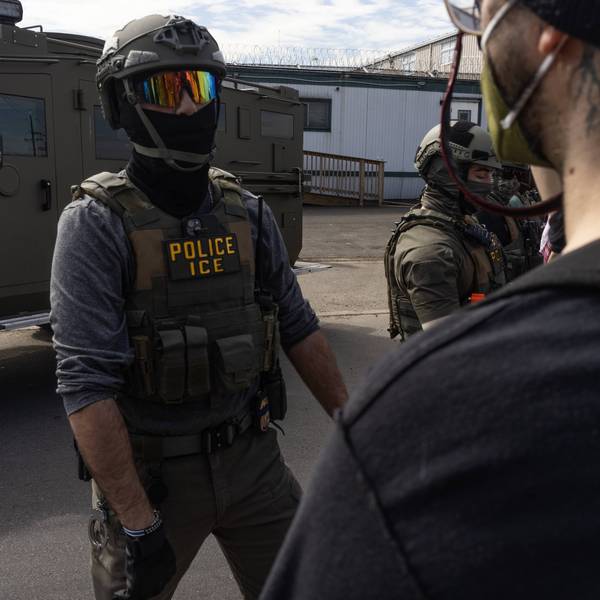
    ICE agents and immigration activists face off outside Delaney Hall detention center in Newark, New Jersey

    ‘Should Concern All Americans’: Records Show ICE Has Gathered 50 Million Voter Records Ahead of Midterms

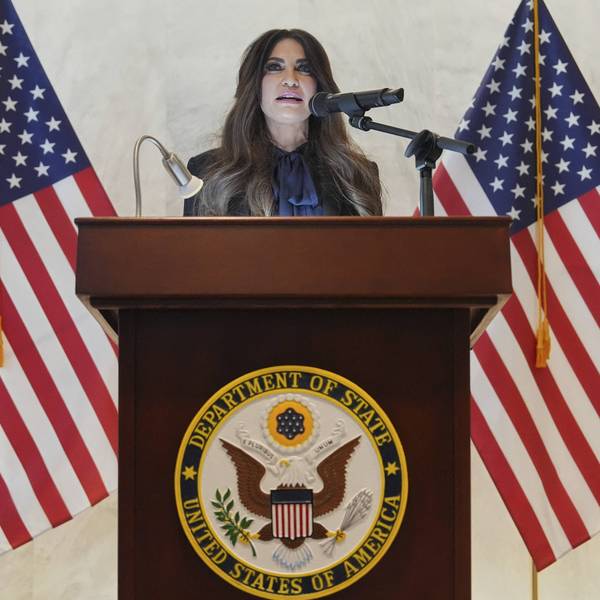
    'It Was All Quid Pro Quo': GOP Donor Goes on the Record to Accuse Kimberly Guilfoyle of Corruption

    ‘It Was All Quid Pro Quo’: GOP Donor Goes on the Record to Accuse Kimberly Guilfoyle of Corruption

    Prosecutors have charged Watson with violating them when he participated in a news conference calling for Trump to be removed from office over his launching of military actions against Iran, Cuba, and Venezuela without congressional authorization.

    After the speech, Watson stood on the Capitol steps holding a sign that read “Impeach, Convict, Remove” and was arrested after he refused to move.

    Before he was charged, Watson gave a CNN interview on August 17 in which he continued to criticize Trump, accusing him of “flagrantly violating the Constitution” and “breaking the law.”

    He acknowledged that he could face severe consequences as a result of his speech: “We just have to be willing to accept that we can change what is happening in our country if we are just willing to pay a price for it,” he said.

    One day later, he was arrested while on duty and taken into pretrial confinement. He now faces a general court-martial, the military’s most severe trial, which is capable of imposing lengthy prison sentences.

    On Friday, Watson’s lawyer, Christopher Mutimer, told CNN that after nearly two months, Watson is “still in solitary confinement 24 hours a day,” which he said amounted to “cruel and unusual” punishment.

    “Even if he gets an hour to eat or to exercise, he is alone,” Mutimer said. “He is literally by himself, with his thoughts, in a room where the light never turns off all day.”

    In an essay published Sunday by writer Monte Mader, Watson himself acknowledged spending his days in isolation, revealing that his Bible had only recently been returned to him and that he had little access to news.

    Watson described the conditions of his confinement as the reality one must accept when choosing to engage in nonviolent resistance.

    “Walking this path,” he said, “means exposing oneself to violence while refusing to retaliate against it.”

    After his July 1 protest, Watson had been restricted to Joint Base Anacostia-Bolling in Washington. Though the base reportedly has a confinement facility, following his detention, he was instead moved to a county jail in Maryland.

    During Watson’s September 18 preliminary hearing, Maj. Joshua Wendell, the hearing officer, said Watson could not be confined with civilians and was therefore kept in solitary confinement.

    “He was placed in confinement because of the law, which puts him in solitary confinement,” Wendell said, according to Stars and Stripes.

    Article 13 of the UCMJ “forbids punishing a service member before trial and forbids pretrial restraint more rigorous than the circumstances require.”

    Mutimer has pointed out that solitary confinement is “usually reserved for individuals who are disobeying or are violent, and injuring other people,” and usually only for “a day or two, or a week.” Watson, he said, has “been in there for months now.”

    Rachel VanLandingham, a former Air Force judge advocate and professor of law at Southwestern Law School, told Common Dreams that this “seems to be a blatant case of illegal pretrial punishment given that the nature of his pretrial restraint does not seem necessary to either ensure his presence at trial or to prevent foreseeable serious criminal misconduct.”

    “Solitary confinement is rare, and must be justified,” she said. “What, is the administration so afraid of this major’s words that he cannot talk to anyone?”

    Military defense attorney Cody Harnish, who attended Watson’s preliminary hearing, has raised concerns that his detention could be unlawful and that his especially harsh treatment was political in nature.

    “I represent people at court-martial in the military, who are accused of doing some very bad things,” he said during an interview this weekend with Meidas Defense. “They are not in pretrial confinement.”

    Harnish noted other abnormal aspects of Watson’s preliminary hearing: He was denied the ability to wear his uniform and instead arrived handcuffed, unshaven, and wearing an undershirt, which pointed to the possibility that he was facing degrading treatment.

    He also pointed out that Watson had submitted a request to resign his commission in exchange for avoiding a court-martial, but that the request was denied in 24 hours.

    “Nothing gets processed in the military that fast,” he said, suggesting that this could indicate influence from senior Pentagon officials.

    During his second term, Trump has used members of the military for political purposes in ways that have challenged longstanding norms of political neutrality. This has included hosting overtly political rallies before uniformed troops, screening them for ideology, and purging senior military officers deemed disloyal.

    Harnish suggested that the Trump administration was seeking to make an example out of Watson for speaking out against the president.

    “When someone speaks out against this administration in the military,” he said, “they’re going to crush him to silence anyone else in the ranks from ever thinking about it.”

    Article by Stephen Prager republished from Common Dreams under Creative Commons (CC BY-NC-ND 3.0).

    Elon Musk urges you to be a Fascist like him, says that you can ignore facts and reality then.
    Elon Musk urges you to be a Fascist like him, says that you can ignore facts and reality then.
    Orcas discuss Donald Trump and the killer apes' concept of democracy. Front Orca warns that Trump is crashing his country's economy and that everything he does he does for the fantastically wealthy.
    Orcas discuss Donald Trump and the killer apes’ concept of democracy. Front Orca warns that Trump is crashing his country’s economy and that everything he does he does for the fantastically wealthy.
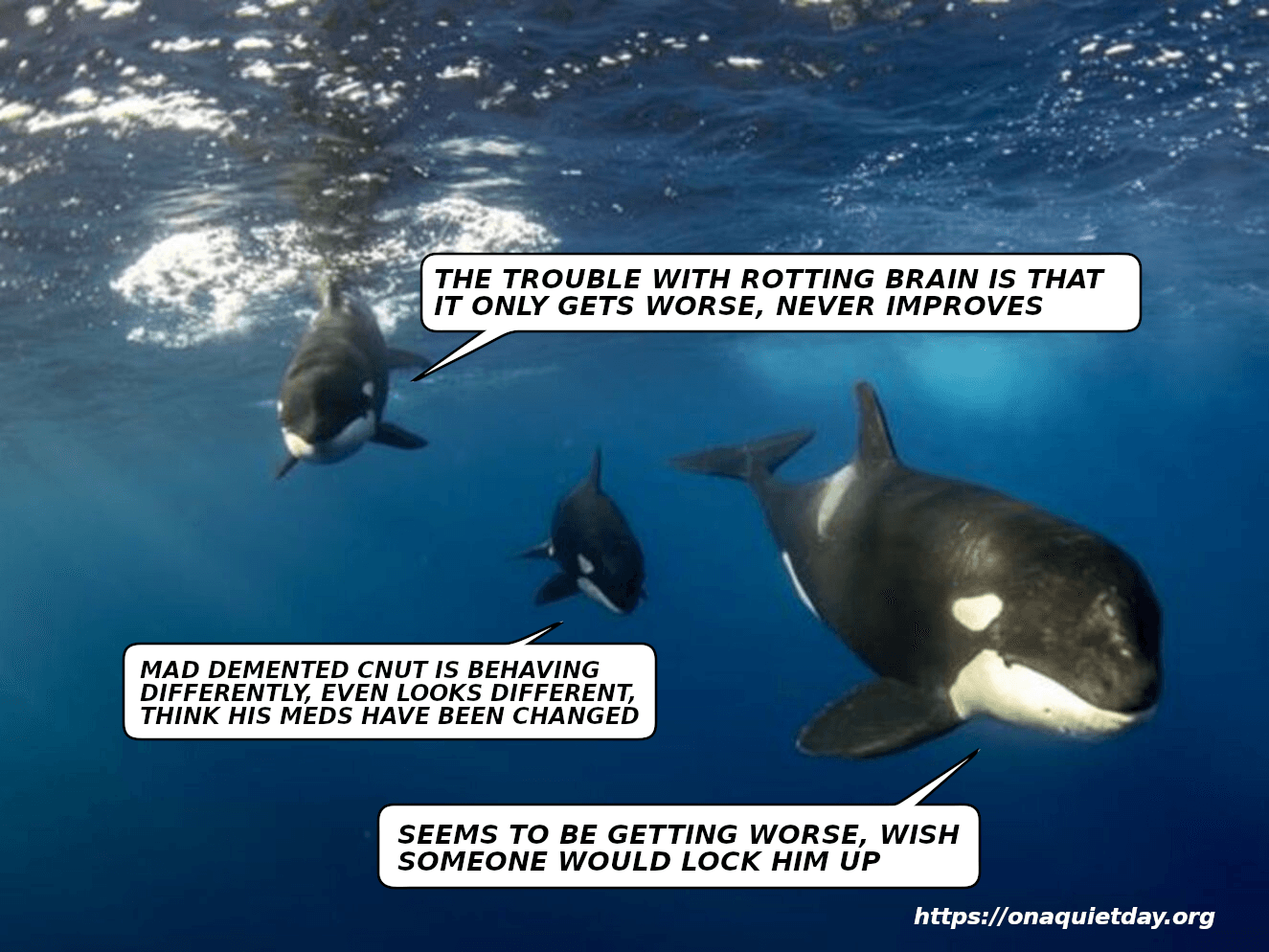
    Orcas discuss rotting brain, front Orca says he wishes someone would Lock Him Up, small Orca says he thinks that his meds have been changed.
    Orcas discuss rotting brain, front Orca says he wishes someone would Lock Him Up, small Orca says he thinks that his meds have been changed.
  • ‘We Don’t Waste Our Time’ With Courts, Says Trump, Bragging of Extrajudicial Murders in Pacific and Caribbean

    Spread the love

    Article by Stephen Prager republished from Common Dreams under Creative Commons (CC BY-NC-ND 3.0).

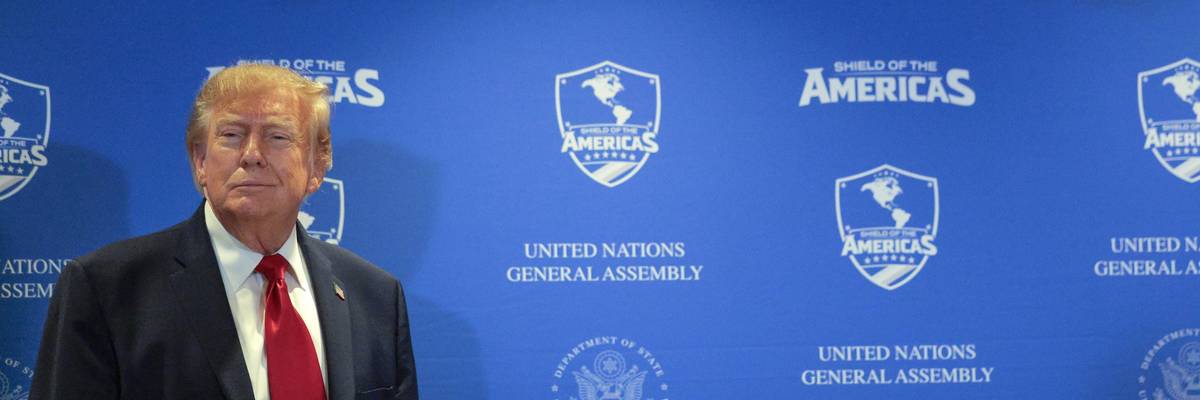
    US President Donald Trump arrives for a Shield of the Americas meeting in conjunction with the 81st session of the United Nations General Assembly at the UN headquarters on September 22, 2026 in New York City. (Photo by Chip Somodevilla/Getty Images)

    Critics have described Trump’s boat strikes as extrajudicial killings that violate due process. At a meeting during this week’s gathering of the UN General Assembly, he seemed to agree.

    Critics have often described President Donald Trump’s campaign of boat strikes in the Caribbean and Pacific—which have taken the lives of at least 234 mostly unknown people—as extrajudicial killings that flout the very basics of due process.

    On Tuesday, Trump essentially described them that way too, seeming to suggest that killing people outside the law is the whole point.

    RECOMMENDED…

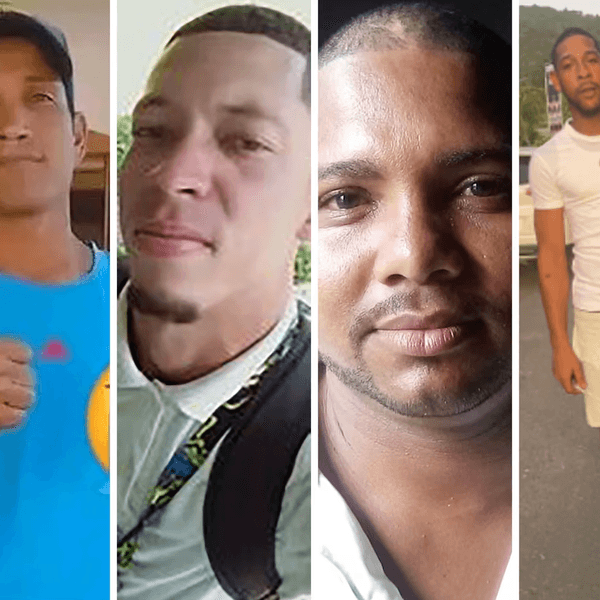
    Four victims of the Trump administration’s boat bombings

    Trump Condemned for 200+ Extrajudicial Killings After Yearlong Murder Spree at Sea

    A boat burns after being bombed by US forces in the Pacific Ocean

    As Trump Resumes Boat Strikes, Amnesty Says ‘Congress Must Stop Murderous Yearlong Campaign’

    “For years, administrations just played games, and they’d bring them to a court in Miami or something, and the judge would release them immediately, and they’d go back to selling drugs,” Trump said. “But now, we don’t waste our time doing it.”

    He was speaking at a meeting of the Washington-led “Shield of the Americas” coalition, an alliance of leaders and foreign ministers ostensibly dedicated to stamping out drug cartels and other criminal organizations across the Americas.

    The boat strike campaign—known first by the Defense Department as “Operation Southern Spear” before it was rebranded last month as Joint Task Force Western Hemisphere—is part of this effort. The administration says the more than 70 vessels it has targeted with lethal strikes since last September were engaged in “narco-trafficking,” and that killing their operators is a justifiable form of self-defense.

    The principal illicit cargo on the maritime routes targeted by Southern Spear is cocaine. But the White House rarely provides any evidence publicly to substantiate that the boats it targets are involved with drug trafficking, and members of Congress have complained that even classified briefings lacked hard evidence. Some of those killed in the strikes have later been identified as ordinary fishermen and other civilians with no known ties to the drug trade.

    An investigation from the Washington Office on Latin America found in July that the military has relied on extraordinarily broad criteria to launch the strikes against anyone deemed to be “affiliated” with a secret list of designated terrorist groups. They do not require the commanders launching them to know the identities of those aboard a vessel or have any evidence that it is carrying drugs at all.

    Even if the boats were engaged in drug trafficking as the administration claims, wrote Ben Saul, the United Nations special rapporteur on human rights and counterterrorism, in a report released earlier this week, there are no “international legal rights to unilaterally use military force” to counter drug cartels or other organized crime groups that have not mounted any “armed attack” against the US.

    The strikes, Saul added, were not a “last resort” or “necessary or proportionate” since the US had not tried to use non-lethal means like intercepting or boarding them before resorting to bombings.

    Concurring with several other UN experts, he said that the strikes were “contrary to international law, violate the human right to life, and plausibly constitute crimes against humanity,” including “murder.”

    Trump’s comments on Tuesday seemed to underscore what Saul and others critical of the boat bombings have emphasized: that rather than using lethal force as a last resort to repel an immediate threat, his administration was simply killing suspects as an alternative to avoid a cumbersome legal process.

    Norman Ornstein, a political scientist and scholar at the conservative American Enterprise Institute, said in a post on social media that Trump’s comments were “worthy of the International Criminal Court.”

    Defense Secretary Pete Hegseth has suggested the administration’s calls to “dismantle” the ICC are in part out of concern that the court, which prosecutes war crimes and other international criminality, could be used to prosecute members of the Trump administration over the boat strikes.

    Trump described the ICC as “anti-American” and “evil” during a speech at the UN General Assembly earlier on Tuesday, in which he also threatened to “annihilate” Iran and celebrated that he was claiming the “spoils” of war from Venezuela.

    During that same speech, he also boasted that his administration “has carried out dozens of strikes on cartel drug boats, destroying 97% of the drugs coming into the ocean and sea,” a claim that his administration has not provided evidence to substantiate.

    An internal analysis by the US Drug Enforcement Agency (DEA), reported on in July by the Washington Post, found the opposite, in fact, stating that the strikes “failed to affect the supply or price of cocaine in the United States.”

    As Trump heralded the boat strike campaign before the eyes of the world on Tuesday, a coalition of more than 70 lawmakers across the Americas called for the US to end what it said were “hundreds of extrajudicial killings of civilians.”

    The statement was signed by 15 Democratic members of the US Congress, including Reps. Jesús “Chuy” García (D-Ill.), Greg Casar (D-Texas), Alexandria Ocasio-Cortez (D-NY), Ilhan Omar (D-Minn.), Rashida Tlaib (D-Mich.) and Pramila Jayapal (D-Wash.). It was also signed by lawmakers from Puerto Rico as well as 12 other countries across the Americas—Argentina, Brazil, Canada, Chile, Colombia, Ecuador, Guatemala, Honduras, Mexico, Paraguay, Peru, and Uruguay.

    “The identities of nearly all the victims remain publicly unknown, and many families lack effective or safe avenues to obtain information or redress. Coastal and fishing communities face fear and uncertainty as these attacks put lives and livelihoods at risk,” the lawmakers wrote.

    “The rights to life, due process, and protections against the arbitrary use of force are core principles of democratic rule of law that our countries have committed to uphold,” they added. “Allegations of drug trafficking, however serious, do not circumvent or override these protections, nor do they justify lethal force against people who pose no imminent threat.”

    Article by Stephen Prager republished from Common Dreams under Creative Commons (CC BY-NC-ND 3.0).

    Donald Fuhrump says that Amerikkka doesn't bother with crimes or charges anymore, not being 100% Amerikkkan and opposing his real estate intentions is enough.
    Donald Fuhrump says that Amerikkka doesn’t bother with crimes or charges anymore, not being 100% Amerikkkan and opposing his real estate intentions is enough.
    Donald Trump sings and dances, says that it's fun to kill everyone ... unless he gets distracted or falls asleep.
    Donald Trump sings and dances, says that it’s fun to kill everyone … unless he gets distracted or falls asleep.