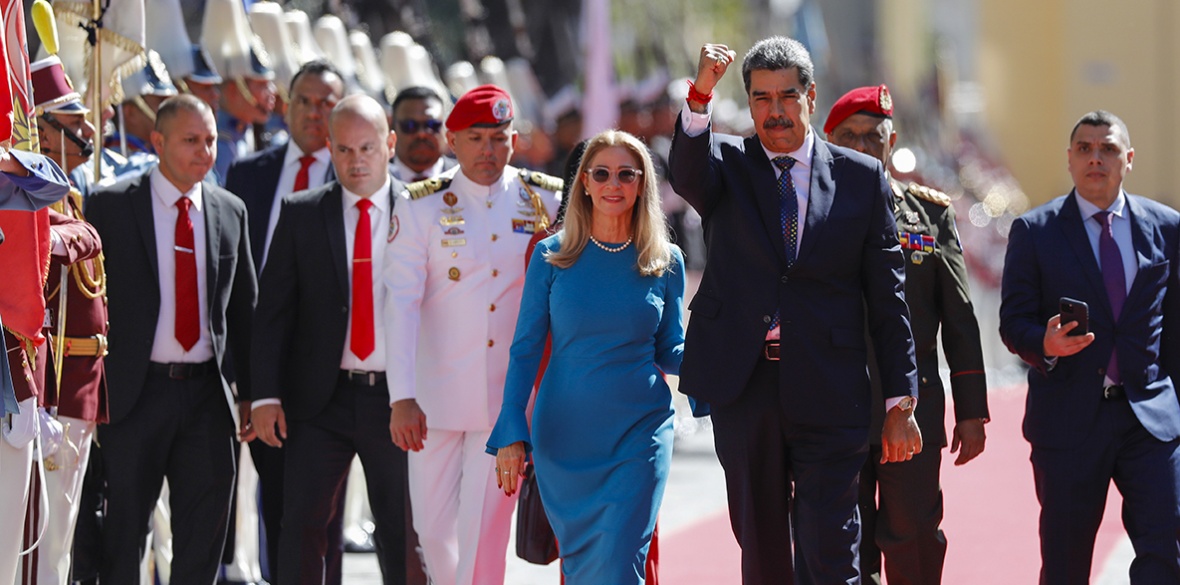
Venezuelan President Nicolas Maduro and his wife Cilia Flores arrive at the National Assembly for his swearing-in ceremony for a third term in Caracas, Venezuela, January 10, 2025
VENEZUELAN President Nicolas Maduro was sworn in for a third term of office today.
The occasion was marked by the US government saying that it had increased the reward for information leading to Mr Maduro’s arrest, with $25 million (around £20.4m) now being offered.
During the swearing-in ceremony in the capital Caracas, the president highlighted his loyalty to the legacy of his legendary predecessor Hugo Chavez.
“If anything characterises the 500-year history of the people of this land called Venezuela, it is the history of heroic, wonderful resistance against all forms of domination, against all forms of colonialism and against all imperialisms,” Mr Maduro said.
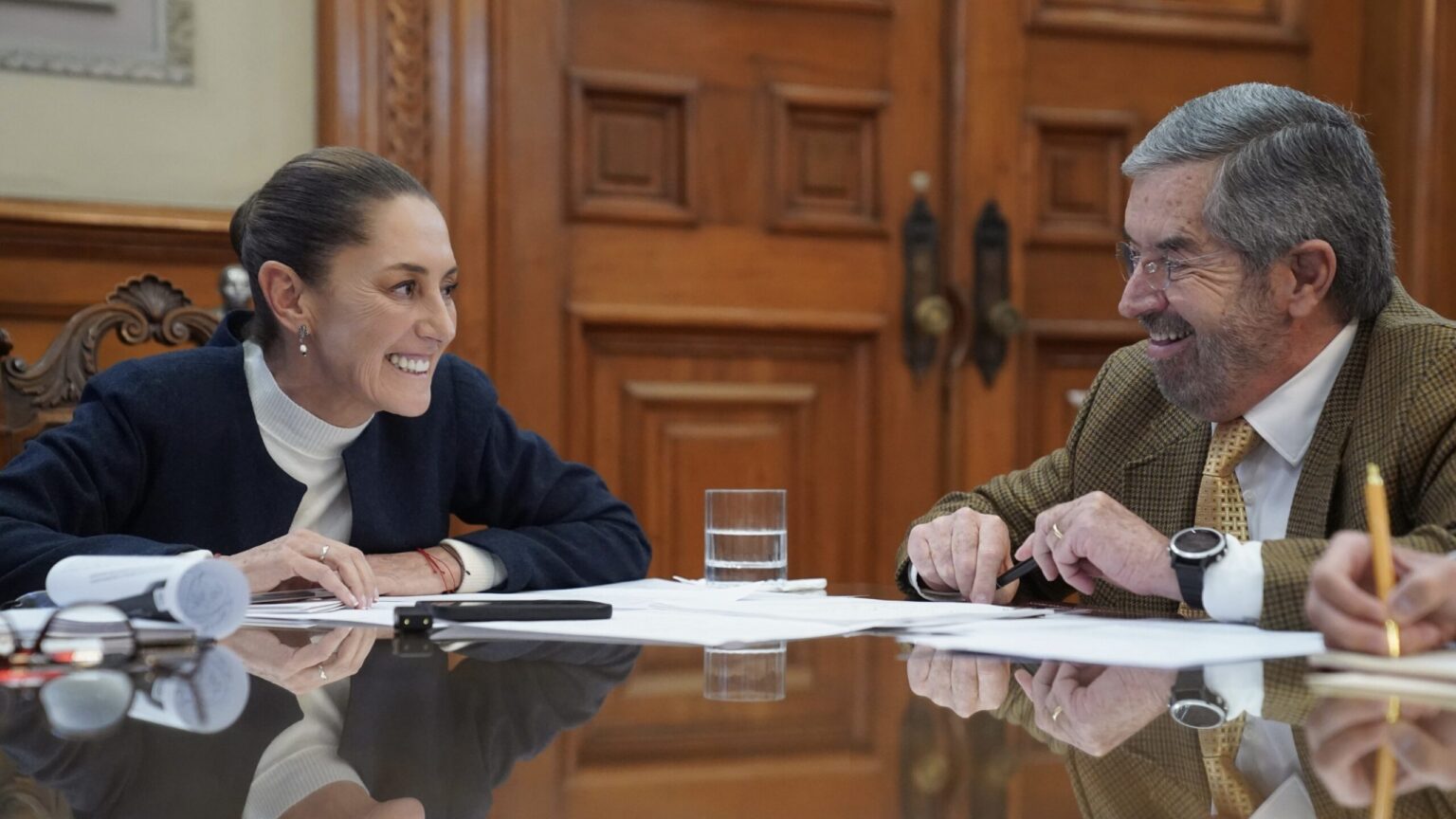
Mexican President Claudia Sheinbaum speaking on the phone to US president-elect Donald Trump. Photo: Presidencia MX
The Mexican President told the press that it is not true that she informed the US President-elect that she would close the border between both countries, contradicting statements from Trump about their conversation
The tensions between Mexican President Claudia Sheinbaum and US president-elect Donald Trump are growing, with Trump continuing to launch accusations and threats at the Southern neighbor of the US, only to be met with a firm and resolute Sheinbaum.
On November 25, Trump, in a post on his media platform Truth Social, threatened to impose a 25% tariff on Mexican and Canadian products until illegal migration and drug imports into US territory were stopped. He also threatened that products coming from China will have to pay 10% more tariffs if the Asian country does not further control the sale of certain chemicals from which fentanyl is made. The three targeted countries responded clearly and firmly (more so China and Mexico than Canada) to Trump’s warnings and pointed out that if the threat were to become a reality, a real “trade war” could be unleashed.
For her part, the Mexican President stated in her daily morning press conference on November 26 that the imposition of new tariffs will not reduce drug consumption in the United States, nor will it curb illegal migration to the United States; on the contrary, “it would cause the United States and Mexico inflation and job losses.”
That same day, Sheinbaum and Trump spoke on the phone and addressed several issues of interest to both nations, such as immigration, drug trafficking, drug consumption, and more. However, in the aftermath of their conversation, two versions have emerged of what was said and agreed on, with Trump insisting that Mexico has agreed to effective “clos[e] our Southern Border” to “stop the illegal invasion of the USA”.
Donald Trump said through his social network, Truth Social “Just had a wonderful conversation with the new President of Mexico, Claudia Sheinbaum Pardo. She has agreed to stop Migration through Mexico, and into the United States, effectively closing our Southern Border. We also talked about what can be done to stop the massive drug inflow into the United States, and also, the US consumption of these drugs. It was a very productive conversation!”
The president-elect added “Mexico will stop people from going to our Southern Border, effective immediately. THIS WILL GO A LONG WAY TOWARD STOPPING THE ILLEGAL INVASION OF THE USA. Thank you!!!”
However, for the Mexican head of state, this version is far from the truth.
Sheinbaum’s version
For her part, Sheinbaum reported on X “I had an excellent conversation with President Donald Trump. We addressed the Mexican strategy on the migration phenomenon and I shared that no caravans are arriving at the northern border because they are being taken care of in Mexico. We also talked about strengthening collaboration on security issues within the framework of our sovereignty and the campaign we are carrying out in the country to prevent the consumption of fentanyl.”
However, the Mexican President said that at no time did she communicate to Trump that she would order the closure of the Mexican-US border: “In our conversation with President Trump, I explained to him the comprehensive strategy that Mexico has followed to address the migratory phenomenon, respecting human rights. Thanks to this, migrants and caravans are attended to before they arrive at the border. We reiterate that Mexico’s position is not to close borders but to build bridges between governments and between peoples.”
In an official visit to the state of Nuevo León, the Mexican leader highlighted that trade ties between the United States and Mexico are very deep, so a trade war would only bring higher inflation and a contraction of the GDP of the countries involved. In the case of the United States, Sheinbaum said that Mexican remittances are partially consumed in the United States, so a disruption could imply a major disruption of the US economy; she also noted that a reduction in migration would increase the US social security debt by 13%.
The Mexican president also announced last week that in her letter to Trump, she called on the head of state to remove the economic sanctions and blockade on Cuba and Venezuela, and that respectful and open dialogues be established between all nations of the continent.
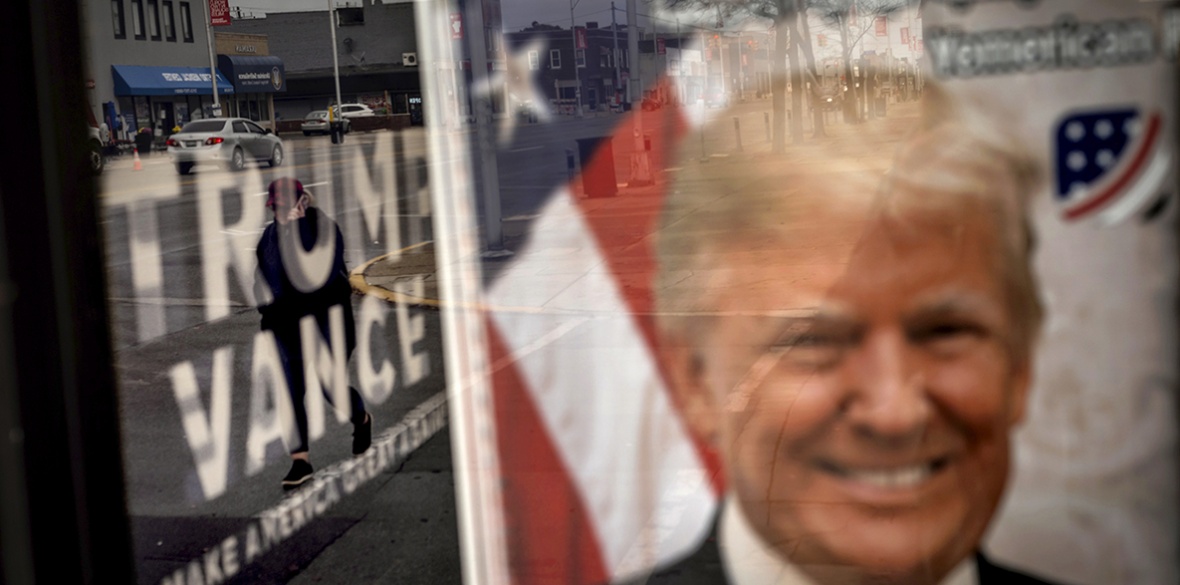
An image of Republican presidential nominee former President Donald Trump hangs in the window of a campaign office in Hamtramck, Michigan, November 4, 2024
TIM YOUNG warns that the president-elect’s record of economic and political interference from his last stint in the White House show dangerous potential for escalated aggression against the Bolivarian government from 2025
THE US election result raises the spectre of Trump renewing the assault on Venezuela that his loss to Biden interrupted in 2020.
In office between 2016 and 2020, Trump’s approach to Latin America showed an implacable hostility towards Venezuela, as well as other governments in the region determined to advance their population’s interests, not those of the US.
Venezuela has been subjected to US extraterritorial intervention and interference for over two decades. From the early days of Hugo Chavez’s election as president in 1998, the US has sought, in conjunction with Venezuela’s economic and political elites, to topple the Venezuelan government and re-establish its control and influence over the country and its oil wealth.
…
While the global situation has changed since 2020, with wars in Ukraine and the Middle East and the US’s developing aggressive strategy towards Russia and China, there is no reason to believe the US’s long-standing desire to destabilise the Venezuelan government and achieve “regime change” is off the table.
For his part, Trump made it plain when campaigning this year in North Carolina what motivated his drive to unseat Maduro: “When I left, Venezuela was ready to collapse. We would have taken it over; we would have gotten all that oil.”
The solidarity movement in Britain must be prepared to defend Venezuela’s sovereignty against any renewed offensive by Trump when he assumes the presidency in 2025 — as well as continuing to campaign for Britain to give Venezuela back its gold.
The coup plot comes just a month and a half after President Nicolás Maduro was reelected in the presidential election, which to date, the US has refused to recognize
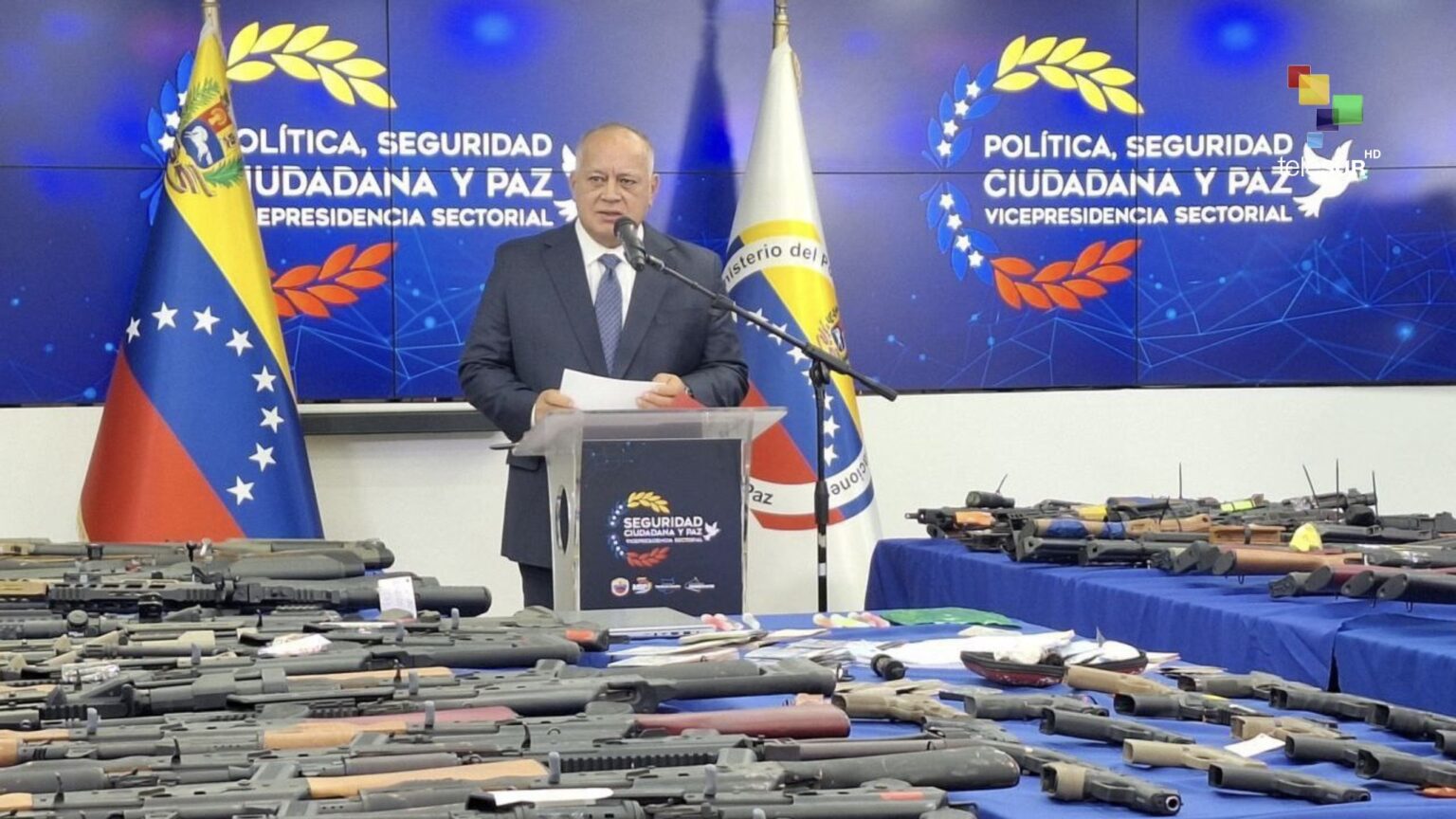
In a press conference given on September 14, Venezuelan Interior Minister Diosdado Cabello announced that authorities had dismantled an operation reportedly backed by the Central Intelligence Agency of the United States and the National Intelligence Center of Spain, which sought to assassinate President Nicolás Maduro, Vice President Delcy Rodríguez, Cabello, and other government officials. The minister announced that Venezuelan authorities had seized 400 weapons from the US and arrested 14 mercenaries who were involved in the plot. Among the arrested is Wilber Joseph Castañeda, an active US military officer and Navy Seal. Two Spanish citizens were reportedly also arrested, José María Basua and Andrés Badasbe.
#ÚltimoMinuto| Ministro de Interior @dcabellor da detalles de la operación sobre Venezuela que han sido detectados y desarticulados.
Algunos puntos claves:
✔️ Fueron decomisadas 400 armas que provenían de EEUU para asesinar al presidente Nicolás Maduro, la Vicepresidenta… pic.twitter.com/ztdATsYVDq
Officials stated that according to a document they seized from one of the detainees, the plot included attacking the Miraflores Palace and other public institutions, in addition to carrying out sabotage actions against various public services to generate chaos.
According to officials, those arrested possessed between 10-12 weapons in their homes that were set to be used in the destabilization plan. Cabello noted that many of those arrested also have links to Venezuela’s far-right opposition network.
He added that the weapons seized by authorities were brought to the country in “apparently legal” shipments and received by groups linked to the extreme right.
One of the leaders of the illegal arms trafficking network in the country, Cabello claimed, is a man who is already a fugitive from Venezuelan justice, Iván Simonovis. “Because of the capture of this weaponry here in Venezuela, they have taken actions in other countries that have included the murder of people. Simonovis knows what I am talking about,” he stated.
Venezuela has demanded that the United States government respond to the incident and “clarify the use of its agencies and the use of its territory to traffic weapons aimed at overthrowing a democratically elected government.”
Cabello declared: “The United States is behind this operation, they are delivering these weapons so that they circulate freely and reach Venezuela…They can say what they want, their agents are confessing. Castañeda is the head of the operation [of] the CIA here and they have a link with criminal groups in Venezuela.”
Regarding the Venezuelan state’s intelligence capacities, Cabello stated: “Let the world know that we are going to use all the necessary mechanisms to repel, to defeat these groups of mercenaries, of terrorists who try to undermine peace and order in Venezuela…prepare to be defeated again.”
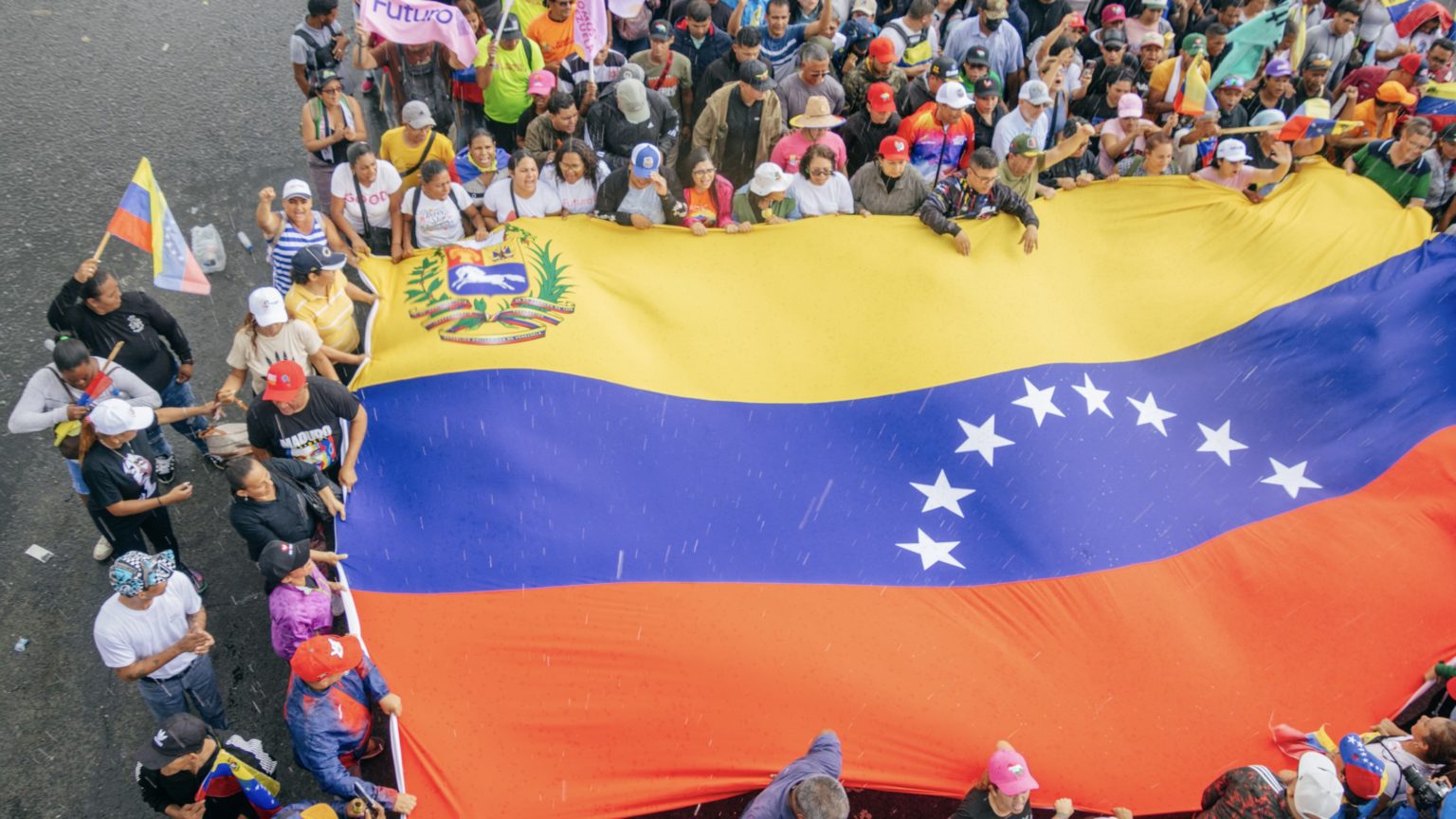
Venezuelan people marched in the rain on July 30 in defense of the electoral results. Photo: Zoe Alexandra
Social and workers’ movements across the world have launched a campaign to stand in solidarity with the Venezuelan people as they face a wave of attacks following the presidential elections.
On August 9, the ALBA Movimientos, a platform of social and political movements from across the Americas and the Caribbean, the International Peoples’ Assembly, the Simon Bolivar Institute, and the Assembly of Caribbean Peoples, launched a campaign titled: “For Democracy and Sovereignty: Hands Off Venezuela!” The campaign comes in the aftermath of Venezuela’s presidential election and a wave of seemingly coordinated attacks from right-wing political actors, mainstream media, and US and its allies.
The launch document states that, for several months, a media campaign has been created to question the legitimacy of the elections in the Caribbean country. “From the hegemonic media, with political and diplomatic strategies, it has been sought to install an idea of the illegitimacy of the recent Venezuelan electoral process,” states the communiqué.
The joint statement affirms that the campaign mentioned above against the legitimacy of the Venezuelan electoral process has been shaped from several communicational fronts: creating doubts about the technological capacity of the electoral machines, reinforcing the 930 economic sanctions against Venezuela, generating violence in the streets and illegally self-declaring González Urrutia as president of the country, among others.
The geopolitical importance of Venezuela, both for its geographic location and vast natural resources, are at the center of the current dispute, the organizations argue. “It is impossible [to understand the situation of] Venezuela without placing it in the regional and global geopolitical context: its privileged place in world oil production, its common goods placed at the service of the people, the place it occupies in the multipolar world together with the emerging countries, and of course, its leadership of a project of union and regional integration in Latin America and the Caribbean that gives continuity to the defeat of the FTAA and keeps alive the horizon of continental sovereignty far from the designs of the United States”.
In this way, the document invites progressive and revolutionary organizations to combat the media campaign imposed by the national and international opposition to Venezuela, which, according to the document, is directly aligned with the imperialist interests of the United States.
On August 9, the launch day of the campaign, the movement platforms have called on organizations across the globe to mobilize on the streets and on social media in support of Venezuela.
🇻🇪 BREAKING! The people of New York City say “HANDS OFF VENEZUELA” and “NO to US Intervention” in front of New York Times Headquarters
While The New York Times has been engaged in a misinformation campaign to encourage and justify US-led coup attempts and economic warfare… pic.twitter.com/TbMXycKvr4
South African workers speak out in support of Venezuela
The National Union of Metalworkers of South Africa (NUMSA), in a press release issued on August 8, 2024, congratulated the Venezuelan people for holding free and fair elections, as well as congratulating the re-election with more than 51% of the votes of Nicolás Maduro as president of Venezuela.
NUMSA also questions the media campaign against the legitimacy of the electoral process that could lead to a coup d’état in Venezuela. According to the communiqué, “These media houses are not neutral. Their role is to advance the interests of capital and to promote US imperialism and hegemony. It is not in the interest of Western powers to endorse the elections in Venezuela…We are deeply concerned that US propaganda is being reproduced by many media houses that have sadly been trapped into reinforcing attempts at a coup by imperialism against the will of the Venezuelan people.”
In addition, the NUSMA communiqué insists on the close relationship that the Venezuelan opposition has with the geopolitical interests of the United States, including the friendship that María Corina Machado has professed with the Zionist government of Israel; “The United States does not have a commendable history in defending the dignity of most people. Today, we can take one look at the US-backed genocide against the Palestinian people to know this. It, therefore, comes as no surprise that the right-wing opposition coup leader in Venezuela is a Zionist”.
Likewise, the NUMSA communiqué recognizes the great economic and geostrategic value of Venezuela in current international relations, which is why there are imperial powers that seek to control the political future of Venezuela at any cost so that the recognition of the elections would be a way for the people to reaffirm their sovereignty and their ability to decide their future without the interference of other countries: “the US has set its sights on the enormous mineral wealth of Venezuela and seems determined to expropriate these through the imposition of a puppet regime under the leadership of Edmundo González. Against this backdrop, all progressive forces must reaffirm their unwavering commitment to the sovereignty of Venezuela. We call on our government, media, governments, and media houses worldwide to uphold the principles of peace, democracy, and national self-determination by acknowledging the outcomes of the Venezuelan election.”
Anti-imperialist and progressive movements from across the world are gearing up for the international campaign to condemn the so-called hybrid war against Venezuela and express their support to its struggle for sovereignty and democracy.