Tag: Venezuela

  • Experts Decry US ‘Summary Execution’ of Alleged Drug Runners Off Venezuelan Coast

    Spread the love

    Original article by Brett Wilkins republished from Common Dreams under Creative Commons (CC BY-NC-ND 3.0). 
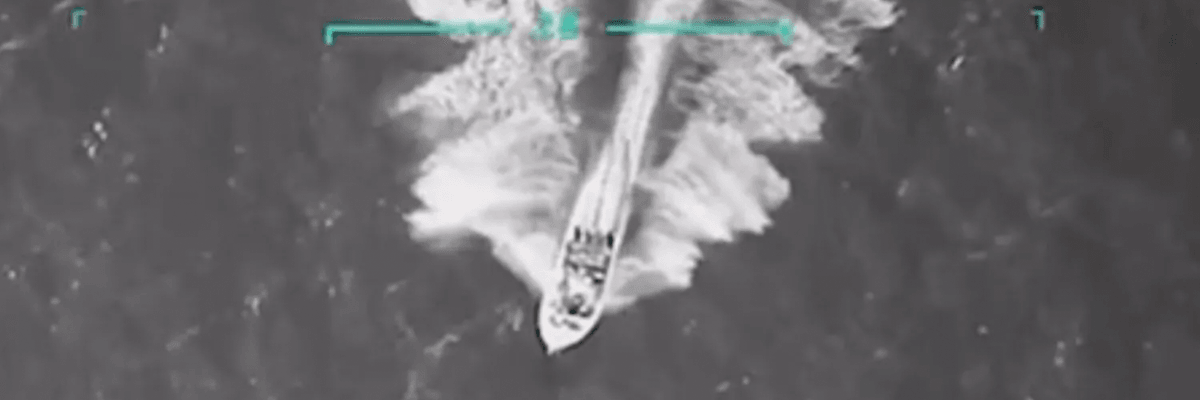
    This image was posted on social media by President Donald Trump and shows a boat that was allegedly transporting cocaine off the coast of Venezuela when it was destroyed by US forces on September 2, 2025. (Photo: President Donald Trump/Truth Social)

    “Drug trafficking is a crime, not an act of war,” noted one critic. “Traffickers must be arrested, not summarily executed.”

    Legal and human rights experts said that Tuesday’s deadly US attack on a boat the Trump administration claimed was transporting cocaine off the coast of Venezuela violated international law.

    “Drug trafficking is a crime, not an act of war,” former Human Rights Watch director Kenneth Roth said on social media following the strike, which US President Donald Trump said killed 11 people. “Traffickers must be arrested, not summarily executed, which US forces just illegally did.”

    “Trump admits he ordered a summary execution—the crime of murder,” Roth added. “Drug traffickers are not combatants who can be shot on sight. They are criminal suspects who must be arrested and prosecuted.”

    Declassified video showing the U.S. committing a war crime when it fired on a civilian vessel near Venezuela.Being suspected of carrying drugs does not carry a death sentence and certainly not without due process.

    — Arturo Dominguez (@extremearturo.bsky.social) 2025-09-02T23:02:57.529Z

    Michael Becker, an associate professor of international law at Trinity College, Dublin in Ireland, told the BBC Wednesday that the Trump administration’s designation of the Venezuela-based Tren de Aragua and other drug trafficking groups as terrorist organizations “stretches the meaning of the term beyond its breaking point.”

    “The fact that US officials describe the individuals killed by the US strike as narcoterrorists does not transform them into lawful military targets,” Becker said. “The US is not engaged in an armed conflict with Venezuela or the Tren de Aragua criminal organization.”

    “Not only does the strike appear to have violated the prohibition on the use of force, it also runs afoul of the right to life under international human rights law,” Becker added.

    Although the United States is not a signatory to the United Nations Convention on the Law of the Sea, US military legal advisers have asserted that the country should “act in a manner consistent with its provisions.”

    Luke Moffett, a professor of international law at Queens University Belfast in Northern Ireland, told the BBC that while “force can be used to stop a boat,” this should generally be accomplished using “nonlethal measures.”

    Such action, said Moffett, must be “reasonable and necessary in self-defense where there is immediate threat of serious injury or loss of life to enforcement officials,” and the US attack was likely “unlawful under the law of the sea.”

    “It reflects the worst of US militarism—secretive, unilateral, and contemptuous of due process, human rights, and the rule of law.”

    The peace group CodePink said Wednesday that “even if Washington’s claims are accurate, drug trafficking does not justify a death sentence delivered by missile.”

    “International law is clear: The use of force is only lawful in self-defense or with explicit UN Security Council authorization,” the group continued. “This strike had neither. It reflects the worst of US militarism—secretive, unilateral, and contemptuous of due process, human rights, and the rule of law.”

    “Under US law, it’s equally indefensible,” CodePink argued. “The Constitution gives Congress, not the president, the power to authorize war. Unilateral action may only be used in emergencies or self-defense, and this strike meets neither.”

    CodePink continued:

    With the US Southern Command assets already deployed in the region, why blow up a vessel instead of capturing and interrogating the crew? If the goal were really to uncover evidence of [Venezuelan President Nicolás] Maduro’s alleged involvement, this reckless approach raises only two possibilities: Either the narrative is fabricated and Washington used it as a pretext for a deadly show of force or it’s real, and the US chose extrajudicial killing over law, evidence, and humanity.

    CodePink called on Congressional Progressive Caucus Chair Greg Casar (D-Texas) “to lead the fight in Congress to stop this escalation,” urging him to “introduce legislation to block unauthorized military force, hold hearings to expose the dangers of border militarization, insist on transparency of all relevant directives, and rally Congress to cut off funding for these reckless operations.”

    Tuesday’s attack came amid Trump’s deployment of an armada of naval warships off the coast of Venezuela, whose socialist government has long endured US threats of regime change—and sometimes more.

    Infused with the notion that it has the right to meddle anywhere in the hemisphere under the Monroe Doctrine, the US has attacked, invaded, occupied, and otherwise intervened in Latin American and Caribbean nations well over 100 times since the dubious declaration was issued by President James Monroe in 1823.

    Since the late 19th century, oil-rich Venezuela has seen US interventions including involvement in border disputes, help with military coups, support for dictators, and attempts to subvert the Bolivarian Revolution—including by officially recognizing opposition figures claiming to be the legitimate presidents of the country.

    Critics of US imperialism highlighted Washington’s hypocritical policies and practices toward Venezuela.

    “Venezuela produces no cocaine, but US warships patrol its coastline under the banner of a ‘drug war,’” New Hampshire Peace Action organizing director Michael “Lefty” Morrill wrote Wednesday.

    Meanwhile, neighboring Colombia and nearby Peru—the world’s two leading cocaine producers—get no such treatment. Nor does Ecuador, which has emerged as one of the world’s leading trafficking hubs.

    Morrill also briefly explored bits of the long US history of supporting narcotraffickers when strategically expedient, noting that former Panamanian President Manuel Noriega “was first a CIA asset, then branded a narco-dictator and dragged to a US prison.”

    “The Taliban was once a strategic partner in Afghanistan’s opium trade, before being cast as the world’s largest trafficker,” he added. “‘Drugs’ are not simply powders; they are pretexts, shaped to fit the contours of empire.”

    Original article by Brett Wilkins republished from Common Dreams under Creative Commons (CC BY-NC-ND 3.0). 

    Orcas discuss how Trump was re-elected and him being an insane, xenophobic Fascist.
    Orcas discuss how Trump was re-elected and him being an insane, xenophobic Fascist.
    Elon Musk urges you to be a Fascist like him, says that you can ignore facts and reality then.
    Elon Musk urges you to be a Fascist like him, says that you can ignore facts and reality then.
    Donald Fuhrump says that Amerikkka doesn't bother with crimes or charges anymore, not being 100% Amerikkkan and opposing his real estate intentions is enough.
    Donald Fuhrump says that Amerikkka doesn’t bother with crimes or charges anymore, not being 100% Amerikkkan and opposing his real estate intentions is enough.

    CODEPINK Condemns Illegal U.S. Missile Strike Near Venezuelan Waters ›

  • Venezuelan youth train to “defend the Homeland and construct the future” amid US escalation

    Spread the love

    Original article by Pablo Meriguet republished from peoples dispatch under a Creative Commons Attribution-ShareAlike 4.0 (CC BY-SA) license.

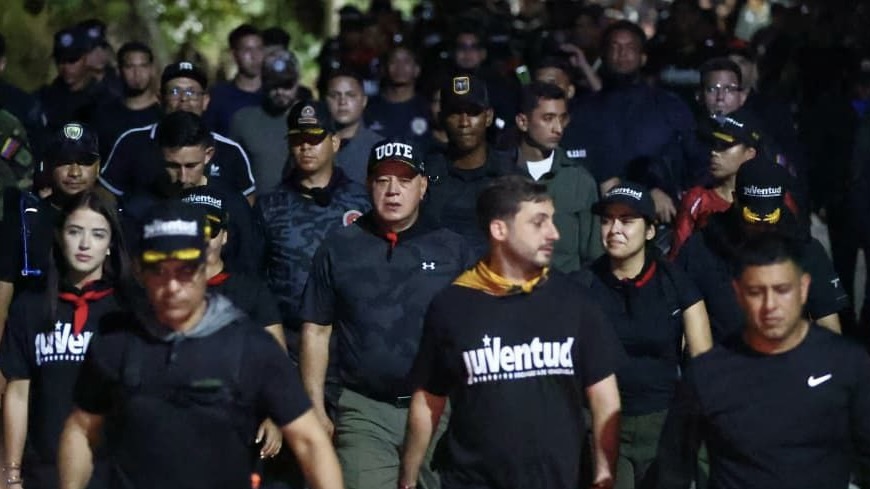
    Youth of the PSUV carried out a week of training, culminating in a 10k night march led by Diosdado Cabello. Photo: Con el Mazo Dando

    As the US escalates its threats against Venezuela, youth of the PSUV engaged in a week-long “Basic Revolutionary Resistance Training”

    The youth wing of the United Socialist Party of Venezuela (PSUV) carried out “Basic Revolutionary Resistance Training” over the past week in the Venezuelan state La Guaira. On the evening of August 28, the youth participated in a 10 kilometer night march led by Secretary General of PSUV, Diosdado Cabello.

    The training took place amid rising tensions between Washington and Caracas. The situation flared up when the administration of US President Donald Trump reiterated accusations that the Venezuelan government plays a major role in drug trafficking, increasing the bounty on the head of President Nicolás Maduro, and at the same time deploying troops to the Caribbean to support the US “war on drugs”.

    Read more: Trump’s smokescreen on Venezuela: Exposing the “narco-state” accusation

    “The socialist youth, with its morale and rebelliousness, is ready for the defense of the Homeland and the construction of the future,” said Cabello who also serves in the administration of the Bolivarian Republic. 

    The Chavista leader expressed that these trainings seek to build a combative youth in view of recent events that increased pressures on the South American country: “Chávez dreamed it and we are making it a reality, a combatant corps of the youth of the United Socialist Party of Venezuela.”

    The activities are taking place after Venezuelan President Nicolás Maduro, called on all branches of the Armed Forces, including the militia, and the PSUV to be on high alert and prepared for a potential US attack.

    Read more: Venezuela mobilizes 4.5 million militia members as US deploys troops to the Caribbean

    Meanwhile, the military enlistment days organized by Chavismo continue to advance throughout Venezuela. According to Venezuelan authorities, “thousands of people have responded to the government’s call to join the ranks of the national defense.”

    Vice President Delcy Rodríguez said in this regard: ‘’The workers are highly conscious of what it means to defend our homeland; today we heed the call of President Nicolás Maduro to defend our nation…We are ready to defend the social happiness of our people, to defend the future, to defend Venezuela’s right to exploit and develop its productive capacities.”

    The United States continues to reinforce military and diplomatic positions.

    On August 14, US Secretary of State Marco Rubio announced the deployment of several military vessels in the southern Caribbean Sea after declaring that Maduro is the alleged leader of the so-called Cartel de los Soles.

    This organization has already been designated as a terrorist organization by Washington, which many analysts have seen as a tactic to attack Venezuela and thus overthrow the Chavista government.

    In addition, several US allies in South America, Ecuador, Paraguay and Argentina, have also declared the Cartel de los Soles as an international terrorist organization, which can be interpreted as a form of alignment behind Washington’s geopolitical pretensions.

    However, other countries in the region such as Colombia and Mexico, led by progressive presidents Gustavo Petro and Claudia Sheinbaum respectively, have expressed that they will not support a military intervention on Latin American soil as they consider that it goes against the principle of non-intervention that characterizes the foreign policy of several countries in the region.

    “We will never be in favor of intervention by a foreign country.”

    🇲🇽In her daily morning press conference, Mexican President Claudia Sheinbaum responded to a question by a journalist about a possible US military intervention in Venezuela. pic.twitter.com/XJ3DUJCmJF

    — Peoples Dispatch (@peoplesdispatch) August 27, 2025

    Washington continues to reinforce its military positions in the Caribbean, specifically in Curacao and Guyana, countries that have granted permission to the US military to dock in their coasts.

    Meanwhile, US Secretary of State Marco Rubio, has begun a tour of Latin America and the Caribbean to seek greater support for the Trump administration’s position on Venezuela and to rally more support for his regional strategy. Mexico and Ecuador will be part of Rubio’s tour. 

    Original article by Pablo Meriguet republished from peoples dispatch under a Creative Commons Attribution-ShareAlike 4.0 (CC BY-SA) license.

    Donald Fuhrump says that Amerikkka doesn't bother with crimes or charges anymore, not being 100% Amerikkkan and opposing his real estate intentions is enough.
    Donald Fuhrump says that Amerikkka doesn’t bother with crimes or charges anymore, not being 100% Amerikkkan and opposing his real estate intentions is enough.
    Elon Musk urges you to be a Fascist like him, says that you can ignore facts and reality then.
    Elon Musk urges you to be a Fascist like him, says that you can ignore facts and reality then.

  • Trump’s Venezuela Drug War Gambit and the Militarization Playbook at Home

    Spread the love

    This article by Michelle Ellner republished from Common Dreams under Creative Commons (CC BY-NC-ND 3.0).

    National Guard troops are deployed to the Washington Monument as part of US President Donald Trump’s mobilization of law enforcement on August 12, 2025 in Washington, DC. (Photo by Andrew Leyden/Getty Images)

    Whether it’s a wall in the desert or barricades in front of the White House, the message is the same: Perceived threats, real or manufactured, are met with troops, not talks.

    US President Donald Trump has quietly authorized the Pentagon to carry out military operations against what his administration calls “narco-terrorist” networks in Latin America. On paper, it’s a counter-narcotics policy. In practice, it serves as a green light for open-ended US military action abroad, bypassing congressional approval, sidestepping international law, and stretching the definition of “national security” until it becomes a catchall justification for the use of force.

    The directive allows the US to target groups unilaterally labeled as both criminal and terrorist. Once that designation is made, the military can operate without the consent of the targeted country, a move that violates international law. In a region with a long history of US-backed coups, covert wars, and destabilization campaigns, the risk of abuse isn’t hypothetical; it’s inevitable.

    While the order applies across Latin America, Venezuela stands at the top of the list. The Trump administration has accused President Nicolás Maduro’s government of working with transnational cartels, and has doubled the bounty on him to $50 million (double the bounty for Osama bin Laden). It’s a lawfare tactic designed to criminalize a head of state and invite mercenaries and covert operatives to participate in regime change. The accusations fueling this escalation have grown increasingly far-fetched casting Maduro in turn as a partner of Colombia’s FARC, the head of the “Cartel de los Soles,” a patron of Venezuela’s Tren de Aragua, and now, as an ally of Mexico’s Sinaloa Cartel. a charge even Mexico’s own president says has no evidence, revealing how politicized and unfounded this allegation is.

    The core premise of the accusation is that Maduro is involved in a cocaine trafficking network of Venezuelan military and political figures called Cartel de los Soles. The Venezuelan government denies the cartel’s existence, calling it a fabrication to justify sanctions and regime change efforts. Multiple independent investigations have shown no hard evidence exists and that this narrative thrives in a media-intelligence echo chamber. Reports from outlets like Insight Crime cite anonymous US sources; those media stories are then cited by policymakers and think tanks, and the cycle repeats until speculation becomes policy.

    The communities in Caracas and Los Angeles, in the Venezuelan plains, and in the US-Mexico border may seem worlds apart, but they are facing the same war machine.

    Fulton Armstrong, a professor at American University and a former longtime US intelligence officer, has stated that he knows no one in the intelligence community, apart from those currently in government, who believes in the existence of the Cartel de los Soles.

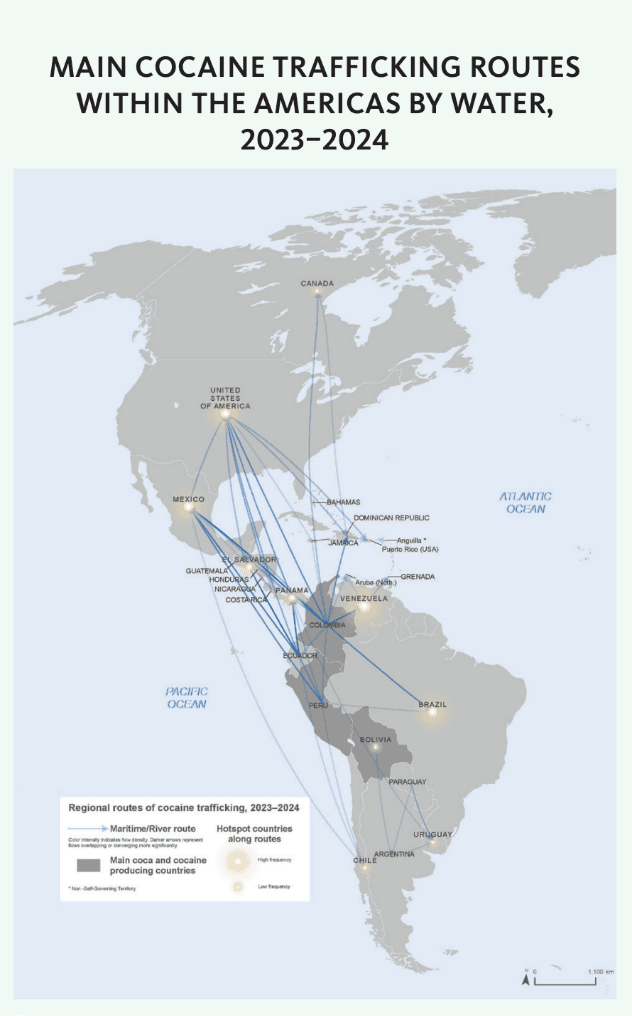
    Drug monitoring data also contradict this narrative. The Washington Office on Latin America (WOLA) reports that only about 7% of US-bound cocaine transits through the Eastern Caribbean via Venezuela, while approximately 90% takes Western Caribbean and Eastern Pacific routes. The United Nations Office on Drugs and Crime’s 2025 World Drug Report likewise confirms that trafficking remains concentrated in major Andean corridors, not through Venezuela. Yet Venezuela is targeted anyway, not for its actual role in the drug trade, but because neutralizing its government has become a pillar of US foreign policy, seen in Washington as a step toward reshaping the country’s political system and prying open its economy to foreign control.

    The “narco-terror” label put on Venezuela also attempts to rope Venezuela into the US fentanyl crisis, despite the absence of evidence that the country plays any role in fentanyl trafficking. Even US drug enforcement assessments make no mention of Venezuela as a source or transit point.

    This link exists only in political rhetoric, a way to fold Venezuela into a domestic public health crisis and recycle the same logic used to brand it a “national security threat.” That accusation dates back to 2015 when then-President Barack Obama created the legal and political scaffolding for an open-ended campaign of coercion. Once the “narco-terror” framework is in place, Washington can sustain and escalate military measures over time, regardless of the immediate pretext.

    This framing turns a political standoff into a declared security imperative. It broadens the range of permissible military tools, from ISR (intelligence, surveillance, reconnaissance) to direct action.

    The pattern is familiar. In Panama (1989), Colombia (2000s), and Honduras (2010s), US militarized antidrug campaigns failed to dismantle supply chains or reduce trafficking volumes. What they did accomplish was shifting routes, militarizing criminal actors, and destabilizing governments, and left societies more fragile—costing lives and destroying communities in the process.

    The Mirror at Home: Militarization and Communities of Color

    The same militarized logic driving US policy in Venezuela is being applied inside the United States. In August 2025, President Trump signed an executive order placing the DC Metropolitan Police Department under federal control and deployed the National Guard, citing a public safety “emergency,” despite official data showing violent crime at multiyear lows. Even US law enforcement statistics contradict the White House narrative, but the administration dismissed them, casting the city as overrun by “roving mobs,” “wild youth,” and “drugged-out maniacs.”

    DC is only one example. The same militarized logic has sent thousands of troops to the US-Mexico border, converted military bases into detention centers from Texas to New Jersey, and stationed soldiers inside Immigration and Customs Enforcement detention facilities in over 20 states. In Los Angeles, Marines and National Guard units patrolled immigrant neighborhoods in a show of force, a deployment beaten back only by mass community resistance and the threat of labor action.

    Whether it’s a wall in the desert or barricades in front of the White House, the message is the same: Perceived threats, real or manufactured, are met with troops, not talks. The playbook never changes: In Venezuela, the “threat” is cast as narco-terrorism; in the US, it’s a “border surge” or a manufactured public safety emergency built on racially coded depictions of Black and brown communities. In both cases, the logic is identical: Treat political disputes and social crises as security emergencies, sideline diplomacy and community solutions, usurp greater executive powers, and make military force a routine tool of governance.

    The Real Threat

    Trump’s “narco-terror” authorization uses the language of fighting drugs and crime to mask a deeper project: expanding the military’s role in governance and normalizing its use as a tool of political control both at home and abroad.

    In Latin America, that means more interventions against governments the US wants to topple. At home, it means embedding the military deeper into civilian life, particularly in Black and brown neighborhoods.

    The communities in Caracas and Los Angeles, in the Venezuelan plains, and in the US-Mexico border may seem worlds apart, but they are facing the same war machine. Until we reject militarization in all its forms, the targets will keep shifting, but the people under the gun will look the same.

    This article by Michelle Ellner republished from Common Dreams under Creative Commons (CC BY-NC-ND 3.0).

  • Venezuela mobilizes 4.5 million militia members as US deploys troops to the Caribbean

    Spread the love

    Original article by Devin B. Martinez republished from peoples dispach under a Creative Commons Attribution-ShareAlike 4.0 (CC BY-SA) license.

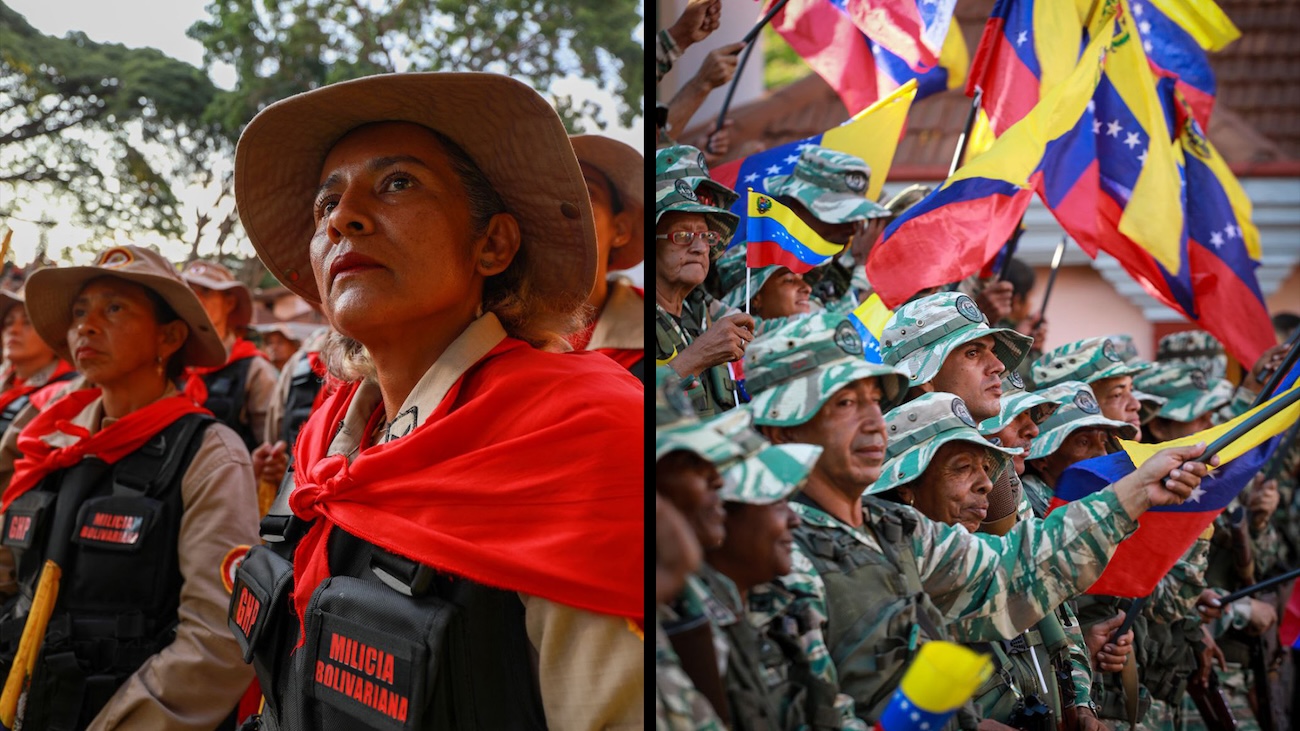
    Mobilization of the Bolivarian Militia in April 2025. Photo: Prensa Presidencial / Telegram

    President Nicolás Maduro announced on Monday, August 18, that he is activating “over 4.5 million militia members across the entire national territory” of the Bolivarian Republic of Venezuela, in response to the US deployment of three Navy guided-missile destroyers and 4,000 military personnel to the Caribbean. The White House has described the deployment as an anti-drug trafficking operation in the region, while some analysts have called it a new threat against Venezuela – the country with the largest oil reserves in the world. 

    The US military deployment comes after Washington raised its bounty on the Venezuelan president from USD 25 million to USD 50 million, alleging links to drug cartels.

    The “extravagant, bizarre, and outlandish threats” of the United States have been firmly rejected by the Venezuelan government.

    Minister of Foreign Affairs Yván Gil described the accusations as a sign of desperation, revealing Washington’s “lack of credibility and the failure of its policies in the region”. He also pointed out that Venezuela has made major gains against drug trafficking after expelling the United States’ Drug Enforcement Agency (DEA) – who many Venezuelans call “the planet’s chief drug traffickers” – from the country in 2005.

    No US agency or international body has produced concrete evidence of drug production and distribution being concentrated in Venezuela or linked to Maduro. In fact, available global drug data makes almost no mention of the Caribbean nation or the alleged “Cartel of Suns” at all. According to the United Nations Office on Drugs and Crime (UNODC), the epicenter of activity is in Colombia, Ecuador, and Peru, with the US identified as the main destination for distribution, recording the highest level of drug consumption in the world.

    UNODC data reports that only 5% of Colombian drugs transit through Venezuela, and that the country is free of coca leaf cultivation, and marijuana and cocaine processing. The Trump administration, on the other hand, has maintained its position that the Venezuelan government is a “narco-terror cartel”.

    Venezuela mobilizes as the US bares its teeth

    Last week, mass protests across Venezuela denounced the “interventionist policies of the US government” following the bounty increase on Maduro and the accusation of cartel ties. However, US Secretary of State Marco Rubio confirmed the deployment of US troops to the region on August 14. On Tuesday, August 19, White House Press Secretary Karoline Leavitt was asked if the administration was open to “boots on the ground” in Venezuela, to which she responded, “[Trump] is prepared to use every element of American power to stop drugs from flooding into our country.”

    This week, Venezuela’s “prepared, activated, and armed” militia members are being deployed “throughout the entire territory, and meticulously, sector by sector”, as part of what the government is calling a peace plan to defend the principles of sovereignty and shared economic development.

    “The Bolivarian National Militia is the people in arms, it is the genuine expression of civic-military union,” said Maduro in 2019, as he announced the incorporation of the militia that Hugo Chávez created – which has surged to nearly 5 million members, according to the government – into the Armed Forces as an official “combat unit”.

    “We are also deployed throughout the Caribbean,” Venezuela’s Interior Minister Diosdado Cabello reminded the public. “Our sea, which is Venezuelan territory.”

    The Venezuelan government is not alone in speaking out against the escalation of tensions in the Caribbean. When asked about the US military deployment during a regular press conference, President Claudia Sheinbaum said Mexico’s message to the region is, “No to interventionism. This is not just a conviction, it’s in the Constitution.”

    To this day, the US does not recognize President Nicolás Maduro as the winner of the July 28 elections in Venezuela, claiming that opposition figure Edmundo González is the true president. In the months following the election, Washington targeted dozens of officials in the Venezuelan National Electoral Council (CNE) and other government departments with sanctions and visa bans, on top of the long-standing US economic blockade of the Bolivarian nation.

    Despite the mounting pressure, Venezuelan officials are confident that the nation can defend its sovereignty. “It’s not about Maduro, it’s about the ordinary people, the people in the neighborhoods, the communities,” says Nahum Fernández, head of government in Caracas.

    “This country belongs to Venezuelans; in the face of any threat, the Venezuelan people will not remain silent.”

  • US increases bounty on Venezuelan President Nicolás Maduro to 50 million

    Spread the love

    Original article by Pablo Meriguet republished from peoples dispatch under a Creative Commons Attribution-ShareAlike 4.0 (CC BY-SA) license.

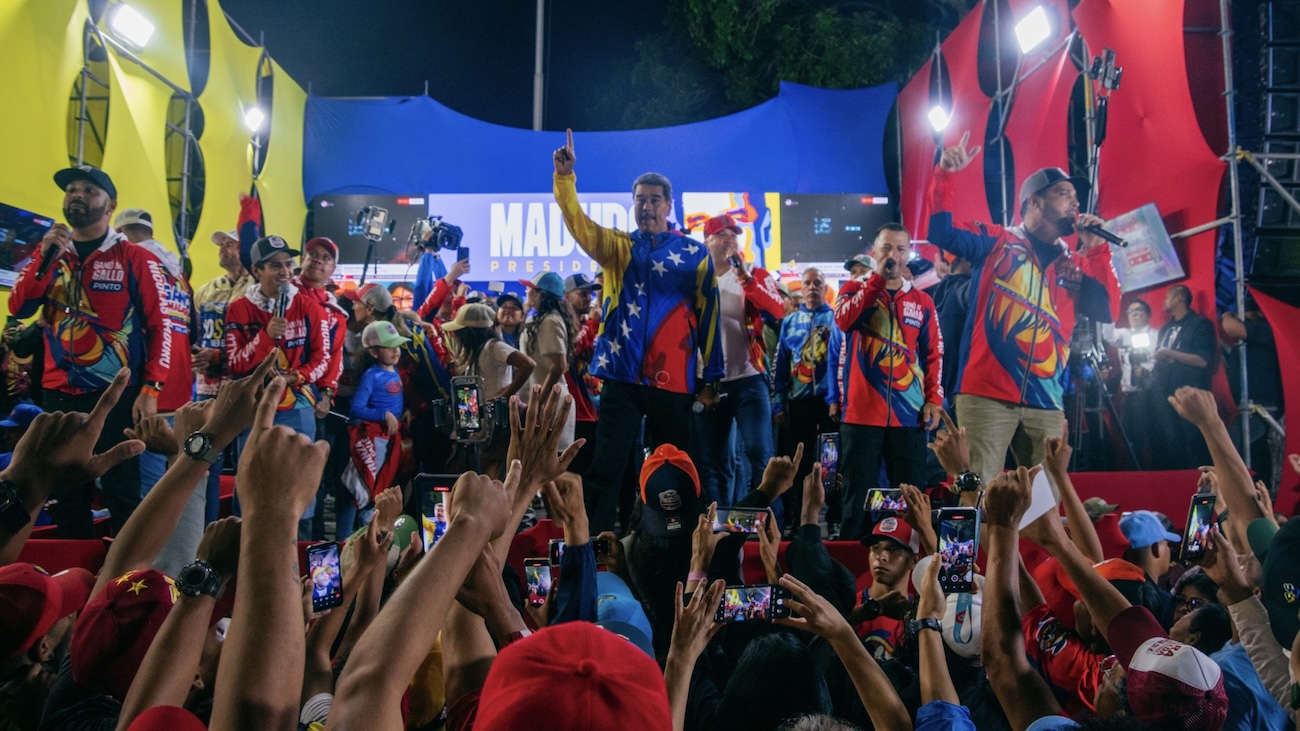
    Nicolás Maduro greets thousands of supporters outside of MIraflores Palace on July 28, 2024. Photo: Zoe Alexandra

    The reaction came after the US Attorney General increased the reward to USD 50 million for information leading to the arrest of the Venezuelan president.

    The Venezuelan government has said that the increase in the reward for the arrest of President Nicolás Maduro by US Attorney General Pam Bondi is “ridiculous” and that it is part of a “propaganda operation” and a “desperate distraction” from the internal problems facing the United States.

    Bondi published a video on August 7, announcing that the US Department of Justice and Department of State are offering USD 50 million for “information leading to the arrest of Nicolás Maduro”.

    This is not the first time the US government has tried to pressure the Bolivarian government in this way. In 2020, the US Department of Justice offered USD 15 million for Maduro’s arrest. The accusations were based on alleged acts of “narco-terrorism” by the Venezuelan government.

    According to the US government, Maduro allegedly collaborated with the Revolutionary Armed Forces of Colombia (FARC) “to use cocaine as a weapon to ‘flood’ the United States”.

    During the Biden administration, this figure was increased to USD 25 million (the same amount offered for the capture of Osama Bin Laden after the attacks of September 11, 2011).

    This time, Washington is doubling the “bet” to USD 50 million. According to the Trump administration, Maduro is one of the world’s most prominent drug traffickers, as he allegedly works closely with the criminal gangs the Sinaloa Cartel, the Tren de Aragua, and the Cartel de Los Soles. 

    “Under President Trump’s leadership, Maduro will not escape justice, and he will be held accountable for his despicable crimes,” said US Attorney General Pamela Bondi in a video. Bondi accused Maduro of using Foreign Terrorist Organizations (FTO) Tren de Aragua, Sinaloa Cartel, and the Cartel de Los Soles to “to bring deadly drugs and violence into our country”.

    For his part, Venezuelan Foreign Minister Yván Gil said the accusations are nothing more than a media show aimed at satisfying Trump’s most extremist supporters.

    “Pamela Bondi’s pathetic ‘reward’ is the most ridiculous smokescreen we have ever seen. While we dismantle the terrorist plots orchestrated from your country, this lady comes out with a media circus to please Venezuela’s defeated far right,” Gil affirmed in response to Bondi’s statements.

    According to Caracas, the accusations have no real basis and are part of a smear campaign against the Venezuelan government, in addition to the sanctions and economic and trade blockades imposed by the United States on Venezuela.

    Maduro also reacted to Bondi’s accusations, describing them as part of a “fascist conspiracy” to destabilize his government: “Colombian drug trafficking linked to [ex-President Álvaro] Uribe, criminal gangs and recycled criminals that still exist in the country, and the fascist conspiracy financed by the United States, are a disastrous equation against Venezuela.”

    The Cuban government also rejected the decision to increase the reward for Maduro’s “head”. The country’s Foreign Minister, Bruno Rodríguez, posted on X: “We condemn the fraudulent reward announced by the US government against the legitimate President of Venezuela, Nicolás Maduro, which constitutes a new act of aggression against that sister nation. The US government lacks the legal and moral authority to take such a measure.”

    Original article by Pablo Meriguet republished from peoples dispatch under a Creative Commons Attribution-ShareAlike 4.0 (CC BY-SA) license.