In 2002, former US President George W. Bush meets María Corina Machado, then director of Súmate, an “independent democratic civil society group” funded by the US government to “oversee the electoral process in Venezuela”. Source: White House/Eric Draper
Venezuelan opposition figure María Corina Machado was awarded the Nobel Peace Prize, but there’s nothing peaceful about her politics
When I saw the headline María Corina Machado wins the Peace Prize, I almost laughed at the absurdity. But I didn’t, because there’s nothing funny about rewarding someone whose politics have brought so much suffering. Anyone who knows what she stands for knows there’s nothing remotely peaceful about her politics.
If this is what counts as “peace” in 2025, then the prize itself has lost every ounce of credibility. I’m Venezuelan-American, and I know exactly what Machado represents. She’s the smiling face of Washington’s regime-change machine, the polished spokesperson for sanctions, privatization, and foreign intervention dressed up as democracy.
Machado’s politics are steeped in violence. She has called for foreign intervention, even appealing directly to Benjamin Netanyahu, the architect of Gaza’s annihilation, to help “liberate” Venezuela with bombs under the banner of “freedom,” She has demanded sanctions, that silent form of warfare whose effects – as studies in The Lancet and other journals have shown – have killed more people than war, cutting off medicine, food, and energy to entire populations.
Machado has spent her entire political life promoting division, eroding Venezuela’s sovereignty, and denying its people the right to live with dignity.
This is who María Corina Machado really is:
She helped lead the 2002 coup that briefly overthrew a democratically elected president, and signed the Carmona Decree that erased the Constitution and dissolved every public institution overnight.
She worked hand in hand with Washington to justify regime change, using her platform to demand foreign military intervention to “liberate” Venezuela through force.
She cheered on Donald Trump’s threats of invasion and his naval deployments in the Caribbean, a show of force that risks igniting regional war under the pretext of “combating narcotrafficking.” While Trump sent warships and froze assets, Machado stood ready to serve as his local proxy, promising to deliver Venezuela’s sovereignty on a silver platter.
She pushed for the US sanctions that strangled the economy, knowing exactly who would pay the price: the poor, the sick, the working class.
She helped construct the so-called “interim government,” a Washington-backed puppet show run by a self-appointed “president” who looted Venezuela’s resources abroad while children at home went hungry.
She vows to reopen Venezuela’s embassy in Jerusalem, aligning herself openly with the same apartheid state that bombs hospitals and calls it self-defense.
Now she wants to hand over the country’s oil, water, and infrastructure to private corporations. This is the same recipe that made Latin America the laboratory of neoliberal misery in the 1990s.
Machado was also one of the political architects of “La Salida,” the 2014 opposition campaign that called for escalated protests, including guarimba tactics. Those weren’t “peaceful protests” as the foreign press claimed; they were organized barricades meant to paralyze the country and force the government’s fall. Streets were blocked with burning trash and barbed wire, buses carrying workers were torched, and people suspected of being Chavista were beaten or killed. Even ambulances and doctors were attacked. Some Cuban medical brigades were nearly burned alive. Public buildings, food trucks, and schools were destroyed. Entire neighborhoods were held hostage by fear while opposition leaders like Machado cheered from the sidelines and called it “resistance.”
She praises Trump’s “decisive action” against what she calls a “criminal enterprise,” aligning herself with the same man who cages migrant children and tears families apart under ICE’s watch, while Venezuelan mothers search for their children disappeared by US migration policies.
Machado isn’t a symbol of peace or progress. She is part of a global alliance between fascism, Zionism, and neoliberalism, an axis that justifies domination in the language of democracy and peace. In Venezuela, that alliance has meant coups, sanctions, and privatization. In Gaza, it means genocide and the erasure of a people. The ideology is the same: a belief that some lives are disposable, that sovereignty is negotiable, and that violence can be sold as order.
If Henry Kissinger could win a Peace Prize, why not María Corina Machado? Maybe next year they’ll give one to the Gaza Humanitarian Foundation for “compassion under occupation.”
Every time this award is handed to an architect of violence disguised as diplomacy, it spits in the face of those who actually fight for peace: the Palestinian medics digging bodies from rubble, the journalists risking their lives in Gaza to document the truth and the humanitarian workers of the Flotilla sailing to break the siege and deliver aid to starving children in Gaza, with nothing but courage and conviction.
But real peace is not negotiated in boardrooms or awarded on stages. Real peace is built by women organizing food networks during blockades, by Indigenous communities defending rivers from extraction, by workers who refuse to be starved into obedience, by Venezuelan mothers mobilizing to demand the return of children seized under US ICE and migration policies and by nations that choose sovereignty over servitude. That’s the peace Venezuela, Cuba, Palestine, and every nation of the Global South deserves.
Michelle Ellner is a Latin America campaign coordinator of CODEPINK.
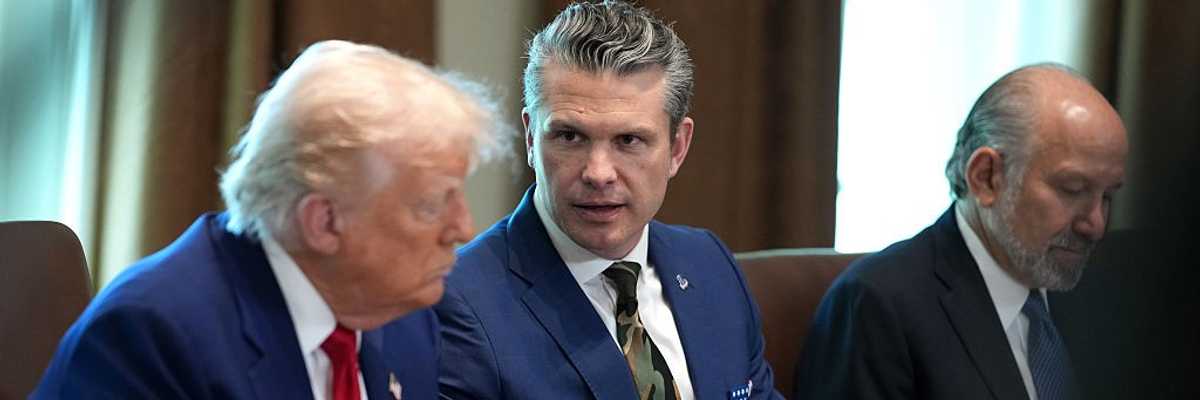
US Defense Secretary Pete Hegseth (R) looks on as US President Donald Trump speaks during a Cabinet meeting at the White House on April 30, 2025 in Washington, DC. (Photo by Andrew Harnik/Getty Images)
NBC reported Friday that the US military is considering options including drone strikes against drug cartel members within the South American country, prompting fears of escalation.
The Trump administration may strike alleged drug targets inside Venezuela’s borders within weeks, sources familiar with the situation toldNBC News on Friday.
Two US officials and two other sources with knowledge of the conversations that had taken place said that the US military was considering plans that could include drone strikes against members and leaders of drug trafficking groups as well as drug laboratories. If approved, the strikes would be a further escalation following three Trump administration attacks on alleged drug-carrying boats in the Caribbean that have killed at least 17 people, even though the administration has provided no evidence that those killed were actually smuggling drugs.
“More mass murder on the cards?” the news outlet Venezeulanaysiswrote in response. “NBC reports that the Trump administration is weighing strikes against ‘drug targets’ (emphasis on the air quotes) inside Venezuelan territory. Lots of speculation and anonymous sources, but it shows that no war crimes are off limits.”
US President Donald Trump has already come under heavy criticism for authorizing boat strikes that many decry as illegal. Democratic lawmakers have moved to bar the president from authorizing further attacks, and Colombian President Gustavo Petro called for the United Nations to take criminal proceedings against the US president in a speech on Tuesday.
“This is the most egregious instance of disinformation against our nation, intended to justify an escalation to armed conflict that would inflict catastrophic damage across the entire continent.”
Now, observers are responding with alarm to the news that the administration might go even further.
El Pais correspondent Juan Diego Quesada wrote on social media that strikes within Venezuelan territory “would escalate the conflict to a level whose consequences I dare not measure.”
“How would this not be considered an act of war?” asked poster Cindy Gossett. “Trump can’t just claim Venezuelan citizens are drug lords therefore he’s going to fly a drone over and destroy them. If Venezuela did the same in our country it wouldn’t be accepted.”
Speaking at the UN General Assembly on Friday, Venezuelan Foreign Minister Yvan Gil Pinto said that the US had an “illegal and completely immoral military threat hanging over our heads.”
Pinto also cast doubt on the notion that the Trump administration’s true aim was to combat the drug trade.
He accused the US of trying to permit “external powers to rob Venezuela’s immeasurable oil and gas wealth” and said that the administration was using “vulgar and perverse lies” to “justify an atrocious, extravagant, and immoral multibillion-dollar military threat.”
Trump has yet to authorize any particular plan, according to NBC. The Pentagon declined to comment on their report, and the White House referred the outlet to a previous statement from Trump: “We’ll see what happens. Venezuela is sending us their gang members, their drug dealers, and drugs. It’s not acceptable.”
Venezuelan President Nicolás Maduro has denied that his administration has not done enough to prevent drug trafficking through the South American country, as Trump has accused.
Maduro sent a letter to the White House on September 6 calling for peace and dialogue and defending his record, noting that, according to a UN report, only 5% of the drugs that leave Colombia do so via Venezuela.
He wrote of the trafficking claims, “This is the most egregious instance of disinformation against our nation, intended to justify an escalation to armed conflict that would inflict catastrophic damage across the entire continent.”
Toward the end of the letter, he appealed to Trump to work with him to reduce tensions.
“President, I hope that together we can defeat the falsehoods that have sullied our relationship, which must be historic and peaceful,” Maduro wrote.
Donald Fuhrump says that Amerikkka doesn’t bother with crimes or charges anymore, not being 100% Amerikkkan and opposing his real estate intentions is enough.Orcas discuss how Trump was re-elected and him being an insane, xenophobic Fascist.
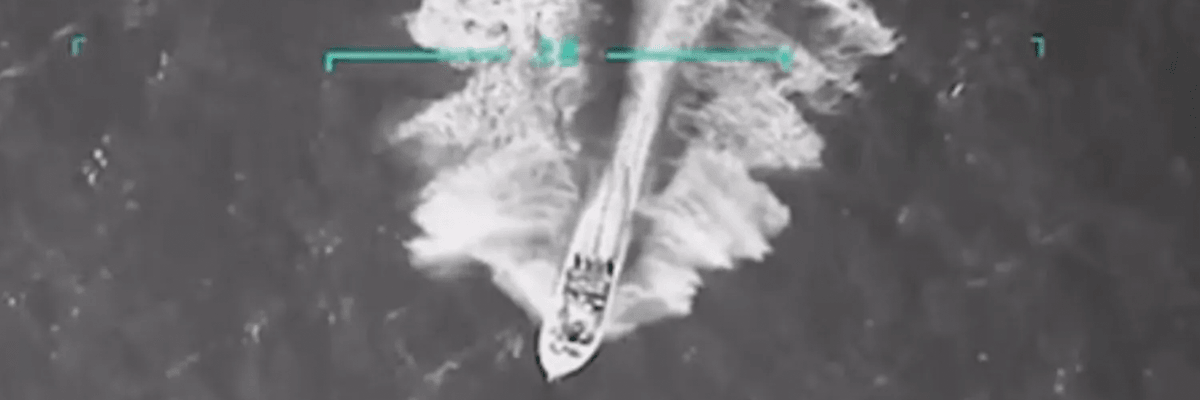
This image was posted on social media by President Donald Trump and shows a boat that was allegedly transporting cocaine off the coast of Venezuela when it was destroyed by US forces on September 2, 2025. (Photo: President Donald Trump/Truth Social)
The recent massacre in the Caribbean was a step toward making America a police state under President-for-Life Trump.
Why is Donald Trump committing murder on the high seas?
Last week President Trump bragged that “On my Orders,” the Navy destroyed a speedboat with eleven people aboard, claiming that those slain were “Tren de Aragua Narco terrorists . . . transporting illegal narcotics, heading for the United States.”
The legal procedure for dealing with drug traffickers on the high seas is actually for the Navy or Coast Guard to stop and board the suspect vessel, confirm it is carrying illegal drugs, then arrest and prosecute those on board.
Instead, Trump treated what should have been an (alleged) criminal law enforcement matter as open warfare and, without any need, killed everyone aboard. Why? Because Trump wants the lethal use of military firepower on supposed foreign “bad guys” to serve as a model for militarizing American cities – in the name of stopping an imaginary crime wave.
One week after the Caribbean Sea attack, Trump and the Defense Department have yet to provide evidence the vessel was carrying drugs to America. But even if had been, summarily killing eleven civilians is still murder.
Killing eleven people in Venezuela was Donald Trump’s out-of-town tryout. Trump’s militarization of our cities, if not resisted, could lead to the termination of free elections in America.
Calling a criminal gang a “foreign terrorist organization” does not make it legal to slay alleged gang members without a trial – particularly when the gang has not been linked to acts of political terrorism, as confirmed by the fact that the Justice Department’s twoindictments of gang members include no charges of terrorism.
Still less does tagging them “Narco terrorists” mean that the United States is in “armed conflict” with a gang, to which the laws of war might apply. Gangs aren’t enemy nations and they’re not fighting for a political ideology – they’re in it for the money. Suppressing them isn’t warfare. The Navy was not engaged in a naval battle with a speedboat.
A former State Department attorney specializing in counterterrorism, Brian Finucane, put it succinctly. “Outside of armed conflict, we have a word for the premeditated killing of people. That word is murder.”
Annie Shiel, the U.S. advocacy director of the Center for Civilians in Conflict, confirmed the point. “Using lethal force in this way, outside of any recognizable armed conflict and without due process, is an extrajudicial execution, not an act of war.” Myriad legal experts confirm that obvious conclusion.
But Secretary of State Marco Rubio sought to justify the slayings by asserting “interdiction doesn’t work.” “What will stop them is when you blow them up, when you get rid of them.”
Secretary of Defense Pete Hegseth echoed the sentiment. “Anyone trafficking in those waters who we know is a deadly terrorist will face the same fate.”
But if our military is allowed to blow up people on unproven assertions of drug dealing, the same logic would justify the military engaging in summary executions of those they deem “bad guys” in the United States itself. Which is perhaps the point.
Drug trafficking is not a capital offense in the United States. The alleged crimes would not warrant execution even if Trump’s targets were found to be cartel drug smugglers..
In reality, there is little reason to credit Trump’s claims about who the people on board were and what they were doing.
The U.S. Department of Justice brought two indictments against the Tren de Aragua gang this year, in April and August. Neither indictment alleges the gang brings drugs from Venezuela to the United States.
The indictments actually suggest more disturbing possibilities: that most of those Trump ordered killed were victims of sex trafficking. The April indictment charged Tren de Aragua with “forcing young women trafficked from Venezuela into commercial sex work.”
A former senior federal law enforcement official suggested that the vessel was on a human smuggling run, carrying refugees seeking to flee Venezuela.
Nonetheless, Trump prefers the drug smuggling story because it is part of his strategy to conflate immigration, crime and gangs to justify sending troops into American cities.
Trump’s claim that undocumented immigrants have brought rampant crime to America is false. Few of those Trump is deporting have committed a serious crime, and immigrants as a group are actually less likely to commit crimes than native born Americans. But Trump has repeated his phony charge hundreds of times, and it has had an impact.
Drug-running gangs enjoy little sympathy, and Trump expects few people to worry about whether the eleven individuals he ordered killed were drug traffickers or actually the gang’s victims. But if he gets away with having the Navy blow them up, he hopes Americans will come to see troops on our streets as acceptable, even desirable, since they are (purportedly) fighting the same drug dealing villains.
Trump himself drew the direct connection between his war powers as commander in chief and his claim that military force is the solution to crime in the U.S. when he recently threatened, “Chicago about to find out why it’s called the Department of WAR.”
He will not immediately order unrestrained violence against alleged criminals (or opponents) as freely as he did in the Caribbean Sea off Venezuela. But he has begun the process of legitimizing law-free military “law enforcement,” first abroad and eventually in America.
Where will it end?
Trump has declared emergency after emergency, many of them focusing on his deportation agenda, and all of them stretching – and breaching – the lawful limits of presidential power. Trump has correctly concluded that if he is to swiftly deport millions of immigrants without considering their possible right to be here, his targets must be deprived of the due process of law which our Constitution guarantees to everyone in America.
But eliminating due process rights does not enjoy broad popular support, and Trump’s deportation efforts have repeatedly been stymied by the courts. Enter the concocted “Narco terrorist” boat incident. In Trump’s narrative – never mind truth or evidence – the U.S. Navy eliminates “bad guys” on the high seas without bothersome legal process.
It’s political theater. But not just theater.
The legal theories are those Trump’s Justice Department has asserted with little success in federal court: First, that Trump is entitled to use the military for “law enforcement” because we are being “invaded.” Second, that alleged gang members can be summarily deported and imprisoned (and now killed) because we are “at war” with cartels. Trump may not be able to persuade the courts that these outlandish legal theories are correct, but he can act on them with impunity in the waters off Venezuela, by ordering the Navy to dole out death.
Trump’s ultimate end is plain enough: unlimited power.
Donald Trump was the only president in the life of the Republic to refuse to surrender office after losing an election. Donald Trump was the only president to unleash an insurrection to try to hold onto office. And now, having lawfully returned to power, he has not concealed his desire to remain after his current term ends.
During the 2024 campaign, Trump promised his followers that if he was elected, things would be “fixed so good” that “in four years, you don’t have to vote again.” And, after predicting his election to a second four-year term, Trump told another audience “we’re probably entitled to another four after that.”
Trump has said he is “not joking.” “A lot of people want me to do it,” he told NBC News this Spring. “There are methods which you could do it.”
What method does Trump have in mind? Here are some ways Trump could use the military to unconstitutionally retain power:
Arrest or detain voters. Recall Trump’s baseless assertion that undocumented immigrants are voting en masse in American elections. With the military placed in key cities as a “crime fighting” force, Trump could use the soldiers and his masked ICE agents to remove Hispanics and other “suspect” voters from polling places, on the claim the soldiers are “ensuring election integrity.” Troops at polling places arresting people would certainly also frighten others away from the polls.
Seize voting machines. In 2020 Trump explored having Homeland Security or the Defense Department take control of voting machines in swing states. Attorney General Robert Barr reportedly shot down the suggestion.
But loyal sycophants Attorney General Pam Bondi or “War” Department Secretary Hegseth might well direct their departments to obey Trump’s orders to confiscate voting machines – and later report Trump’s amazing, landslide electoral victory.
Cancel elections because of an “emergency.” Donald Trump is the master of emergencies. He might manufacture one to justify suspending elections.
Trump claimed a handful of disruptive protests against ICE raids in Los Angeles constituted a “rebellion,” requiring a military response. And he falsely asserted crime was “totally out of control in the District of Columbia” to rationalize the troop takeover of the nation’s capital. Now he threatens to send troops into Chicago, Baltimore and other cities that tend to vote Democratic.
As Trump prepares to rig the 2028 election as best he can, millions of Americans will take to the streets against his illegal candidacy. Trump has little tolerance for the constitutional right to assemble and protest. In June 2025 he warned: “For those people who want to protest, they’re going to be met with very big force.” During the widespread peaceful demonstrations over the murder of George Floyd in 2020, Trump asked his Defense Secretary about protestors near the White House. “Can’t you just shoot them? Just shoot them in the legs or something?”
The Defense Secretary at the time did not grant Trump’s wish. But loyalist Hegseth is not likely to oppose any Trump suggestion.
A president who whipped up a mob to seize the Capitol in January 2021 could mobilize right-wing militias and MAGA forces for political violence before an election, and Trump might assert that elections had to be suspended until “order” was (someday) restored. Troops would enforce “calm” as the election was dismantled.
These scenarios only seem far-fetched because we still find it difficult to contemplate an American president engaging in naked, lethal dictatorial action.
Killing eleven people in Venezuela was Donald Trump’s out-of-town tryout. Trump’s militarization of our cities, if not resisted, could lead to the termination of free elections in America.
Mobilizing for the next election is not enough. The danger is now and we must resist now. We must withhold our cooperation from Trump’s authoritarian moves, refuse to obey in advance, pressure the institutions we are associated with to stand up for our constitutional democracy, and peacefully take to the streets to demonstrate the scope of the resistance. It is not too late. But if democracy is to be rescued, we must be the rescuers ourselves.
Don’t just blow your horn. Get out of the car and join the protest.
Elon Musk urges you to be a Fascist like him, says that you can ignore facts and reality then.Donald Fuhrump says that Amerikkka doesn’t bother with crimes or charges anymore, not being 100% Amerikkkan and opposing his real estate intentions is enough.
US President Donald Trump, Venezuelan President Nicolás Maduro. Photos via Presidential Press
The war drums beating in Washington are not just a threat to a distant nation; they are a symptom of a political system that thrives on the distraction of war abroad to cover its internal crises.
The sun glints off the gray hull of the USS Iwo Jima, a massive amphibious assault ship cutting through the Caribbean Sea. Secretary of War Pete Hegseth, a key architect of the Trump administration’s “maximum pressure” policies, stands on deck before a group of sailors and marines. His voice, amplified by the ship’s public address system, is a low, serious rumble that carries across the choppy waters. “What you’re doing right now is NOT training,” he says, in a scene reminiscent of George W. Bush’s staged landing to declare victory in Iraq. “This is a REAL-WORLD EXERCISE on behalf of the vital national interests of the United States of America, to end the POISONING of the American people.” His words hang heavy in the air, a dramatic prelude to what some suspect is an impending invasion of Venezuela.
The history of the Caribbean is a bloody one, stained by the imperial ambitions of European powers and the United States. The region now sits on the verge of another bloody chapter. As the great writer and historian Juan Bosch once observed, this region of Latin America is a battleground where empires have fought to seize the rich lands of its peoples and to claim what other empires had already conquered.
Today, the Caribbean is again being transformed into a stage for imperial aggression.
In a dangerous and dramatic escalation, the government of the United States, through its aptly renamed Department of War, has amassed a formidable naval force and deployed advanced fighter jets to the waters off Venezuela. This military buildup, consisting of at least eight warships, 4,000 sailors and marines along with P-8 spy planes and at least one nuclear submarine, is a clear threat to Venezuelan sovereignty and a blatant crime against international law. Washington is hiding behind a well-worn, cynical pretext: the “war on drugs”.
A sordid history of manufactured pretexts
The latest act of lawlessness came on September 2, when US forces in the Caribbean allegedly interdicted a “drug trafficking” vessel. Instead of following international protocols, the US Coast Guard and DEA agents opened fire, destroying the boat and killing all 11 people on board. This extrajudicial execution at sea is a clear violation of international law, which mandates that law enforcement actions must prioritize arrest and the preservation of life. The use of lethal force is only permitted as a last resort in cases of immediate self-defense. Though the US is not a signatory to the United Nations Convention on the Law of the Sea, the US military’s legal advisors have previously said that the US should “act in a manner consistent with its provisions”. To destroy a vessel and summarily execute its occupants without due process is not law enforcement; it is a state-sanctioned massacre, a crime that echoes other massacres in American military missions abroad. Recently, Professor Michael Becker of Trinity College in Dublin told the BBC that the US action “stretches the meaning of the term beyond its breaking point”.
This act of violence is not an anomaly but part of a deliberate pattern of provocation. The US Southern Command (SOUTHCOM) has significantly bolstered its presence with additional destroyers and littoral combat ships. Meanwhile, the US Air Force has sent F-35 fighter jets, aircraft designed for air dominance and striking high-value targets – not for intercepting drug runners – to its base in Puerto Rico, an island under US colonial domination. This military posture has nothing to do with curbing narcotics flow and everything to do with encircling and intimidating a nation that has defiantly resisted Washington’s hegemony for over two decades.
The historical context is inescapable. The United States has a long and sordid history of fabricating justifications for military action to achieve its political ends. The sinking of the USS Maine, the Gulf of Tonkin incident, and the non-existent “Weapons of Mass Destruction” used to justify the invasion of Iraq are all well-worn chapters in the same playbook. The current administration, with its bellicose rhetoric, is drafting a new one. Key architect of Trump-era maximum pressure policies, Secretary of State Marco Rubio, has consistently agitated for regime change, framing the Venezuelan government as a “narco-state”.
Exposing the “narco-state” smokescreen
The “narco-state” narrative collapses under the weight of its own fiction. According to the United Nations Office on Drugs and Crime (UNODC) and the US State Department’s own annual reports, the vast majority of cocaine leaving South America originates from and passes through US-allied nations like Colombia, Ecuador, and Peru. Venezuela is not a significant producer of cocaine. The narrative is a convenient smokescreen, a lie sold to the public to manufacture consent for aggression. The hypocrisy is further exposed by Rubio’s recent tour of Ecuador, a nation with extremely high levels of collaboration with US anti-drug agencies. Despite this collaboration, Ecuador has been plunged into a devastating crisis of drug trafficking and gang violence, proving that US intervention solves nothing and only fuels instability.
The true goal of this military buildup is clearly the overthrow of Venezuela’s government and the seizure of its vast oil reserves. The threats emanating from Washington are not veiled. They range from scenarios of massive bombing campaigns to the outright kidnapping or assassination of President Maduro. Donald Trump’s past musings about a “military option” for Venezuela are now being operationalized.
The Venezuelan people prepare for resistance
In the face of this existential threat, the Venezuelan people are preparing to defend their homeland. President Maduro has called for a “people in arms”, and an estimated 8 million Venezuelans have joined citizen militias. Across the country, young people, students, workers, and retirees are training in basic combat, emergency response, and civil defense. Their resolve is a powerful testament to the spirit of resistance.
“We are not an army for aggression, but an army for peace, for the defense of our sacred land,” said Maria Delgado*, a 20-year-old university student and new militia member in Caracas. “They think that because we are young or because we are not professional soldiers, we will be afraid. They are wrong. We know what is at stake: our sovereignty, our future, and the project of justice that our parents built.”
President Maduro has framed this mobilization in stark terms: “Venezuela is facing its greatest threat in 100 years. Having defeated all forms of hybrid warfare, they [United States] have opted for the worst mistake.”
The war drums beating in Washington are not just a threat to a distant nation; they are a symptom of a political system that thrives on the distraction of war abroad to cover its internal crises. The billions spent on deploying F-35s and destroyers to the Caribbean are billions stolen from the right to healthcare, education, and housing of ordinary Americans at home.
*Name changed
Manolo De Los Santos is Executive Director of The People’s Forum and a researcher at Tricontinental: Institute for Social Research. His writing appears regularly in Monthly Review, Peoples Dispatch, CounterPunch, La Jornada, and other progressive media. He coedited, most recently, Viviremos: Venezuela vs. Hybrid War (LeftWord, 2020), Comrade of the Revolution: Selected Speeches of Fidel Castro (LeftWord, 2021), and Our Own Path to Socialism: Selected Speeches of Hugo Chávez (LeftWord, 2023).
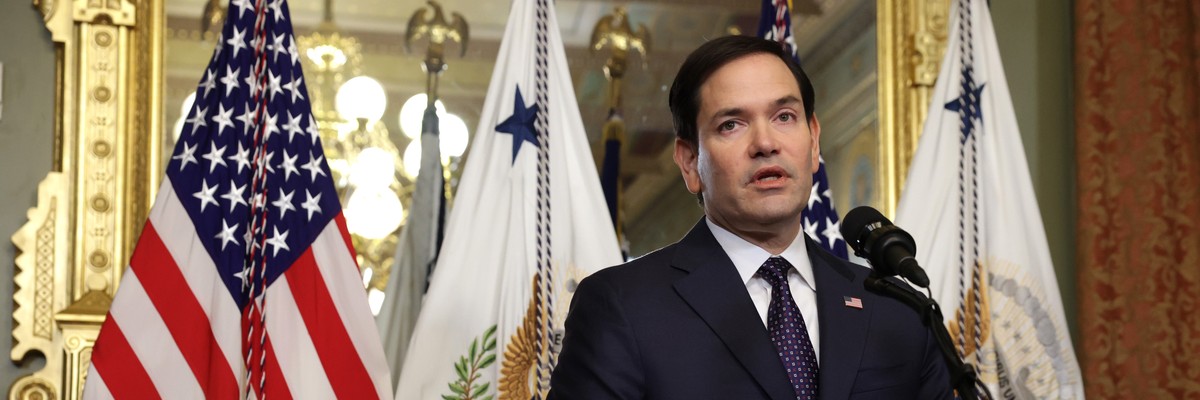
U.S. Secretary of State Marco Rubio speaks on January 21, 2025 in Washington, DC. (Photo by Alex Wong/Getty Images)
“There is no military solution to the overdose crisis, but there is a political solution to a president with authoritarian ambitions,” said one peace advocate. “Congress must act now to end unauthorized military action.”
As rights groups and Democratic lawmakers condemned the Trump administration’s bombing of a boat it claims—without evidence—was carrying drugs off the coast of Venezuela, Secretary of State Marco Rubio made clear on Thursday that targeting vessels linked to drug smuggling in Latin America, and possibly elsewhere, will be part of the White House’s ongoing policy.
At a news conference in Quito, Ecuador, Rubio suggested Latin American governments have a choice: Work with the Trump administration to crack down on drug trafficking or see the US kill more citizens suspected of trying to smuggle illegal substances.
“For cooperative governments, there’s no need because those governments are going to help us,” said Rubio. “They’re going to help us find these people and blow them up, if that’s what it takes.”
Some governments in the region have avoided criticizing this week’s bombing of a boat off the coast of Venezuela, which the US has said killed 11 people it had identified at “narco-terorrists” connected to Tren de Aragua, and which was conducted under the 2001 Authorization for the Use of Military Force.
The White House has not provided evidence of the suspected drug smuggling or that the victims were connected to the gang. US intelligence agencies have also called into question President Donald Trump’s claims that Tren de Aragua is a high-level gang that terrorist organization working with the Venezuelan government.
Ecuador’s government said Thursday it intends to revise its extradition agreement with the US, and President Daniel Noboa praised the US for its efforts to “actually eliminate any terrorist threat.” On the same day, Rubio announced $20 million in new security assistance for Ecuador.
“Under Trump, if the president declares you a terrorist, the U.S. military will apparently execute you on his behalf, no questions asked.”
The White House has also turned its attention to two Ecuadorian gangs, Los Lobos and Los Choneros, with Rubio announcing they have been designated as terrorist groups. The designation gives the Trump administration “all sorts of options,” Rubio claimed, for cracking down on the gangs’ activities, including potentially killing those suspected of being leaders or traffickers for the groups.
“This time, we’re not just going to hunt for drug dealers in the little fast boats and say, ‘Let’s try to arrest them,’” Rubio said. “No, the president has said he wants to wage war on these groups because they’ve been waging war on us for 30 years and no one has responded.”
As Rubio spoke in Quito, Defense Secretary Pete Hegseth said at Fort Benning in Georgia on Thursday that while Trump said he ordered the strike on the boat in the Caribbean this week, low-ranking military officers will soon be empowered to make final decisions on such attacks—strikes which international law experts have decried as nothing less than extrajudicial murder.
“The understanding is that those authorities are better made, those decisions are better made, by men and women in the professional arms,” Hegseth said.
Despite the administration’s use of the military to attack the boat near Venezuela this week and Rubio’s rhetoric about being at “war” with groups involved in the drug trade, human rights advocates and other Latin American leaders have stressed in recent days that drug trafficking is a crime that must be confronted by law enforcement—not an entity that the US can defeat through military action.
“We have been capturing civilians transporting drugs for decades without killing them. Those who transport drugs are not the big drug traffickers, but the very poor young people of the Caribbean and the Pacific,” said Colombian President Gustavo Petro.
Adam Isacson of the Washington Office on Latin America toldThe Washington Post that “you don’t just simply blow boats out of the water. You follow law enforcement procedures.”
Sara Haghdoosti, executive director of Win Without War, said that with this week’s deadly attack—and plans to conduct more strikes—Trump has brought former President George W. Bush’s “dream to full fruition.”
“Under Trump, if the president declares you a terrorist, the U.S. military will apparently execute you on his behalf, no questions asked,” said Haghdoosti. “That should deeply alarm us all, especially at a time when the president thinks nothing of labeling anyone from a USAID worker to a college student as a terrorist.”
The killing of 11 suspected Venezuelan gang members, added Haghdoosti, will make “no difference whatsoever in the lives of people struggling with their own or a loved one’s addiction,” particularly as the Republican Party’s budget cuts have “ravaged” funding for substance use disorder treatment and overdose prevention.
“There is no military solution to the overdose crisis, but there is a political solution to a president with authoritarian ambitions,” said Haghdoosti. “Congress must act now to end unauthorized military action in the Caribbean, investigate these apparently lawless killings, and restore the proven health and harm reduction programs that people struggling with the scourge of fentanyl desperately need.”
Donald Fuhrump says that Amerikkka doesn’t bother with crimes or charges anymore, not being 100% Amerikkkan and opposing his real estate intentions is enough.Donald Trump urges you to be a Climate Science denier like him. He says that he makes millions and millions for destroying the planet, Burn, Baby, Burn and Flood, Baby, Flood.Elon Musk urges you to be a Fascist like him, says that you can ignore facts and reality then.