Prime Minister Sir Keir Starmer during a meeting with German Chancellor Friedrich Merz, in Downing Street, London, on his first official visit to Britain, July 17, 2025
…
Just 12 per cent of the public approve of the government’s record, a historic low. Current polling shows the great majority of Labour MPs losing their seats at the next election, either to Reform, or to the new left party struggling to be born, or in Scotland and Wales to nationalist parties.
Certainly, at present it is as easy to see the suspended four — and the already-whipless John McDonnell and Apsana Begum who rebelled a year ago against the two-child benefit cap — securing re-election as independents than as candidates of the Starmer regime.
It is certainly hard to see this move breaking resistance to the new austerity agenda going forward. Only successful leaders can hope to get away with this sort of crackdown.
So this latest exercise in authoritarianism speaks only to Starmer’s loss of capacity to advance his right-wing agenda, as well as to his consigliere Morgan McSweeney’s blinkered view that whatever the problem is the answer lies in attacking the left.
But it is also a challenge to the Labour left. Over the last five years it has consistently failed to find the means to arrest the Starmer-McSweeney purge of the left, often for want of the simple virtue of sticking together when under attack.
The response to the latest suspensions has been robust, in words at least. The left has shown it can inflict defeats on the government, reversing specific policy proposals.
But it is now beyond obvious that only a fighting plan to actually oust Starmer himself has any prospect of reversing Labour’s dismal prospects in time to save the next election. They should take every opportunity — and even create them — to express no-confidence in this government of austerity, war and authoritarianism.
Failure to do so will certainly turbocharge the case for the new socialist party being promoted by Zarah Sultana and Jeremy Corbyn. The appeal of that venture rests in part on the perception that Labour is a lost cause.
Starmer’s latest sanctions against dissent tend to make that case. He has flung down the gauntlet — the left in the PLP, the affiliated unions and the membership must pick it up.
Keir Starmer justifies why he has to travel abroad so muchKeir Starmer says that the Labour Party under his leadership all feel a small part of Scunthorpe.
Zarah Sultana with Jeremy Corbyn in 2022. He said earlier he wants to offer an alternative to Labour. Photograph: Stefan Rousseau/PA
Sultana lost the whip last year and she and ex-party leader want to enlist other independent MPs and campaigners
…
She said in a statement posted on X that she was “resigning from the Labour Party”.
“Jeremy Corbyn and I will co-lead the founding of a new party, with other independent MPs, campaigners and activists across the country.”
She said that “Westminster is broken but the real crisis is deeper” and the “two-party system offers nothing but managed decline and broken promises”.
She added: “A year ago I was suspended by the Labour Party for voting to abolish the two-child benefit cap and lift 400,000 children out of poverty. I’d do it again. I voted against scrapping winter fuel payments for pensioners. I’d do it again. Now, the government wants to make disabled people suffer; they just can’t decide how much.”
Keir Starmer says that the Labour Party under his leadership all feel a small part of Scunthorpe.Keir Starmer commits to play the caretaker role for Capitalism through the “hard times”.Keir Starmer objects to criticism of the IDF. He asks how could anyone obect to them starving people to death, forced marches like the Nazis did, bombing Gaza’s hospitals and universities,mass-murdering journalists, healthworkers and starving people queuing for food, killing and raping prisoners and murdering children. He calls for people to stop obstructing his genocide for Israel.
4 July 2025 1.20pm
It appears that Jeremy Corbyn has yet to comment regarding Zarah Sultana’s announcement. I don’t know what’s going on and can only speculate.
There have been false starts of a new left party before, the announcement itself is a political event signalling that there is an extent of opposition organising against shameless genocidalist Keir Starmer. I would expect that the old school Socialists like Jeremy Corbyn and John McDonnell would prefer to stay in the Labour Party. That’s where they’ve always been, after all. Is there a plan or is it just testing the waters?
At 6:30pm tonight, Corbyn is due to speak at an event with independent candidate Leanne Mohamad about “Breaking the Two-Party Nightmare“. That would be an appropriate place for Corbyn to address Sultana’s announcement. So we may know a bit more by the end of the day.
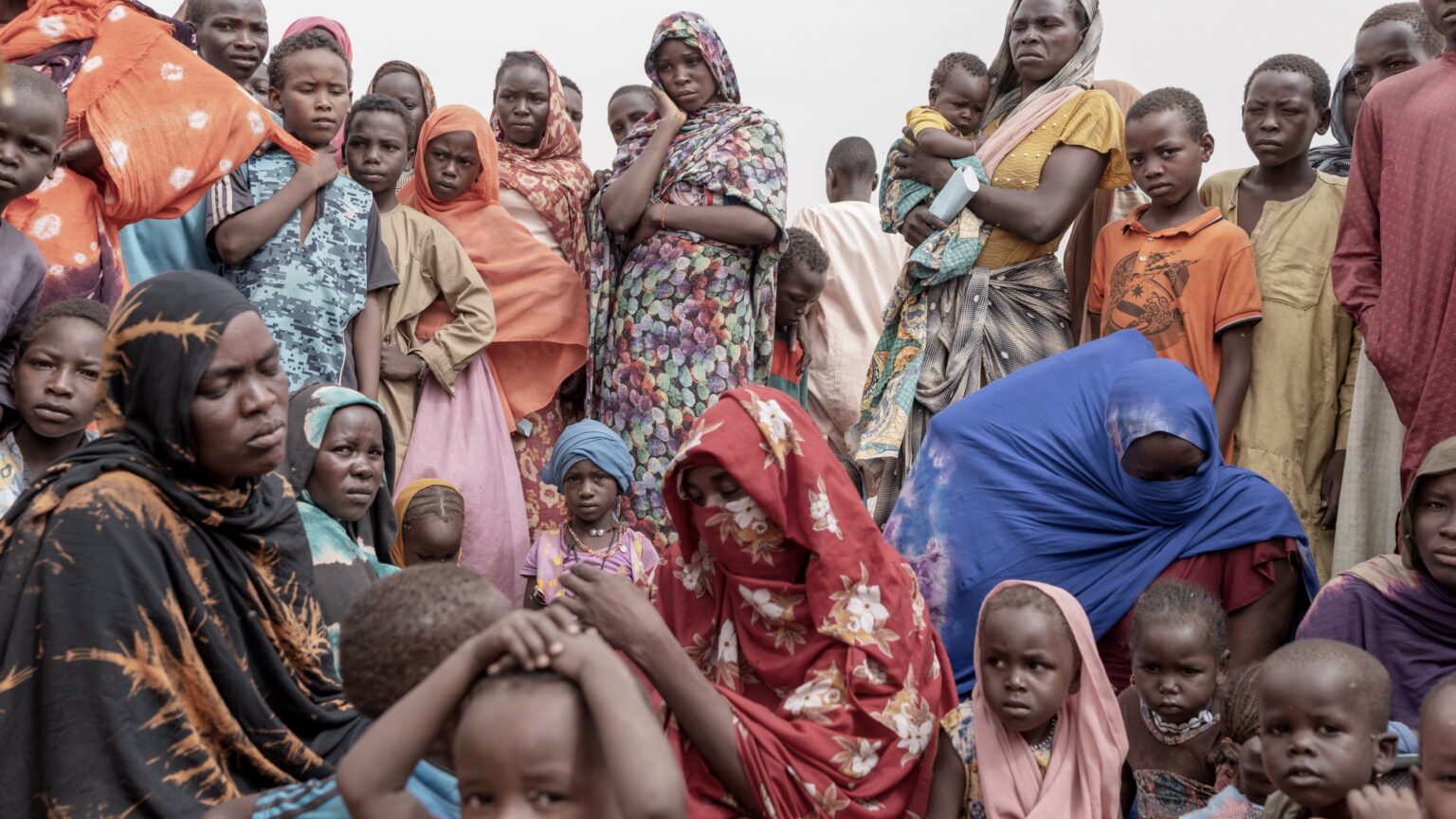
The violence in Sudan has pushed North Darfur’s Zamzam camp, home to over 500,000 people, into famine. Photo: WHO
“The world has completely forgotten the crisis in Sudan” where “a slow death” has become the plight of millions, decried Adam Rojal, spokesperson of the General Coordination of Darfur Displaced People and Refugees.
As the fighting between the Sudanese Armed Forces (SAF) and the paramilitary Rapid Support Forces (RSF) intensifies in North Darfur state and the Kordofan region, UN Human Rights Chief Volker Türk warned on Friday, June 20 of a “further aggravation in an already brutal and deadly conflict.”
The war, which began in April 2023, has created the world’s worst humanitarian disaster, displacing nearly 13 million, leaving Sudan with the highest number of displaced people globally. 30 million, almost two-thirds of the population, need humanitarian aid, including food assistance.
The worst affected are children, amounting to half of the hungry and displaced population, the UN said last week, decrying a severe fund shortage, leaving it unable to assist over 80% of the children in need.
Children under the age of five are the largest group of victims of the measles outbreak, amounting to over 60% of the 2,200 suspected cases since the start of this year. Another 230 children have been killed and 7,300 suspected to have been infected by cholera, which broke out last July, killing over 2,000 and suspectedly infecting over 80,000 people.
The number of cholera cases sharply spiked earlier this year in Sudan’s capital region of Khartoum where over 34,000 displaced people returned mainly since March after the SAF retook control from the RSF.
Damaged in the fighting, most of the homes to which they returned lacked water or sanitation. In May, the RSF launched a series of drone strikes on water purification units and power plants, further curtailing water supply, and forcing residents to resort to unsafe sources, which caused over a nine-fold rise in cholera cases in the second half of that month.
Last week, Doctors Without Borders (MSF) raised the alarm that the cholera wave had now reached the western semi-arid region of Darfur for the first time since the war began.
In a press statement on Sunday, June 22, the General Coordination of Darfur Displaced People and Refugees warned that diseases may spread rapidly as monsoon season has begun in Darfur, with rains lashing over the displaced sheltering only under plastic sheets with no sanitation facilities.
Particularly vulnerable to the deadly diseases are the children and the pregnant and breast-feeding women who are already suffering from malnutrition, its spokesperson Adam Rojal told Peoples Dispatch, “The world has completely forgotten the crisis in Sudan” where “a slow death” has become the plight of millions, he decried.
The Darfur region consists of five states, of which North Darfur remains the only state where the SAF has retained a foothold in its capital El Fasher. The RSF, which controls the rest of the region, has laid a siege on the city for over a year now, cutting off its supply of food and other essentials, and frequently bombarding the famine-stricken displaced peoples camp on its outskirts. Activists have warned that El Fasher itself is on the verge of famine.
Now in its third year, the war that has caused a humanitarian catastrophe on such a scale “is far from over”, a UN fact-finding mission warned last week.
The RSF – which the SAF claims to have killed 28,613 and wounded 43,575 since the start of the war – is also making advances in the Kordofan region in the center and southern region of Sudan. Civilians in South Kordofan’s city of El-Dibeibat – a crucial crossroad linking the state with North Kordofan and West Darfur – have been caught up in the crossfire for over two years.
Fleeing this city, thousands sought refuge in North Kordofan’s capital El-Obeid, under SAF’s control. However, the RSF has surrounded El-Obeid, “and may attack it in the coming days, as announced by the RSF commander,” the UN Human Rights Office of the High Commissioner said on June 20.
“We cannot allow ourselves to be dragged into another Middle East war based on lies.”
While a number of statements by members of Congress in the wake of U.S. President Donald Trump’s bombing of Iranian nuclear facilities focused largely on the fact that the White House acted without congressional authorization—a constitutional violation—U.S. Sen. Bernie Sanders expressed anger over another aspect of the unilateral military action: the “lies” that the Trump administration is telling the public to justify the bombing.
The White House’s act of war against Iran, said the Vermont independent senator, was just the latest in a long line of military boondoggles that followed lies powerful politicians told about the threats posed by foreign countries—before taking action that ultimately killed millions of people while doing nothing to protect U.S. security.
“In the 1960s the United States government lied to the American people and took us into a terrible war in Vietnam,” said Sanders. “The result of that war was that over 58,000 young Americans died and many more came back wounded both in mind and in spirit. Millions of Vietnamese were also killed.”
Decades later, Americans were told by then-President George W. Bush that the U.S. must act quickly to stop Iraq from building “weapons of mass destruction”—with U.S. officials following the guidance of Israeli Prime Minister Benjamin Netanyahu.
“The United States invaded Iraq and became embroiled in a long civil war there. No weapons of mass destruction were ever found. That war was based on a lie—a lie which cost us 4,492 young Americans, 32,000 wounded, over half a million Iraqis and trillions of dollars,” said Sanders.
“The American people are being lied to again today,” he added. “We cannot allow history to repeat itself.”
U.S. intelligence agencies have assessed that Iran is not attempting to build a nuclear weapon with its enriched uranium stockpile, backing up repeated statements from Iranian officials who have said the country’s nuclear program is used only for peaceful civilian purposes.
Sanders’ statement came several hours after he learned while speaking at a rally in Tulsa, Oklahoma that Trump had bombed Iran, authorizing strikes on three nuclear facilities, which Iranian officials condemned as a violation of international law.
At the rally, supporters erupted in a chant of “No more war!” after Sanders read Trump’s statement on the attack.
I learned about Trump’s unconstitutional attack on Iran at a large rally in Tulsa, Oklahoma. Here is the response: pic.twitter.com/eziVpp3Y54
The spontaneous display of outrage over the latest U.S. attack on the Middle East underscored the reality of the moment, said The Nation writer Jeet Heer, as one poll released Thursday showed that just 8% of Americans favored the U.S. becoming directly involved in Israel’s attacks on Iran that began earlier this month.
“There is only one off-ramp from Trump’s mad rush to war: the quick mobilization of an anti-war opposition,” said Heer. “The people are ready.”
3. In 2003, Bush/Cheney actually had a very sophisticated public relations campaign that won over large segments of the establishment (NY Times, New Yorker published WMD lies) and Dem party (half of congressional Dems, including Biden & Clinton, voted for war). Trump hasn't…
As the Trump administration boasted about the “severe damage” the strikes had done to Iran’s nuclear program, progressive strategist Waleed Shahid called on Democratic lawmakers to tap into voters’ palpable outrage—not about Trump’s failure to seek congressional authorization for the strikes, but about the fact that the U.S. is pursuing a war in Iran at all while repeating Netanyahu’s unsubstantiated claims about the Iranians’ ability to produce a nuclear bomb.
“No one ever won a fight yelling, ‘Congressional authorization.’ Voters need clarity amid the chaos,” said Shahid. “Lead with this: No more blank checks for corrupt and endless foreign wars, we’re here to focus on fighting for working Americans.”
“The U.S. faces enormous problems here at home, which we must address,” said Sanders. “We cannot allow ourselves to be dragged into another Middle East war based on lies.”
When Israel launched a surprise military strike on Iran last week, it did more than risk igniting a catastrophic regional war. It also exposed long-simmering tensions in Washington—between entrenched bipartisan, pro-Israel hawks and a growing current of lawmakers (and voters) unwilling to be dragged into another Middle East disaster.
“This is not our war,” declared Rep. Thomas Massie (R-KY), one of the House’s most consistent antiwar voices. “Israel doesn’t need U.S. taxpayers’ money for defense if it already has enough to start offensive wars. I vote not to fund this war of aggression.” On social media, he polled followers on whether the U.S. should give Israel weapons to attack Iran. After 126,000 votes (and 2.5 million views), the answer was unequivocal: 85% said no.
For decades, questioning U.S. support for Israel has been a third rail in Congress. But Israel’s unprovoked attack on Iran—coming just as the sixth round of sensitive U.S.-Iran nuclear talks were set to take place in Oman—sparked rare and unusually direct criticism from across the political spectrum. Progressive members, already furious over Israel’s war on Gaza, were quick to condemn the new offensive. But they weren’t alone.
Rep. Pramila Jayapal (D-WA) called Israel’s strike “reckless” and “escalatory,” and warned that Prime Minister Netanyahu is trying to drag the U.S. into a broader war. Rep. Chuy García (D-IL) called Israel’s actions “diplomatic sabotage” and said, “the U.S. must stop supplying offensive weapons to Israel, which also continue to be used against Gaza, & urgently recommit to negotiations.”
Rep. Summer Lee (D-PA) was even more blunt. “The war criminal Netanyahu wants to ignite an endless regional war & drag the U.S. into it. Any politician who tries to help him betrays us all.”
Netanyahu’s strikes on Iran are acts of diplomatic sabotage that risk escalation, endangering civilians in both countries & across the region.
The US must stop supplying offensive weapons to Israel, which also continue to be used against Gaza, & urgently recommit to…
— Congressman Chuy García (@RepChuyGarcia) June 13, 2025
More striking, however, were the critiques from moderate Democrats and some Republicans.
Sen. Tim Kaine (D-VA), a longtime advocate for requiring congressional approval before the U.S. gets involved in new wars, blasted Israel for jeopardizing planned U.S.-Iran diplomacy. “The American people have no interest in another forever war,” he wrote. Sen. Jack Reed (D-RI), Ranking Member of the Senate Armed Services Committee, warned that strikes “threaten not only the lives of innocent civilians but the stability of the entire Middle East and the safety of American citizens and forces.”
Some pro-Israel Democrats are feeling comfortable speaking out on this conflict because it fits their anti-Trump critique. Sen. Maria Cantwell (D-WA) said:
We are at this crisis today because President Trump foolishly walked away from President Obama’s Iran nuclear agreement under which Iran had agreed to dismantle much of its nuclear program and to open its facilities to international inspections, putting more eyes on the ground. The United States should now lead the international community towards a diplomatic solution to avoid a wider war.”
Adding to this diverse chorus of opposition are some Republicans from the party’s non-interventionist wing. Sen. Rand Paul (R-KY) declared, “War with Iran is not in America’s interest. It would destabilize the region, cost countless lives, and drain our resources for generations.” Rep. Warren Davidson (R-OH) lamented that “some members of Congress and U.S. Senators seem giddy about the prospects of a bigger war.”
War with Iran is not in America’s interest. It would destabilize the region, cost countless lives, and drain our resources for generations.
We should pursue diplomacy, not destruction. Engaging in dialogue with adversaries is not weakness; it’s the strength of a confident nation…
And in a rare show of agreement with progressive critics, Rep. Marjorie Taylor Greene (R-GA) blasted the hawks in both parties. “We’ve been told for the past 20 years that Iran is on the verge of developing a nuclear bomb any day now. The same story. Everyone I know is tired of U.S. intervention and regime change in foreign countries. Everyone I know wants us to fix our own problems here at home, not bomb other countries.”
Of course, many in Congress rushed to support Israel. Senate Republican leader John Thune said, “Israel has determined that it must take decisive action to defend the Israeli people.” Democratic Sen. John Fetterman (D-PA) voiced full support for the strike and urged the U.S. to provide Israel “whatever is necessary—military, intelligence, weaponry.”
Our commitment to Israel must be absolute and I fully support this attack.
Keep wiping out Iranian leadership and the nuclear personnel.
We must provide whatever is necessary—military, intelligence, weaponry—to fully back Israel in striking Iran. https://t.co/3lm1YD6dVr
— U.S. Senator John Fetterman (@SenFettermanPA) June 13, 2025
The most crass was Senator Lindsey Graham, who posted:
Game on. Pray for Israel.”
But these crude pro-war responses, once guaranteed to go unchallenged, are now being met with resistance–and not just from activists. With public opinion shifting sharply–especially among younger voters, progressives, and “America First-ers” – the political calculus on unconditional support for Israel is changing. In the wake of Israel’s disastrous war in Gaza and its widening regional provocations, members of Congress are being forced to choose: follow the AIPAC money and the old playbook–or listen to their constituents.
If the American people continue to raise their voices, the tide in Washington could turn away from support for a war with Iran that could plunge the region into deeper chaos while offering no relief for the suffering people of Gaza. We could finally see an end to decades of disastrous unconditional support for Israel and knee-jerk support for catastrophic wars.
Feature photo | Israelis gather next to a direct hit site following an Iranian missile strike against Israel, June 16th 2025. Matan Golan | AP
Medea Benjamin is co-founder of Global Exchange and CODEPINK: Women for Peace. She is the co-author, with Nicolas J.S. Davies, of War in Ukraine: Making Sense of a Senseless Conflict, available from OR Books in November 2022. Other books include, “Inside Iran: The Real History and Politics of the Islamic Republic of Iran” (2018); “Kingdom of the Unjust: Behind the U.S.-Saudi Connection” (2016); “Drone Warfare: Killing by Remote Control” (2013); “Don’t Be Afraid Gringo: A Honduran Woman Speaks from the Heart” (1989), and (with Jodie Evans) “Stop the Next War Now” (2005).
The views expressed in this article are the author’s own and do not necessarily reflect MintPress News editorial policy.

 Prime Minister Sir Keir Starmer during a meeting with German Chancellor Friedrich Merz, in Downing Street, London, on his first official visit to Britain, July 17, 2025