As we speak, 4.3 million children in the UK are living in relative poverty. Over 350,000 people are homeless in England.
Millions are worried about the cost of heating their home, braced for yet another hike in energy bills. Meanwhile, billionaires are richer than ever.
So what is the government doing?
They could lift children out of poverty, if they wanted to, by scrapping the two-child benefit cap.
Keir Starmer says that a changing world means we have to increase defence spending (Picture: Ministry of Defence)
They could help pensioners with energy bills, if they wanted to, by restoring universal winter fuel allowance.
They could ensure nobody had to sleep rough on the streets, if they wanted to, by launching a massive council-house-building programme.
Instead, they have signed off on a 13.4 billion increase in military spending. With that money, the government could scrap the two-child benefit cap 10 times over.
Now, today, we’re told the government is preparing to cut billions from welfare budgets.
…
Even David Lammy admits Gaza is in ‘rubble’ (Picture: Getty Images)
Put simply: there is never any money for the poor, but always enough money for war. I just wish the government was honest about that.
Keir Starmer says pensioners can freeze to death and poor children can starve and be condemned to failure and misery all their lives.Keir Starmer justifies why he has to travel abroad so much
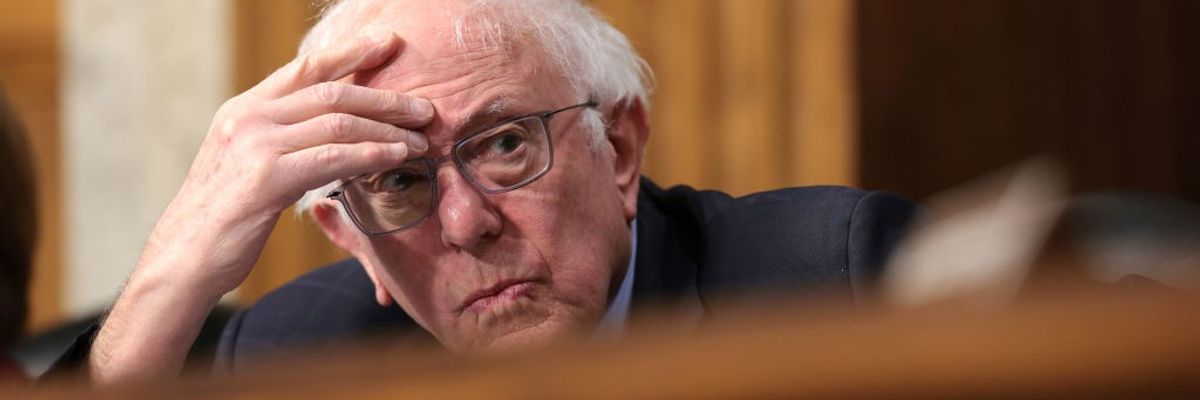
U.S. Sen. Bernie Sanders (I-Vt.) attends a Senate hearing on January 29, 2025 in Washington, D.C. (Photo: Win McNamee/Getty Images)
“Does anyone really think that the oligarchs give a damn about ordinary Americans?” the senator asked. “Trust me, they don’t.”
As U.S. President Donald Trump and billionaire Elon Musk on Tuesday continued their effort to gut the federal government, Sen. Bernie Sanders warned that “the oligarchs, with their unlimited amounts of money, are waging a war on the working class of our country, and it is a war that they are intent on winning.”
A week after delivering a speech that sounded the alarm about “America’s dangerous movement toward oligarchy, authoritarianism, and kleptocracy,” Sanders (I-Vt.) took the Senate floor again to target the world’s three richest people—Musk, Jeff Bezos, and Mark Zuckerberg—and the politicians who serve them.
“We are living in an extremely dangerous time,” the seantor said Tuesday. “Future generations will look back at this moment—what we do right now—and remember whether we had the courage to defend our democracy against the growing threats of oligarchy and authoritarianism.”
“As we speak, right now, Elon Musk, the wealthiest man on the planet, is attempting to dismantle major agencies of the federal government which are designed to protect the needs of working families and the disadvantaged,” said Sanders. “These agencies were created by the U.S. Congress and it is Congress’ responsibility to maintain them, to reform them, or to end them. It is not Mr. Musk’s responsibility. What Mr. Musk is doing is patently illegal and unconstitutional—and must be ended.”
Sanders also detailed Trump and his allies’ attacks on the federal judiciary, which has delivered a series of blows to the Republican president’s agenda since he took office last month.
“Mr. Trump and his friends are not just trying to undermine two of the three pillars of our constitutional government—Congress and the courts—they are also going after the media, in a way that we have never seen in the modern history of this country,” the senator said. While recognizing that the media “makes mistakes every day,” he added that “I do hope that every member of Congress understands that you cannot have a functioning democracy, you cannot have a free flow of information, you cannot have the pursuit of truth, without an independent press.”
The senator also how the top three billionaires impact what information reaches people by buying news outlets and social media platforms—as Musk did with Twitter, which he rebranded X, and Bezos did with The Washington Post and Twitch. Zuckerberg, meanwhile, has made his money through Meta, the parent company of Facebook and Instagram.
“They will use the enormous media operations they own to deflect attention away from the impact of their policies while they ‘entertain us to death,’” Sanders warns. “They and their fellow oligarchs will continue within our corrupt campaign finance system to spend huge amounts of money to buy politicians in both major political parties.”
“Does anyone really think that the oligarchs give a damn about ordinary Americans?” he asked. “Trust me, they don’t.”
Sanders warned that “if we do not stop them, they will soon be going after the healthcare, nutrition, housing, and educational programs that protect the most vulnerable people in our country—all so that they can raise they money they need to provide huge tax breaks for themselves and for others billionaires. As modern-day kings who believe they have the absolute right to rule, they will sacrifice, without hesitation, the well-being of working people in order to protect their power and their privileges.”
However, he also stressed that “the worst fear of the ruling class of our country is that the American people—whether they are Black or white or Latino, whether they are urban or rural, whether they are young or old, gay or straight, whatever—the fear of the ruling class is that the American people come together to demand a government that represents all of us, not just the people on top.”
“The oligarch’s nightmare is that we will not allow ourselves to be divided up by race, religion, sexual orientation, or country of origin and will come together and have the courage to take them on,” he declared. “If we stand together, we’re gonna win this fight, and not only will we save American democracy, we’re gonna create the kind of nation that I think most of us know we should become.”
Elon Musk urges you to be a Fascist like him, says that you can ignore facts and reality then.Climate Science Denier Donald Trump says Burn, Baby, Burn.
Omar el Qataa is a photojournalist operating out of northern Gaza
Facebook has severely restricted the ability of Palestinian news outlets to reach an audience during the Israel-Gaza war, according to BBC research.
In a comprehensive analysis of Facebook data, we found that newsrooms in the Palestinian territories – in Gaza and the West Bank – had suffered a steep drop in audience engagement since October 2023.
The BBC has also seen leaked documents showing that Instagram – another Meta-owned platform – increased its moderation of Palestinian user comments after October 2023.
Meta – the owner of Facebook – says that any implication that it deliberately suppressed particular voices is “unequivocally false”.
…
During a period of war, audience engagement might be expected to rise. However, the data showed a 77% decline after the Hamas attacks on 7 October 2023.
Palestine TV has 5.8 million followers on Facebook. Journalists at the newsroom shared statistics with us showing a 60% drop in the number of people seeing their posts.
“Interaction was completely restricted, and our posts stopped reaching people,” says Tariq Ziad, a journalist at the channel.
Over the past year, Palestinian journalists have raised fears that their online content is being “shadow-banned” by Meta – in other words, restricted in how many people see it.
To test this, we carried out the same data analysis on the Facebook pages of 20 Israeli news organisations such as Yediot Ahronot, Israel Hayom and Channel 13. These pages also posted a large amount of war-related content, but their audience engagement increased by nearly 37%.
Hundreds of demonstrators, holding Israeli flags and photos of prisoners, gather at the streets and march from Jaffa Street in Jerusalem towards Prime Minister Benjamin Netanyahu’s residence, to demand a ceasefire and prisoner swap deal in Gaza in Jerusalem on December 14, 2024. [Saeed Qaq – Anadolu Agency]
The Al-Qassam Brigades, the military wing of the Palestinian resistance group Hamas, said Saturday that the Israeli army bombed a location in the Gaza Strip, where Israeli hostages were held, confirming that the bombing was repeated to ensure their death, Anadolu reports.
Abu Obaida, the spokesperson for the group, said on Telegram: “The occupation army recently bombed a location where some enemy prisoners were present and repeated the bombing to ensure their death.”
“We have intelligence confirming that the enemy deliberately bombed the location with the aim of killing the prisoners and their guards,” Obaida noted.
He added: “Our fighters attempted to rescue the enemy prisoners and succeeded in retrieving one of them, whose fate remains unknown.”
Obaida held Israeli Prime Minister Benjamin Netanyahu, his government, and the Israeli army “fully responsible for this event and the lives of their prisoners.”
A video released by al-Qassam Brigades showed the bombed location and a person without clarifying whether they were killed or injured, with no facial features shown.
The video included a statement: “Netanyahu and [Chief of General Staff Herzi] Halevi seek to get rid of their prisoners in Gaza by all means.”
Israel estimates that there are currently 101 Israeli prisoners held in Gaza.
Mediation efforts led by the US, Egypt, and Qatar to reach a cease-fire and prisoner swap agreement between Israel and Hamas have failed due to Netanyahu’s refusal to halt the ongoing conflict.
Israel has launched a genocidal war on the Gaza Strip that has killed more than 44,800 victims, mostly women and children, since an attack by the Palestinian resistance group, Hamas, on 7 October 2023.
The second year of genocide in Gaza has drawn growing international condemnation, with officials and institutions labeling the attacks and the blocking of aid deliveries as a deliberate attempt to destroy a population.
The International Criminal Court issued arrest warrants last month for Israeli Prime Minister Benjamin Netanyahu and his former defense chief Yoav Gallant for war crimes and crimes against humanity in Gaza.
Israel also faces a genocide case at the International Court of Justice for its war on Gaza.
This work by Middle East Monitor is licensed under a Creative Commons Attribution-NonCommercial-ShareAlike 4.0 International License.
A lifeguard hut rests on its side after Hurricane Milton, October 11, 2024, at Clearwater Beach, Fla.
RICH countries received strong criticism at the Cop29 conference in Azerbaijan today for wanting to spend more on wars and weapons than on preventing climate change.
“Global military spending stands at $2.5 trillion (£1.9trn) annually,” Panamian climate envoy Juan Carlos Monterrey Gomez told delegates at the faltering annual talks sponsored by the United Nations.
“For some, $2.5trn dollars to kill each other, it’s not enough, but $1trn to save lives is unreasonable.”
“Causing our own extinction is the most ridiculous thing. At least the dinosaurs had an asteroid. What is our excuse?”
Palestinian Environment Quality Authority chairwoman warned that Israel is committing “ecocide” after over a year of bombardments in Gaza.
“Protection of the environment is actually not an ancillary issue, it is not a secondary option, it is a basic right that is related to all of us as human beings,” she said.
…
Brazilian President Luiz Inacio Lula da Silva urged developed nations to consider moving their 2050 emission goals forward to 2040 or 2045.
“The G20 is responsible for 80 per cent of greenhouse-effect emissions,” he said. “Even if we are not walking the same speed, we can all take one more step.”
Meanwhile, a new scientific study has found that climate change has made Atlantic hurricanes about 18mph stronger in the last six years.