Three major water companies illegally discharged sewage hundreds of times last year on days when it was not raining, a BBC investigation suggests.
The practice, known as “dry spilling”, is banned because it can lead to higher concentrations of sewage in waterways.
Thames, Wessex and Southern Water appear to have collectively released sewage in dry spills for 3,500 hours in 2022 – in breach of their permits.
Water UK, the industry body, said the spills “should be investigated”.
…
Collectively throughout 2022, Thames, Southern and Wessex illegally started releasing sewage on dry days 388 times – research by the BBC’s climate and data teams suggests – including during last summer when these regions were in drought.
There even appears to have been spills by all three companies on 19 July 2022, the hottest day on record, when temperatures topped 40C in some places and many people tried to cool off in rivers.
Parliamentary committees need to investigate water company accounting, especially as they are continuing with the practices that brought down Carillion.
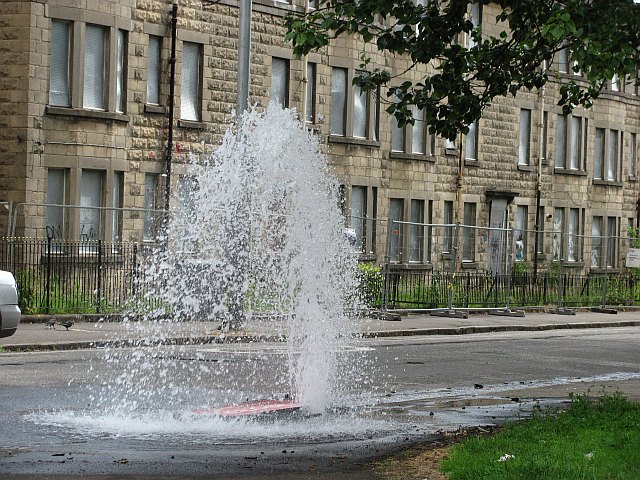
Image of a burst water main.
Prem Sikka is an Emeritus Professor of Accounting at the University of Essex and the University of Sheffield, a Labour member of the House of Lords, and Contributing Editor at Left Foot Forward.
Ever since its privatisation in 1989, the water and sewage industry in England and Wales has set new standards in ripping people off.
Profits are made by not plugging water leaks and by dumping tons of sewage in rivers and seas. More than one trillion litres of water is lost to leaks from crumbling pipes each year. In 2022, raw sewage was dumped into rivers and seas 824 times a day, nearly 301,000 times a year over 1.75m hours. Despite higher demand, no new reservoirs have been built since privatisation. With captive customers and no competition, companies have hiked charges by 40% in real terms. The biggest winners are shareholders. More than 90% of the nine water companies are owned by overseas investors.
Since privatisation, companies have paid £72bn in dividends and another £15bn is expected by the 2030. These are largely funded by over £60bn of debt. To soothe public anxieties, Ministers claim that since 1989 water companies have invested £190bn. Such claims need to be treated with caution as the companies have a history of murky accounting practices.
Thames Water is England’s’ biggest water company. Since 2010, it has been sanctioned 92 times by the regulators and paid fines of £163m. Since privatisation, it has paid £7.2bn in dividends and has debts of around £14bn.
Taking cue from the water company, in June 2023 a Minister told parliament that “Thames Water itself has not paid any dividends for the last six year”. Of course, water companies are not operating as not-for-profit organisations and are masters of financial engineering and obfuscation.
Page 43 of the company’s 2022-23 financial report describes £45m payment (£37m for 2022) to its immediate parent company Thames Water Utilities Holdings Limited as “dividend” which then forwards it to Thames Water Utilities Limited and is still described as “dividend”. The same page then claims that it is not really a dividend because its purpose is to “solely to service debt obligations and group related costs of other companies within the wider Kemble Water Group”. Page 22 of the 2022 accounts of Thames Water Utilities Holdings Limited shows “Dividend Income” of £37.1m. Anything described as a “dividend” in the accounts is a dividend and in the last two years alone this amounts to £82m (£45m + £37m). Since privatisation, vast amounts are likely to have travelled via this route to the company’s ultimate controllers but are not included in the £7.2m of dividends.
Yorkshire Water is also engaged in sleight of hands. Since 2010, it has paid £1.2bn in dividends and claims to have stopped paying dividends from 2017-18. However, page 137 of its 2022-23 financial report states that the company paid £62.3m “dividends” to its parent company. Its 2021-22 accounts (page 99) state that “the Board of Yorkshire Water has approved the payment of £52.6m in dividends.”
… [article continues discussing Water companies’ financial obfuscation.]
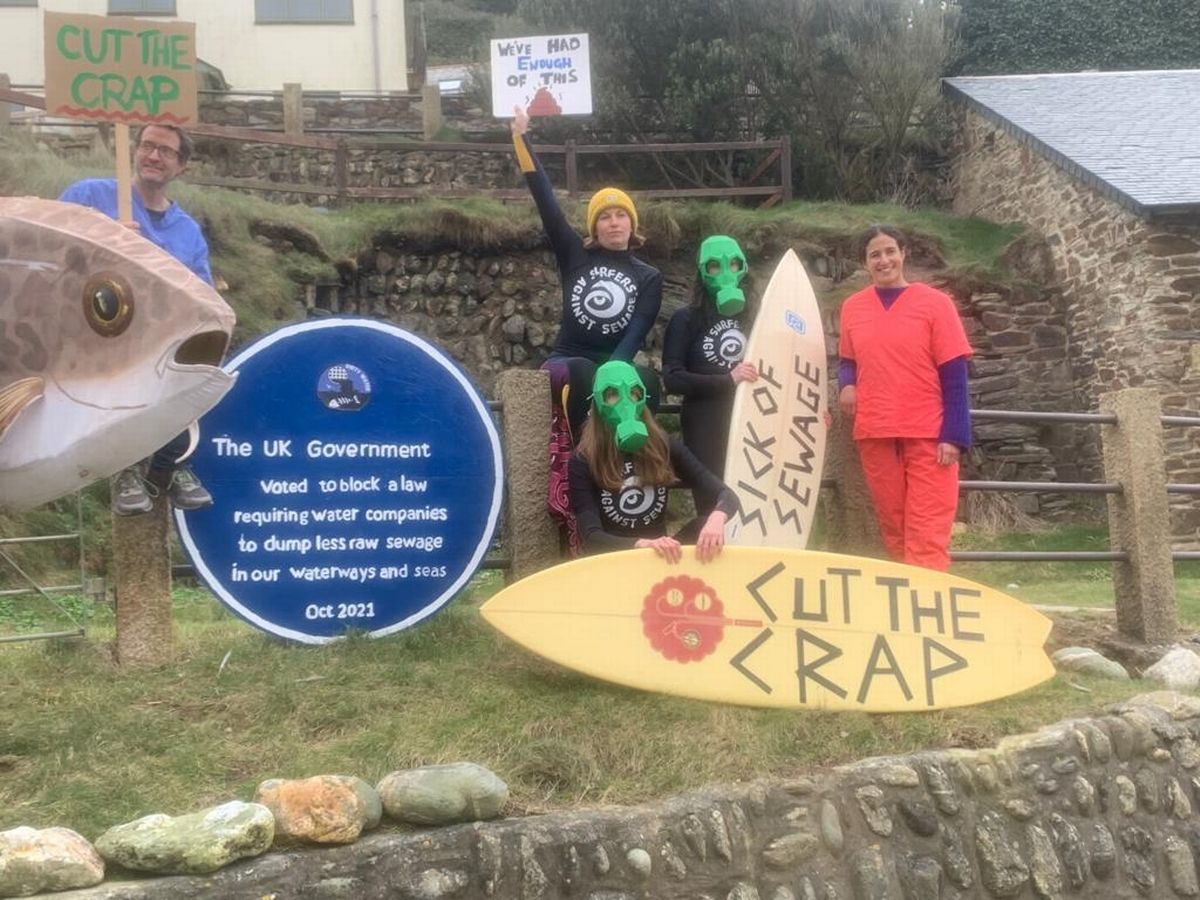
April 2023 Surfers Against Sewage and Extinction Rebellion protests in St Agnes, Perranporth, Truro and Charlestown which unveiled spoof Blue Plaques to the MPs and Conservative Government who allowed raw sewage to be dumped in the sea (Image: Surfers Against Sewage)
On Wednesday 5 to Thursday 6 July, the High Court will hear a legal challenge that aims to force the Government to toughen up its plan for reducing sewage dumped in England’s rivers and seas. Good Law Project is supporting the Marine Conservation Society, Richard Haward’s Oysters and surfer and activist Hugo Tagholm as they argue that the Government’s strategy is inadequate, allowing water companies to pollute waters and beaches for another 27 years.
England’s sewers were designed with 14,500 storm overflows to stop them becoming overwhelmed, allowing a mixture of surface water and sewage to be discharged during heavy rainfall. But according to the Environment Agency, these overflows are now used on a routine basis. Water companies discharged untreated sewage through storm overflows more than 300,000 times in 2022 for a total of 1.7 million hours.
The Department for Environment, Food and Rural Affairs (DEFRA) published the Storm Overflows Discharge Reduction Plan to tackle this in August last year. It imposed a deadline of 2035 for reducing the sewage flowing into bathing waters and areas of ecological importance, but gave companies until 2050 to stop discharges elsewhere.
This legal challenge, which has been backed by cross-party MPs, aims to force the Government to bring forward these deadlines and introduce tougher targets.
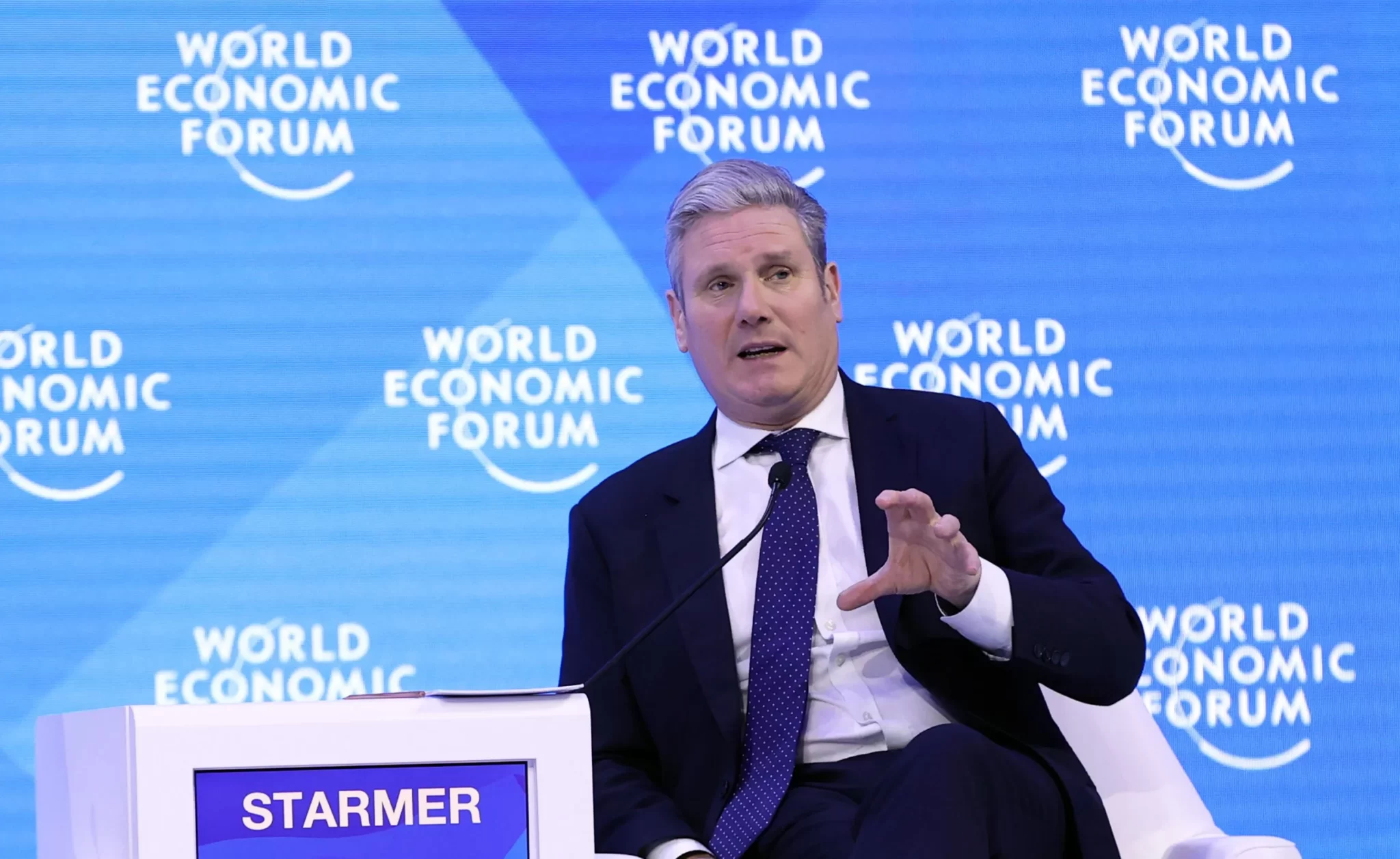
Lindsey German on … [Keith Starmer] , the establishment’s friend …
The fate of Thames Water should be the end of the privatisation model pioneered by Thatcher in the 1980s. The major utilities and public companies were sold off at undervalued prices, their shares rapidly snapped up by big corporations and investors, prices for consumers rose rapidly, and profits went to shareholders, not to investment. That’s why today the common refrain about most parts of public life in Britain is that nothing works. And it is epitomised by Thames Water drowning in debt and likely to be taken back into public ownership temporarily.
But any form of nationalisation is going to be resisted to the bitter end, not just by the greedy privatised companies themselves, but by the Tories and the increasingly right-wing Labour Party under Keir Starmer. The cheek of the privatised companies was illustrated when the head of another, Severn Trent, convened a meeting of all the water firms to explicitly discuss ways of resisting nationalisation. And it’s no use going to the supposed regulators for help. As the Observer reported, ‘27 former Ofwat directors, managers and consultants [are] working in the industry they helped to regulate, with about half in senior posts.’ So a number of those regulating the industry have moved over to take lucrative positions in…. the privatised water companies.
While investors take the money and run, working class people are left with dire and expensive services that fail frequently because there is no investment. The water companies are publicly disgraced because of their dumping of sewage in rivers and seas, rather than invest in new treatment plants. But in London (and no doubt elsewhere) there have been several burst water mains, risking lives as they cause disruption sometimes for months, because of lack of investment. In the southeast of England, drinking water supplies have failed ‘because of the hot weather’, in what must be the lamest excuse from a company supposed to provide just that.
The answer from government and industry alike is that future investment will have to be paid for by us, through much higher bills and higher taxes. Already gas and electricity is beyond affordable for millions. But the energy companies will set the benchmark for other industries as profits are protected. No wonder nearly 13 million adults struggle to pay bills.
dizzy: Under Capitalism failing companies would normally go bankrupt so that the companies’ debts would be transferred to it’s creditors. This is not the case with the banks in the banking crisis of 2008, the energy companies failures ofrecent yearsand it looks like failing water companies now. Instead of the companies creditors shouldering the debt as part of the normal process, the poor public is instead burdened with it. This is great for the banks of course because it means that they can borrow without any risk of default, knowing that they will profiteer from the public regardless.
Those debts have reached more than £14 billion, leading to fears the government – or UK taxpayers to be precise – may have to bail the company out.
The news of Thames Water’s difficulties may have shocked some of its 15 million customers. But as someone who has researched the finances of water companies, I was not entirely surprised. These issues have been a long time in the making, and I raised concerns publicly over five years ago.
When the water and sewage companies of England and Wales were privatised in 1989, the intention was to bring fresh finance and innovation to create efficiency. But in the 2000s, a new kind of financial investor began to dominate the sector.
Our recent research found that by 2021, of 15 English water and sewage companies, nine were owned by “special purpose companies”. These are organisations set up for the purpose of buying water utilities, with owners consisting of a range of private equity funds, pension funds and sovereign wealth funds.
These kinds of investors were then able to use water company revenue to generate significant returns to shareholders. And one way this happens is by hiking up company debts.
Newly privatised water companies had started out with zero debt in 1989. Yet by the end of March 2022, total debt in the sector was at £60.6 billion. In part, the increased debt was used to refinance the companies so that investors could repay themselves part of the original cost of buying the water utility.
Our research shows that Thames Water was the archetype of this model. When it was taken over in 2007 by a consortium led by Macquarie, an Australian investment bank, debts increased over the next ten years from £3.2 billion to £10.7 billion. The proportion of assets funded by borrowing increased to over 80%, while the company paid out dividends of £2.5 billion. The company has previously said that it has a “strict, performance-linked dividend policy monitored by Ofwat”.
Perfect storm
But such high debts are problematic for a water company. First there is the issue of inequality, where customers’ water bills are used to pay down debts that have increased to pay dividends to its owners. And second, as we see with Thames Water, these highly indebted companies are potentially unstable in the event of cost pressures.
What we have now is a perfect storm in which Thames Water’s finances may collapse. A key pressure is inflation, which is pushing up the value of some of the company’s debt at the same time as it pushes up costs. More than half of Thames Water’s debt is linked to inflation, contributing to the uplift in debt value.
Then there is the cost of improving performance. This has become more urgent after Ofwat, the water company regulator, was given new powers (effective from April 2025) to prevent companies paying dividends if these weaken financial resilience or are not linked to performance.
In 2022, the government set out a plan to tackle the rapidly growing issue of sewage discharge in a £56 billion investment plan. All of this adds up to intense pressure on the company’s finances.
If those finances do unravel, it is likely that the company will be underwritten by the government to keep the taps flowing while a rescue package is put together (as happened with the energy company Bulb).
However, this situation also creates the opportunity for a new public model of water supply, one that treats water not as a private commodity but as part of the wider ecosystem, providing social equity as well as environmental sustainability.
Public ownership need not be a step back to the 1970s. In fact, it would bring the UK into step with most of the modern world, including most of Europe. In Paris, where water provision was made public in 2009 after years of outsourcing, the change is widely considered a success story.
The last 34 years have revealed the fundamental problems with the current system. This crisis is a chance to direct England’s water in a new direction.