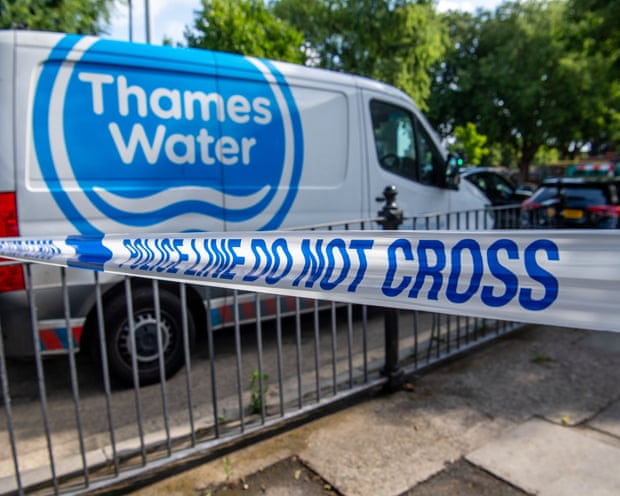
Thames Water has been on the brink of collapse for more than a year, struggling under the weight of £17bn in net debt, built up over decades since privatisation. Photograph: Jill Mead/The Guardian
Debt-ridden utility company warns of ‘material uncertainty’ despite seeing profits rise to more than £400m
Thames Water has said crisis talks to secure its future with lenders are taking “longer than expected” and will drag into 2026 as it faces the prospect of a collapse into government control.
Britain’s biggest water company on Wednesday said it had swung to a profit of £414m for the six months to September helped by bills rising by nearly a third, after losing £149m in the same period in 2024.
Despite the jump in reported profits, the company said there was “material uncertainty which may cast significant doubt” on its status as a going concern. A collapse into government control under a special administration regime (SAR) – a form of temporary nationalisation – “could occur in the very near term” if it is unable to agree the terms of a formal takeover by its controlling lenders.
Those creditors have asked the regulator, Ofwat, and the government for Thames to be let off future fines for pollution, arguing the prospect of hundreds of millions of pounds of extra costs is making a turnaround impossible.
The standoff has already continued for months longer than originally anticipated and the talks were expected to have concluded by the end of the year.
On Wednesday, the company said: “Discussions are taking longer than expected but this is a complex situation and the current phase of the restructuring plan will likely take a number of months to conclude.”
A tanker pumps out excess sewage from the Lightlands Lane sewage pumping station in Cookham, Berskhire which flooded after recent heavy rainfall, January 10, 2024
Water companies record worst-ever environmental performance in England as serious pollution incidents increase by 60% in 2024, Environment Agency finds
EMBATTLED water companies have recorded their worst-ever environmental performance in England, with serious pollution incidents up 60 per cent last year, data from the Environment Agency revealed yesterday.
Thames Water, Southern Water and Yorkshire Water were responsible for 81 per cent of all serious incidents, while Thames Water alone saw cases more than double.
Northumbrian and Wessex Water were the only companies with none.
The agency said only Severn Trent achieved the top four-star rating for 2024, while all nine water and sewage firms in England collectively earned just 19 out of a possible 36 stars — the lowest since the annual performance system began in 2011.
The regulator said the decline marked the end of over a decade of gradual improvement.
Serious pollution incidents causing significant environmental harm rose to 75, their highest since 2013.
The agency partly blamed extreme weather, which strained ageing infrastructure, but said “this is never an excuse.”
It also cited long-term underinvestment and poor maintenance.
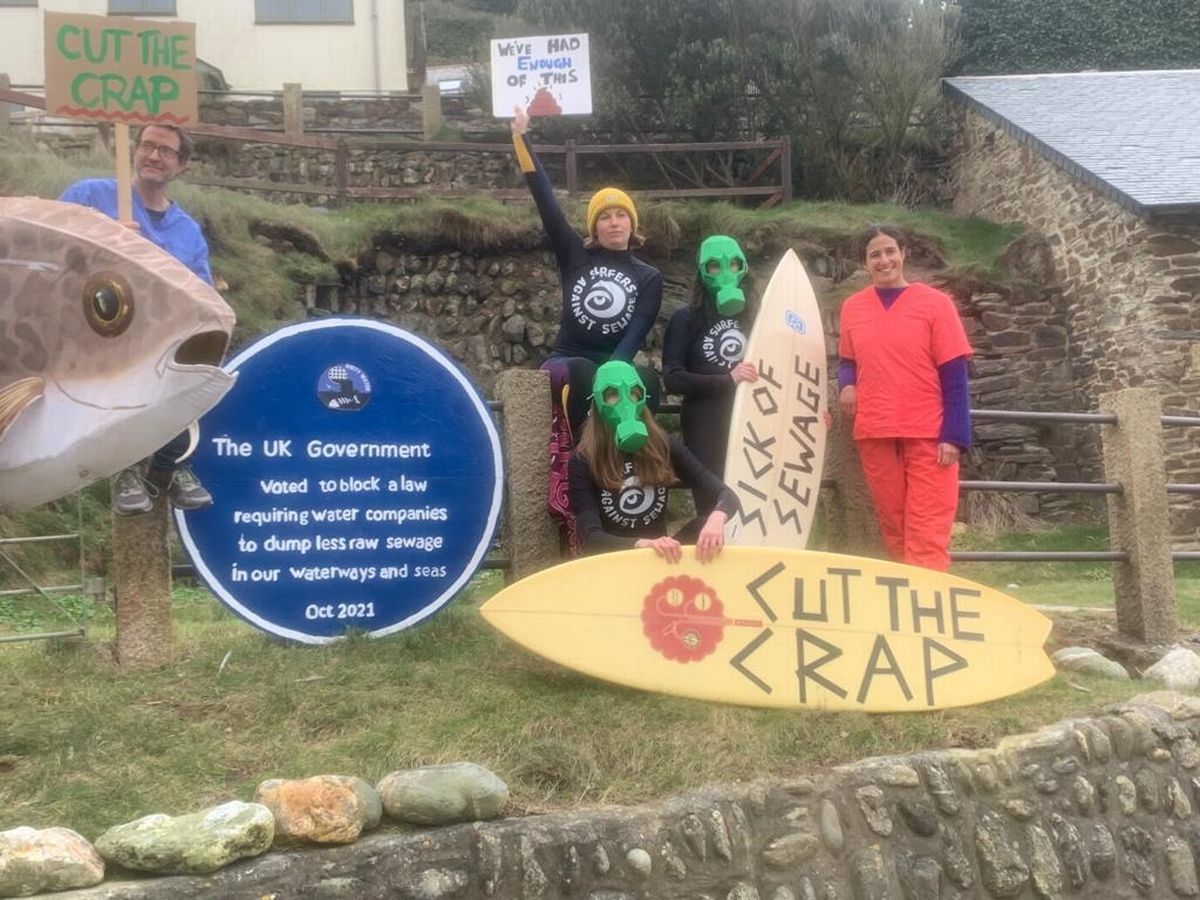
April 2023 Surfers Against Sewage and Extinction Rebellion protests in St Agnes, Perranporth, Truro and Charlestown which unveiled spoof Blue Plaques to the MPs and Conservative Government who allowed raw sewage to be dumped in the sea (Image: Surfers Against Sewage)
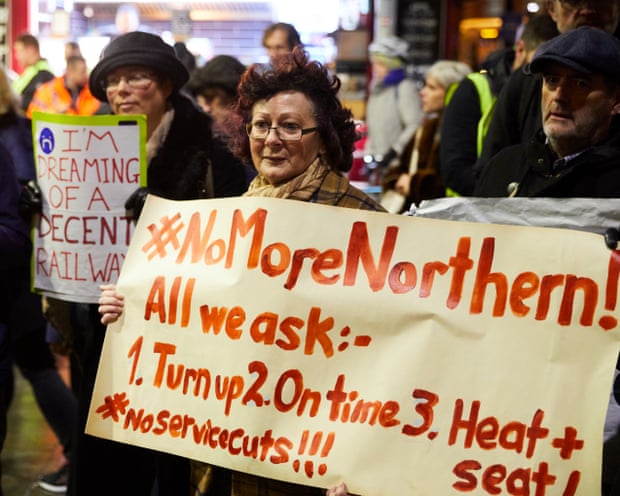
Northern Rail passengers protest over poor service in Manchester in 2019 Photograph: Christopher Thomond/The Guardian
Analysis reveals ‘privatisation premium’ of £250 per household per year paid to owners of water, rail, bus, energy and mail services since 2010
The public has paid almost £200bn to the shareholders who own key British industries since they were privatised, research reveals.
The transfer of tens of billions of pounds to the owners of the privatised water, rail, bus, energy and mail services comes as families face soaring bills, polluted rivers and seas, and expensive and unreliable trains and buses.
As a result, citizens have been paying a “privatisation premium” of £250 per household per year since 2010 alone, the analysis found.
Recent focus has been on the privatised water industry, which has run up long-term debts of £73bn and paid out dividends of £88.4bn in the past 34 years at the same time as overseeing record sewage spills, according to the latest figures.
But for the first time the thinktank Common Wealth has drawn together the haemorrhaging of billions of pounds to shareholders across four key sectors, most of which were privatised from the 1980s and 1990s by Margaret Thatcher’s Conservative government – energy, transport, water and mail.
This work by Middle East Monitor is licensed under a Creative Commons Attribution-NonCommercial-ShareAlike 4.0 International License.
Palestinians flock to the Zikim crossing to acquire limited food aid as hunger crisis worsens with the ongoing Israeli blockade in North Gaza, Gaza on August 18, 2025. [Khalil Ramzi Alkahlut – Anadolu Agency]
The UN human rights office on Tuesday said over 1,850 Palestinians have been killed while trying to access food in Gaza in less than three months, warning that humanitarian conditions are worsening as Israel continues to restrict aid, Anadolu reports.
“Reaching the meagre supplies available can be a deadly pursuit,” spokesperson Thameen Al-Kheetan told reporters in Geneva, noting that between May 27 and Aug. 17, the human rights office documented that 1,857 Palestinians were killed while seeking food, “including 1,021 killed in the vicinity of the Gaza Humanitarian Foundation sites, and 836 killed on the routes of supply trucks.”
“Most of these killings appear to have been committed by the Israeli military,” he said.
He warned that “the risk of starvation is everywhere in Gaza,” describing it as “a direct result of the Israeli government’s policy of blocking humanitarian aid.”
“In the past few weeks, Israeli authorities have only allowed aid to enter in quantities that remain far below what would be required to avert widespread starvation.”
The spokesperson also noted that hundreds of thousands of Palestinians, displaced to the Al-Mawasi area west of Khan Younis in southern Gaza, have little or no access to essential services and supplies, including food, water, electricity, and tents.
He added that the Israeli army has intensified its attacks in the north of the strip, while displacement orders continue even in areas where strikes are recorded.
The spokesperson also recalled High Commissioner for Human Rights Volker Turk’s remarks that warned against plans for a military takeover of Gaza City, saying such a move “must be immediately halted.”
Al-Kheetan said the plan has a “huge risk” for civilians, explaining the risks as mass displacement, more killings, and more misery.
He also addressed the recently released footage of Israeli National Security Minister Itamar Ben-Gvir, showing Palestinian leader Marwan Barghouthi in prison.
“Video footage showing Israeli National Security Minister Itamar Ben-Gvir berating and taunting Palestinian leader Marwan Barghouthi face-to-face inside an Israeli jail is unacceptable,” he said.
“The minister’s behavior and the publication of the footage constitute an attack on Barghouthi’s dignity.”
Israel has killed more than 62,000 Palestinians in Gaza since October 2023. The military campaign has devastated the enclave, which is facing famine.
This work by Middle East Monitor is licensed under a Creative Commons Attribution-NonCommercial-ShareAlike 4.0 International License.
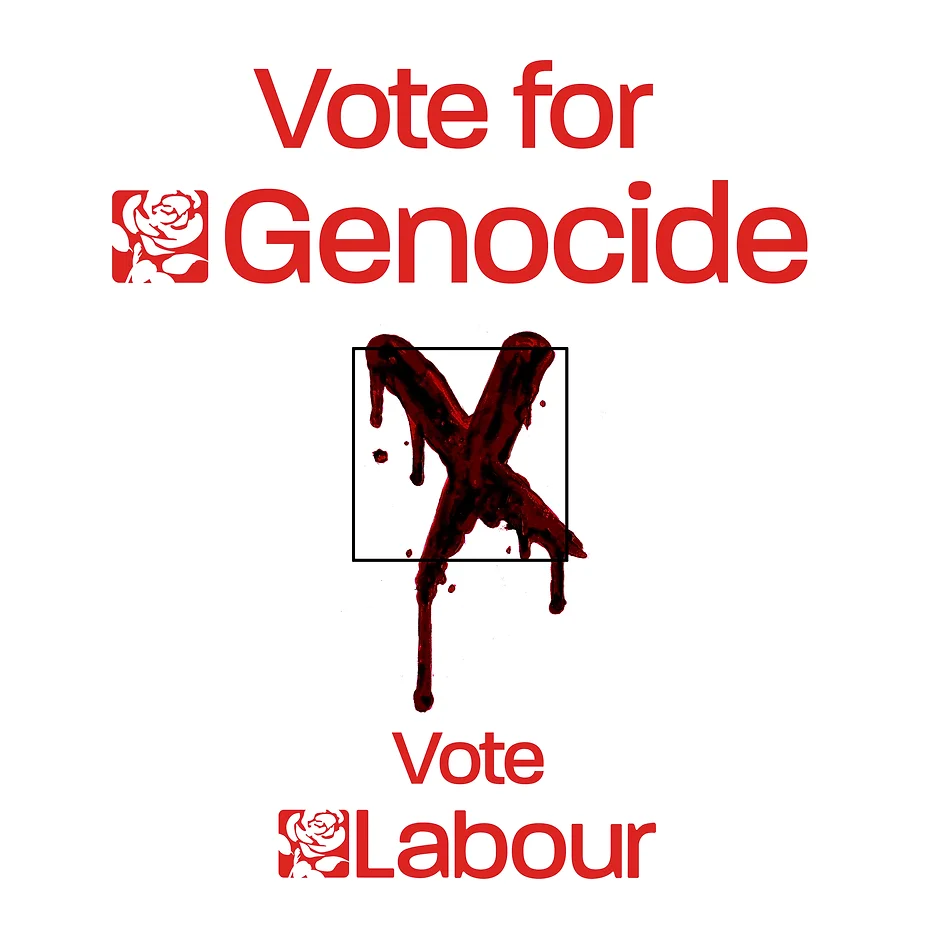
Genocide denier and Current UK Prime Minister Keir Starmer is quoted that he supports Zionism without qualification. He also confirms that UK air force support has been essential in Israel’s mass-murdering genocide. Includes URLs https://www.declassifieduk.org/keir-starmers-100-spy-flights-over-gaza-in-support-of-israel/ and https://youtu.be/O74hZCKKdpAUK Labour Party government Keir Starmer, Angela Rayner and Rachel Reeves explain that they are participants and complicit in Israel’s Gaza genocide providing Israel with army and air force support. They explain that they don’t do gas chambers but do do forced marches, starvation, destroy hospitals, mass-murders of journalists and healthcare workers.Vote Labour for Genocide.
Only a truly democratic party can provide the space for the policies that are needed to transform society. Up and down the country, there is huge appetite for an economic reset. One that brings water, energy, rail and mail into public ownership. One that invests in welfare, not warfare. One that ends this government’s complicity in genocide and brings about justice for the Palestinian people. One that makes the wealthiest in society pay a bit more in tax to ensure that everyone can live in dignity.
This is the political vision that can inspire hope, not fear. The great dividers want you to think that migrants and minorities are responsible for the problems in our society. They’re not. Those problems are caused by a rigged economic system that protects the interests of billionaires and corporations. By scapegoating migrants and minorities for its own domestic failures, Labour has paved the path for Reform UK. This Labour government is here to appease Reform. We are here to defeat Reform. We are at a critical juncture, and we need an alternative, now.
…
Think of what we could achieve together.
The future we deserve is no pipe dream. Look around you, and you will find proof that a better world is possible. We are not fighting for crumbs. We are fighting for real change – and we are never, ever going away.
dizzy: I need to spend time on other projects for the next few years. We need left bloggers and social media activists. It’s a hard slog to get established but go for the long term. Teams of 10 or more would be ideal because you could share the work, maybe concentrate on your own area of interest. Suggest that you change passwords regularly and drop and replace people who don’t pull their weight. In a few years, ready for the next election, you should be kicking and taking on number 10’s influence and influencers reported in this article.

 A tanker pumps out excess sewage from the Lightlands Lane sewage pumping station in Cookham, Berskhire which flooded after recent heavy rainfall, January 10, 2024