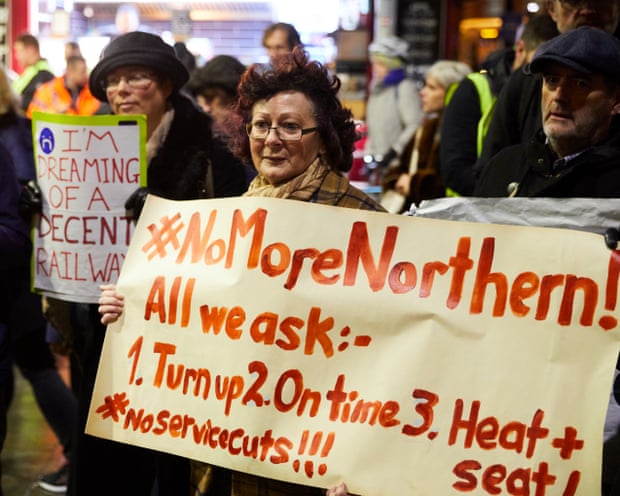
Northern Rail passengers protest over poor service in Manchester in 2019 Photograph: Christopher Thomond/The Guardian
Analysis reveals ‘privatisation premium’ of £250 per household per year paid to owners of water, rail, bus, energy and mail services since 2010
The public has paid almost £200bn to the shareholders who own key British industries since they were privatised, research reveals.
The transfer of tens of billions of pounds to the owners of the privatised water, rail, bus, energy and mail services comes as families face soaring bills, polluted rivers and seas, and expensive and unreliable trains and buses.
As a result, citizens have been paying a “privatisation premium” of £250 per household per year since 2010 alone, the analysis found.
Recent focus has been on the privatised water industry, which has run up long-term debts of £73bn and paid out dividends of £88.4bn in the past 34 years at the same time as overseeing record sewage spills, according to the latest figures.
But for the first time the thinktank Common Wealth has drawn together the haemorrhaging of billions of pounds to shareholders across four key sectors, most of which were privatised from the 1980s and 1990s by Margaret Thatcher’s Conservative government – energy, transport, water and mail.
This work by Middle East Monitor is licensed under a Creative Commons Attribution-NonCommercial-ShareAlike 4.0 International License.
Palestinians flock to the Zikim crossing to acquire limited food aid as hunger crisis worsens with the ongoing Israeli blockade in North Gaza, Gaza on August 18, 2025. [Khalil Ramzi Alkahlut – Anadolu Agency]
The UN human rights office on Tuesday said over 1,850 Palestinians have been killed while trying to access food in Gaza in less than three months, warning that humanitarian conditions are worsening as Israel continues to restrict aid, Anadolu reports.
“Reaching the meagre supplies available can be a deadly pursuit,” spokesperson Thameen Al-Kheetan told reporters in Geneva, noting that between May 27 and Aug. 17, the human rights office documented that 1,857 Palestinians were killed while seeking food, “including 1,021 killed in the vicinity of the Gaza Humanitarian Foundation sites, and 836 killed on the routes of supply trucks.”
“Most of these killings appear to have been committed by the Israeli military,” he said.
He warned that “the risk of starvation is everywhere in Gaza,” describing it as “a direct result of the Israeli government’s policy of blocking humanitarian aid.”
“In the past few weeks, Israeli authorities have only allowed aid to enter in quantities that remain far below what would be required to avert widespread starvation.”
The spokesperson also noted that hundreds of thousands of Palestinians, displaced to the Al-Mawasi area west of Khan Younis in southern Gaza, have little or no access to essential services and supplies, including food, water, electricity, and tents.
He added that the Israeli army has intensified its attacks in the north of the strip, while displacement orders continue even in areas where strikes are recorded.
The spokesperson also recalled High Commissioner for Human Rights Volker Turk’s remarks that warned against plans for a military takeover of Gaza City, saying such a move “must be immediately halted.”
Al-Kheetan said the plan has a “huge risk” for civilians, explaining the risks as mass displacement, more killings, and more misery.
He also addressed the recently released footage of Israeli National Security Minister Itamar Ben-Gvir, showing Palestinian leader Marwan Barghouthi in prison.
“Video footage showing Israeli National Security Minister Itamar Ben-Gvir berating and taunting Palestinian leader Marwan Barghouthi face-to-face inside an Israeli jail is unacceptable,” he said.
“The minister’s behavior and the publication of the footage constitute an attack on Barghouthi’s dignity.”
Israel has killed more than 62,000 Palestinians in Gaza since October 2023. The military campaign has devastated the enclave, which is facing famine.
This work by Middle East Monitor is licensed under a Creative Commons Attribution-NonCommercial-ShareAlike 4.0 International License.
Genocide denier and Current UK Prime Minister Keir Starmer is quoted that he supports Zionism without qualification. He also confirms that UK air force support has been essential in Israel’s mass-murdering genocide. Includes URLs https://www.declassifieduk.org/keir-starmers-100-spy-flights-over-gaza-in-support-of-israel/ and https://youtu.be/O74hZCKKdpAUK Labour Party government Keir Starmer, Angela Rayner and Rachel Reeves explain that they are participants and complicit in Israel’s Gaza genocide providing Israel with army and air force support. They explain that they don’t do gas chambers but do do forced marches, starvation, destroy hospitals, mass-murders of journalists and healthcare workers.Vote Labour for Genocide.
Only a truly democratic party can provide the space for the policies that are needed to transform society. Up and down the country, there is huge appetite for an economic reset. One that brings water, energy, rail and mail into public ownership. One that invests in welfare, not warfare. One that ends this government’s complicity in genocide and brings about justice for the Palestinian people. One that makes the wealthiest in society pay a bit more in tax to ensure that everyone can live in dignity.
This is the political vision that can inspire hope, not fear. The great dividers want you to think that migrants and minorities are responsible for the problems in our society. They’re not. Those problems are caused by a rigged economic system that protects the interests of billionaires and corporations. By scapegoating migrants and minorities for its own domestic failures, Labour has paved the path for Reform UK. This Labour government is here to appease Reform. We are here to defeat Reform. We are at a critical juncture, and we need an alternative, now.
…
Think of what we could achieve together.
The future we deserve is no pipe dream. Look around you, and you will find proof that a better world is possible. We are not fighting for crumbs. We are fighting for real change – and we are never, ever going away.
dizzy: I need to spend time on other projects for the next few years. We need left bloggers and social media activists. It’s a hard slog to get established but go for the long term. Teams of 10 or more would be ideal because you could share the work, maybe concentrate on your own area of interest. Suggest that you change passwords regularly and drop and replace people who don’t pull their weight. In a few years, ready for the next election, you should be kicking and taking on number 10’s influence and influencers reported in this article.
This work by Middle East Monitor is licensed under a Creative Commons Attribution-NonCommercial-ShareAlike 4.0 International License.
A large crowd gather during a food distribution by a charity organization, as many Palestinians struggle to access food due to Israel’s ongoing attacks on the Gaza Strip, on July 18, 2025. [Abdalhkem Abu Riash – Anadolu Agency]
In Gaza, mornings no longer begin with the sound of explosions — but with the quiet, urgent cries of hunger.
Mothers wake to infants with no milk. Children search for scraps to ease empty stomachs before the bombs return to flatten what little hope remains.
This isn’t exaggeration. It’s a grim, documented reality. Gaza is not only under bombardment — it’s under siege. And the weapon now cutting deepest is starvation. Because hunger is silent, the world looks away, as if a slow death does not count.
For months, Gazans have faced a dual siege: daily airstrikes and international indifference. Border crossings remain closed. Those searching for food are shot. Humanitarian supply lines are systematically broken. Bread has become a fantasy. Water is a daily fight. Medicine, a rare miracle.
“Humanitarian catastrophe” no longer captures it. What’s unfolding now is a deliberate campaign of starvation — one that meets every definition, legal and moral, of genocide.
Footage smuggled out of Gaza shows children collapsing while queuing for bread, families surviving on weeds, mothers dividing a single loaf between four hungry children. It’s not the bombs killing them — it’s the slow wasting of malnourished bodies.
The people of Gaza are not asking for the impossible. They are asking for a shred of global conscience.
But what hurts even more than the hunger is the silence.
In the early days of the assault, Western leaders issued cautious statements: calls for restraint, reminders of international law, expressions of concern. But those voices have since faded. Forgotten. Buried in old press releases. No action followed. No policies changed.
Instead, support for Israel intensified. Some governments even suspended funding to the UN’s main relief agency, UNRWA — in the middle of Gaza’s collapse.
Have you ever heard of a government withdrawing aid from a humanitarian agency while children are starving?
It happened. And it happened quietly.
As Nelson Mandela once said:
“To deny people their human rights is to challenge their very humanity.”
Today, Gaza is being punished not only with bombs, but with hunger — a form of collective punishment enabled by an international consensus too timid to speak out. You won’t find this consensus in official statements, but you’ll see it in every sealed border, every empty bowl, and every child who cries from thirst.
According to UN agencies:
Food insecurity has reached catastrophic levels.
Over 90 per cent of children in Gaza are malnourished.
Infant deaths from starvation and dehydration are now a daily reality.
Yet the world remains still.
Worse still, some governments continue to justify Israel’s actions under the banner of “self-defence” — as if using starvation as a weapon were somehow legitimate.
But it isn’t just the West that bears responsibility.
Egypt too must answer for its role. The Rafah crossing — Gaza’s only exit not controlled by Israel — has been shut for months. Cairo waits for Tel Aviv’s permission to let aid in or patients out. When will we stop pretending this is neutrality? This is complicity.
And what of the Arab governments who have normalised ties with Israel? Some have remained silent. Others have gone further, publicly strengthening relations while Gaza starves. At least the West doesn’t claim kinship. But these regimes do — while doing nothing to stop the suffering of fellow Palestinians.
As former UN Secretary-General Kofi Annan once warned:
“When food becomes a weapon, humanity itself has collapsed.”
Gaza is facing that collapse — and the international system is allowing it to happen.
Yet despite everything, Gaza endures. Its people turn hunger into defiance. They resist, even when stripped of everything. In Gaza, dignity isn’t found in comfort — it’s found in survival.
But let’s be honest: Israel cannot sustain this alone. It relies on silence. On selective outrage. On diplomatic cover. And that is exactly what it gets from world powers who claim to care about human rights — but choose which victims matter.
So who is really standing with Gaza?
Not governments. Not institutions. But ordinary people. Protesters. Citizens. The ones who still have a conscience and refuse to look away.
Gaza doesn’t want pity. It wants justice. It demands an end to the genocide — and accountability for those who enable it.
The question is no longer: What is happening?
We know.
The question is: Who will act?
And when history is written — who will be remembered for their silence?
Because silence, in the face of starvation, is not neutrality.
It is complicity.
The views expressed in this article belong to the author and do not necessarily reflect the editorial policy of Middle East Monitor.
This work by Middle East Monitor is licensed under a Creative Commons Attribution-NonCommercial-ShareAlike 4.0 International License.
Keir Starmer objects to criticism of the IDF. He asks how could anyone obect to them starving people to death, forced marches like the Nazis did, bombing Gaza’s hospitals and universities,mass-murdering journalists, healthworkers and starving people queuing for food, killing and raping prisoners and murdering children. He calls for people to stop obstructing his genocide for Israel.
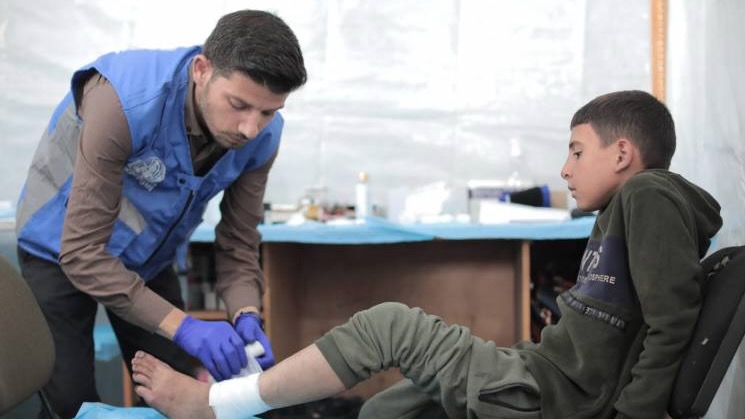
Medication shortages leave burn victims without full care in Gaza. Photo: UNRWA
The health crisis in Gaza worsens as Israeli attacks persist, supplies dwindle, and most lack access to food and water.
Less than half of all health facilities in the Gaza Strip remain partially operational and capable of providing basic primary care and surgery, the Al Mezan Center for Human Rights warned in a press release. Israeli attacks have rendered nearly all hospitals in northern Gaza non-functional, destroying dialysis units, oncology departments, and rehabilitation centers. The threat of total shutdown is now advancing into the southern governorates: the European Hospital has already been forced to close due to the attacks, and the Nasser Medical Center could be next in line.
This major institution has been operating far beyond capacity for weeks and is under imminent threat of closure, according to both international and non-governmental organizations. “Its closure would deprive thousands of access to critical healthcare and effectively amounts to a death sentence for the wounded and sick in the southern district,” Al Mezan reported.
According to the Jewish Voice for Peace (JVP) Health Advisory Council, most patients at Nasser Medical Center are victims of direct sniper shots to the head or chest, illustrating the deliberate targeting of Palestinians by Israeli forces.
Medics forced to repurpose used supplies
The crisis at Nasser, as with other medical facilities, is worsened by widespread shortages of essential supplies. Over 50% of medications for chronic conditions are unavailable, 64% of cancer and hematology drugs are missing, and the shortage of orthopedic equipment has reached nearly 90%, according to health organizations. Both the JVP Health Advisory Council and United Nations agencies have highlighted that the lack of basic items such as gauze, medicines, and surgical equipment is forcing medical staff into extreme triage decisions. “Medical teams have been forced to reuse equipment – sterilizing and repurposing implants from recovered patients – due to the acute shortage of these items,” Al Mezan stated.
Fuel shortages are of particular concern, as they endanger the functioning of critical medical devices such as ventilators in neonatal intensive care units (NICUs). “Newborns in NICUs are often too small to breathe on their own – they need ventilators and oxygen to survive,” staff from Doctors Without Borders (MSF) pointed out. “The charade of only allowing medical and fuel supplies at the very last minute before a looming disaster is nothing but a band-aid on a gushing wound.”
Hunger rates grow further
At the same time, hunger is sweeping through Gaza. Following Israel’s months-long blockade of aid and the weaponization of humanitarian deliveries, most of the population is experiencing rising degrees of malnutrition. This is impacting public health in multiple ways, including reducing the pool of eligible blood donors, even as blood banks face dire shortages.
“We are missing everything: medical consumables like gauze, medications, and food for our patients,” said MSF nursing manager Katja Storck. “This also includes therapeutic food for people with malnutrition, especially children.”
By June 15, nearly 19,000 children under five had received treatment for malnutrition, though this likely underrepresents the full extent of the crisis. As the JVP Health Advisory Council noted, these cases emerged “within a population where wasting was non-existent 20 months ago.” Malnutrition is not only increasing susceptibility to infectious disease, but is also causing serious long-term effects such as stunted growth and mental health problems. Prenatal health is also affected: one in five newborns is now being born preterm or underweight.
While many adults are trying to shield children from hunger by reducing their own intake, most coping strategies are ineffective under the conditions imposed by the occupation. “Most families reported surviving on one meager meal a day – thin broths, lentils or rice with salt, macaroni, cans of beans or peas, and boiled legumes,” UN sources reported. “One third said they go entire days without eating or rely on a single piece of bread and duqqa.”
Beyond hunger caused by Israel’s blockade, Palestinians in Gaza are also facing an escalating water crisis. With much of the water infrastructure destroyed and fuel to power desalination plants missing, access to safe drinking water has plummeted. In Deir al-Balah, 97% of residents reported being unable to obtain adequate water. “This is Gaza’s most critical moment since this war on children began – a woeful bar to sink below,” UNICEF spokesperson James Elder stated on June 20. “A virtual blockade is in place; humanitarian aid is being sidelined; the daily killing of girls and boys in Gaza does not register; and now a deliberate fuel crisis is severing Palestinians’ most essential element for survival: water.
Zionist Keir Starmer is quoted “I support Zionism without qualification.” He’s asked whether that means that he supports Zionism under all circumstances, whatever Zionists do.Keir “I support Zionism without Qualification” Starmer supporting genocide.Vote Labour for Genocide.