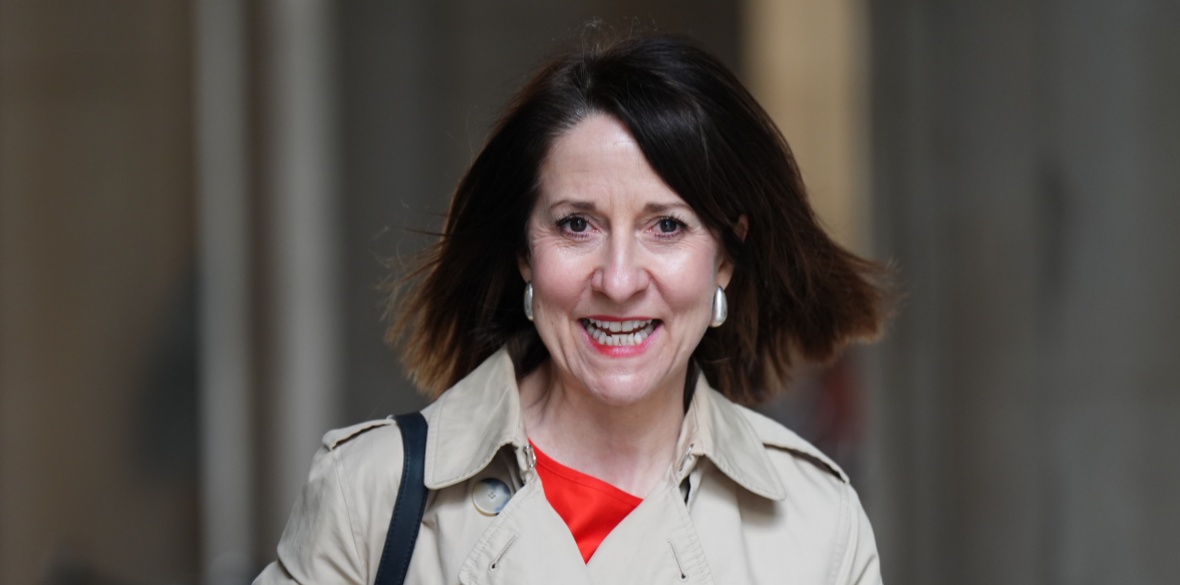
Work and Pensions Secretary Liz Kendall arrives in Downing Street, London, for a Cabinet meeting, March 11, 2025
ALMOST two-thirds of disabled people on Personal Independence Payments (PIP) “will not cope” without it, a charity has warned, amid reports that the government will reduce the benefit.
Work and Pensions Secretary Liz Kendall is expected to unveil reforms aimed at reducing welfare costs that ministers have described as “unsustainable.”
Reports suggest that PIP, the main benefit for working-age adults both in and out of work, could be frozen rather than increased in line with inflation, delivering a real-terms cut for 3.6 million claimants.
A new analysis from Sense has found that 38 per cent of PIP recipients with complex needs are already behind on energy bills. Almost half — 46 per cent — are struggling to afford essential costs such as council tax and water, while 41 per cent are living in debt due to benefits failing to cover the cost of essentials like food.
Fifty-eight per cent of those polled reported significant ongoing extra costs due to disability and 53 per cent said their PIP payments were insufficient to cover those expenses.
Sense chief executive James Watson-O’Neill said PIP “exists because living with a disability means facing higher costs, from increased energy bills to specialised equipment and specific diets.”
“These additional expenses won’t disappear if eligibility is tightened. It will only plunge more disabled people into poverty.
“Making it harder to access benefits won’t help disabled people find jobs either. It will only deepen the struggle.”
Keir Starmer confirms that he’s proud to be a red Tory continuing austerity and targeting poor and disabled scum.Keir Starmer, Angela Rayner and Rachel Reeves wear the uniform of the rich and powerful. They have all had clothes bought for them by multi-millionaire Labour donor Lord Alli. CORRECTION: It appears that Rachel Reeves clothing was provided by Juliet Rosenfeld.
“The government is today trumpeting its “Things Can Only Get Cleaner” tour. But the reality is that can only happen if we take back control of our water.
“United Utilities offers a prime example of the failed privatisation experiment with our water.
“So the company has now belatedly agreed to invest £200m in cleaning up Lake Windemere. But it’s been dragged kicking and screaming to act.
“United Utilities has spent years focussed on paying out dividends to shareholders and fat cat salaries rather than treating sewage.
“The Group’s CEO has amassed around £1.41m a year in salary and bonuses and the company will pay its investors – which include some of the world’s biggest asset managers – £339m in dividends this year, up from £310m for 2023. This hike follows reported higher operating profits thanks to a rise in customer bills. All this puts the £200m investment into Windemere into sharp focus.
“It’s time to bring United Utilities and all water companies back into public hands so that our bills can be used to improve the service rather than being siphoned off into the pockets of shareholders.”
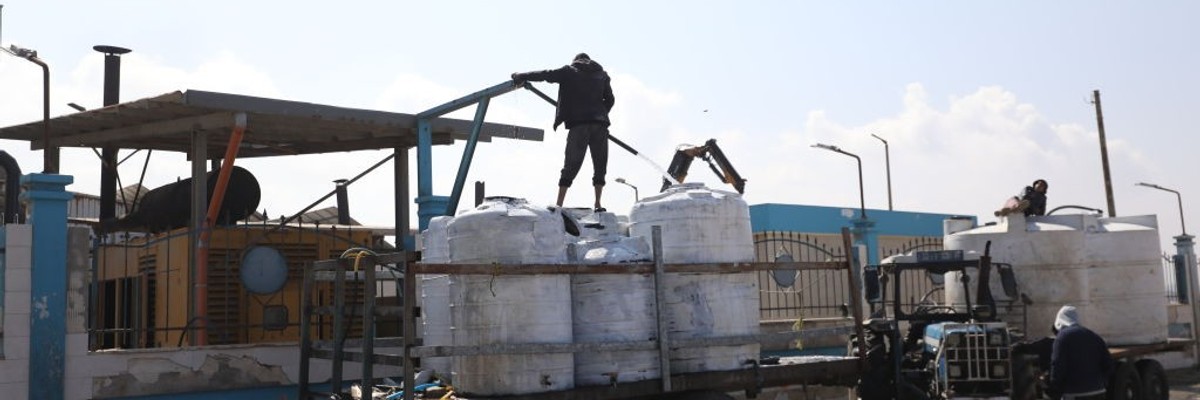
A water treatment plant in Deir al-Balah, Gaza is on the verge of shutting down due to Israel’s order to cut electricity flow on March 10, 2025. (Photo: Moiz Salhi/Anadolu via Getty Images)
One expert noted that “this collective punishment of civilians” violates the Geneva Convention as well as a preliminary injunction from the International Court of Justice.
Outrage over the Israeli government’s decision to cut off electricity to a water treatment plant in the decimated Gaza Strip mounted on Monday.
As Common Dreams reported Sunday, Israeli Energy Minister Eli Cohen said that he “signed an order for the immediate halt of electricity to the Gaza Strip” as part of a policy to use “all of the tools that are at our disposal to ensure the return of all the hostages” taken by Hamas on October 7, 2023.
The Times of Israel noted that the new move by Israeli Prime Minister Benjamin Netanyahu’s government “was mainly expected to affect a single desalination plant, the only facility in the strip still running on a power line supplied from Israel.”
Responding on social media Monday, the Peace & Justice Project—founded by Jeremy Corbyn, an Independent member of the U.K. Parliament—condemned the cutoff as Israel’s “latest act of genocidal collective punishment against the Palestinian people.”
“This latest despicable act must be condemned by all governments and Israel must be sanctioned,” the group added.
Also speaking out on social media, Francesca Albanese, United Nations special rapporteur on the situation of human rights in the Palestinian territory occupied since 1967, declared, “GENOCIDE ALERT!”
“Israel cutting off electricity supplies to Gaza means, among others, no functioning desalination stations, ergo: no clean water,” Albanese said. “STILL NO SANCTION/NO ARMS EMBARGO against Israel means, among others, AIDING AND ASSISTING Israel in the commission of one of the most preventable genocides of our history.”
Unconscionable, and immoral:Israel stops electricity supply to Gaza to ratchet up pressure on Hamas | The Times of Israel www.timesofisrael.com/liveblog_ent…
Izzat al-Rishq, a member of Hamas’ political bureau, called the move “a desperate attempt to pressure our people and their resistance through cheap and unacceptable blackmail tactics,” according to The Times of Israel.
He tied the decision to Israel halting all humanitarian aid into the Palestinian enclave last week, saying that “we strongly condemn the occupation’s decision to cut off electricity to Gaza, after depriving it of food, medicine, and water.”
Clean water has been a key issue in Gaza since October 2023. Oxfam said last July that Israel had systematically reduced the water available by 94%, with just 4.74 liters per resident obtainable each day—less than a third of the recommended minimum amount in emergencies.
A Human Rights Watch report from December accuses Israel of “extermination and acts of genocide” in Gaza “by intentionally depriving Palestinian civilians there of adequate access to water, most likely resulting in thousands of deaths.”
Netanyahu said that last week’s block on aid was done “in full coordination” with U.S. President Donald Trump, who proposed an American takeover of Gaza—a plan that Israeli Finance Minister Bezalel Smotrich said Sunday “is taking shape.”
Israel and Hamas reached a fragile three-part cease-fire and hostage-release deal in January. Stage one expired on March 1, and negotiators have not yet agreed to terms for the second phase, but talks are being held in Qatar this week.
“Food cut off, almost all electricity cut off, with the remaining energy now cut off too, in order to cut off water supply. This is a ‘cease-fire’ Israel-style,” said Nick Dearden, director of the U.K.-based group Global Justice Now. “Barbaric collective punishment. Stop all weapons, suspend trade deals, economic sanctions now.”
Since we made this statement Israel has announced it is cutting off electricity to Gaza. We say again: the threat of starvation and denial of vital humanitarian aid and services should never be used as a tool of war or a bargaining chip in negotiations. www.quaker.org.uk/news-and-eve…
University of Michigan professor Juan Cole wrote Monday on his website, Informed Comment, that “the Israeli government is cutting Palestinian civilians in Gaza off from staples as a means of pressuring Hamas to release all Israeli hostages with no quid pro quo so that Netanyahu can start bombing again.”
“This collective punishment of civilians violates the Geneva Convention and other elements of internationally agreed on laws of war to which Israel is signatory,” noted Cole. “It also violates the preliminary injunction of the International Court of Justice, in which Israel also has membership.”
Israel faces an ongoing genocide case at the Hague-based court over its deadly blockade and assault of Gaza—assisted by billions of dollars in U.S. weapons. Like his predecessor, Trump’s administration is working to send even more arms to Israel.
Zionist Keir Starmer is quoted “I support Zionism without qualification.” He’s asked whether that means that he supports Zionism under all circumstances, whatever Zionists do.
Neo-Fascist Climate Science Denier Donald Trump says Burn, Baby, Burn.
This work by Middle East Monitor is licensed under a Creative Commons Attribution-NonCommercial-ShareAlike 4.0 International License.
Workers from the Gaza Electricity Distribution Company repair the power lines that supply seawater to the desalination plant in Deir al-Balah, Gaza on July 04, 2024 [Ashraf Amra/Anadolu Agency]
Israel has cut off power to two desalination plants in the Deir Al-Balah area of central Gaza, depriving thousands of Palestinians of water, the local municipality has said.
In a statement, the Deir Al-Balah Municipality announced that the South Sea Desalination Plant and the Basra Desalination Plant ceased operations after Israeli occupation forces cut off the electricity supply.
It added that the plants produce about 20,000 cubic meters of desalinated water daily which supply about 70 per cent of the area’s residents with water.
For his part, Director General of Planning, Water and Sanitation in the Gaza Municipality, Maher Ashour Salem, warned that “the amount of water currently available in the Strip is less than 25 per cent of the normal quantities,” explaining that more than 70 per cent of water had been lost due to Israel’s destruction of the water supply lines.
He warned of a looming humanitarian disaster if the Israeli water company cuts off the water supply which makes up 80 per cent of the currently available water.
“The loss of this vital water source will severely affect domestic use, hospitals and shelters, amid almost non-existent alternative water sources as a result of the destruction of more than three-quarters of the water wells in the Gaza Strip,” Salem said.
The Israeli occupation’s decision came a day after Israeli Prime Minister, Benjamin Netanyahu, stopped the entry of humanitarian aid into Gaza, hours after the first phase of the ceasefire with Hamas had ended.
This work by Middle East Monitor is licensed under a Creative Commons Attribution-NonCommercial-ShareAlike 4.0 International License.
Zionist Keir Starmer is quoted “I support Zionism without qualification.” He’s asked whether that means that he supports Zionism under all circumstances, whatever Zionists do.Genocide denier and Current UK Prime Minister Keir Starmer is quoted that he supports Zionism without qualification. He also confirms that UK air force support has been essential in Israel’s mass-murdering genocide. Includes URLs https://www.declassifieduk.org/keir-starmers-100-spy-flights-over-gaza-in-support-of-israel/ and https://youtu.be/O74hZCKKdpAUK Foreign Minister David Lammy confirms that UK government and military are active participants in Israel’s genocides and that the F-35 parts that they suspended from supplying to Israel are instead simply diverted via the United States. He says see https://youtu.be/QILgUHrdWRE
Water bills are going up in England and Wales, even after the series of scandals around water companies. Last year water firms paid £158 million in fines following a record-breaking number of sewage dumps in rivers and seas.
Severn Trent Water and United Utilities alone reportedly made 1,374 illegal sewage spills over two years. (Both companies took issue with the analysis that led to this figure but acknowledged concerns about sewage discharges.)
There have been other notable incidents. Whistleblowers have told of water companies that fail to treat legally required amounts of sewage and divert that sewage to public waterways. To add to the disgrace, water companies have generally failed to invest enough in the UK’s water infrastructure.
Research suggests that governments have been pressured to become more “business-like”. This has given rise to the use of public-private partnerships (PPPs) to run important public services, such as water, transport and even prisons. Water companies in England and Wales are private companies that bid for their contracts, while in Scotland, the water provider is a public organisation.
While other findings show that PPPs can support important public service needs, such as public health, research by my colleagues and I examines a consistent pattern in UK PPP scandals and wrongdoing. Over the past decade and a half, billions of pounds of taxpayers’ funds are unaccounted for. This appears to be largely because private interests have been prioritised over public needs.
As a researcher of PPP wrongdoing, the reasons for many of the scandals seem obvious. My colleagues and I studied parliamentary inquiries and reports that have scrutinised PPP wrongdoing. This research can tell us a great deal about the UK’s predicament with regard to the failings in the water industry.
The first lesson is that, in general, many PPPs are motivated actually to reduce the quality of the services they deliver. One parliamentary inquiry found that contracting services out from the public to the private sector had become a “transactional process” where cost-cutting is favoured and the “knock-on cost” to users results in a lower-quality public service.
Other findings showed that companies regularly reduced the quality of a service to maximise profits. One way was to bid for a public service at a low price. A Public Accounts Committee member observed that companies coming in with low quotes for contracts can end up damaging services by under-investing in them.
Another example is Sodexo – a private prison management provider. It cut employee numbers by around 200 and a subsequent BBC Panorama documentary detailed escapes and widespread drug use in the prisons they managed and also criticised a lack of safety for both prisoners and prison officers. Sodexo acknowledged the programme had highlighted problems and said it would investigate, but added that there had been “positive actions and improvements” already.
Similar practices were observed at a children’s prison run by security firm G4S, where an officer was left with brain damage after an attack by inmates. G4S admitted liability for the officer’s injuries and agreed a settlement with him.
Pay the fine, it’s cheaper
The second lesson is it can be cost-effective to breach contracts and pay fines. Companies sometimes breach the terms of their public-private contracts because it’s in their economic interest. This even has a name – economists call it “efficiency breach”.
When observing the fines in comparison to the profitable contracts, it’s easy to posit what the motivations of many in the UK’s public service system are. In 2017, despite previous indictments of wrongdoing, G4S won £25 million of government contracts.
In 2020 the firm won another £300 million contract to run Wellingborough “mega-prison” in England. Despite some raised eyebrows, G4S said at the time it aimed to make the site a blueprint for “innovation, rehabilitation and modernisation” in the prison service.
Pay the shareholders, invest later
The third lesson is that shareholders are more important than long-term investments in a service. This is perhaps the most notable feature of the UK’s public service system, where a vast array of shareholders benefit from the profits made by PPPs. In one of the parliamentary reports we analysed, which details the collapse of the facilities management firm Carillion, it was clear that shareholders’ interests trumped good management and long-term investment.
As was noted in the report, despite Carillion’s collapse, the firm paid out £333 million more to shareholders than it generated in cash between 2012 and 2017. Often, this shareholder primacy can even go against a firm’s own employees rather than just the state and taxpayers. One MP noted that despite its pension scheme being in deficit, shareholders were still receiving dividends.
Often, shareholders are prioritised because of short-term thinking. These processes can lead to firms passing these bad practices down their supply chains.
The behaviour of water companies is suggestive of these dynamics. Since water companies have been privatised, they have loaded themselves up with debt (£64 billion) but paid out £78 billion to shareholders. Some 70% of these shareholders are “foreign investment firms, private equity, pension funds and businesses lodged in tax havens”.
So what should be done? There are plenty of ways to enhance and improve the UK’s PPP problems. The most obvious may be to renationalise public services and renew the quality of public services through New Deal-style investments. After all, this is what what most of the UK electorate wants.
There are other options. An innovative and exciting frontier is opening for businesses to recognise their environmental responsibilities – initiatives in New Zealand, India and Ecuador are giving the status of personhood to rivers and ecosystems, for example.
Outdoor fashion brand Patagonia has “the Earth” as its only shareholder, and hair and skincare brand Faith in Nature has appointed nature to its board. Imagine if the UK’s water companies had the rivers and seas represented.
In the end, only time will tell how water companies will be held accountable. But for the moment it’s the UK taxpayer and consumer paying the price.
G4S was approached about this article but declined to comment.