Israeli soldiers take positions during a military raid at a market in Nablus, occupied-West Bank, September 27, 2026
ZIONISM has been “racist and much more besides,” said Jewish Voice for Liberation (JVL) today as it defended the Green Party membership vote on Sunday to define the ideology as racist.
The leading left Jewish group slammed “bad faith actors” for refusing to engage with “what the real substance of the motion is — a reaction to genocide and an attempt to root out its causes.”
In a statement released after a Whitehall gathering to mark the third anniversary of the killing of more than 1,200 people in a Hamas-led attack on Israel, JVL said that unlike its critics, the resolution “emphatically” does not identify Jews with the actions of Israel, which is “generally agreed” to be antisemitic.
“We reject the accusations that the resolution is antisemitic and are appalled but not surprised by the media pile up against both the Green Party and its Jewish leader, Zack Polanski,” JVL said.
“The motion defines quite clearly the zionism which it is calling out as racist.
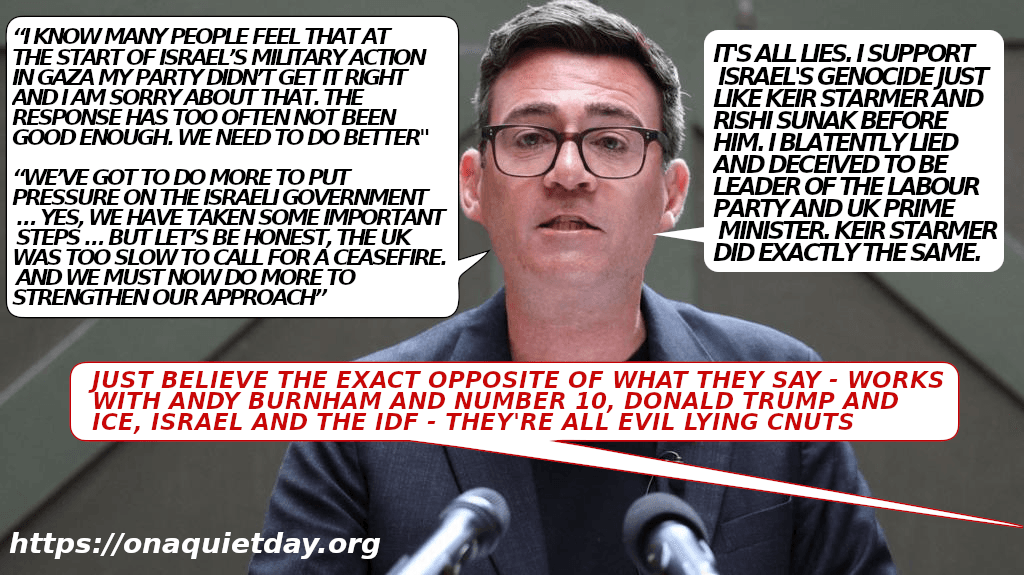
Keir Starmer objects to criticism of the IDF. He asks how could anyone object to them starving people to death, forced marches like the Nazis did, bombing Gaza’s hospitals and universities, mass-murdering journalists, healthworkers and starving people queuing for food, killing and raping prisoners and murdering children. He calls for people to stop obstructing his genocide for Israel. New Labour UK Prime Minister Andy Burnham continues Labour party policy of active support and complicity in Israel’s genocide.Ed Miliband says that he and the Labour Party are full of shit criminalising people holding signs as terrorists despite anything he says.UK Prime Minister Andy Burnham admits to blatently lying and engaging in deception to become leader of the UK Labour Party and Prime Minister.
A large group of Jewish and Muslim demonstrators carrying banners and Palestinian flags march from Bryant Park toward the United Nations headquarters to protest the policies of Israeli Prime Minister Benjamin Netanyahu and US President Donald Trump regarding the war in Gaza in New York, United States, on September 24, 2026. [Waleed Zein – Anadolu Agency]
In 1975, the United Nations General Assembly adopted Resolution 3379 declaring Zionism “a form of racism and racial discrimination.” Sixteen years later, the resolution was revoked in the political context surrounding the Madrid Peace Conference. Western politics subsequently behaved as though the argument itself had been buried. It had not. History did not end in 1991, and neither did the political question the resolution raised.
Today, that question has returned under circumstances far more devastating than those of 1975.
Apartheid is no longer a term confined to Palestinian activists or to the margins of political debate. Major international, Palestinian, and Israeli human-rights organisations, UN experts and scholars have documented a system of domination, segregation, dispossession, demographic engineering and unequal rights imposed on Palestinians.
Gaza has taken the argument into even darker territory. Genocide is no longer merely a warning about what could happen, but a conclusion reached by major human-rights organisations, UN experts and genocide scholars.
We therefore need to stop behaving as though the central political task is to prove, for the thousandth time, that Palestinians are subjected to systematic oppression. The evidence has been documented for decades. The more difficult question is what follows from it.
When I wrote about Zionist apartheid in 2013, even the terminology was largely excluded from mainstream Western political discourse. The argument was routinely dismissed before it could even be examined.
Today, the vocabulary has changed dramatically. Words that were once considered beyond the boundaries of respectable debate, apartheid, ethnic cleansing and genocide have moved into mainstream legal, academic and political discussion. But language alone changes nothing.
If we recognise apartheid while refusing to examine the political system that produces it, we have achieved little. If we condemn individual settlements while leaving untouched the ideology that makes settlement and demographic domination politically meaningful, we have avoided the central question. If we condemn individual military operations while refusing to confront the structure within which Palestinian life has been made permanently subordinate, we are describing consequences while protecting causes. That is no longer enough.
If apartheid is structural rather than an accidental deviation from Israeli politics; if dispossession, settlement, demographic engineering, unequal rights and the prevention of Palestinian return are enduring features rather than temporary policies; and if Gaza represents an extreme manifestation of a political order in which Palestinian existence can be subordinated to the maintenance of Zionist Jewish political and demographic supremacy, then the ideology through which that order was established and justified must itself be confronted. That ideology is Zionism.
Zionism is a modern political ideology and movement. Judaism is an ancient religion, culture and tradition stretching back thousands of years. The two cannot simply be collapsed into one another. Jewish religious attachment to Palestine is not Zionism. Jewish historical connection to the land is not Zionism. Jewish residence in Palestine is not Zionism. There are Jewish Zionists, Christian Zionists and secular Zionists, just as there are Jewish people who are non-Zionist and anti-Zionist. Zionism must therefore be examined for what it is: a political project.
The modern Zionist movement contained different ideological currents: socialist, liberal, religious, revisionist and others, and supporters of Zionism understand it in different ways, most commonly as a movement for Jewish national self-determination. But political ideologies are not judged by their self-description. They must be judged by the institutions they build, the relations of power they create and the consequences they produce for those subjected to them. The political question is therefore not what Zionism promises in the abstract, but what Zionism has meant in practice.
Who possesses the right to the land? Who can immigrate from anywhere in the world while people expelled from that same land and their descendants are prevented from returning? Who controls territory, borders and resources? Whose communities can expand and whose homes can be demolished? Whose demographic presence is protected as a political objective and whose demographic presence is discussed as a threat? Who possesses sovereignty, and who lives permanently under the sovereignty of others? These are not theological questions. They are questions of political power, and political power must be judged by its consequences.
This is why the question of racism cannot simply be declared illegitimate. If a political project requires the maintenance of political and demographic predominance for one group while another population is displaced, fragmented, prevented from returning and denied equal political power, then the relationship between that ideology and racism is not an antisemitic question. It is a political question, and it must be confronted politically.
For too long, much of Western politics has avoided that confrontation by reducing the problem to individual Israeli governments. Netanyahu becomes the problem. Ben-Gvir becomes the problem. Smotrich becomes the problem. A settlement becomes the problem. A military operation becomes the problem. An extremist minister becomes the problem. A particular government becomes the problem. Yet every time, the underlying structure survives.
Governments change. Coalitions change. Prime ministers change. The language changes. Yet Palestinian refugees remain unable to return. Settlements continue. Palestinian land continues to be fragmented. Different legal and political regimes continue to determine people’s rights according to identity and location. The fundamental struggle over land, sovereignty and demographic control remains. At some point, blaming only the most extreme administrators of a system becomes a way of avoiding the system itself.
The political challenge is therefore no longer simply to condemn the excesses. It is to confront the structure, and that requires confronting its ideological foundations.
This is why the decision of the Green Party of England and Wales in October 2026 matters. Its members voted by 1,022 to 813 to adopt an explicitly anti-Zionist policy, defining Zionism as an ethnonationalist political project and rejecting the proposition that anti-Zionism should automatically be equated with antisemitism.
Something politically important has happened: a major European political party has crossed a line that mainstream Western politics spent decades insisting could not be crossed. It has moved the discussion from Israeli policy to Zionism itself.
That matters because the argument can no longer credibly end with Netanyahu, the settlements or individual military operations. If the structures are permanent, their ideological foundations have to be examined as well.
Human beings have rights. Political ideologies do not. Every Jewish person has the right to live free from antisemitism, discrimination, dispossession, violence and hatred. Palestinians possess exactly the same human rights.
They have the right to live free from discrimination, dispossession, forced displacement, military domination, ethnic cleansing and genocide. There can be no serious universalism that passionately defends the rights of one people while treating the rights of another as permanently negotiable.
This is where the debate becomes larger than Zionism itself. It becomes a question about political responsibility. For decades, Western governments and political institutions have presented themselves as defenders of international law, human rights and a rules-based international order. Gaza has exposed the limits of those claims with extraordinary brutality. International law means very little if it applies only to enemies. Human rights mean very little if they are defended selectively. And “never again” means very little if it describes only crimes safely located in the past.
The purpose of historical memory cannot simply be to condemn yesterday’s atrocities after their victims have already been destroyed. Its purpose must also be to recognise the structures, language and political choices that make atrocities possible while they are happening. That requires taking sides, not between peoples, but between domination and equality.
There is a persistent idea in Western politics that refusing to take a position represents moderation. It does not. In situations of profound inequality, neutrality does not stand outside politics. It operates within existing relations of power. When one side possesses the state, the army, the borders, the resources and the ability to determine the rights and movement of another population, refusing to challenge that structure does not create balance. It leaves the structure intact.
There are moments when political ambiguity ceases to be caution and becomes complicity. This is one of them. Future generations will not primarily ask whether politicians used sufficiently careful language, whether institutions protected themselves from controversy or whether commentators maintained an appearance of neutrality. They will ask what people did when the destruction was visible, when the structures of domination were known and when the consequences of decades of dispossession could no longer be denied. They will ask who defended the system, who challenged it and who remained silent.
History has asked these questions before. It is asking them again.
The debate over Zionism is therefore not an academic exercise and it is not merely an argument about terminology. It is a political struggle over whether a system that privileges one people while dispossessing and dominating another can continue to claim legitimacy. No political ideology, whether nationalism, colonialism, religious fundamentalism or Zionism is entitled to protection from judgment simply because questioning it has become politically uncomfortable.
The question before political parties, civil-society organisations, universities and governments is increasingly simple: if you recognise apartheid, if you recognise dispossession, and if you recognise genocide, are you willing to confront the political ideology and structures that made them possible?
The views expressed in this article belong to the author and do not necessarily reflect the editorial policy of Middle East Monitor.
This work by Middle East Monitor is licensed under a Creative Commons Attribution-NonCommercial-ShareAlike 4.0 International License.
UK Prime Minister Andy Burnham admits to blatently lying and engaging in deception to become leader of the UK Labour Party and Prime Minister.Ed Miliband says that he and the Labour Party are full of shit criminalising people holding signs as terrorists despite anything he says.
This work by Middle East Monitor is licensed under a Creative Commons Attribution-NonCommercial-ShareAlike 4.0 International License.
Zack Polanski, UK Green Party leader. [Photo/AA]
Israeli Foreign Minister Gideon Sa’ar on Sunday decided to bar British Green Party leader Zack Polanski from entering Israel, in response to his party adopting a resolution declaring Zionism a form of racism.
The Israeli Foreign Ministry said in a statement on X that Sa’ar had decided “to declare Green Party leader Zack Polanski barred from entering Israel” after his party adopted the resolution, adding that the decision was made in coordination with the relevant Israeli authorities.
Earlier on Sunday, the Green Party adopted the resolution at its conference in Brighton, with 56 per cent voting in favour and 44 per cent against, describing Zionism as a “racist ideology”.
With the adoption of the motion, describing Zionism as a “racist movement” became part of the party’s official policy.
According to the BBC, the resolution calls for a single Palestinian state across all of historic Palestine, where everyone, including Jews, would have equal rights, with no reference to Israel continuing as a separate state or to a two-state solution.
“Today, the Green Party in Britain adopted a resolution equating Zionism with racism, legitimising armed struggle against Israel, and calling for the establishment of a Palestinian state “from the river to the sea” – meaning the destruction of the State of Israel,” the Israeli Foreign Ministry said.
It also claimed that “the resolution constitutes a clear antisemitic text according to the IHRA definition, as it denies the Jewish people’s right to self-determination.”
Ed Miliband says that he and the Labour Party are full of shit criminalising people holding signs as terrorists despite anything he says.UK Prime Minister Andy Burnham admits to blatently lying and engaging in deception to become leader of the UK Labour Party and Prime Minister.
A B-1 bomber at R.A.F. Fairford in Britain taking off on Sunday. All 12 B-1s were moved from the base in a highly unusual withdrawal.Credit…David Bown/Getty Images
The withdrawal came with unusual speed, following what U.S. officials said were threats of an Iran-based plot against the installation.
The United States rushed over the weekend to withdraw all 12 B-1 Air Force bombers from an air base in southern England after commanders received new threats about an Iran-backed plot against the installation, two U.S. officials said on Sunday.
The withdrawal was highly unusual: Such moves are rarely made so quickly from an allied air base in a peacetime country thousands of miles from a combat zone.
The need to move the bombers out of the base, R.A.F. Fairford, was deemed so urgent that some of the planes and their flight crews left while aerial refueling aircraft were still being scrambled to support their flights to the United States. At least three of the planes had landed at their home base in South Dakota by Sunday, the officials said, speaking on the condition of anonymity to discuss operational matters.
The Pentagon’s European Command confirmed on Sunday that the bombers had left England but declined to comment on any new warnings.
dizzy: I linked to this US article because the UK media is omitting the urgency with which the planes were removed [ed: and] is strongly speculating that it is related to or caused by security concerns following a security incident or scare at RAF Fairford.
It’s speculation and it would be equually valid to speculate that it was decided to abruptly terminate US-Israel’s war on Iran ahead of the Midterm elections at the defence chief’s meeting or that there was an assessment concluding that majority opinion in UK has turned against US/UK’s Zionist support of genocide and neo-colonialism and that as a consequence the aircraft were at risk. We need to see what happens next.
[23.58 The security incident is so concocted that it should be dismissed as fake news. I would expect that Donald Trump is unable to discern that as a consequence of his condition. It’s also unlikely that he has any real power for the same reason.]

 Israeli soldiers take positions during a military raid at a market in Nablus, occupied-West Bank, September 27, 2026