Stocks of food at the Trussell Trust Brent Foodbank, Neasden, London
A COALITION of 120 children’s charities today called for the complete eradication of child poverty in 20 years, increasing pressure for government to scrap the two-child benefit cap.
The End Child Poverty Coalition set out eight tests it said should be met by the government’s taskforce strategy if it is to succeed in tackling and ending child poverty.
Among them was that government must ultimately aim to halve child poverty in the next 10 years, and completely eradicate it in the next 20.
The coalition also said the two-child limit to benefit payments must be scrapped, estimating this could immediately lift around 300,000 children out of poverty, and that “further fundamental reform” to the social security system is needed.
…
End Child Poverty Coalition chair Joseph Howes said: “Child poverty is a blight on our society and is also completely avoidable.
“If the government is serious about tackling and ultimately eradicating child poverty in this country, it needs to be bold and ambitious in its investments, including immediately scrapping the two-child limit to benefit payments.
The temperature control of a radiator in a domestic home
DEMANDS for more energy support for vulnerable households intensified today as temperatures are expected to plummet this week.
Some areas rose above 16°C on Sunday, but the Met Office forecast a sharp drop by last night, with temperatures potentially plunging to -8°C in parts of Scotland.
Meteorologists warned that the cold spell would continue tomorrow, with parts of England becoming as chilly as -3°C.
The cold snap comes just over a month after energy regulator raised the price cap by 10 per cent, while 6.5 million households remain trapped in fuel poverty.
Peter Smith of National Energy Action said: “Millions of people will endure these freezing conditions at the same time as unaffordable energy bills and unmanageable energy debt.
“At this exceptionally difficult time for vulnerable households, we see a desperate need for a larger energy discount or a new social tariff to provide long-term protection.
WELFARE AUSTERITY: (L to R) Secretary of State for Work and Pensions Liz Kendall; Keir Starmer
DIANE ABBOTT MP condemns the government’s vicious attack on benefits that callously denies the pandemic’s impact on the working class while pushing vulnerable people into unsuitable work through punitive measures
THERE is now overwhelming evidence that the government is reimposing austerity measures. This is true in relation to income tax, public spending after next year, higher energy bills, bus fares and other prices determined by government.
But perhaps one of the most misunderstood aspects of austerity has been the planned cuts to the welfare bill.
Yet Keir Starmer, Liz Kendall and a host of other ministers have done their best to dispel any complacency on this issue. People who are on welfare, for whatever reason, are in the government’s firing line.
Their attack has two prongs. The first is that there is a blanket assertion that the welfare bill is “too high” and the second is that they will crack down on benefit fraud. Deliberately or otherwise, it is clear that these two issues are closely connected.
Promising “radical reforms to get Britain working,” in a recent article, Starmer went on to say, “In the coming months, Mail on Sunday readers will see even more sweeping changes. Because make no mistake, we will get to grips with the bulging benefits bill blighting our society.”
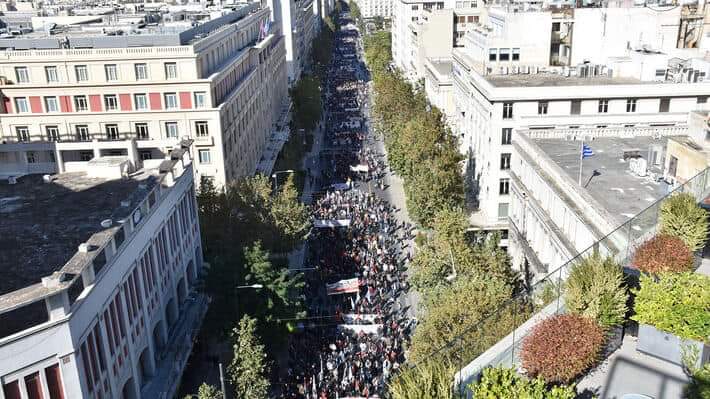
Thousands of people across Greece joined a general strike and mass protests, demanding action against high living expenses, restrictions on union organizing, and excessive military spending
Greece was brought to a halt on Wednesday, November 20, as a 24-hour general strike brought workers from across sectors—including education, logistics, construction, public transportation, and health—to the streets of dozens of cities. The mass mobilization, which began early in the morning, followed a media strike on Tuesday that included both public and private outlets.
The striking workers demanded the repeal of anti-worker laws, including measures that extended working hours, and called for wage restoration. Over the past decade, successive governments, most recently led by Prime Minister Kyriakos Mitsotakis, have implemented austerity policies under pressure from the European Union and international financial institutions. These policies have led to drastic income reductions, with wages remaining about 14% lower than in 2011, according to trade unions.
Protesters warned that current conditions mean they cannot lead dignified lives. With a minimum wage of approximately 900 euros, they face housing and food costs comparable to those in European countries with higher income. While the government has boasted about recent improvements in unemployment rates, unions highlighted that these figures mask the economy’s heavy reliance on tourism and fail to account for poor working conditions.
Greek unions emphasized that anti-worker legislation has persisted for over a decade, including wage cuts and freezes, extended working hours, and severe restrictions on collective bargaining. These policies have left only a small fraction of workers benefiting from collective agreements. “At the same time, they are further commodifying the functioning of critical sectors such as health, education, energy, water, transport, social security, infrastructure and civil protection services for natural disasters,” stated the All Workers Militant Front (PAME) ahead of the strike. In response, unions demanded guarantees of universal, public, and free education and healthcare, alongside accessible housing solutions.
The push to privatize and commodify basic rights highlights how successive administrations have prioritized fiscal targets over people’s interests. This has led to a situation where financial organizations commend Greece’s economic recovery, while the working class continues to face systemic denial of basic rights. On top of that, Greece has allocated millions of euros to military spending through NATO—a decision that has become a significant point of contention for trade unions.
“We do not accept our basic and daily needs to be sacrificed to give billions to NATO armaments, for missiles, frigates, war planes,” PAME stated. Hundreds of thousands of euros have been allocated for the frigate in the Red Sea—”money that is equivalent to the annual budget of a hospital”—the workers’ organization concluded.
Marches on November 20 highlighted international solidarity as opposed to war and militarization. Palestinian flags were prominently displayed at the rallies, reflecting the longstanding support of Greek workers for the people of Gaza and other occupied territories. Trade unions called for an immediate end to the Israeli genocide against Palestinian and Lebanese people. This message resonated with the general strike’s motto: “Out of the war slaughterhouses; fund wages, health, and education instead.”
“The large participation in the strike and rallies demonstrates the workers’ strong opposition to the government’s anti-people policies and its alignment with business interests,” PAME stated on the day of the strike. The organization reaffirmed its commitment to continue with the mobilizations, aiming to pressure the government to shift its priorities toward addressing workers’ rights and peace.
The DWP confirms that draconian ‘savings’ are coming down the track. Are we a nation that will repair hospitals, but not help a nurse with long Covid?
In the days after the budget, the headlines were dominated by talk of Rachel Reeves’s “tax and spend” bonanza. The message was clear: austerity is officially over. When there was concern about squeezed incomes, it was solely for workers. As the Mail front page put it: “Reeves’ £40bn tax bombshell for Britain’s strivers”. Almost a week later, there has still barely been a word about the policy set to hit the group long scapegoated as Britain’s skivers: the billions of pounds’ worth of benefit cuts for disabled people.
Making up just a couple of lines in a 77-minute speech, you’d have been forgiven for dozing past Reeves’ blink-and-you’d-miss-it bombshell. With a record number of Britons off work with long-term illness, the government will need to “reduce the benefits bill”, she said, before noting ministers had “inherited” the Conservatives’ plans to reform the work capability assessment (WCA). That plan, let’s not forget, was to take up to £4,900 a year each from 450,000 people who are too sick or disabled to work – a move that the Resolution Foundation says would “degrade living standards” for families already on some of the lowest incomes in the country.
…
Much like when George Osborne aimed to cut the disability benefits bill by a fifth, “welfare reform” based on arbitrary cost-cutting says the quiet part out loud: benefits won’t be awarded based on who needs them – just on what they cost. It is social security by spreadsheet, severing the social contract that promises the state will be there in times of sickness and disability, and adding a footnote that says, “but only if we can afford it”. That last week’s budget revealed huge investment for infrastructure at the same time as disability benefit cuts exposes how even the affordability argument is largely fabricated. There is money to fix hospital buildings but not to feed a nurse bedbound with long Covid.
The financial impact of such “reform” on those relying on benefits is well established but the psychological toll should not be underestimated. Since gaining power, Labour has drip-fed the rightwing press sound bites and op-eds on potential benefit cuts, leaving news outlets to speculate wildly for clicks. The budget’s half-announcement has only added to the confusion and fear, issuing vague dog whistles of “fraud” and high “benefit bills” while forcing millions of people to wait months to find out if they will lose the money they need to live.