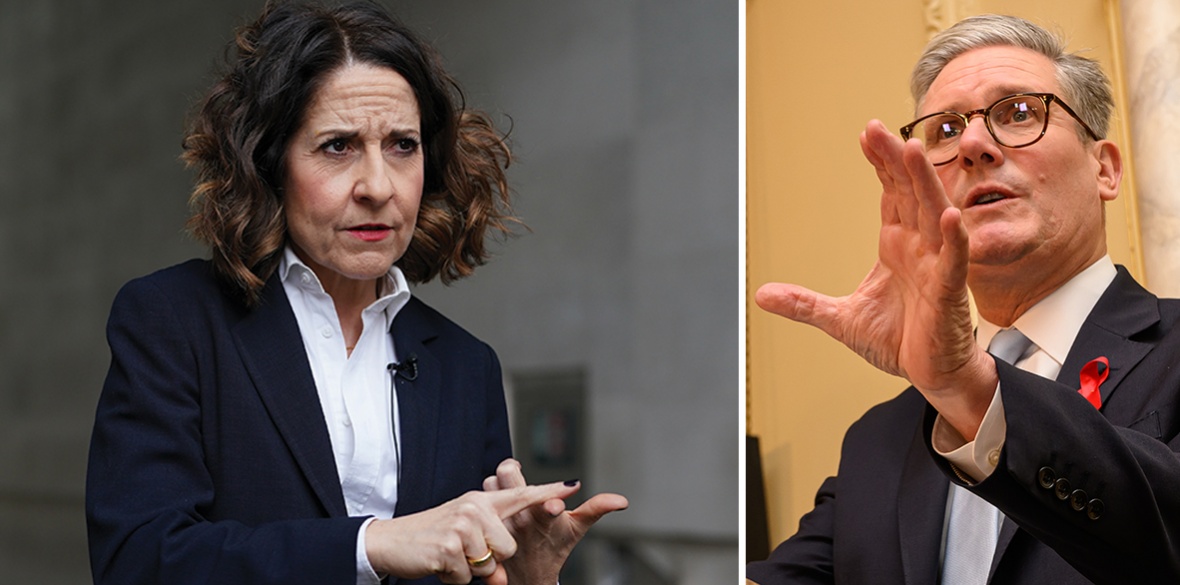
WELFARE AUSTERITY: (L to R) Secretary of State for Work and Pensions Liz Kendall; Keir Starmer
DIANE ABBOTT MP condemns the government’s vicious attack on benefits that callously denies the pandemic’s impact on the working class while pushing vulnerable people into unsuitable work through punitive measures
THERE is now overwhelming evidence that the government is reimposing austerity measures. This is true in relation to income tax, public spending after next year, higher energy bills, bus fares and other prices determined by government.
But perhaps one of the most misunderstood aspects of austerity has been the planned cuts to the welfare bill.
Yet Keir Starmer, Liz Kendall and a host of other ministers have done their best to dispel any complacency on this issue. People who are on welfare, for whatever reason, are in the government’s firing line.
Their attack has two prongs. The first is that there is a blanket assertion that the welfare bill is “too high” and the second is that they will crack down on benefit fraud. Deliberately or otherwise, it is clear that these two issues are closely connected.
Promising “radical reforms to get Britain working,” in a recent article, Starmer went on to say, “In the coming months, Mail on Sunday readers will see even more sweeping changes. Because make no mistake, we will get to grips with the bulging benefits bill blighting our society.”
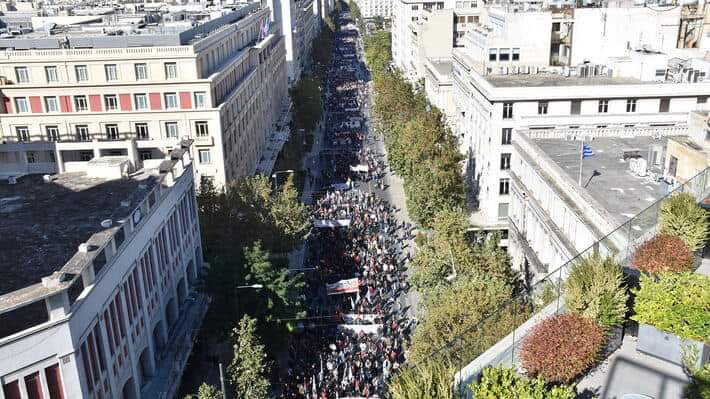
Thousands of people across Greece joined a general strike and mass protests, demanding action against high living expenses, restrictions on union organizing, and excessive military spending
Greece was brought to a halt on Wednesday, November 20, as a 24-hour general strike brought workers from across sectors—including education, logistics, construction, public transportation, and health—to the streets of dozens of cities. The mass mobilization, which began early in the morning, followed a media strike on Tuesday that included both public and private outlets.
The striking workers demanded the repeal of anti-worker laws, including measures that extended working hours, and called for wage restoration. Over the past decade, successive governments, most recently led by Prime Minister Kyriakos Mitsotakis, have implemented austerity policies under pressure from the European Union and international financial institutions. These policies have led to drastic income reductions, with wages remaining about 14% lower than in 2011, according to trade unions.
Protesters warned that current conditions mean they cannot lead dignified lives. With a minimum wage of approximately 900 euros, they face housing and food costs comparable to those in European countries with higher income. While the government has boasted about recent improvements in unemployment rates, unions highlighted that these figures mask the economy’s heavy reliance on tourism and fail to account for poor working conditions.
Greek unions emphasized that anti-worker legislation has persisted for over a decade, including wage cuts and freezes, extended working hours, and severe restrictions on collective bargaining. These policies have left only a small fraction of workers benefiting from collective agreements. “At the same time, they are further commodifying the functioning of critical sectors such as health, education, energy, water, transport, social security, infrastructure and civil protection services for natural disasters,” stated the All Workers Militant Front (PAME) ahead of the strike. In response, unions demanded guarantees of universal, public, and free education and healthcare, alongside accessible housing solutions.
The push to privatize and commodify basic rights highlights how successive administrations have prioritized fiscal targets over people’s interests. This has led to a situation where financial organizations commend Greece’s economic recovery, while the working class continues to face systemic denial of basic rights. On top of that, Greece has allocated millions of euros to military spending through NATO—a decision that has become a significant point of contention for trade unions.
“We do not accept our basic and daily needs to be sacrificed to give billions to NATO armaments, for missiles, frigates, war planes,” PAME stated. Hundreds of thousands of euros have been allocated for the frigate in the Red Sea—”money that is equivalent to the annual budget of a hospital”—the workers’ organization concluded.
Marches on November 20 highlighted international solidarity as opposed to war and militarization. Palestinian flags were prominently displayed at the rallies, reflecting the longstanding support of Greek workers for the people of Gaza and other occupied territories. Trade unions called for an immediate end to the Israeli genocide against Palestinian and Lebanese people. This message resonated with the general strike’s motto: “Out of the war slaughterhouses; fund wages, health, and education instead.”
“The large participation in the strike and rallies demonstrates the workers’ strong opposition to the government’s anti-people policies and its alignment with business interests,” PAME stated on the day of the strike. The organization reaffirmed its commitment to continue with the mobilizations, aiming to pressure the government to shift its priorities toward addressing workers’ rights and peace.
The DWP confirms that draconian ‘savings’ are coming down the track. Are we a nation that will repair hospitals, but not help a nurse with long Covid?
In the days after the budget, the headlines were dominated by talk of Rachel Reeves’s “tax and spend” bonanza. The message was clear: austerity is officially over. When there was concern about squeezed incomes, it was solely for workers. As the Mail front page put it: “Reeves’ £40bn tax bombshell for Britain’s strivers”. Almost a week later, there has still barely been a word about the policy set to hit the group long scapegoated as Britain’s skivers: the billions of pounds’ worth of benefit cuts for disabled people.
Making up just a couple of lines in a 77-minute speech, you’d have been forgiven for dozing past Reeves’ blink-and-you’d-miss-it bombshell. With a record number of Britons off work with long-term illness, the government will need to “reduce the benefits bill”, she said, before noting ministers had “inherited” the Conservatives’ plans to reform the work capability assessment (WCA). That plan, let’s not forget, was to take up to £4,900 a year each from 450,000 people who are too sick or disabled to work – a move that the Resolution Foundation says would “degrade living standards” for families already on some of the lowest incomes in the country.
…
Much like when George Osborne aimed to cut the disability benefits bill by a fifth, “welfare reform” based on arbitrary cost-cutting says the quiet part out loud: benefits won’t be awarded based on who needs them – just on what they cost. It is social security by spreadsheet, severing the social contract that promises the state will be there in times of sickness and disability, and adding a footnote that says, “but only if we can afford it”. That last week’s budget revealed huge investment for infrastructure at the same time as disability benefit cuts exposes how even the affordability argument is largely fabricated. There is money to fix hospital buildings but not to feed a nurse bedbound with long Covid.
The financial impact of such “reform” on those relying on benefits is well established but the psychological toll should not be underestimated. Since gaining power, Labour has drip-fed the rightwing press sound bites and op-eds on potential benefit cuts, leaving news outlets to speculate wildly for clicks. The budget’s half-announcement has only added to the confusion and fear, issuing vague dog whistles of “fraud” and high “benefit bills” while forcing millions of people to wait months to find out if they will lose the money they need to live.
Jeremy Corbyn, MPs and politicians from the Green party, Plaid Cymru and others respond to the budget.
Labour’s first budget punishes the “working people” they claim to support. Keir Starmer and Rachel Reeves promised to deliver real change to the electorate, after 14 years of Tory rule. This week, they have broken that promise. This budget is austerity by another name.
While we welcome the government’s decision to invest in school and hospital buildings, it is extremely disappointing that these investments have been undermined by a swathe of public sector cuts, cruel attacks on the worst off, and a dogmatic refusal to redistribute wealth and power. These are not “tough choices” for government ministers, but for ordinary people who are forced to choose between heating their home and putting food on the table.
Labour is raising defence expenditure to 2.5% of GDP while telling us there is no money to lift 250,000 children out of poverty. This is a lie. There is plenty of money – it’s just in the wrong hands. The richest 1% in the UK hold more wealth than 70% of Britons. By refusing to impose a wealth tax, this government has chosen to force vulnerable communities to pay the price for years of economic failure, instead of making the richest pay their fair share. Labour’s first budget shows us whose side they’re on.
Years of austerity and privatisation have decimated our public services and pushed millions into poverty, disproportionately impacting women, people of colour and disabled people. Making millions of children, working, retired and disabled people poorer damages our entire economy and stretches our public services. An austerity economy is a false economy.
We, along with nearly 100 progressive Independent and Green politicians across the country, are calling on the Labour government to:1) introduce wealth taxes; 2) abolish the two-child benefit cap and stop attacking welfare recipients; 3) reverse cuts to winter fuel; 4) restore the £2 bus cap; and 5) invest in a Green New Deal.
We refuse to believe that child poverty, mass hunger and homelessness are inevitable in the sixth largest economy in the world. A progressive movement is growing up and down the country, demanding a real alternative to this race to the bottom between Labour and the Tories, which has seen the new government perpetuate decades of austerity and rampant corporate greed.
The Tories’ collapse allowed Labour to come to power with the lowest vote share ever won by any single-party majority government. Labour haemorrhaging votes to progressive independents and Greens in their heartlands should be a lesson to this government: you are wrong to believe that progressive voters have nowhere else to go. Our movement is growing every day – and you ignore the demand for a real alternative at your peril.
Jeremy Corbyn MP Independent,Carla Denyer MPGreen partyco-leader, Adrian Ramsay MP Green party co-leader, Sian Berry MP Green party, Ben Lake MPPlaid Cymru,Ann Davies MP Plaid Cymru, Liz Saville Roberts MP Plaid Cymru, Llinos Medi MP Plaid Cymru,Zack Polanski Green party deputy leader and London assembly member , Leanne Mohamad Independent candidate for Ilford North, Jamie Driscoll Former North of Tyne mayor, Andrew Feinstein Former ANC MPand Independent candidate for Holborn and St Pancras, Leanne WoodFormer leader, Plaid Cymru, Beth Winter Former Labour MPfor Cynon Valley, Hilary SchanChair, We Deserve Betterand Independent councillor in Worthing, Anthony SlaughterWales Green partyleader
This blog has previously experienced copyright take down notices. I am republishing this letter in full on the basis that the original authors have and retain rights of copyright and that they have indicated that they wanted it published by submitting it to the Guardian newspaper.
Keir Starmer, Angela Rayner and Rachel Reeves wear the uniform of the rich and powerful. They have all had clothes bought for them by multi-millionaire Labour donor Lord Alli. CORRECTION: It appears that Rachel Reeves clothing was provided by Juliet Rosenfeld.
Keir Starmer says pensioners can freeze to death and poor children can starve and be condemned to failure and misery all their lives.
…
So-called austerity is best understood as a massive transfer of wealth — from public to private, from the many to the few, as the fortunes of the super-rich ballooned while Britain endured the longest wage squeeze since the Napoleonic wars.
This is a grotesquely unequal country in which big banks and energy giants post the largest profits in their history, in which the richest 1 per cent own more than the poorer 70 per cent of the population put together, in which millions rely on foodbanks while the number of billionaires increased by a fifth during the Covid crisis alone.
When Reeves gives with one hand and takes away with the other — as PCS leader Fran Heathcote notes she does by offering a 1.7 per cent increase in departmental spending, while setting a 2 per cent savings target for those same departments — she cites pressure on the public finances that could be relieved easily through higher corporation tax, a financial transactions tax or a wealth tax. As Unite’s Sharon Graham notes, a 1 per cent tax on the richest 1 per cent would raise £25 billion, filling the so-called “black hole” in the budget at a stroke.
It is a choice to echo Tory hysteria over benefit fraud, when the amount lost to this is less than goes unclaimed in social security payments people are entitled to. Giving the Department for Work & Pensions power to remove money directly from bank accounts will likely increase non-take-up of benefits by people who need them but understandably fear their personal finances being exposed in this way.
And it’s a choice to hike the cost of a bus ticket by 50 per cent while maintaining a fuel duty freeze — when governments across Europe are making public transport cheaper because it is essential to reduce greenhouse gas emissions.