Category: Climate Crisis

  • Investigating the so-called ‘windfall tax’

    Spread the love
    Rishi Sunak offers huge fossil fuel subsidies to develop fossil fuel extraction in UK.
    Rishi Sunak offers huge fossil fuel subsidies to develop fossil fuel extraction in UK.

    Rishi Sunak awards a huge tax break to further destroy the climate.

    It’s called a windfall tax – it’s a further windfall for fossil fuel companies on top of their windfall of higher prices following the invasion of Ukraine.

    https://neweconomics.org/2023/11/the-windfall-tax-was-supposed-to-rein-in-fossil-fuel-profits-instead-it-has-saved-corporations-billions#:~:text=The%20levy%20raised%20the%20effective,to%2075%25%20in%20November%202022.

    …

    Back in May 2022, the UK government announced the energy profits levy, as a response to the growing pressure for a ​‘windfall tax’ on the massive profits being generated by companies pumping oil and gas in the North Sea. These profits were fuelled by skyrocketing fossil fuel prices in the wake of the Russian invasion of Ukraine. The levy raised the effective rate of corporation tax paid on oil and gas profits from 40% to 65%, and again to 75% in November 2022.

    But, it came with a caveat. Despite the UK’s urgent need to kick its addiction to expensive fossil fuels, this government didn’t want to discourage investment in more oil and gas extraction. So they included a tax loophole to ensure that companies investing in new projects to pump fossil fuels out from under the North Sea would see their tax relief (already generous by most standards) rise to 91%. In other words, fossil fuel companies could deduct 91% of their capital investment costs from their corporation tax bill. The ​‘windfall tax’ may have, on the surface, attempted to tackle the grotesque profits being raked in by massive companies in the midst of the cost of living crisis – but it also made it cheaper for these companies to extract the fossil fuels contributing to the sky-high cost of living in the first place.

    At NEF, we analysed last week’s new OBR data, and found that the loophole included in the energy profits levy has massively increased the amount of tax relief which fossil fuel companies will potentially receive. We estimate that oil and gas extractors could receive up to £18.1bn in tax relief between 2023 and 2026. That’s a massive increase of £10.5bn, or 136%, from the £7.6bn they were expected to receive before the energy crisis. This is an enormous amount of lost revenue that could go to the government to be spent on lowering our energy bills or improving our public services. The OBR expects the UK oil and gas industry to pay £24.3bn in tax between 2024 and 2027, meaning that closing the tax loophole in the energy profits levy could almost double the amount of tax revenue our government could receive – and the businesses in question would still walk away with billions.

    …

    Even if you accept the government’s warped logic, which seeks to encourage greater North Sea extraction, the policy appears to be failing. While total potential for tax relief has risen by £10.5bn, total forecast investment has risen by just £3.4bn. This would represent an abysmal return on a government tax measure. Relief has largely been extended to investments which were expected to occur anyway, suggesting the policy is (intentionally or not) little more than a vehicle for oil and gas companies to keep most of their explosive profit growth, while the windfall tax sustains an illusion of fairness.

    The energy profits levy helped pay for the government’s emergency cost of living support measures – in theory. But our energy bills remain extortionate, costing 50% more than they did in early 2022, prior to the Russian invasion of Ukraine. With the poorest households over £200 a week short of the amount they need for an acceptable standard of living, this government has still not provided enough support. Looking forward, removing the perverse tax reliefs extended to the oil and gas industry could free up almost £13bn of tax revenue between 2024 and 2026: enough to give every household in the country three £150 annual payments to help cover their energy costs.

    …

    It’s reasonable to compare the so-called windfall tax to Norway’s windfall tax since they are both taxing fossil fuel activities in the North Sea. The Uk’s Labour party has repeatedly said that it intends to impose a “proper windfall tax”. There was further brief mentions of this during the Labour Party’s reformulation and massive restriction of it’s green policies yesterday 8th February 2024 but it remains unclear what is intended.

    What’s obviously clear is that Norway’s windfall tax has made and continues to raise huge sums for Norway. There is still a disguised fossil fuel subsidy for exploration and extraction – from what I can see it appears to be 78%. That’s a long way from Sunak’s 91% and since we’re dealing with vast sums of money, 91 – 78 = 13% of vast sums of money is still vast sums of money (as any Chancellor should realise).

    https://blogg.pwc.no/skattebloggen-en/the-norwegian-petroleum-tax-system#:~:text=The%20special%20tax%20is%20a,effect%20from%201%20January%202022.

    …

    Example:

    Investment in an offshore operating asset in Year 1 is 100.

    In the ordinary tax base (22%), 100 must be capitalized and depreciated linearly over 6 years. The depreciation in Year 1 is 100 / 6 = 16.7, i.e., a deduction of 16.7. This results in a tax amount in Year 1 of -16.7 * 22% = -3.7. 

    In the special tax base (56%), the entire amount of 100 can be deducted directly. The special tax base will therefore initially be -100. However, we must deduct the tax amount from the ordinary tax base of -3.7 from the -100. The special tax base will thus be -100 – (-3.7) = -96.3. To calculate the special tax amount, we must use the technical special tax rate of 71.8%. The special tax will thus be -96.3 * 71.8% = -69.3.

    Hence, total tax on the investment of 100 in the offshore operating asset in Year 1 is 

    -3.7 + (-69.3) = -73, i.e., a tax deduction of 73.

    In Years 2 – 6, the linear depreciation continues in the ordinary tax base. For each of these years, the tax on the investment of 100 in Year 1 is thus -3.7 in the ordinary tax base. At the same time, this tax is treated as “income” in the calculation of special tax, as the amount must be deducted in the special tax base. The special tax will thus be 3.7 * 71.8 = 2.7 in each of the years. Total tax per year will therefore be -3.7 + 2.7 = -1. 

    Looking at the entire period Year 1 – Year 6 as a whole, the total nominal tax for the investment of 100 in Year 1 is the sum of -73 in Year 1 and -1 for each of Years 2 – 6 (5 years), i.e., -73 + (-5) = -78, resulting in a total deduction of 78 over the period.

    …

    https://www.globalwitness.org/en/press-releases/despite-windfall-tax-and-record-profits-shell-paid-just-15-million-to-uk-22p-per-brit-last-year/

    …

    Despite windfall tax and record profits, Shell paid just £15 million to UK, 22p per Brit last year

    By comparison Norway received £6.3 billion from Shell, over a grand per Norwegian

    28th March 2023, London – Energy giant Shell paid just £15 million in taxes and fees to the UK last year on their drilling, compared to over £6.3 billion to the Norwegian government over the same period, according to Global Witness analysis of Shell’s latest tax reporting, released today.   

    This means Shell paid around just 22p per UK citizen, compared to the £1,171 it paid for every citizen of Norway. This £15 million is much closer to the £9.7 million it awarded its CEO in 2022, than the considerably more it paid to most other countries in which it drills.

    The UK ranks 19th out of 25 countries for taxes received by Shell last year, with the likes of the USA, Germany, Qatar and Italy all receiving far more from Shell than the UK. It comes despite the introduction of a UK windfall tax that Rishi Sunak, as Chancellor, described as a “significant set of interventions”.

    …
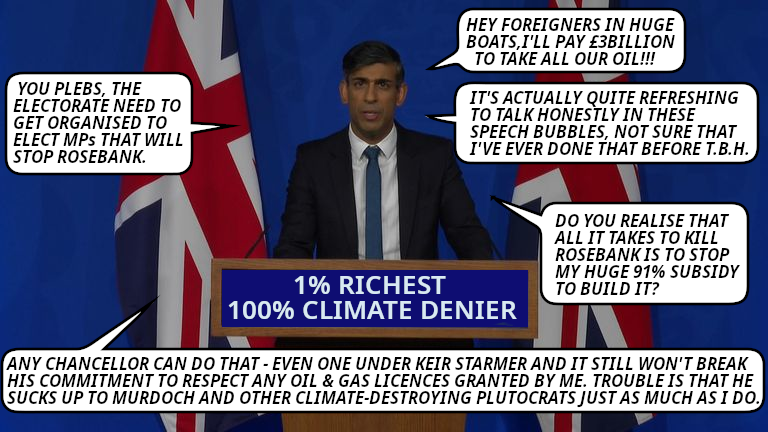
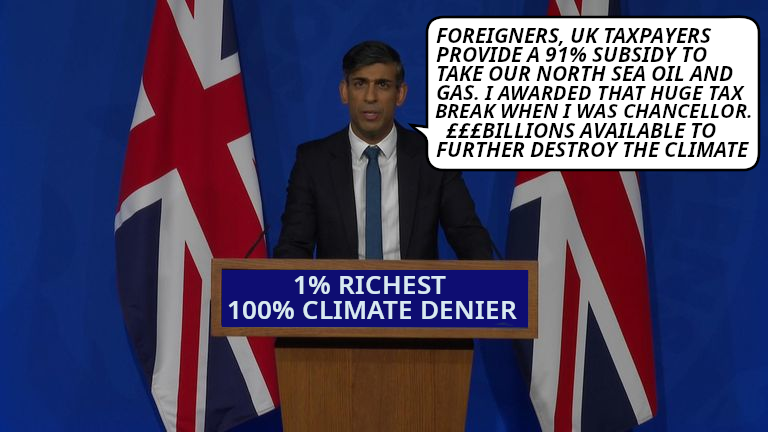
    Rishi Sunak on stopping Rosebank says that any chancellor can stop his huge 91% subsidy to build Rosebank, that Keir Starmer is as bad as him for sucking up to Murdoch and other plutocrats and that we (the plebs) need to get organised to elect MPs that will stop Rosebank.
    Rishi Sunak on stopping Rosebank says that any chancellor can stop his huge 91% subsidy to build Rosebank, that Keir Starmer is as bad as him for sucking up to Murdoch and other plutocrats and that we (the plebs) need to get organised to elect MPs that will stop Rosebank. [3rd version of image has same text].
  • Greenpeace activists scale Unilever HQ in plastic pollution protest

    Spread the love

    https://morningstaronline.co.uk/article/greenpeace-activists-scale-unilever-hq-plastic-pollution-protest

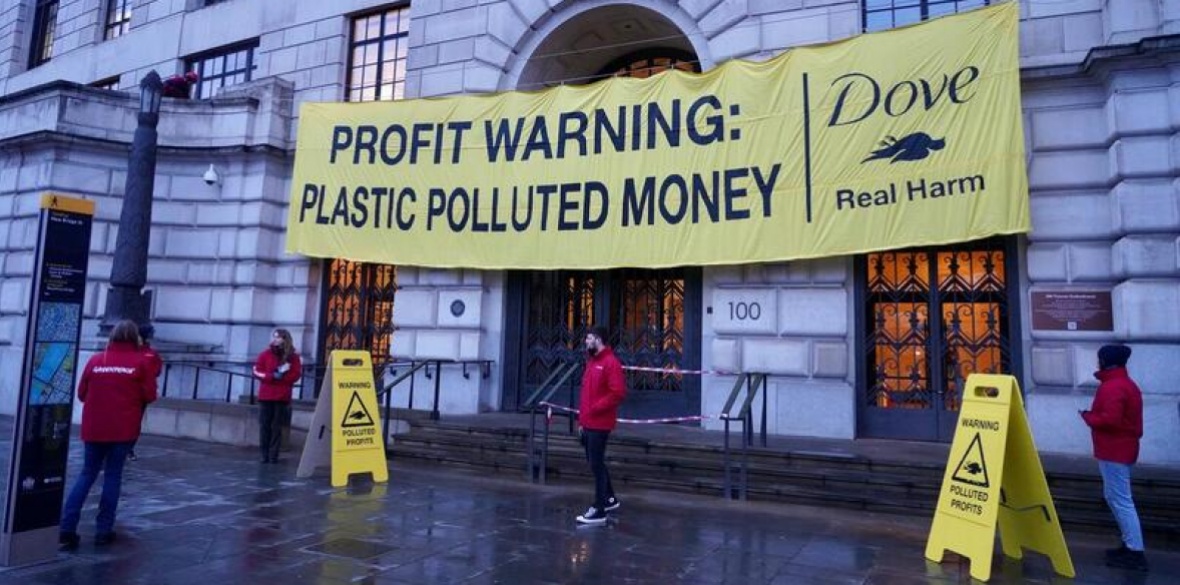
    Greenpeace UK scale the company’s HQ by Blackfriars Bridge in London and unveil a huge banner reading PROFIT WARNING – Plastic Polluted Money Photo: © Kristian Buus / Greenpeace

    GREENPEACE activists scaled Unilever’s London headquarters on the eve of its profit announcement today.

    The activists unfurled a banner reading “Profit Warning — Plastic Polluted Money” in protest against the company’s destructive use of environmentally harmful packaging.

    The protesters then set up a pollution warning zone around the entrance to the headquarters, warning passers-by about the company’s overwhelming plastic pollution problem.

    A previous Greenpeace investigation revealed the consumer goods giant as the biggest seller of some of the worst polluting packaging, multilayered plastic sachets. According to the report, Unilever sells 1,700 sachets every second.

    The sachets are typically used to package products such as soap, shampoo and laundry detergent, and are virtually impossible to recycle.

    Greenpeace say they exacerbate devastating floods when they enter the environment as they jam local waste systems and waterways.

    …

    https://morningstaronline.co.uk/article/greenpeace-activists-scale-unilever-hq-plastic-pollution-protest

  • World ‘not prepared’ for climate disasters after warmest ever January

    Spread the love
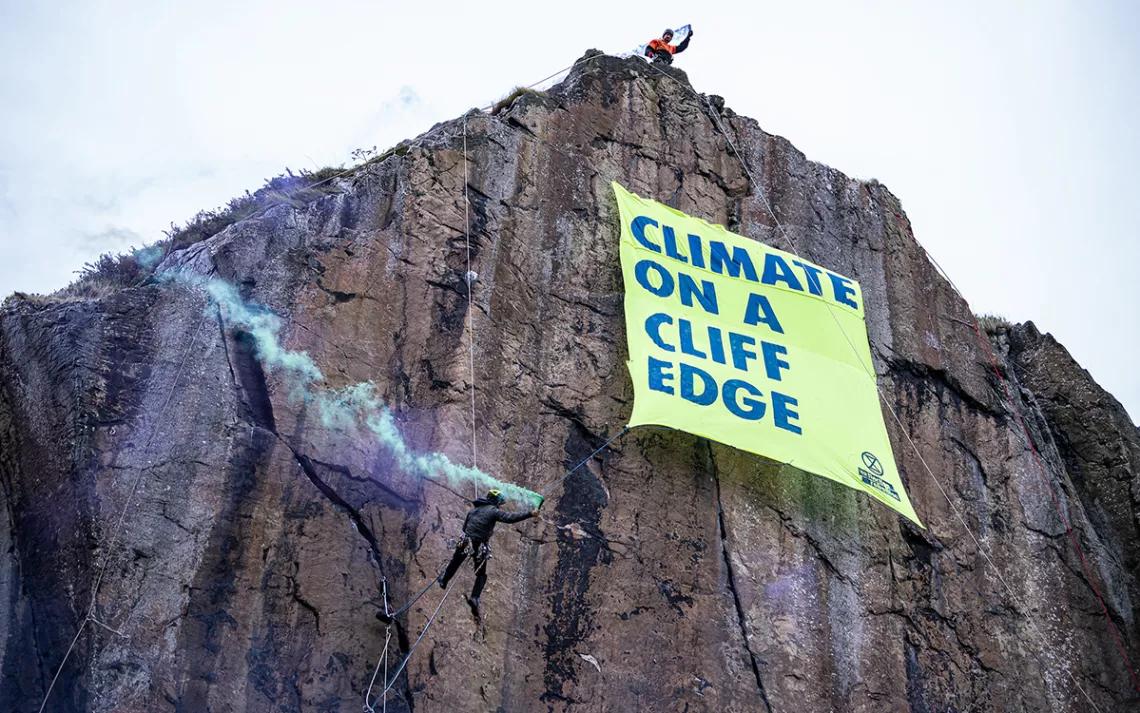
    Experienced climbers scale a rock face near the historic Dumbarton castle in Glasgow, releasing a banner that reads “Climate on a Cliff Edge.” One activist, dressed as a globe, symbolically looms near the edge, while another plays the bagpipes on the shores below. | Photo courtesy of Extinction Rebellion and Mark Richards
    Experienced climbers scale a rock face near the historic Dumbarton castle in Glasgow, releasing a banner that reads “Climate on a Cliff Edge.” One activist, dressed as a globe, symbolically looms near the edge, while another plays the bagpipes on the shores below. | Photo courtesy of Extinction Rebellion and Mark Richards

    https://www.theguardian.com/environment/2024/feb/06/world-not-prepared-for-climate-disasters-after-warmest-ever-january Jonathan Watts

    …

    “Fuelled by extreme weather and climate extremes, the frequency of climate-related disasters has dramatically risen in recent years,” said Raul Cordero, a climate professor at the University of Groningen and the University of Santiago. “In some regions of the world, we are facing climate-fuelled disasters for which we are not prepared, and it is unlikely that we will be able to fully adapt to them.”

    Richard Betts, of the Met Office’s Hadley Centre in the UK, said many extremes, including longer heatwaves, heavier rainfall, increased drought and more fire weather, were becoming more severe due to human-caused climate change.

    “We can still limit the extent to which extremes get worse if we urgently reduce greenhouse gas emissions to net zero – but with global emissions still rising, it’s hard not to be increasingly concerned about how we will deal with what’s coming,” Betts said. “We already need to adapt to the changes that we’ve already caused, and adaptation will become increasingly difficult the longer we leave it to reduce emissions.”

    …

    Francesca Guglielmo, a senior scientist at the EU’s Copernicus satellite monitoring service, said 2024 had started as 2023 ended, with “exceptional temperatures and many extreme events”.

    …

    Guglielmo said scientists were now considering risks that had been unthinkable until recently. “2023 has broken so many records that a number of new hypotheses, including the dawn of a new phase in the global warming rate, have been floated. These hypotheses were not nearly as prevalent a year ago.”

    https://www.theguardian.com/environment/2024/feb/06/world-not-prepared-for-climate-disasters-after-warmest-ever-january Jonathan Watts

  • Labour abandons £28 billion green investment plan – Greens call it a massive backward step for climate and economy

    Spread the love
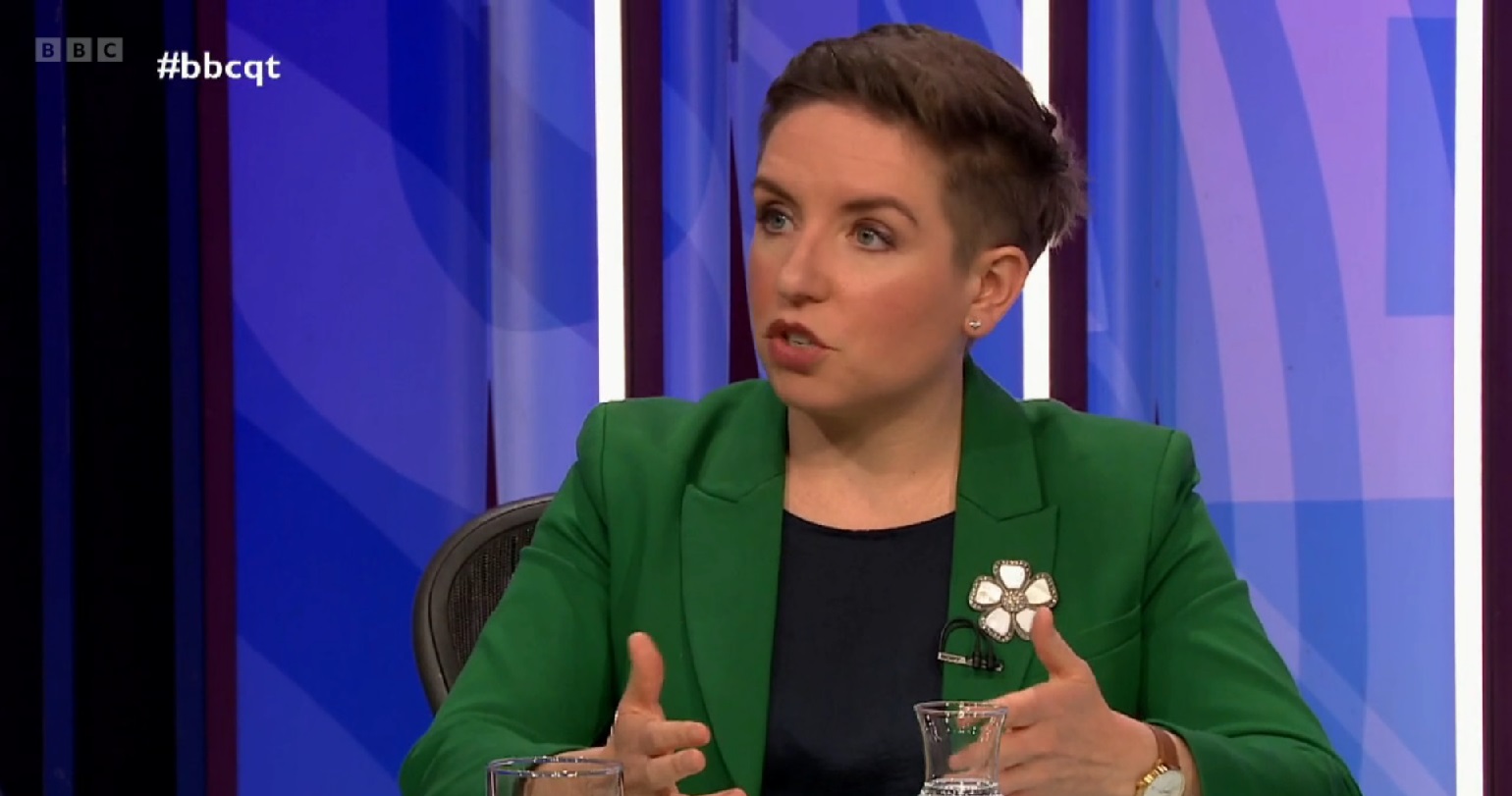
    Image of the Green Party's Carla Denyer on BBC Question Time.
    Image of the Green Party’s Carla Denyer on BBC Question Time.

    Responding to news that Labour is abandoning its policy of spending £28bn a year on its green investment plan, Carla Denyer, co-leader of the Green Party, said:

    “This is a massive backward step – for the climate, for the economy and for good quality jobs. Both the security of our planet for future generations and the UK’s future prosperity is dependent on greening our economy and that requires large scale investment.  

    “Labour have chosen to wear their fiscal rules as a millstone around their neck. A different approach through tax reforms, in particular by introducing a wealth tax on the super-rich, could help pay for the green transition. There is more than enough money in the economy to pay for this. Indeed, the Green Party would go further and faster, investing at least double what Labour originally pledged, so we can turbo charge the transition to a green economy.  

    “Greens recognise that investing in a green future will provide people with economic, social and environmental security. By decarbonising industry, insulating buildings, and ramping up renewable energy infrastructure, the UK can drastically reduce emissions, cut household bills and create new, good quality, well-paid and secure jobs in every corner of the country.   

    “Investing in this secure future is a political choice. By ditching its green investment plan, and making a series of other U-turns, Labour has clearly signalled that it is turning its back on a fairer, greener future.

    The Labour party is expected to make a further announcement today.