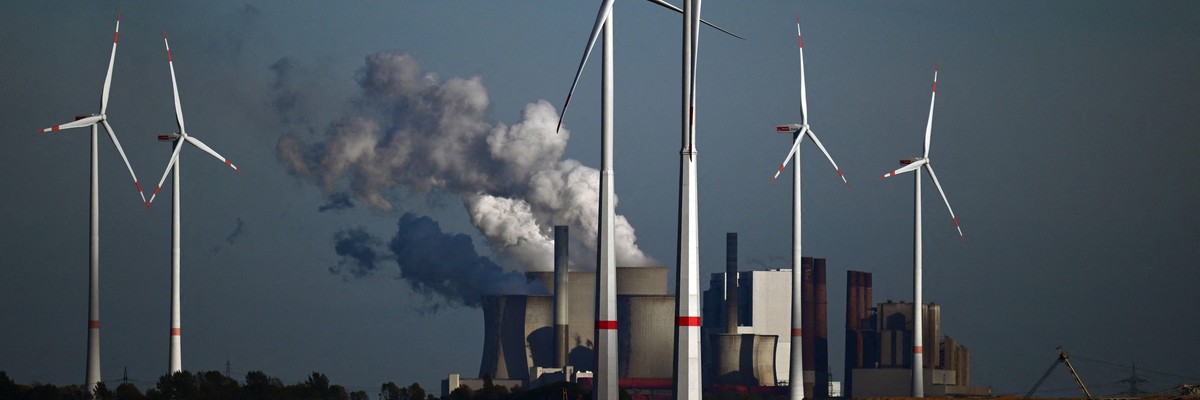
Wind turbines are shown in front of a coal-fired power plant operated by energy giant RWE near Niederaussem, Germany on October 5, 2022. (Photo: Ina Fassbender/AFP via Getty Images)
The International Energy Agency warned that while renewable energy use is surging, fossil fuel production worldwide remains “far too high” to prevent catastrophic warming.
The International Energy Agency warned Tuesday that governments aren’t moving with nearly enough urgency to phase out fossil fuels, leaving the world on a perilous track toward 2.4°C of warming above preindustrial levels by the end of the century.
While the IEA’s latest World Energy Outlook (WEO) report celebrates “the phenomenal rise of clean energy technologies such as solar, wind, electric cars, and heat pumps,” it makes clear that the continued burning of oil, gas, and coal is undermining global renewable energy progress.
“As things stand, demand for fossil fuels is set to remain far too high to keep within reach the Paris Agreement goal of limiting the rise in average global temperatures to 1.5°C,” the IEA said. “The costs of inaction could be enormous: despite the impressive clean energy growth based on today’s policy settings, global emissions would remain high enough to push up global average temperatures by around 2.4°C this century, well above the key threshold set out in the Paris Agreement.”
The IEA released its annual report just over a month before the COP28 summit in the United Arab Emirates, one of the world’s top oil producers.
Kelly Trout, research director at Oil Change International, said in a statement Tuesday that the IEA’s analysis provides a “roadmap for the upcoming United Nations Climate Change COP28 negotiations: limiting warming to 1.5°C requires a clear decision on a fast, fair, and fully funded end of fossil fuels as well as a rapid deployment of renewable energy and energy efficiency, with wealthy countries in the lead and paying their fair share for a just energy transition.”
“We can’t solve the climate crisis by adding renewable energy on top of new fossil fuels—we need to rapidly replace and phase out all fossil fuels, including gas,” said Trout. “There is a massive and deadly gap between current policies, which still lead to higher oil and gas use in 2030 than today, and the rapid declines in fossil fuels required to stave off runaway climate disaster. Every investment in new oil and gas infrastructure is an investment in more methane leaks, more warming, and more of the extreme heat, floods, fires, and drought destroying communities and ecosystems.”
“We need a fast and fair plan to phase out polluting fossil fuels that are killing us.”
The energy agency said the rapid emergence and deployment of renewable energy—including wind and solar power and electric vehicles—are keeping alive hopes of preventing catastrophic warming.
“The transition to clean energy is happening worldwide and it’s unstoppable,” Fatih Birol, the IEA’s executive director, said Tuesday. “It’s not a question of ‘if,’ it’s just a matter of ‘how soon’—and the sooner the better for all of us.”
The energy world will look very different by 2030, even under today's policy settings
But the agency cautioned that even major increases in clean energy use won’t be enough to limit planetary warming if fossil fuel use doesn’t sharply decline. A recent NASA-led study found that keeping warming below 2°C by century’s end is “critical to limiting dangerous and cascading impacts” of climate change.
The IEA’s report notes that the world is currently set for “an unprecedented surge” in new liquefied natural gas (LNG) projects, which are heavily polluting. The agency observed that “more than half of the new projects are in the United States and Qatar.”
Kaisa Kosonen, policy coordinator at Greenpeace International, said in response to the new report that “every new fossil fuel project is in stark violation of the Paris Agreement’s 1.5°C warming limit—leaders simply cannot claim to be in support of global action on climate change while supporting fossil fuel expansion.”
“We need a fast and fair plan to phase out polluting fossil fuels that are killing us,” said Kosonen. “Those who’ve polluted and profited the most must be made accountable and financially support the most vulnerable people, communities, and countries in their transition to clean, renewable energy.”
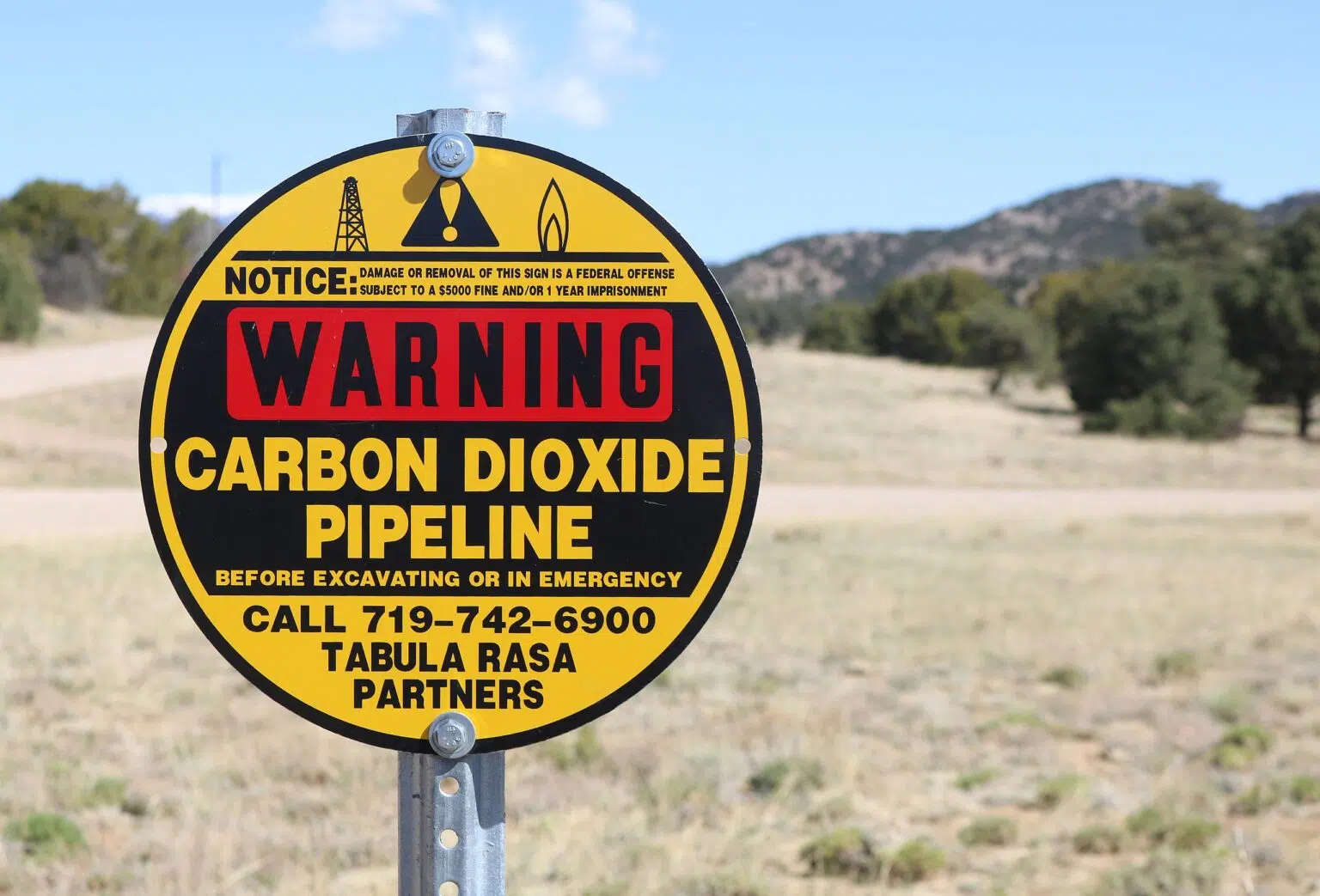
A metal sign warning of a buried carbon dioxide pipeline in Huerfano County, Colorado. Credit: Jeffre Beall, CC BY 4.0
Players in the carbon dioxide pipeline industry canceled major pipeline projects in recent weeks, marking an inauspicious start to President Biden’s ambitious plans to develop carbon capture infrastructure as a key emissions mitigation tool.
“I think what the cancellation shows is that people have had enough of fossil fuel infrastructure being forced upon them,” said Lorne Stockman, research co-director with Oil Change International. “It doesn’t surprise me that communities are standing up to these projects and occasionally winning.”
Stockman pointed out that the U.S. oil and gas industry has built millions of miles of pipelines, and hundreds of thousands of miles were installed in the last decade and a half as a result of the fracking boom. “There is a general awareness that the age of fossil fuels needs to end and that we need to transition to genuinely clean energy, and not dangerous distractions like carbon capture,” he added.
Navigator CO2 Ventures ended their “Heartland Greenway” carbon dioxide pipeline project on October 20, citing “the unpredictable nature of the regulatory and government processes involved.” The project aimed to capture 15 million metric tons of carbon dioxide from ethanol plants in the U.S. Midwest to be injected and stored underground. Much like the fossil fuel industry — which seeks to use carbon capture and storage (CCS) because they allege it will assist in decarbonizing continued oil production — carbon capture is the primary emissions mitigation tool preferred by the ethanol industry as well.
However, experts point to significant problems with the CCS process, particularly that it has historically been used primarily to pump more oil out of the earth. Burning that oil emits much more CO2 than what is captured, which means the technology wouldn’t represent a feasible solution to address climate change.
The disaster also forced the evacuation of 300 people, after the rupture spewed the odorless, colorless gas into the air for several hours. Carbon dioxide is an asphyxiant, and CO2 poisoning can leave victims disoriented and appearing to be drugged. Left untreated it can eventually lead to cardiac and pulmonary problems. More problematic is the relative rarity of mass CO2 poisoning events, meaning first responders might be unfamiliar with how to treat the symptoms. In addition, first responders — such as those responding to the disaster in Satartia — could be hampered by the engines of their vehicles shutting off in the oxygen deprived environment.
These critical health, safety, and disaster-response issues notwithstanding, it was regulatory and bureaucratic processes that have so far stymied carbon dioxide pipeline and capture projects in the Midwest.
The CCS company’s decision to cancel the project is significant for several reasons.
First, Navigator sought to use eminent domain to force landowners to give up their property, and was unsuccessful. Had these been oil or gas pipelines, the landowners might not have been as successful, because fossil fuel pipelines have generally been considered so fundamentally important to the public good that oil and gas companies can get around the Public Use Clause in the U.S. Constitution’s Fifth Amendment.
Iowa-based Summit Carbon Solutions is also proposing the Midwest Carbon Express, a $5.5 billion, 2,000-mile pipeline network across five states, to sequester carbon dioxide emissions from 34 ethanol plants. The CO2 was to be stored in North Dakota, but state regulators denied Summit Carbon a siting permit in August. Then the South Dakota Public Utilities Commission voted unanimously to strike down the company’s application to build a section of the pipeline network through that state as well. Though other pipeline projects have faced stiff public opposition, authorities denied the application to build this pipeline segment because it would violate county ordinances relating to setbacks and other aspects of the pipeline’s route. Summit has accepted the decision and indicated it would “refine their proposal and refile” for the necessary permits.
The Biden administration promised $251 million for CCS projects in seven states in May, from an estimated $12 billion fund from the Bipartisan Infrastructure Law for carbon management in the United States. Reporting from the Associated Press indicated that the funding announcement was a vote of confidence for what is expected to be a largely industry-driven initiative. The same article revealed that most of the funds have been dedicated to nine existing carbon capture projects, with an aim to sequester 50 million metric tons of carbon dioxide. Though this may seem impressive at first glance, it’s negligible when compared with the 5.5 to 6.3 billion metric tons of CO2 emitted annually in the United States alone. It’s especially insignificant given that most, if not all, of these projects are used for enhanced oil recovery — the injection of carbon dioxide into wells to extract the last remaining amounts of oil for production.
“Instead of incentivizing a CO2 reduction, the Inflation Reduction Act, along with the Infrastructure Investment and Jobs Act, through their funding of carbon capture, actually incentivize net increases in CO2, air pollution, land use and consumer costs,” said Mark Z. Jacobson, in an editorial published by The Messenger. Jacobson is a professor of civil and environmental engineering and director of Stanford University’s Atmosphere/Energy Program.
Jacobson identified the Summit project as one that is a direct beneficiary of Biden administration incentives for carbon capture. Noting that no study had determined whether this was an effective or efficient use of public money, Jacobson conducted a study to find out, which was recently published in Environmental Science and Technology. Jacobson compared the anticipated emissions savings and cost of the Summit project, which was intended to provide decarbonized ethanol for use in flex-fuel vehicles, with spending an equal amount on wind farms. The comparison also used two 2023 Ford F-150 pickup trucks for the modeling, as the F-150 is available in both electric and flex-fuel powered variants.
The results were impressive: Compared with the flex fuel-powered F-150, the fully electric version, powered by renewable wind energy, reduced CO2 emissions by 2.4 to four times, and could save drivers tens of billions of dollars – even accounting for the higher cost of the electrically powered F-150. Using wind power would also use 1/400,000 of the land footprint, and would lower air pollution levels, too.
Not only is this better for consumers, the wind and electric vehicle model virtually eliminates CO2 emissions, negating any need for carbon capture, while the ethanol and flex fuel model, even with carbon capture, would still result in a net CO2 increase.
Watchdogs argue carbon capture is being presented to the public as part of the government’s decarbonization efforts, despite being consistently proven to be incapable of reducing CO2 at the scope and scale necessary for climate change mitigation.
“Carbon capture started as a means to enhance oil production,” said Stockman. “It was not developed to address climate change.”
He pointed out that CO2 must be separated from methane in gas processing plants to meet market requirements for gas, and in most cases, it is vented into the atmosphere. In 1972, a plant at the Sharon Ridge oilfield in Texas was designed to capture CO2 from a particularly CO2-rich source of gas. Engineers wanted to see if pumping it into declining oil wells would help squeeze more oil out and make more money, Stockman said. “It worked, and that has been the model for CCS ever since.”
Stockman said that most attempts to use carbon capture and storage to reduce emissions from power plants have failed or been found to be too costly to pursue.
“The most notable success that CCS can claim is how successfully it has been used to convince politicians that it will one day be able to reduce emissions and, therefore, should be supported with public money,” he noted.
“It’s been very successful in capturing public money, which is a testimony to the long history of ‘state capture’ that the oil and gas industry has enjoyed in the U.S.,” he added, referring to Big Oil’s pressure on governments to secure public funding for their projects.
“Large budgets for lobbying and campaign finance have helped the industry maintain subsidies and tax credits, some of which have been around for many decades,” Stockman said. “The 45Q tax credit for carbon capture and EOR [enhanced oil recovery] is just the latest in this long history.”
The ethanol industry is expecting demand to decline in coming years, as recently reported by S&P Commodity Insights. Producing ethanol with CCS would meet some government and industry standards for lowering carbon intensity fuels.
However, experts and analysts routinely point out the capturing and transport process is itself carbon intensive, to the point of negating whatever positive effects sequestration might provide. Jurisdictions like California, Washington state, and the Canadian province of British Columbia could still be viable markets for low carbon intensity ethanol. There is also the possibility of using ethanol as a sustainable aviation fuel, but it all hinges on developing the infrastructure to sequester the carbon dioxide emitted during production.
Even if current pipeline projects have been canceled or shelved, there’s still considerable industry interest and incentive in finding a way to make the projects work.
Stockman urges caution before activists take a victory lap.
“I think folks need to be aware that while they have succeeded in the Midwest, communities in Texas and Louisiana are facing an overwhelming surge in gas, LNG, and CO2 infrastructure,” he said. “Both states have very oppressive legislation in place against protest and opposition to fossil fuel infrastructure, and these communities need our support, as their fight is much harder.”
Move would cost less than $5bn and cut toll of deaths from power outages and lack of supply, Cop28 delegates will hear
All healthcare facilities in poorer countries could be electrified using solar energy within five years for less than $5bn, putting an end to the risk of life from power outages, experts will argue at Cop28 this month.
“I would like the international community to commit to a deadline and funding to electrify all healthcare facilities,” said Salvatore Vinci, an adviser on sustainable energy at the World Health Organization and a member of its Cop28 delegation. “We have solutions now that were not available 10 years ago – there is no reason why babies should be dying today because there is not electricity to power their incubators.
“It’s a low-hanging fruit. There is nothing stopping us,” he said.
About 1 billion people around the world do not have access to a healthcare facility with a stable electricity connection, including 433 million in low-income countries who rely on facilities with no electricity at all, according to the WHO’s Energising Health: Accelerating Electricity Access in Healthcare Facilities report, which was published in January, and co-authored by Vinci.
Electricity is the lifeblood of a functioning healthcare facility, not only powering devices such as ventilators and cardiac monitors, but providing basics amenities such as lighting. Without these basic facilities, even routine conditions can be deadly or lead to complications. Healthcare facilities in countries vulnerable to the impact of extreme weather events will often experience outages because of storms and flooding.
Keir Starmer sucking up to the rich and powerful at World Economic Forum, Davos.
A Guardian article is saying that Labour Party leader Keith Starmer and shadow climate secretary Ed Miliband are promoting “carbon capture to support industries that still need oil and gas to pipe their waste CO2 into depleted North Sea oilfields; building floating windfarms for deep-water sites; and in green hydrogen – a zero carbon fuel needed for energy-intensive industries such as steelmaking, railways and chemicals production.”
Carbon capture is a scam to benefit the fossil-fuel industry, I don’t know if windfarms are needed for deep-water sites and green hydrogen is far from ideal. What’s needed really is a move from or transform these industries so that they don’t need vast amounts of energy. Green hydrogen needs vast amounts of energy in it’s production. Starmer can’t get away from sucking up to the fossil-fuel industry, it’s not going to be any different with him.
11.30 I’ve worked out how to secure deep-water windfarms assuming that securing them is the problem.
Analysis deems technology promoted by Sultan Ahmed Al Jaber ‘dangerous red herring’
Dr. Sultan al Jaber. Image: Arctic Circle, CC BY 2.0, via Wikimedia Commons
Climate-wrecking emissions produced by the oil company of the Cop28 president, Sultan Ahmed Al Jaber, would take hundreds of years to remove using the carbon capture technology he has been promoting.
With just weeks to go until the crucial Cop28 climate summit, Al Jaber, who is the boss of United Arab Emirate oil company Adnoc, has been backing carbon capture as one solution to the climate crisis.
But analysis by Global Witness has found it would take the company 343 years to capture all the CO2 emissions it will produce in just the next six years.
Jonathan Noronha Gant from Global Witness said the findings proved carbon capture was “a dangerous red herring” that would do nothing to tackle the climate crisis.
“Sultan Al Jaber’s Cop is shaping up to be the Cop of false solutions, inundated by fossil fuel lobbyists pushing empty promises. If Al Jaber is serious – if we are serious – we must immediately reject the CCS [carbon capture and storage] false solution and tackle the existential oil and gas problem head on.’’