The UK could be at the forefront of the climate revolution. Here’s how

Spread the love
Keir Starmer’s Labour Party once seemed focused on the climate. Not any more | Leon Neal/Pool/AFP

Original article by Paul Rogers republished from Open Democracy under a Creative Commons Attribution-NonCommercial 4.0 International licence

There are plenty of ways we could enter a new global crisis. One might stem from a pandemic, a cyber attack, or any one of the current wars escalating out of control. Already underway, though, is the crisis of accelerating climate change.

That unfolding global catastrophe has long existed but is becoming more urgent week by week, as climate scientists issue increasingly strident warnings over what is happening and we see hard evidence in the form of extreme weather around the world.

The crisis is not remotely being met by the changes required to turn things around, and certainly not by the essential rapid economic decarbonisation.

The one saving grace is that there may still be time to make the changes, which raises the question of whether individual countries can push them forward. In a previous openDemocracy column, I briefly explored this question in relation to the UK, which was thought to be in a strong position to push change last July, when the apparently climate-focussed Labour Party had just won the general election.

Yet within a few months, there was bitter disappointment among climate activists and many others as Labour’s plans were scaled down and replaced by the dominant theme of ‘growth at almost any price’.

But, still, it is worth taking a more thorough look at what could be done by a country such as the UK – which is wealthy and has huge national potential for developing renewable energy resources – if it had a government determined to respond to climate breakdown in time.

We start with the need to implement an immediate and sustained acceleration of wind and solar power at a considerable scale, effectively trebling the rate of development within at most a couple of years. It will be supported by heavy investment in the power grid and by expanding the national skills base.

In parallel to this, the UK should immediately begin national investment in home and workplace insulation, as well as increasing the use of solar panels and solar thermal systems.

The experience of the late Noughties and early 2010s is relevant here, showing how modest fiscal measures can act as effective catalysts for wider progress. Before leaving office in 2010, Labour had set out to encourage home-based solar panels with a generous feed-in tariff system. That scheme survived and indeed thrived during the 2010-15 coalition government, mainly because of the Liberal Democrats’ insistence, but collapsed when the Conservatives came to power in 2015 and cut it back.

The UK could also speed up the transition from petrol and diesel transport to electric power, coupled with much-increased investment in public transport. There are many other steps to take relating to issues such as methane emissions and food production, but these are also areas where investment will pay off handsomely.

Of course, even if we succeed in curbing carbon dioxide emissions, it will take at least another 30 years to reverse the effects they’ve had, so we will need to invest heavily in the many resources needed to minimise the impact of storms, floods and wildfires to come. Coping with these will require increases in emergency services, which can be aided by a substantial change in the role of the military.

One eye should be kept on Donald Trump and the likely damage he and his people will do in the next four years. As well as head-hunting sacked US climate researchers (which will do much to restore optimism across the whole climate science community), the UK and other rich nations can do much to plug the research gaps that will inevitably emerge as the US president uses his wrecking ball.

We should at least treble our funding for key research into the whole global ecosystem, including atmospheric, oceanographic and polar studies and those in relatively under-researched regions of the world. Funding for carbon capture and storage, meanwhile, should be scaled back, as this will take far too long to have an impact.

A further task will be to boost the transition to renewables across the more marginalised parts of the Global South, especially if that enables states to make the transition to low-carbon economies by leap-frogging their current mix of energy uses.

All of this will be hugely beneficial in straight political terms, with the impact increasingly obvious within two or three years. Energy prices will fall, fuel poverty will ease, and effective political leadership will act as an effective catalyst. The UK would get a reputation for a truly relevant response to a manifest global security challenge.

The costs will not be exorbitant, either. Money could be redirected from the military, which is expected to cost UK taxpayers £59.8bn over the next financial year, up from £56.9, despite climate breakdown exceeding just about every other security challenge facing us.

There are plenty of other sources of funding, too. One symbolic if small option would be to remove all subsidies for fossil fuel production and transfer them to renewables. A more substantial one would be to increase efforts to prevent tax avoidance, and beyond that will be to greatly increase the control of illegal tax evasion, including the myriad forms of tax havens in which the UK is a world leader.

Beyond that there is plenty of scope to increase tax on those best able to bear it, undoing the cuts made under Thatcher in the 1980s, when the top rate of tax was slashed from 83% to 40% and even now is only 45%. Given the obscene levels of wealth that we have in 21st century Britain, largely down to the changes of those Thatcher years, just a thousand people now possess close to a trillion pounds of wealth. That surely calls for the introduction of substantial wealth taxes.

Devil’s advocates might say that the changes required are too big and too expensive, but that misses one key point. A decade or two ago, one might have reasonably argued that we needed proof that something was going wrong before we took such ‘extreme’ action. But we can now see with our own eyes that climate breakdown is happening.

This point will only be reinforced every time a catastrophic weather event hits any part of the world. The UK could be at the forefront of the necessary transformation that has to come globally. It could finally have found a worthwhile post-imperial role.

Original article by Paul Rogers republished from Open Democracy under a Creative Commons Attribution-NonCommercial 4.0 International licence

Neo-Fascist Climate Science Denier Donald Trump says Burn, Baby, Burn.
Continue ReadingThe UK could be at the forefront of the climate revolution. Here’s how

Fossil fuel industry accused of seeking special treatment over oilfield emissions

Spread the love

https://www.theguardian.com/environment/2025/feb/18/fossil-fuel-industry-accused-of-seeking-special-treatment-over-oilfield-emissions

Protests against the Rosebank oilfield in Edinburgh in 2024. Labour pledged in its manifesto to halt new North Sea licensing, but Rosebank was awaiting final approval when the party won the general election. Photograph: Murdo MacLeod/The Guardian

Lobbyists argued it was unfair for their industry to be treated the same as others as end product – oil and gas – inevitably produced emissions

Experts have accused the fossil fuel industry of seeking special treatment after lobbyists argued greenhouse gas emissions from oilfields should be treated differently to those from other industries.

The government is embroiled in a row over whether to allow a massive new oilfield, Rosebank, to go ahead, with some cabinet members arguing it could boost growth and others concerned it could make the goal of reaching net zero emissions by 2050 impossible to reach. Labour made a manifesto commitment to halt new North Sea licensing, but Rosebank and some other projects had already been licensed and were awaiting final approval when the party won the general election.

Documents seen by the Guardian show the industry group Offshore Energies UK (OEUK) asking for Rosebank and other oilfields’ “scope three emissions” – those caused by the burning of extracted oil and gas – to be treated differently because that was the point of their business.

A court case recently found the licence granted to Rosebank by the previous government was unlawful as it failed to take these emissions into account.

I am only able to quote a small section of this copyrighted article. See the original article at https://www.theguardian.com/environment/2025/feb/18/fossil-fuel-industry-accused-of-seeking-special-treatment-over-oilfield-emissions

Orcas are pleased that Rosebank and Jackdaw oil fields are blocked.

Continue ReadingFossil fuel industry accused of seeking special treatment over oilfield emissions

The Chancellor and her expenses before she became an MP

Spread the love

https://www.bbc.com/news/articles/ckg75jr5284o

Rachel Reeves has had a difficult start to her ministerial career.

As well as Labour’s new chancellor taking on the challenges of the UK economy, she has faced tricky questions about her past.

They began with scrutiny of her online CV late last year.

On the professional networking site LinkedIn, the Chancellor of the Exchequer claimed to have worked as an economist at Halifax Bank of Scotland (HBOS) immediately before becoming an MP.

One of those who challenged it was a retired former colleague, Kev Gillett.

In a public post on LinkedIn, which he asked followers to share, he wrote: “Back in 2009 Rt Hon Rachel Reeves worked 3 levels below me. Just facts. She was a Complaints Support Manager at LBG/HBOS. Not an Economist. #factcheck.”

In fact it emerged that she had worked in a managerial role within the bank’s complaint handling department and her LinkedIn profile was updated to remove the claim.

Thin grey line

Rachel Reeves’s online CV exaggerated how long she spent working at the Bank of England

Thin grey line

Gillett also made another claim about Reeves’s time at the bank from 2006 to 2009, writing that she: “Nearly got sacked due to an expenses scandal where the 3 senior managers were all signing off each others expenses.”

Reeves’s team vigorously denied the allegations.

https://www.bbc.com/news/articles/ckg75jr5284o

dizzy: I’ve quoted the start of a fairly long article from the BBC by Billy Kenber, Politics investigations correspondent and Phil Kemp, Politics producer. It is the report into their investigation of UK Chancellor Rachel Reeves’ errors in her reported career history and an expenses fraud investigation at her former employer Halifax Bank of Scotland.

Continue ReadingThe Chancellor and her expenses before she became an MP

Heathrow expansion cannot be quick fix to economy, campaigners warn

Spread the love

https://morningstaronline.co.uk/article/heathrow-expansion-cannot-be-quick-fix-to-economy-campaigners-warn

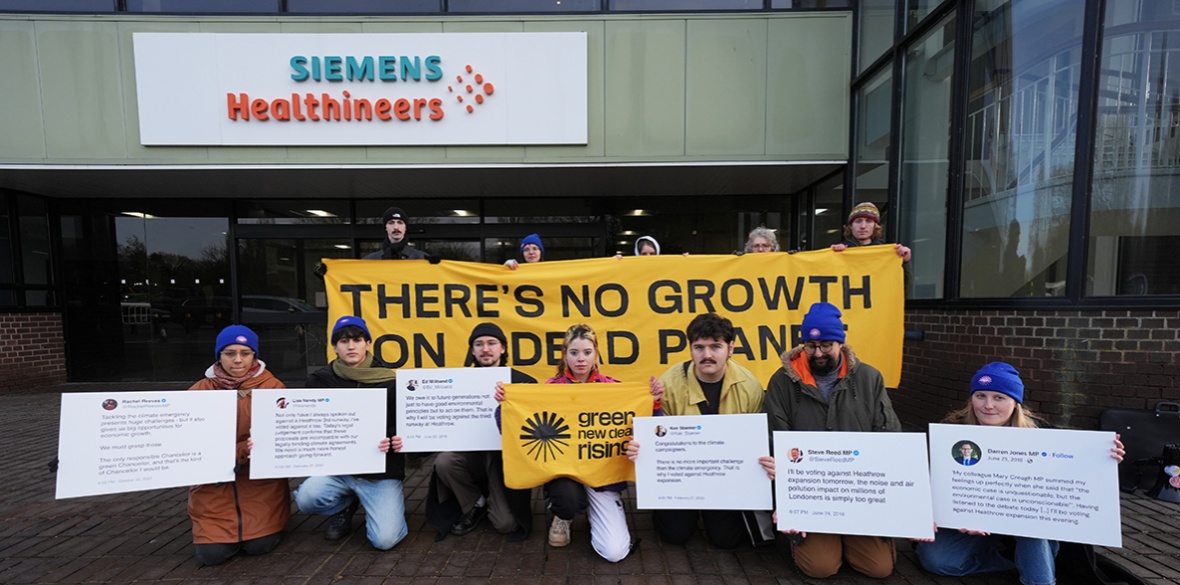
Activists from Fossil Free London and Green New Deal Rising take part in a protest against a third runway at Heathrow, and expansion at Gatwick and Luton, outside Siemens Healthineers in Eynsham, Oxfordshire, January 29, 2025

HEATHROW expansion cannot be the quick fix to the economy, campaigners warned today after the government backed a new multibillion-pound investment programme.

The airport’s chief executive Thomas Woldbye announced funding for upgrades and expansion ahead of its proposal for a third runway, expected to be submitted to the government this summer.

The government said that the investment programme will secure thousands of steel jobs by increasing the demand for British-made steel.

But polling by climate charities suggests a majority of the public believes expansion is the “wrong priority,” with 67 per cent of respondents also saying they did not see much, if any, benefit to taxpayers.

No Third Runway Coalition chairman Paul McGuinness called the announcement “almost Orwellian,” arguing that the government had relied on a Heathrow-commissioned report to promote the project rather than its own Treasury assessment.

Greenpeace UK’s chief scientist Dr Doug Parr said that the “real winners” will be Mr Woldbye and “the rest of the polluting aviation industry.”

“The only ‘perks’ for most people will be noise, air pollution and climate emissions,” he said.

Dr Parr said a third runway is “bad economics,” saying: “Instead of picking up any old polluting project from the discard pile, the Chancellor should focus on green industries that can attract investment and bring economic and social benefits for years to come, like secure jobs, affordable energy bills and cheaper, better transport.”

Continues at https://morningstaronline.co.uk/article/heathrow-expansion-cannot-be-quick-fix-to-economy-campaigners-warn

Continue ReadingHeathrow expansion cannot be quick fix to economy, campaigners warn

Labour ‘bans MPs from criticising government’ after Waspi embarrassment

Spread the love

https://morningstaronline.co.uk/article/labour-bans-mps-criticising-government-after-waspi-embarassment

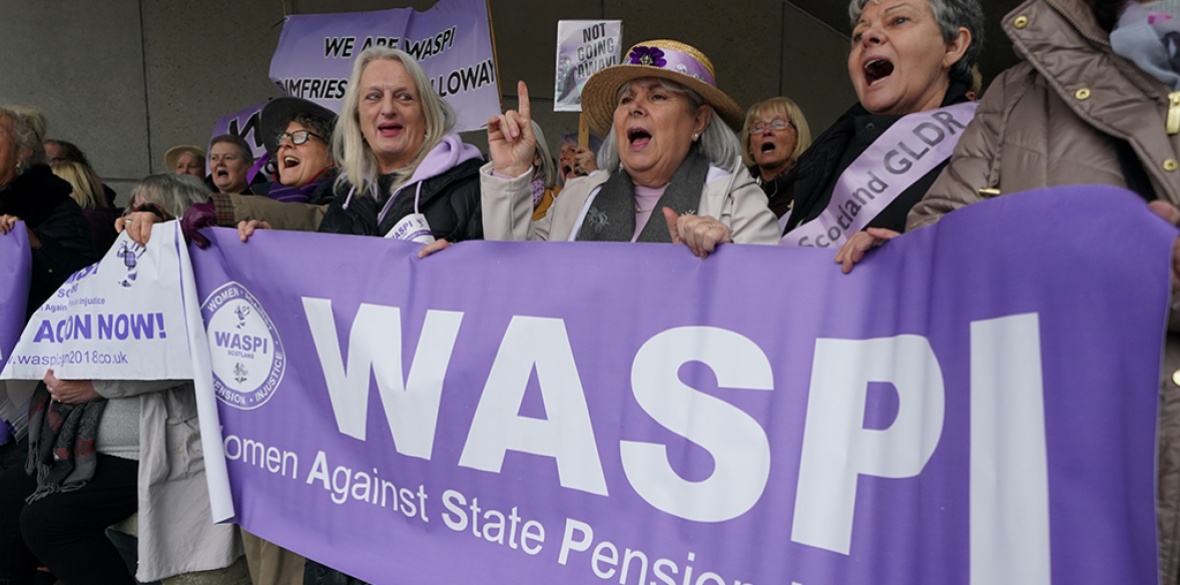
Labour’s refusal to honour an ombudsman recommendation to compensate Waspi women has been deeply unpopular

LABOUR MPs have been banned from publicly criticising government policies in a new clampdown by the beleaguered Starmer regime, it was revealed today.

It is understood that Labour whips have written a threatening letter to the 10 Labour MPs who voted against the government’s refusal to compensate the Waspi women over pension maladministration, as recommended by an ombudsman.

In an unprecedented injunction, the letter includes the warning that “you are not entitled to criticise the government in public.”

The move forms part of an increasing authoritarianism by Labour’s leadership as the government’s popularity plummets in the polls.

Three left MPs have had their six-month suspension for an earlier rebellion over the two-child benefit cap extended for an open-ended period, indicating that they are unlikely ever to be readmitted to the parliamentary party.

Government business managers had only imposed a one-line whip, the lightest form of parliamentary discipline, on the Waspi vote, since it was on a purely symbolic motion tabled by the Scottish National Party.

Continues at https://morningstaronline.co.uk/article/labour-bans-mps-criticising-government-after-waspi-embarassment

Continue ReadingLabour ‘bans MPs from criticising government’ after Waspi embarrassment