‘Not Another Bomb’ to Israel Demand Grows Ahead of Democratic Convention

Spread the love

Original article by JESSICA CORBETT republished from Common Dreams under Creative Commons (CC BY-NC-ND 3.0).

Pro-Palestinian demonstrators chant slogans before marching with placards and flags to commemorate Nakba Day at Lake Eola Park on May 11, 2024 in Orlando, Florida.  (Photo: Paul Hennessy/Anadolu via Getty Images)

“We must double down on our demands ahead of the DNC, where we’ll be marching in the streets for the liberation of all,” said one campaigner.

Leading up to the Democratic National Convention in Chicago next week, calls for the U.S. government to stop arming Israel’s devastating assault on the Gaza Strip—widely denounced around the world as genocide—continued to mount on Friday.

“We join the millions of people who’ve taken action the last 10 months, taxpayers who don’t want to pay for genocide and are demanding an immediate arms embargo on Israel,” U.S. Campaign for Palestinian Rights (USCPR) executive director Ahmad Abuznaid said in a statement Friday.

“We know that politicians won’t change their unjust policies until it’s in their own self-interest to do so,” he continued. “We must double down on our demands ahead of the DNC, where we’ll be marching in the streets for the liberation of all.”

Pro-Palestine protests in Chicago are set to start Sunday, a day before the DNC officially begins. They will continue throughout the week, according to a schedule shared Friday by the Chicago Sun-Times. The March on the DNC is planned for Monday afternoon.

As Common Dreams reported earlier Friday, a coalition of progressive and legal groups and individuals expressed “grave concerns” about recent moves by the Chicago Police Department and the city to stop protests and vowed to take legal action as needed.

The Uncommitted National Movement’s Not Another Bomb campaign is also planning a nationwide day of action for Sunday.

The movement formed when Democratic President Joe Biden was still at the top of the ticket throughout the presidential primary process; hundreds of thousands of voters across the country selected “uncommitted” or took similar action, depending on the options for each state’s ballot, to send the administration a message that they don’t support giving Israel any more military aid.

After a disastrous debate performance against the Republican nominee, former President Donald Trump, Biden dropped out of the race and passed the torch to Vice President Kamala Harris, who has already secured the party’s nomination via an online process and announced Minnesota Gov. Tim Walz as her running mate. Biden, Harris, and Walz are all set to speak at the convention.

“USCPR calls on the Biden-Harris administration, the Harris-Walz campaign, members of Congress, and the DNC to stop arming Israel now, as the Democratic Party currently has the power to end the genocide by cutting off the endless weapons supply to Israel,” the group said Friday.

Since last week, Not Another Bomb has been gathering online signatures for a petition urging Harris “to shift away from President Biden’s disastrous policy on Gaza, and pledge to enact an immediate arms embargo on Israel’s assault and occupation against Palestinians as a material step towards a permanent cease-fire.”

“Consider the overwhelming sentiment among your constituents: 86% of Democrats support the proposed cease-fire deal in Gaza,” the petition notes. “This is the mainstream view of our party’s base, as evidenced by a recent poll that reveals that 52% of Americans and 62% of Biden/Harris voters agree with halting arms sales to Israel. In addition, 70% of Democratic voters support withdrawing U.S. military funding to Israel if Israel rejects the proposed cease-fire deal, as Israel has continuously done.”

Polling released this week shows that Democratic and Independent voters in three key swing states—Arizona, Georgia, and Pennsylvania—would be more willing to vote for Harris in November if she supported cutting off weapons to Israeli forces. However, one of her advisers recently made clear that “she does not support an arms embargo on Israel.”

March on the DNC spokesperson Hatem Abudayyeh told Reuters on Friday that coalition group leaders met after Biden bowed out of the contest to discuss whether they should revise their strategy if Harris became the Democratic nominee.

“There was absolute consensus,” Abudayyeh said. “She represents the policies of the administration and it’s full steam ahead.”

The Biden-Harris administration and current Congress have provided Israel with billions of dollars in military assistance as well as diplomatic support on the world stage, including multiple vetoes of United Nations Security Council cease-fire resolutions.

Fresh calls have come this week not only in anticipation of the convention but also since the Biden administration on Tuesday approved roughly $20 billion in additional U.S.-made weapons for Israel’s military as the official death toll in Gaza neared 40,000. Local officials said Friday that at least 40,005 Palestinians have been killed and another 92,401 have been wounded.

Thousands more remain missing amid the rubble in Gaza and the vast majority of the Palestinian enclave’s 2.3 million residents have been forced to relocate, many of them multiple times. Israeli forces on Friday issued yet another evacuation order for areas in central and southern Gaza—including “safe zones”—leaving Palestinians with “nowhere to go.”

Original article by JESSICA CORBETT republished from Common Dreams under Creative Commons (CC BY-NC-ND 3.0).

dizzy: I’m experiencing disruption presumably by or sanctioned by the UK government. Evading it ;)

Continue Reading‘Not Another Bomb’ to Israel Demand Grows Ahead of Democratic Convention

Foreign Office diplomat resigns accusing govt of complicity in Gaza genocide – MSM ignore

Spread the love

Original article by Skwawkbox republished from the Skwawkbox.

Mark Smith has quit role in FCDO over department’s complicity in ‘unquestionable’ war crimes, cover-ups and refusal to listen to his whistleblowing – UK media silent

Foreign Office (FCDO) diplomat Mark Smith – an expert in arms licensing and sales – has resigned from his role saying he cannot serve in a department he thinks is complicit in ‘unquestionable’ war crimes and which has both covered-up Israel’s unfitness to receive UK weapons and ignored his attempts to blow the whistle on it. Smith wrote:

FCDO complicity in War Crimes

I write to you on my last day in the FCDO with a message I never wanted to send. It is with sadness that I resign after a long career in the diplomatic service, however I can no longer carry out my duties in the knowledge that this Department may be complicit in War Crimes.

As former penholder on the arms exports licensing assessment in MENAD, I am a subject matter expert in the domain of armed sales policy. Each day we witness clear and unquestionable examples of War Crimes and breaches of International Humanitarian Law in Gaza perpetrated by the State of Israel.

Senior members of the Israeli government and military have expressed open genocidal intent, Israeli soldiers take videos, deliberately burning destroying, and looting civilian property and openly admit to the rape and torture of prisoners.

Over half of Gaza’s homes and over 80°/o of commercial properties have been damaged or destroyed. Whole streets and universities have been demolished, humanitarian aid is being blocked and civilians are regularly left with no safe
quarter to flee to. Red Crescent ambulances have been attacked, schools and hospitals are regularly targeted. These are War Crimes.

There is no justification for the UK’s continued arms sales to Israel yet somehow it continues. I have raised this at every level in the organisation including through an official whistle blowing investigation and received nothing more than “thank you we have noted your concerns”.

Ministers claim that the UK has one of the most “robust and transparent” arms export licensing regimes in the world, however this is the opposite of the truth. As a fully cleared officer raising serious concerns of illegality in this Department, to be disregarded in this way is deeply troubling.

It is my duty as a public servant to raise this.

I urge you as officers of good conscience to join the many colleagues who have also raised concerns over this issue.

The FCDO has some of the most brilliant, hard-working and good-hearted people I have ever known and I have been proud to work alongside you.

I hope that we can look back on history and be proud.

Best regards,

Mark

Despite the explosive nature of Smith’s resignation, the UK ‘mainstream’ media appear to be ignoring it. A search for news about him reveals no ‘mainstream’ coverage:

Original article by Skwawkbox republished from the Skwawkbox.

Continue ReadingForeign Office diplomat resigns accusing govt of complicity in Gaza genocide – MSM ignore

Baby bull sharks are thriving in Texas and Alabama bays as the Gulf of Mexico warms

Spread the love

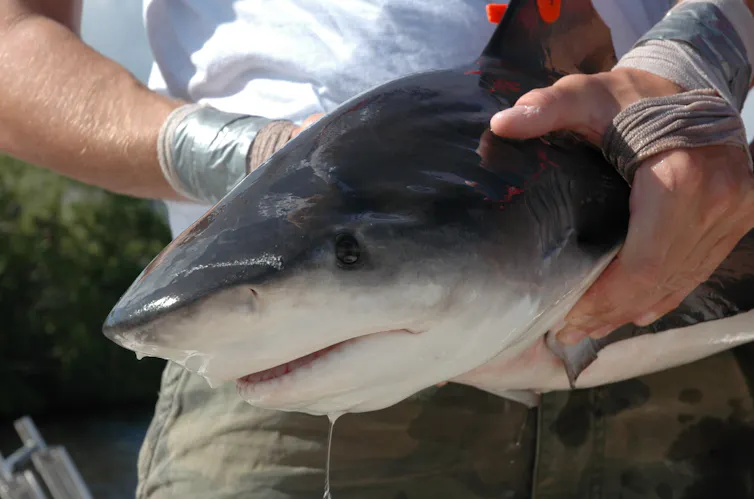
A scientist checks on a young bull shark in Texas. Philip Matich

James Marcus Drymon, Mississippi State University; Lindsay Mullins, Mississippi State University, and Philip Matich, Texas A&M University

In late spring, estuaries along the U.S. Gulf Coast come alive with newborn fish and other sea life. While some species have struggled to adjust to the region’s rising water temperatures in recent years, one is thriving: juvenile bull sharks.

We study this iconic shark species, named for its stout body and matching disposition, along the Gulf of Mexico. Over the past two decades, we have documented a fivefold increase in baby bull sharks in Mobile Bay, Alabama, and a similar rise in several Texas estuaries, as our new study shows.

Despite the bull shark’s fearsome reputation, baby bull sharks are not cause for concern for humans in these waters.

While adult bull sharks are responsible for an occasional unprovoked attack, baby bull sharks haven’t fully developed the skills needed to hunt larger prey. And you’re still far more likely to be killed by bees, wasps or snakes than sharks.

The fascinating life of a young bull shark

Most sharks are fully marine and spend their entire lives in the ocean. Bull sharks, however, are one of a handful of shark species that use freshwater environments as nurseries.

Baby bull sharks have been found in the Alabama River, 75 miles north of the ocean, and up the Mississippi River as far as Illinois. They have evolved to tolerate fresh water by reducing the need for salts and urea in their bodies compared to marine sharks, and actively taking in more salts through their food and across their gills.

In Texas, young bull shark numbers have been increasing in estuaries like Galveston Bay and Sabine Lake over the past 40 years, particularly where rivers like the Trinity, Sabine and Neches intersect with these ecosystems. These areas may offer protection from predators, such as bigger sharks.

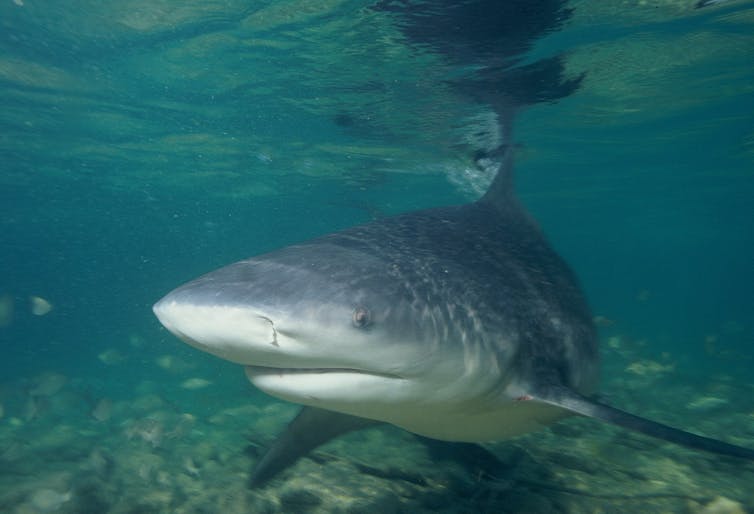
A bull shark swims in shallow water, with its fin just breaking the surface.
In 2012-2023, Texas reported seven shark bites, and Alabama reported two, none of them fatal, according to the International Shark Attack File. After white sharks and tiger sharks, bull sharks have had the most reported unprovoked shark attacks on humans globally. Albert Kok via Wikimedia Commons, CC BY-SA

The presence of bull sharks in these estuaries also contributes to their health and stability.

Because bull sharks frequently move between freshwater and marine ecosystems, they can act as mobile links that connect these two aquatic environments. Bull sharks often feed in one environment, salty water for example, and then rest and excrete nutrients in freshwater bays. Feeding and resting in different locations can improve the ability of these ecosystems to withstand disturbances like warming weather conditions, because if one habitat is disturbed, the other is still supported.

Like a spider web, food webs are connected by many intersecting threads. The more threads, the stronger the web. The use of both freshwater and marine habitats by bull sharks increases the number of these threads through their predator-prey interactions, thereby strengthening the ecosystem.

Waters are warming

As the planet warms, coastal ocean temperatures are rising. In the Gulf of Mexico, water temperatures have risen more than 3 degrees Fahrenheit (more than 1.5 degrees Celsius) due to climate change.

On a global scale, warming waters are harming more fish species than they are helping. Higher temperatures increase food requirements and stress levels, while making fish more susceptible to disease and reducing the survival of their young. A variety of fish populations in the Gulf of Mexico, including mullet and flounder, have declined as warmer conditions affected their spawning.

At the same time, the waters used by baby bull sharks have expanded in part due to this warming, creating a dynamic habitat.

An easy way to understand how sharks use dynamic habitat is to capture them with nets and measure the characteristics of the surrounding environment. In our sampling data, we could see that the mean annual water temperatures on the Alabama and Texas coasts increased at the same time the bull shark populations rose.

In coastal Alabama, we found that the relative abundance of baby bull sharks has increased fivefold over the past 20 years. Slight increases in temperature over that time provided the best explanation for this population increase.

Of all the temperatures recorded in that study, there was no maximum temperature threshold detected for baby bull sharks. So far, at least since 2003, it’s been “the warmer the better” for a baby bull shark.

We observed a similar trend in coastal Texas from Sabine Lake to Matagorda Bay, where warming estuaries supported increased abundances of baby bull sharks up to eightfold over the past 40 years. Warmer waters allowed baby bull sharks to remain in their natal estuaries longer during their first year before overwintering in the Gulf of Mexico, increasing their survival to the next life stage.

Collectively, our recent studies indicate that warming waters are currently beneficial for young bull sharks. But just like your favorite dessert, too much of a good thing can be detrimental.

All animals, including bull sharks, have maximum and minimum temperatures at which they can function. If temperatures get too hot or too cold, this can lead to problems, whether through direct stress on the shark’s bodily functions or on its ecosystem at large.

Some of our previous work from Florida shows that baby bull sharks will leave coastal nurseries in response to episodic cold snaps to avoid cold-stress. Sharks that didn’t leave died. The same may be true for hot temperatures, although conditions have not yet reached that point in the Gulf of Mexico based on our research.

A changing world

It’s clear that climate change is altering coastal ecosystems. Our work shows the direct benefit to young bull sharks, but how the observed population growth is affecting other species in the coastal estuaries remains to be seen.

A gray bull shark almost blends in with the seagrass.
A bull shark swims in a seagrass bed. Saving the Blue

The rise in bull sharks may affect other fish species, including bull shark prey like mullets, drums, herrings and catfish. More bull sharks could eventually mean fewer of the fish that humans rely on. In warmer water, sharks burn more energy.

Ultimately, tracking how the distributions of species like bull sharks change over time remains a critical priority for understanding future shifts in fish populations and the health of our coastal ecosystems.

James Marcus Drymon, Associate Extension Professor in Marine Fisheries Ecology, Mississippi State University; Lindsay Mullins, Ph.D. Student in Marine Science, Mississippi State University, and Philip Matich, Instructional Assistant Professor of Marine Biology, Texas A&M University

This article is republished from The Conversation under a Creative Commons license. Read the original article.

Continue ReadingBaby bull sharks are thriving in Texas and Alabama bays as the Gulf of Mexico warms

Oceans without sharks would be far less healthy – new research

Spread the love

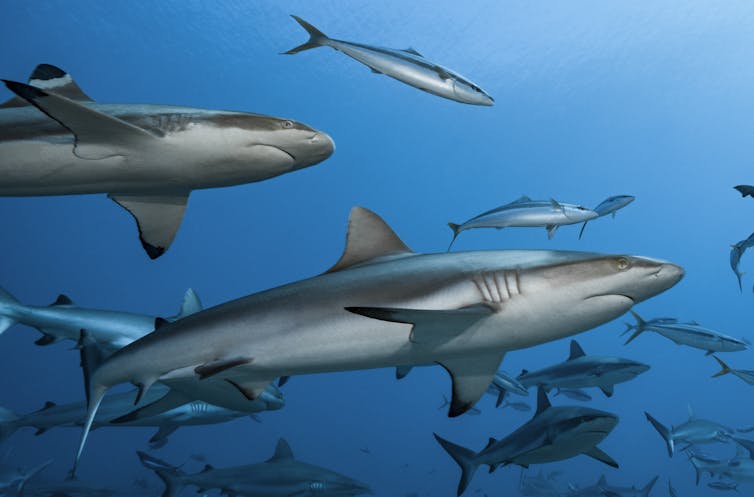
Gray reef sharks and blacktip reef sharks near Tahiti, French Polynesia. Alexis Rosenfeld/Getty Images

Michael Heithaus, Florida International University

There are more than 500 species of sharks in the world’s oceans, from the 7-inch dwarf lantern shark to whale sharks that can grow to over 35 feet long. They’re found from polar waters to the equator, at the water’s surface and miles deep, in the open ocean, along coasts and even in some coastal rivers.

With such diversity, it’s no surprise that sharks serve many ecological functions. For example, the largest individuals of some big predatory species, such as tiger and white sharks, can have an oversized role in maintaining balances among species. They do this by feeding on prey and sometimes by just being present and scary enough that prey species change their habits and locations.

In a newly published study, colleagues and I surveyed decades of research on sharks’ ecological roles and considered their future in oceans dominated by people. We found that because sharks play such diverse and sometimes important functions in maintaining healthy oceans, their current decline is an urgent problem. Since 1970, global populations of sharks and rays have decreased by more than 70%.

People are killing many types of sharks at unsustainable rates, mainly through overfishing. We see a need for nations to rethink where and how to conserve sharks for healthy oceans. https://www.youtube.com/embed/rB4zSDv3oSk?wmode=transparent&start=0 Sharks and rays are overfished as food sources and for oils produced in their livers. Fishing has extended into ever-deeper waters, where many little-studied species live.

How sharks foster seagrasses

Along the remote coast of Western Australia, more than two decades of work shows that the mere presence of tiger sharks shapes the entire seagrass ecosystem by changing where and how big grazers, such as sea turtles and sea cows, feed.

Having tiger sharks nearby protects wide swaths of seagrass from being overgrazed, allowing it to grow into thick underwater meadows that provide habitat for juvenile fish and shellfish. These species are important food for other animals and for humans.

A thick carpet of seagrass underwater with light shining down from the surface.
A healthy seagrass bed in Shark Bay, Western Australia, protected from overgrazing by the presence of tiger sharks. Michael Heithaus, CC BY-ND
A sandy bottom with sparse tufts of seagrass
This seagrass bed in Australia’s Shark Bay is in an area with few sharks. It has been heavily grazed and offers little cover for fish or other species. Michael Heithaus, CC BY-ND

In places where tiger sharks have declined and turtle populations have expanded, seagrasses are being overgrazed. In Bermuda, for example, the exploding turtle population has led to an almost total collapse of seagrasses.

White sharks produce some of the same effects. Along the California coast, where white shark numbers are increasing, otters are spending more time in the safety of protected inland waters and less time in the open waters of Monterey Bay. The otters prey on crabs, which in turn feed on grazing invertebrates such as sea slugs that clean algae from seagrasses. More otters means fewer crabs, more grazers and healthier seagrasses.

Kelp forests and reefs

Kelp forests are dense stands of large brown algae that grow in shallow zones near coasts. Along the U.S. West Coast, overhunting drove local populations of sea otters to extinction by the early 1900s. This caused huge kelp forest losses by allowing sea urchins – a favorite food of otters – to spread and consume kelp.

Over the past 50 years, otter populations have rebounded with federal protection. But as white sharks expand their ranges northward, they are preventing otters from expanding their range because there aren’t kelp forests for the otters to hide in.

The otters will likely expand their ranges only once kelp forests become established. This complicates restoration efforts, since otters won’t be removing enough urchins for kelp to become established.

When sharks are present near coral reefs, fish avoid the sharks by sticking close to the safety of the reef. This reduces grazing on seagrasses and algae across wide areas. There is still much to learn, however, about when, where and how sharks might be important for coral reef health.

Food and nutrient sources

Sharks can also be prey. Some, including large species like white sharks, are important food sources for some killer whale populations around the world. Smaller sharks, including blacktip sharks, can be key menu items for larger sharks, such as great hammerheads.

As sharks consume prey in one place and excrete waste elsewhere, they move nutrients throughout the ocean. In the Pacific, for example, gray reef sharks move nitrogen from the offshore waters where they feed to the coral reefs where they spend their days, providing important fertilizer for ocean food webs.

In Florida’s coastal waters, young bull sharks feed during brief visits to the ocean, then return to safer, nearly freshwater rivers, where they spend most of their time and release nutrients in their waste.

Sometimes sharks’ presence helps other fish. In the open ocean, sharks’ rough scales make perfect scratching posts for fish to remove parasites.

Protecting sharks’ roles

Our review makes clear that sharks play diverse roles in maintaining healthy oceans. We see important implications for shark conservation.

Step 1 would be to set goals beyond simply ensuring that there are sharks in the oceans and to target species that have key ecological roles.

Within populations, it is important to protect certain types of individual sharks. For example, the largest tiger sharks are the ones that shape the behavior of turtles and sea cows, benefiting seagrass ecosystems. Intensive fishing worldwide makes it extremely challenging for large sharks that can live for decades or even centuries to survive and grow to ecologically important sizes.

Working with local communities in coastal areas could build support for protecting these large ocean predators, much as conservationists are working on land to protect iconic predators such as wolves. Nations could build networks of large protected areas that forbid shark fishing, focusing on key areas where individual sharks may roam. https://www.youtube.com/embed/8cQK9b6RAxo?wmode=transparent&start=4 Redesigning fishing gear to target desired species and reduce catch of sharks and other nontarget species can make fishing more sustainable.

Research shows that sharks benefit from creating protected areas, limiting shark catch outside these zones and restricting use of fishing gear that does the most harm to sharks, such as gill nets and longlines. With a clearer understanding of sharks’ ecological value, my colleagues and I hope to see focused action at all levels to protect these essential animals.

Michael Heithaus, Executive Dean of the College of Arts, Sciences & Education and Professor of Biological Sciences, Florida International University

This article is republished from The Conversation under a Creative Commons license. Read the original article.

Continue ReadingOceans without sharks would be far less healthy – new research

Sheikh Hasina resigns as prime minister and leaves Bangladesh following mass protests

Spread the love

Original article republished from peoples dispatch under a Creative Commons Attribution-ShareAlike 4.0 (CC BY-SA) license.

Sheikh Hasina addresses party rally last year (Photo: Delwar Hossain/ Wikimedia Commons)

The protests, initially led by students demanding reforms in the quota system in government jobs, took a violent turn in the last weeks of July

Prime Minister of Bangladesh Sheikh Hasina resigned and left the country, army chief General Waker-Uz-Zaman announced during an address to the nation in the afternoon of Monday, August 5.

The Army chief also claimed to have taken full responsibility over the government, promising that an interim government would be formed soon after consulting all the opposition parties. He also appealed to the protesters to end their demonstrations with a hope that the violence would stop.

Waker-Uz-Zaman promised that he will make sure that all persons responsible for the killing of protesters are held accountable for their acts.

Despite the announcement of Hasina leaving the country, demonstrations continued throughout the day in Bangladesh. There were reports of Hasina’s former official residence being stormed and Dhaka’s international airport being shut down in the afternoon.

Protesters reportedly blocked roads at different places in the country, vandalized the statue of Sheikh Mujibur Rahman, considered the founder of the nation, as well as the offices of Hasina’s Awami League. Attacks were also carried out against the offices of various other parties, and continued into the evening.

Over 300 people, including security personnel, have been killed and thousands of others have been injured in the protests so far.

The protests in the country have been ongoing for over a month now. The first weeks of the protests saw university students demand reforms in the quota system in the recruitment in government jobs, and were largely peaceful. Protests turned violent after they were allegedly attacked by members of the ruling Awami League Party under the cover of security in the third week of July.

Amid the intensification of the protests, the Hasina government called for all universities to be shut down, imposed a curfew and a communication blockade. A shoot on sight order was also issued to the army deployed to control the violence.

Over 200 people were killed and thousands were injured in clashes between the security forces and protesters in the following week of July.

On July 21, the country’s Supreme Court scrapped most of the quota, fulfilling the central demand of the protesters. Yet, the protests continued with growing demands for action against the perpetrators of the violence and against the government itself.

The second round of protests erupted on Sunday, August 3, with thousands gathered in different major cities in the country calling for Hasina to resign. Chittagong, one of the major centers of quota reform protests witnessed the hundred of thousands of people flooding the streets, waving national flags and shouting slogans against Hasina.

Over 100 people, including over a dozen security personnel, have been killed in Sunday’s protests.

Hasina’s government and her Awami League party had alleged that the violent protests were initiated as a part of a conspiracy against the elected government. Hasina had accused the opposition Bangladesh Nationalist Party (BNP) of collaborating with Jamaat-e-Islami, an extremist group, to provoke violence across the country in order to bring regime change in the country as they could not win popular elections.

According to a source on the ground, the violence during the quota reform movement was used by the imperialist powers led by the US to orchestrate regime change in the country. They also claimed that the new regime would be used to undo the secular and progressive reforms initiated by the Hasina government during her four terms. 

In January’s national elections in Bangladesh, Sheikh Hasina had won her fourth straight term as prime minister since 2009. This was her fifth term as prime minister in total. She was first elected as prime minister in 1996. The US had questioned the legitimacy of the last elections in January.

Original article republished from peoples dispatch under a Creative Commons Attribution-ShareAlike 4.0 (CC BY-SA) license.

Continue ReadingSheikh Hasina resigns as prime minister and leaves Bangladesh following mass protests