Left and civil society groups demand India end its complicity in Israel’s genocide
Original article republished from peoples dispatch under a Creative Commons Attribution-ShareAlike 4.0 (CC BY-SA) license.
Left parties will observe a day of solidarity with Palestine on August 3 to pressure the Indian government to stop sending weapons to Israel and to end the genocide
Five left parties in India issued a joint call, asking the Indian government to stop supplying weapons to Israel, and demanding immediate comprehensive international sanctions over its continued violations of international law and the genocide of Palestinians in Gaza. Similar calls were made by civil society groups as well.
The parties include the Communist Party of India (Marxist), the Communist Party of India (CPI), the Revolutionary Socialist Party (RSP), Forward Bloc, and the Communist Party of India (Marxist-Leninist) Liberation, issued a joint call for a nationwide protest mobilization on August 3, in solidarity with the Palestinian people.
Apart from calling for an immediate ceasefire in Gaza and creation of a Palestinian state on pre-1967 borders, the left parties demanded Israel be declared an apartheid state, and denounced Israel’s continued defiance of UN resolutions, existing international laws and the rulings of the International Court of Justice (ICJ).
“In the light of brazen violations of UN resolutions, the ICJ rulings against the genocide by Israel in Gaza and the escalation of such genocide against the people of Palestine,” the left parties call upon “Indian people to express their solidarity with the Palestinian people and against the genocide and atrocities being carried out by Israel backed by the United State of America” the text of the joint call reads.
The left parties also demanded that the government of India “cancel all export licenses and permissions to various Indian companies for the supply of military arms and ammunition to Israel, and halt all arms imports from Israel” and “end all forms of complicity with Israel’s illegal military occupation and genocide [which is] based on the principles of colonial apartheid.”
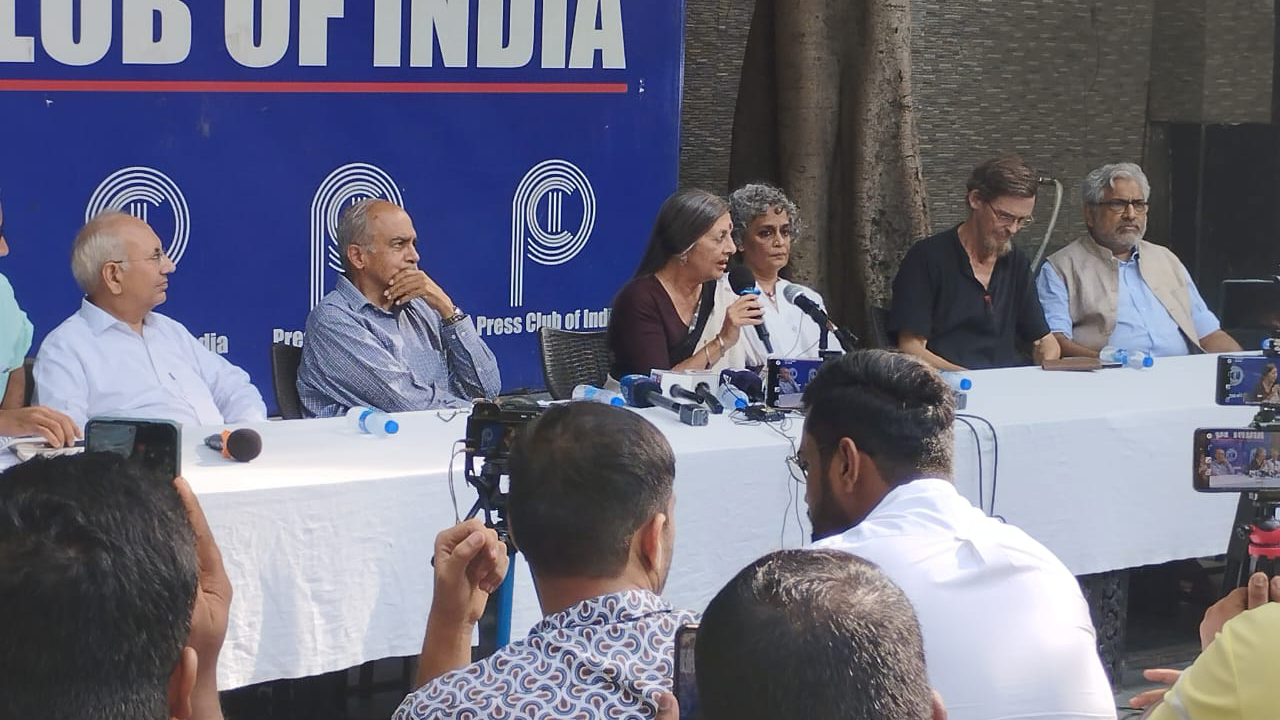
Speaking in a press conference organized by civil society groups on Thursday in New Delhi, Brinda Karat, a CPI (M) polit bureau member said that, “our deep and abiding solidarity for Palestinian freedom requires us to hold our own government accountable for actions which help the perpetrators of the continuing barbaric horrors against the children, the people of Palestine.”
Speaking in the press conference, economist and right to food activist Jean Dreze accused the Indian government of complicity in genocide and starvation of Palestinians, by refusing to stop cooperation with the Zionist state and by refusing to press Israel to stop its war in Gaza.
Almost 40,000 Palestinians have been killed and over 90,000 injured so far in the Israeli genocide on Gazam which began on October 7 of last year.
Stop aiding Israeli genocide in Gaza!
Several prominent figures, including former judges of the Supreme Court of India, scholars and activists wrote a joint letter to India’s defense minister Rajnath Singh on Wednesday, asking the country to immediately halt all supplies of weapons to Israel, claiming it violates India’s obligations to international laws and its own constitutional provisions.
Quoting media reports about Spain not allowing the docking of at least two ships allegedly carrying military equipment from India to Israel in recent months, as well as labels of “made in India” found on some of the missiles dropped by Israel in Gaza, the civil society members claimed in a press conference on Thursday that the Narendra Modi-led government of India has forgotten its own commitments to the Genocide Convention and other international laws, and even failed to implement its historical positions on the Palestinian issue.
The joint letter to India’s defense minister provides evidence of how at least three Indian companies are manufacturing missile parts and Hermes drones, which are used by Israel to launch attacks inside civilian areas in Gaza.
“Any supply of military material to Israel would amount to a violation of India’s obligations under international humanitarian law and the mandate of Article 21 read with Article 51 (c) of the Indian constitution. We urge you, therefore, to cancel the concerned export licenses and halt the granting of any new licenses to companies supplying military equipment to Israel,” the joint letter reads.
India’s billions of dollars of arms trade with Israel contradicts its own stated positions of “peaceful resolution in Palestine” and its voting patterns on successive UN resolutions most of which support an immediate ceasefire and the creation of a Palestinian state on the occupied territories, various speakers said in the press conference on Thursday.
Speakers, including Karat, demanded that the Indian government should stop trying to be a beneficiary of the Israeli occupation and stop indulging in opportunistic practices, such as sending its workforce to replace Palestinians in Israel.
Last year, the Indian government agreed to send workers to replace thousands of Palestinians whose work permits were canceled by Israel after the beginning of the war on October 7.
Siddharth Varadarajan, editor of the Wire, said that India’s policy on supporting Israel during the war goes against the Modi government’s stated position of preserving Indian interests, as Israeli acts such as the assassination of Ismail Haniyeh in Iran earlier this week could result in the eruption of regional warm which can force around 5 million Indians working in the Gulf countries to return home.
Lawyer Prashant Bhusan, and prominent writer Arundhati Roy, also underlined that any clandestine deal between India and Israel violates India’s democratic principles and its historic commitments to anti-colonial struggles around the world.
Original article republished from peoples dispatch under a Creative Commons Attribution-ShareAlike 4.0 (CC BY-SA) license.