Chancellor of the Exchequer Rachel Reeves during her visit to the National Manufacturing Institute Scotland (NMIS) in Paisley, Renfrewshire, August 28, 2024
Age UK warns that two million pensioners could be in serious trouble this winter
CHANCELLOR Rachel Reeves pledged to press ahead with her winter fuel squeeze on pensioners today despite warnings that she is risking a public health crisis.
…
“It’s not a decision I wanted to make, but a decision I had to make in incredibly challenging circumstances to put the public finances on a firm footing,” she said, while also not ruling out tax rises in her October Budget.
Bosses attending the talks with Energy Minister Miatta Fahnbulleh are set to increase average household bills by £149 from October following a green light for the rise in the price cap from regulator Ofgem.
At the same time, the government is looking to save £1.4 billion by axing winter fuel payments from all pensioners not in receipt of pensions credit or other means-tested assistance.
…
Charity Age UK said it “strongly” opposed Ms Reeves’s benefit cut, which would mean “as many as two million pensioners who badly need the money to stay warm this winter will not receive it and will be in serious trouble as a result.”
Simon Francis, of the End Fuel Poverty Coalition, warned that “this has the potential to create a public health emergency which will actually create more pressure on the under-pressure NHS which the Prime Minister says he wants to fix.”
Keir Starmer confirms that he is continuing Tory policies and that he’s proud to be a red Tory.Keir Starmer says pensioners can freeze to death and poor children can starve and be condemned to failure and misery all their lives.
Leaders of Pacific island nations gather in Nuku’alofa, Tonga on August 26, 2024 for the 53rd Pacific Islands Forum Leaders Meeting (PIFLM53). (Photo: Pacific Islands Climate Action Network/X)
U.N. Secretary-General António Guterres stressed that “the region urgently needs substantial finance, capacities, and technology to speed up the transition and to invest in adaptation and resilience.”
As more than 1,500 delegates from over 40 nations gathered in Tonga for the 53rd Pacific Islands Forum Leaders Meeting, climate defenders on Monday urged the world’s biggest polluters to do much more to phase out the fossil fuels that are driving a planetary emergency disproportionately affecting low-lying island countries, which are among the world’s lowest greenhouse gas emitters.
“Tonga’s vision for the 53rd Pacific Islands Forum Leaders Meeting (PIFLM53) is for the Pacific to move beyond policy deliberation to implementation—to achieve transformation by building better now,” summit organizers said in a statement affirming the event’s mission to “develop collective responses to regional issues and deliver on their vision for a resilient Pacific region of peace, harmony, security, social inclusion, and prosperity.”
“We may be small island countries but we are a force to be reckoned with.”
Addressing attendees at the summit’s opening ceremony in the Tongan capital of Nuku’alofa, Pacific Islands Forum (PIF) Secretary-General Baron Waqa of Nauru called for regional unity to tackle common challenges.
“We may be small island countries but we are a force to be reckoned with,” he said. “We are at the center of geostrategic interest, we are at the forefront of a battle against climate change and its impacts.”
Speaking at Monday’s opening session, United Nations Secretary-General António Guterres lamented that “humanity is treating the sea like a sewer. Plastic pollution is choking sea life. Greenhouse gases are causing ocean heating, acidification, and a dramatic and accelerating rise in sea levels.”
Humanity is treating the sea like a sewer.
Plastic pollution is choking sea life.
Greenhouse gases are causing ocean heating, acidification & accelerating rise in sea levels.
Pacific islands, dramatically impacted by the consequences of climate change, are showing the way to… pic.twitter.com/CEAjeNVpz5
Guterres—who warned in Samoa last week that low-lying island nations face the threat of climate “annihilation”—said that “Pacific islands are showing the way to protect our climate, our planet, and our ocean: By declaring a climate emergency and pushing for action, and with your declarations on sea-level rise, and aspirations for a just transition to a fossil fuel-free Pacific. But, the region urgently needs substantial finance, capacities, and technology to speed up the transition and to invest in adaptation and resilience.”
“The young people of the Pacific have taken the climate crisis all the way to the International Court of Justice,” Guterres added. “You have also rightly recognized that this is a security crisis—and taken steps to manage those risks together.”
Ouaaaa 🇹🇴 While leaders prepare for #PIFLM53, we joined 200 Tongan youth in visioning what the theme of “Build Better Now” could mean for our islands.
And what is a resilient Pasifiki without a safe livable climate and some good old island dance-offs? pic.twitter.com/YUjmNpLKGI
Mahoney Mori, who chairs the Pacific Youth Council and is the PIFLM53 youth representative from the Federated States of Micronesia, called out the international community’s failure to adequately fund climate mitigation initiatives like the loss and damage fund—which developing nations say will require an annual investment of at least $400 billion, or nearly 10 times the amount pledged at last year’s United Nations Climate Change Conference in Dubai.
“Despite the commendable pledges from the United Nations and world leaders such as the Paris agreement, the existing global finance mechanisms still hindered community-based and youth organizations from accessing critical support,” Mori said. “The Pacific’s grassroots organizations struggle to meet global standards amidst this crisis and time is running out.”
As leaders met for PIFLM53 amid torrential rains, a 6.9-magnitude earthquake rocked Tonga’s main island of Tongatapu. While there was no damage reported and no tsunami warning issued, summit attendees said the temblor underscored vulnerabilities faced by low-lying island nations.
Brilliant comment from one of Tonga's leading thinkers – what better time to have flood, wind and earthquake…. pic.twitter.com/HuVIYMP5Sa
Leaders and activists from Pacific island nations took aim at regional giant Australia—which has been perennially ranked as one of the world’s worst climate-wreckers in U.N.-backed Sustainable Development reports—for insufficient climate action.
“We recognize Australia’s desire to present itself as a climate leader and co-host the COP alongside the Pacific,” Pacific Islands Climate Action Network regional director Rufino Varea said in a statement, referring to Australia’s bid to help lead the 2026 United Nations Climate Change Conference, or COP31.
“However, true leadership must not merely be aspirational; it must be actionable,” Varea continued. “To date, Australia has expanded gas production instead of aligning its practices with the urgent needs of the Pacific. This does not reflect the leadership we need.”
“If Australia is to demonstrate genuine commitment, it must align its domestic and international climate policies with our goals and advocate earnestly for a fossil fuel-free Pacific,” he stressed. “It must also commit to ambitious climate actions, ensure effective climate finance is delivered to Pacific island countries, and contribute substantially to the loss and damage fund.”
“If these steps are not taken, we risk witnessing a COP that concedes failure—declaring that critical targets were missed, and that Pacific communities continue to be exploited as mere labor resources for the enrichment of others,” Varea added.
Fascists Mussolini and Hitler salute Angela Rayner and the Labour Party
Our ancestors fought Fascism in the Spanish Civil War and World War 2. I commit to oppose and fight Fascism. Israel and collaborators actions have been recognised as Fascism.
later: What my ancestors did is say: I object, I oppose it and I am willing to fight it and if necessary die (get killed actually) for my values.
later again: Our ancestors fought Fascism. It is our responsibility and duty now to fight and oppose Israel’s Fascism. Fascism is about disregarding human rights and treating people as less than human. Israel is behaving towards others exactly as the Jews were treated by Nazi Fascists during World War 2.
later again again: It’s a system and it is actually a very, very fragile system with vulnerable, insecure infrastructure everywhere … where if only so many (few) people decide they’ve had enough – that they’re not willing to tolerate this Fascism, they might find that they can have a serious effect without too much effort or danger … if they recognised how vulnerable cap is …
later again again again: If we’re going to oppose Israel’s Fascism we should recognise and regard Israel’s collaborators as Fascist equals. If that is accepted US, UK, Germany and very likely many more are as to be regarded as equals to Israel.
later: and should be fought just as if we were opposing and fighting Israel.
Is that understood? I am saying that countries supporting Israel’s genocide of Gaza – most notably US, UK and Germany but probably many others too – should be regarded as Fascists as much as Israel are Fascists. I am also saying that I have huge respect for my ancestors who fought Fascism in the Spanish Civil War and the Second World War – and further – that I appreciate that it now falls on me, that it is my turn to oppose and fight Fascism.
The ability of governments to implement climate policies effectively is the “most important” factor in the feasibility of limiting global warming to 1.5C, a new study says.
The future warming pathways used by the Intergovernmental Panel on Climate Change (IPCC) suggest that holding warming to 1.5C is unlikely, but still possible, when considering the technological feasibility and project-level economic costs of reaching net-zero emissions.
However, the new study, published in Nature Climate Change, warns that adding in political and institutional constraints on mitigation make limiting warming to 1.5C even more challenging.
They find that the most ambitious climate mitigation trajectories give the world a 50% chance of limiting peak global warming to below 1.6C above pre-industrial temperatures. However, adding ”feasibility constraints” – particularly those involving the effectiveness of governments – reduces this likelihood to 5-45%.
The study shows that, thanks to advances such as solar, wind or electric vehicles, “the technological feasibility of climate-neutrality is no longer the most crucial issue”, according to an author on the study.
Instead, he says, “it is much more about how fast climate policy ambition can be ramped up by governments”.
Emissions scenarios
In 2015, almost every country in the world signed the Paris Agreement – with the aim to limit global warming to “well below” 2C above pre-industrial levels, with a preference for keeping warming below 1.5C.
Since then, most countries have set net-zero targets and many are making progress towards achieving them. However, as the planet continues to warm, some scientists are questioning whether it is still possible to limit warming to 1.5C, the new study says.
The IPCC’s special report on 1.5C, published in 2018, included a cross chapter box on the “feasibility” of this temperature limit. The report says there are six components of feasibility that could inhibit the world’s ability to limit warming to 1.5C, as shown in the image below.
The six components of feasibility that could inhibit the world’s ability to limit warming to 1.5C, according to the IPCC”s special report on 1.5C. Source: IPCC SR1.5, cross chapter box 3.
The IPCC’s working group three report from its sixth assessment cycle explores thousands of different future warming scenarios. These scenarios are mainly generated by integrated assessment models (IAMs) that examine the energy technologies, energy use choices, land-use changes and societal trends that cause – or prevent – greenhouse gas emissions.
Fewer than 100 of these scenarios result in warming of below 1.5C with limited or no overshoot, defined as more than a 50% chance of seeing a peak temperature below 1.6C. These are known as the “C1 scenarios”. However, these scenarios do not consider all of the feasibility constraints outlined by the IPCC.
(Furthermore, these scenarios – which run from 2019 – assume that rapid decarbonisation began almost immediately. However, in reality, emissions have continued to rise since 2020, eating into the remaining “carbon budget” for warming to be limited to 1.5C more quickly than the models assume.)
The new study investigates five constraints. The first two – geophysical and technological – focus on the constraints presented by technologies, such as the growth of carbon capture and storage, nuclear power and solar generation, and the Earth’s total geological carbon storage capacity.
For sociocultural constraints, the study explores behavioural changes that can accelerate decarbonisation, such as reduced energy demand. The authors refer to these as “enablers”. And the “economic constraint” focuses on carbon prices.
However, the authors say the “key innovation” of their study is the inclusion of “institutional constraints”, which measure a government’s ability to “effectively implement climate mitigation policies”.
Policy constraints
All countries have different “institutional capabilities” to enforce policies. Some countries are able to quickly and successfully implement policies, such as taxation changes or environmental regulation. Other countries – which are often less wealthy – have lower levels of governance, making it harder to implement these measures.
The indicator is based on the speed and success with which they have achieved their past “environmental goals” – for example, reductions in the sulphur emissions of power plants – he explains. Countries that were successful in achieving these targets in the past are given higher governance scores.
She tells Carbon Brief that the indicator is originally from the Worldwide Governance Indicators published by the World Bank. (See more on the indicators in the guest post Andrijevic and her co-authors wrote for Carbon Brief.)
The graph below, taken from the new study, shows how governance is expected to improve over the 21st century for countries with a population of more than 25 million in 2020, according to this indicator. Each colour indicates a different world region. The grey lines indicate a “pessimistic” scenario in which governance remains frozen at 2020 levels.
Expected increases in governance over the 21st century. Only countries with a population of more than 25 million in 2020 are shown. Each colour indicates a different world region. Source: Bertram et al (2024).
The authors use global average carbon prices as a “proxy” for the overall strength of a country’s climate policy, assuming that countries with higher levels of governance will implement higher carbon prices.
They develop a range of scenarios. In their optimistic scenario, carbon prices vary, but this does not explicitly constrain emissions reductions. In the “default” scenario, both carbon prices and emissions reductions are constrained.
In the pessimistic scenario, governance indicator values are “frozen” at their 2020 levels, meaning that governments’ ability to implement new climate mitigation policies does not improve over the 21st century.
Bertram tells Carbon Brief that the measure is “not perfect”, but says that it gives a good approximation of “how fast decarbonisation can happen in different countries”.
Is 1.5C ‘feasible’?
The authors used existing literature to quantify how much each of the five constraints might affect the world’s ability to limit global warming. They then produced a set of different “feasibility scenarios” and assessed their future CO2 emissions using eight IAMs.
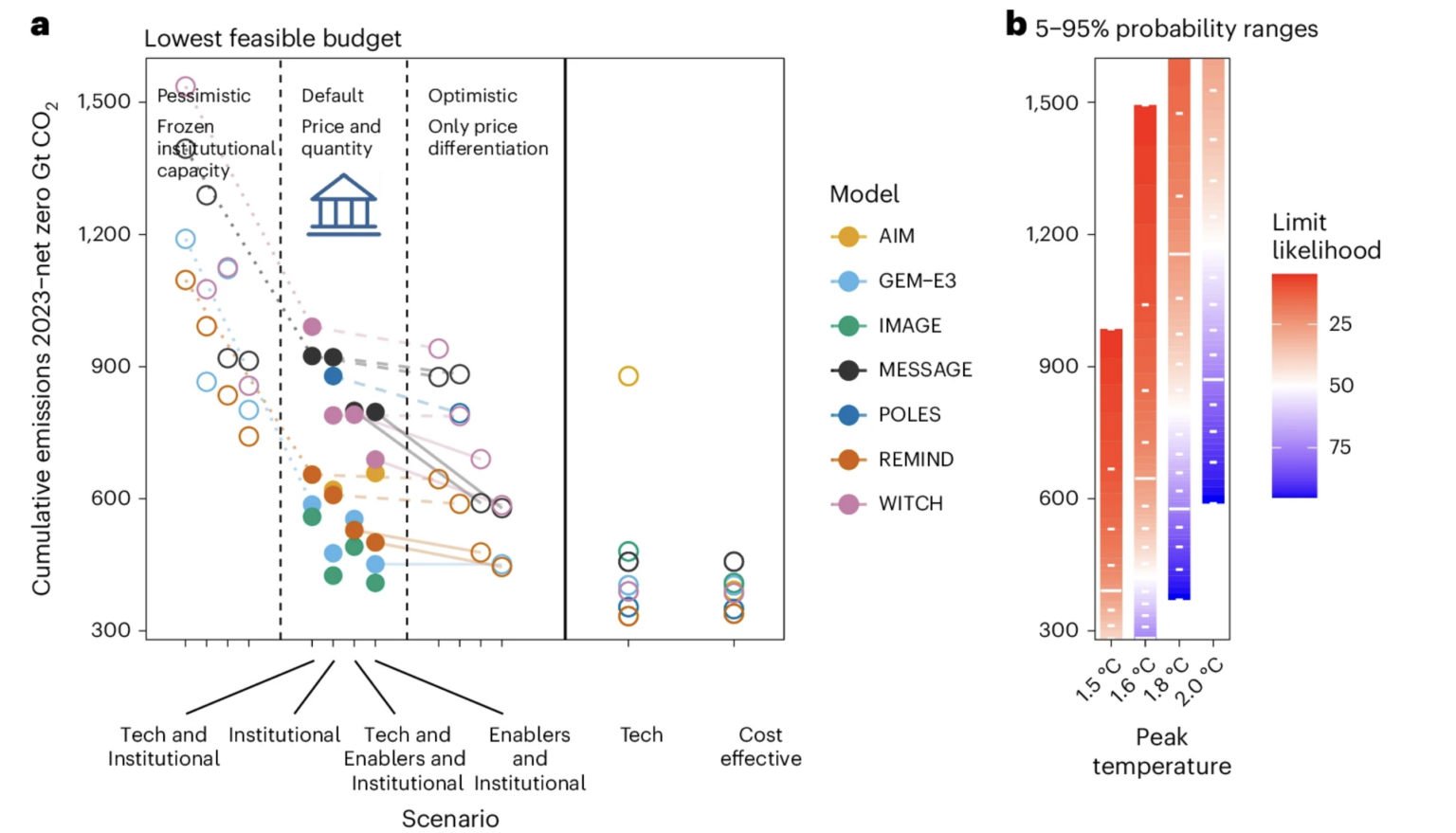
The plot below shows the minimum total global CO2 emissions that could be produced between 2023 and the date that net-zero CO2 is reached for these scenarios. In the panel “a”, on the left, each dot indicates a model result.
The column on the far left is a “pessimistic” institutional feasibility scenario, in which governance indicators do not improve beyond 2020 levels. Cumulative global CO2 emissions before net-zero here are the highest of any scenario explored.
The next column is the “default” assumption of carbon prices and emissions-reduction quantities, under four different combinations of constraints.
From left to right within this column, the combinations cover technological and institutional constraints, only institutional constraints, technological and institutional constraints with enablers and then institutional constraints with enablers.
The enablers include measures such as reduced energy demand in high income countries and increased electrification. This helps to “create more flexibility on the supply side and thus further improve the feasibility of implementation”, according to the paper.
The final column shows “optimistic” scenarios, divided between a scenario with technological constraints (left) and a “cost-effective” scenario, as used in the IPCC (right).
Panel “b” shows the likelihood, based on the 14 feasibility scenarios in panel a, of staying below 1.5C, 1.6C, 1.8C and 2.0C peak temperatures. Each bar indicates a different peak temperature. Red indicates a high likelihood of meeting the temperature target, given the level of emissions, and purple indicates a low likelihood.
Minimum achievable carbon budget from 2023 until net-zero CO2, across 14 different feasibility scenarios. Source: Bertram et al (2024).
In scenarios without any institutional constraints, nearly all models are able to produce scenarios which line up with the IPCC’s C1 scenarios, which have more than a 50% chance of seeing a peak temperature below 1.6C.
However, adding institutional constraints reduces this likelihood to 5-45%.
(A peak temperature of 1.6C would not necessarily breach the long-term goal of the Paris agreement, as long as temperatures were brought back down below the 1.5C threshold by the end of the century. However, there are risks associated with overshoot – such as crossing tipping points – and it relies more heavily on large-scale implementation of negative emissions technologies.)
Under the “pessimistic” institutional constraints, the ability of countries to cut emissions is “sharply curtailed”, the authors say, resulting in only a 30-50% chance of limiting warming even to 2C above pre-industrial levels.
The study shows that “technological constraints are not a crucial impediment to a fast transition to net-zero anymore,” Bertran tells Carbon Brief.
“Thanks to the latest advances in low-carbon technology deployment, such as solar, wind or electric vehicles, the technological feasibility of climate-neutrality is no longer the most crucial issue,” Prof Gunnar Luderer – a study author and lead of the energy systems group at the PIK – added in a press release.
Instead, he said, “it is much more about how fast climate policy ambition can be ramped up by governments”.
Future warming
The findings of this study have implications for meeting the Paris Agreement 1.5C limit. “Our study does not imply that the 1.5C target needs to be abandoned,” the study says. However, it adds:
“The world needs to be prepared for the possibility of an overshoot of the 1.5C limit by at least one and probably multiple tenths of a degree even under the highest possible ambition.”
“The 1.5C target was always something that, while theoretically possible, was very unlikely given the real-world technical, institutional, economic and political setting that determines climate policy,” says Prof Frances Moore from the department of environmental science and policy at UC Davis, who was not involved in the study.
However, she tells Carbon Brief, the finding that humanity could still limit warming to 2C is “a signal of the progress countries have made in committing to climate action”.
However, he says the results “need to be interpreted very cautiously”. For example, he notes that the study only considers CO2 emissions and not other greenhouse gases, such as methane.
In addition, he notes that “institutional capacities affect climate action in a myriad of different ways that are not easily representable in the modelling world”. As a result, the study authors had to “settle” on an approach that “may only be partly representative of ‘real world’ dynamics and is very sensitive to modelling assumptions”.
Moore says this is a “valuable initial study”, but makes a similar point, noting that the “implementation of institutional constraints and demand-side effects is somewhat arbitrary and ad-hoc”, such as using carbon prices as a governance indicator.
Dr William Lamb is a researcher at the Mercator Research Institute and was also not involved in the study. He tells Carbon Brief that the study results are “sobering” and says that “we need to start focusing research, policy and advocacy on the underlying institutions and politics that shape climate action”.
He adds that there are other aspects of feasibility that could be considered:
“We know that incumbent fossil fuel interests are politically powerful in many countries and are able to obstruct the implementation of climate policies, or even reverse those that are already in place. In other words, some governments may be capable, but do not want to implement ambitious climate action.”