Analysis: The climate papers most featured in the media in 2025

Spread the love

Original article republished from Carbon Brief under a CC license

The year 2025 saw the return to power of Donald Trump, a jewellery heist at the Louvre museum in Paris and an engagement that “broke the internet”.

Amid the biggest stories of the year, climate change research continued to feature prominently in news and social media feeds.

Using data from Altmetric, which scores research papers according to the attention they receive online, Carbon Brief has compiled its annual list of the 25 most talked-about climate-related studies of the past year. 

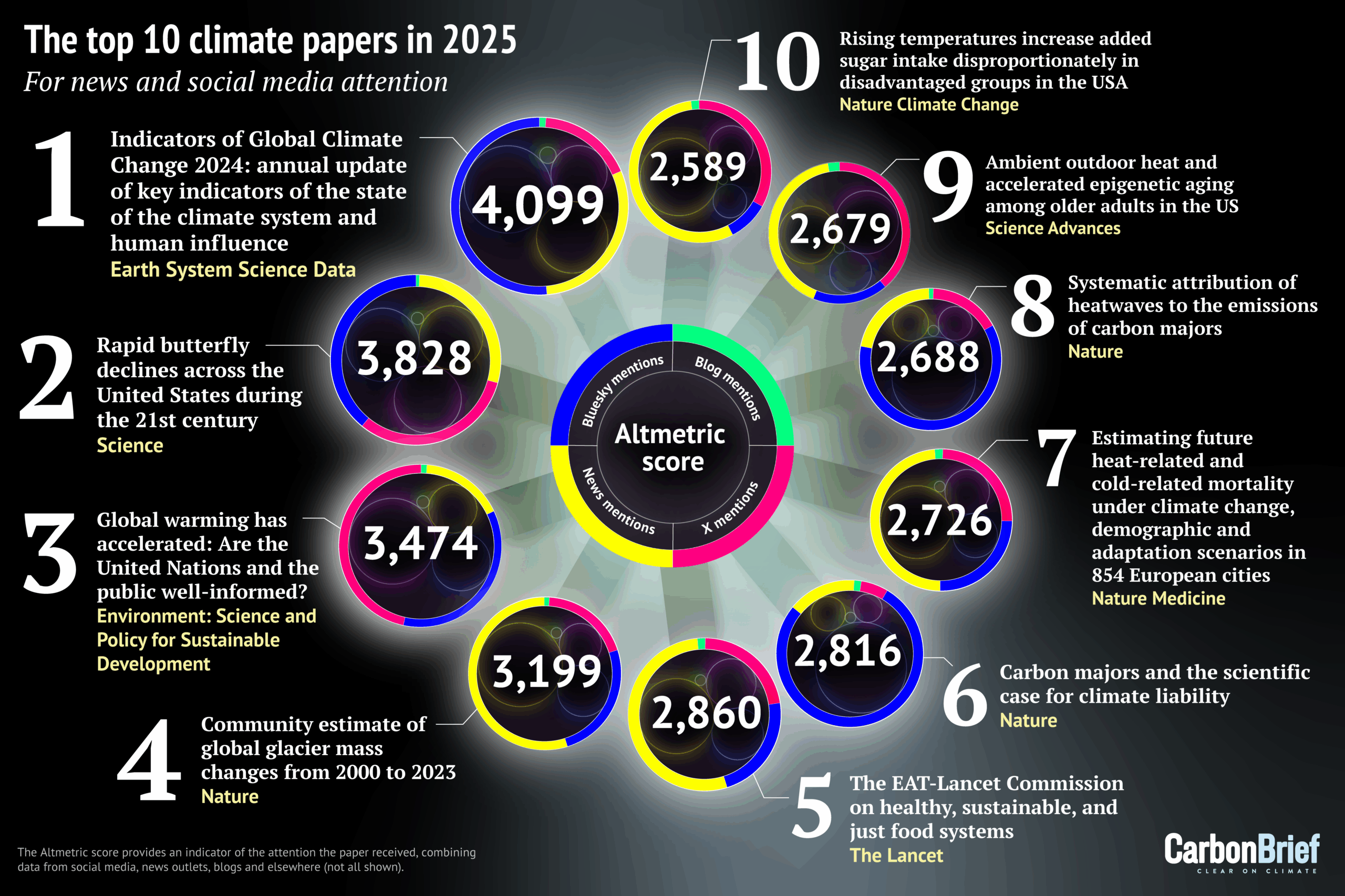
The top 10 – shown in the infographic above and list below – include research into declining butterflies, heat-related deaths, sugar intake and the massive loss of ice from the world’s glaciers:

  1. Indicators of Global Climate Change 2024: annual update of key indicators of the state of the climate system and human influence
  2. Rapid butterfly declines across the US during the 21st century
  3. Global warming has accelerated: Are the UN and the public well informed?
  4. Community estimate of global glacier mass changes from 2000 to 2023 
  5. The EAT-Lancet Commission on healthy, sustainable and just food systems 
  6. Carbon majors and the scientific case for climate liability 
  7. Estimating future heat-related and cold-related mortality under climate change, demographic and adaptation scenarios in 854 European cities 
  8. Systematic attribution of heatwaves to the emissions of carbon majors 
  9. Ambient outdoor heat and accelerated epigenetic aging among older adults in the US 
  10. Rising temperatures increase added sugar intake disproportionately in disadvantaged groups in the US

Later in this article, Carbon Brief looks at the rest of the top 25 and provides analysis of the most featured journals, as well as the gender diversity and country of origin of authors.

New for this year is the inclusion of Altmetric’s new “sentiment analysis”, which scores how positive or negative a paper’s social media attention has been.

(For Carbon Brief’s previous Altmetric articles, see the links for 202420232022202120202019201820172016 and 2015.) 

Global indicators

The top-scoring climate paper of 2025, ranking 24th of any research paper on any topic, is the annual update of the “Indicators of Global Climate Change” (IGCC) report.

The report was established in 2023 to help fill the gap in climate information between assessments of the Intergovernmental Panel on Climate Change (IPCC), which can take up to seven years to complete. It includes the latest data on global temperatures, the remaining carbon budget, greenhouse gas emissions and – for the first time – sea level rise. 
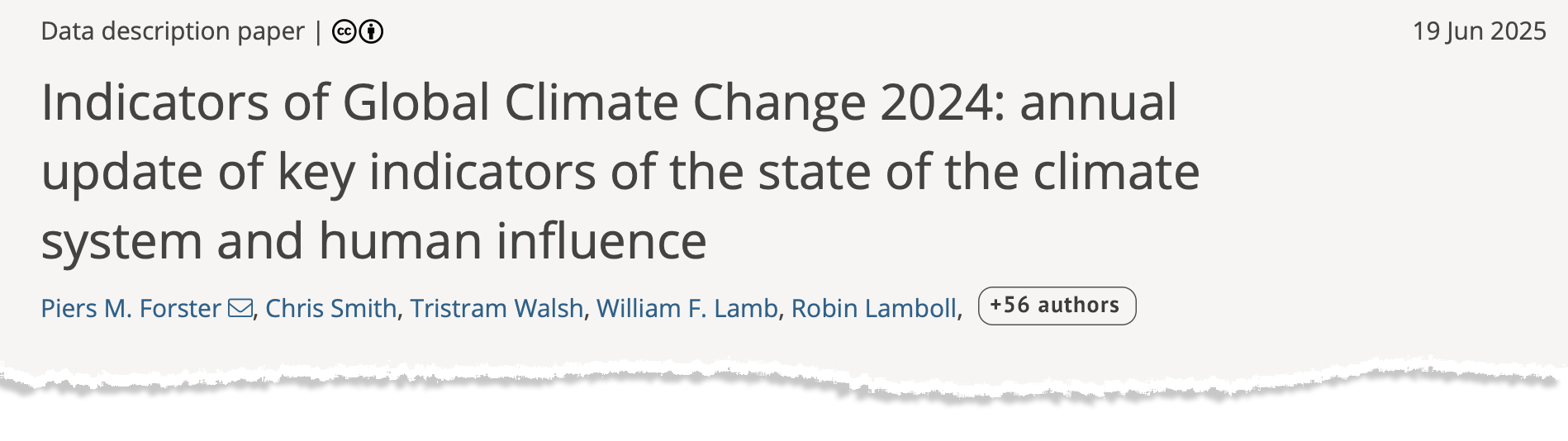
Ragout: Indicators of Global Climate Change 2024: annual update of key indicators of the state of the climate system and human influence

The paper, published in Earth System Science Data, has an Altmetric score of 4,099. This makes it the lowest top-scoring climate paper in Carbon Brief’s list since 2017.

(An Altmetric score combines the mentions that published peer-reviewed research has received from online news articles, blogs, Wikipedia and on social media platforms such as Facebook, Reddit, Twitter and Bluesky. See an earlier Carbon Brief article for more on how Altmetric’s scoring system works.)

Previous editions of the IGCC have also appeared in Carbon Brief’s list – the 2024 and 2023 iterations ranked 17th and 18th, respectively.

This year’s paper was mentioned 556 times in online news stories, including in the Associated PressGuardianIndependentHill and BBC News

Many outlets led their coverage with the study’s findings on the global “carbon budget”. This warned that the remaining carbon budget to limit warming to 1.5C will be exhausted in just three years if global emissions continue at their current rate.
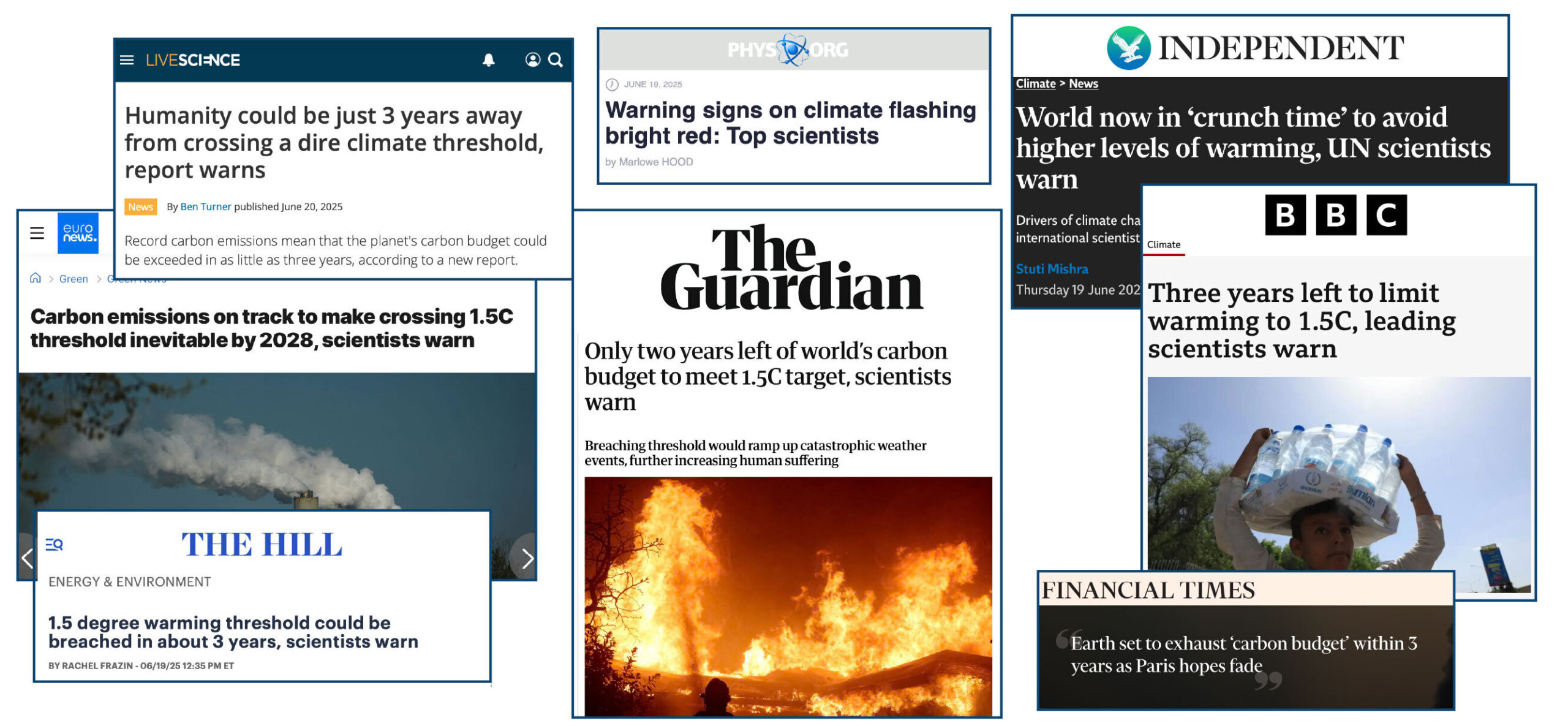
Headline_Montage

In a Carbon Brief guest post about the study, authors Prof Piers Forster and Dr Debbie Rosen from the University of Leeds wrote:

“It is also now inevitable that global temperatures will reach 1.5C of long-term warming in the next few years unless society takes drastic, transformative action…Every year of delay brings reaching 1.5C – or even higher temperatures – closer.”

Forster, who was awarded a CBE in the 2026 new year honours list, tells Carbon Brief that media coverage of the study was “great” at “putting recent extreme weather in the context of rapid long-term rates of global warming”. 

However, he adds:

“Climate stories are not getting the coverage they deserve or need at the moment so the community needs to get all the help we can for getting clear consistent messages out there.”

The paper was tweeted more than 300 times and posted on Bluesky more than 950 times. It also appeared in 22 blogs. 

Using AI, Altmetric now analyses the “sentiment” of this social media attention. As the summary figure below shows, the posts about this paper were largely positive, with an approximate 3:1 split of positive and negative attention.

Altmetric’s AI-generated summary of the sentiment of social media posts regarding the Forster et al.
Altmetric’s AI-generated summary of the sentiment of social media posts regarding the Forster et al. (2025) paper. Totals may add up to more than 100% because of rounding. Source: Altmetric

Butterfly decline

With an Altmetric score of 3,828, the second-highest scoring climate paper warns of “widespread” declines in butterfly numbers across the US since the turn of the century.

The paper, titled “Rapid butterfly declines across the US during the 21st century” and published in Science, identifies a 22% fall in butterfly numbers across more than 500 species between 2000 and 2020.

(There is a higher-scoring paper, “The 2025 state of the climate report: a planet on the brink”, in the journal BioScience, but it is a “special report” and was not formally peer reviewed.)
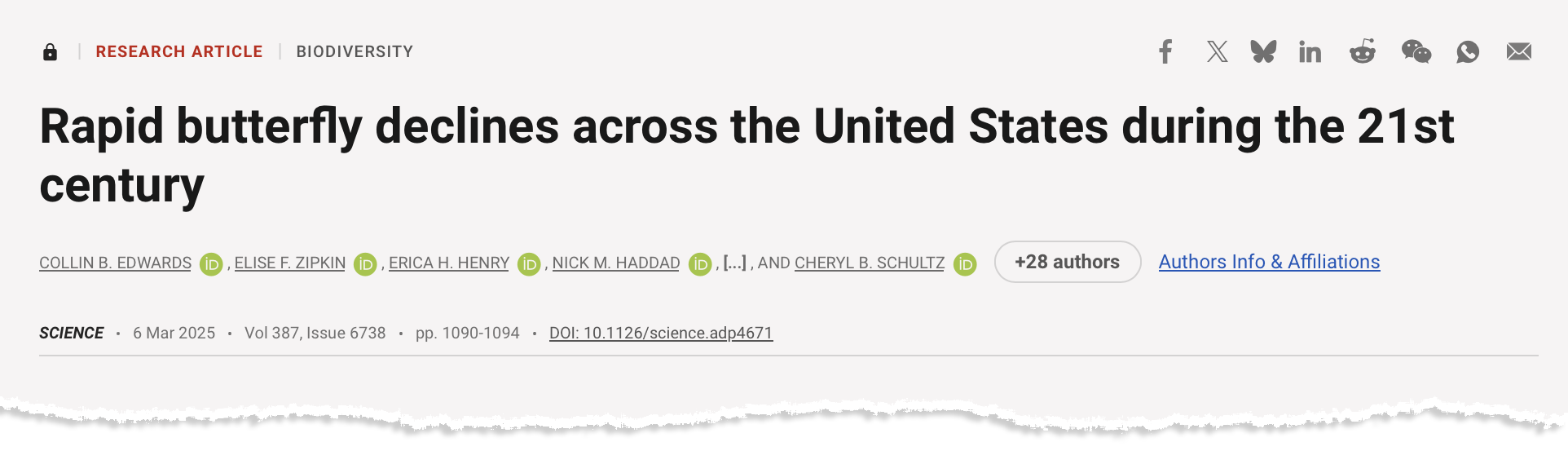
Ragout: Rapid butterfly declines across the United States during the 21st
century

The scale of the decline suggests “multiple and broadly acting threats, including habitat loss, climate change and pesticide use”, the paper says. The authors find that “species generally had stronger declines in more southerly parts of their ranges”, with some of the most negative trends in the driest and “most rapidly warming” US states.

The research was covered in 560 news articles, including the New York TimesGuardianAssociated PressNPREl País and BBC News. Much of the news coverage led with the 22% decline figure.

The paper was also mentioned in 13 blogs, more than 750 Bluesky posts and more than 600 tweets.

The sentiment analysis reveals that social media posts about the paper were largely negative. However, closer inspection reveals that this negativity is predominantly towards the findings of the paper, not the research itself. 

For example, a Bluesky post on the “distressing” findings by one of the study’s authors is designated as “neutral negative” by Altmetric’s AI analysis.

In a response to a query from Carbon Brief, Altmetric explains that the “goal is to measure how people feel about the research paper itself, not the topic it discusses”. However, in some cases the line can be “blurred” as the AI “sometimes struggles to separate the subject matter from the critique”. The organisation adds that it is “continuously working on improving our models to better distinguish between the post’s content and the research output”. 

Altmetric’s AI-generated summary of the sentiment of social media posts regarding the Forster et al.
Altmetric’s AI-generated summary of the sentiment of social media posts regarding the Forster et al. (2025) paper. Totals may add up to more than 100% because of rounding. Source: Altmetric

On the attention that the paper received, lead author Dr Collin Edwards of the Washington Department of Fish & Wildlife says that “first and foremost, people care about butterflies and our results are broad-reaching, unequivocal and, unfortunately, very concerning”. 

Edwards tells Carbon Brief he hopes the clarity of the writing made the paper accessible to readers, noting that he and his co-authors “sweat[ed] over every word”. 

The resulting news coverage “accurately captured the science”, Edwards says: 

“Much as I wish our results were less consistently grim, the consistency and simplicity of our findings mean that even if a news story only provides the highest level summary, it isn’t misleading readers by skipping some key caveat or nuance that changes the interpretation.”

Warming ‘acceleration’

In third place in Carbon Brief’s list for 2025 is the latest scientific paper from veteran climatologist Dr James Hansen, former director of the NASA Goddard Institute for Space Studies and now adjunct professor at Columbia University’s Earth Institute.

The paper, titled “Global warming has accelerated: Are the UN and the public well-informed?” was published in the journal Environment: Science and Policy for Sustainable Development. It generated an Altmetric score of 3,474.
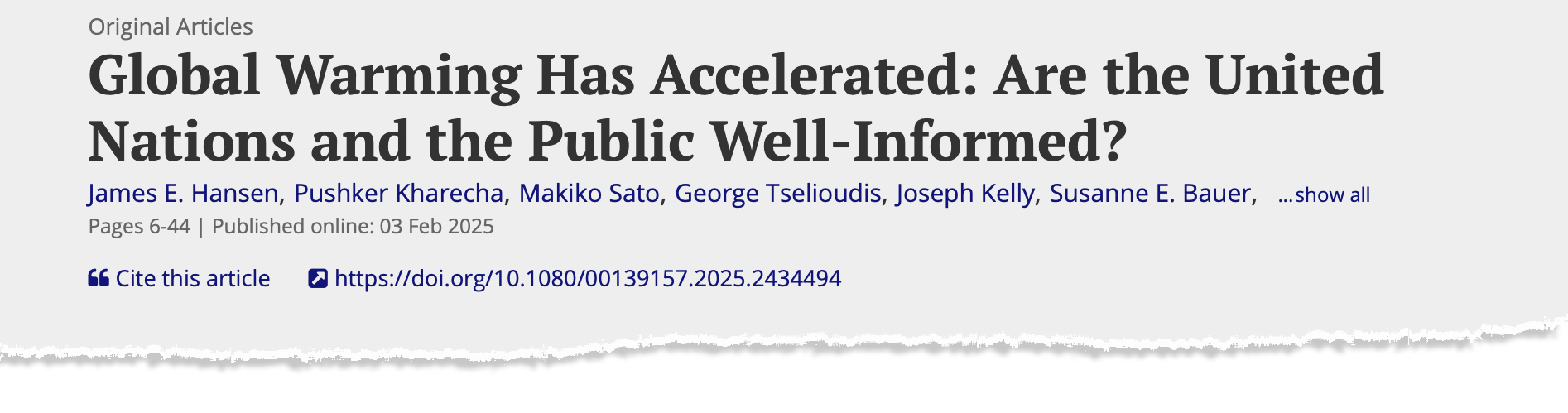
Ragout: Global Warming Has Accelerated: Are the United Nations and the Public Well-Informed

The study estimates that the record-high global temperatures in the last few years were caused by a combination of El Niño and a reduction in air pollution from international shipping

The findings suggest that the cooling effect of aerosols – tiny, light‑scattering particles produced mainly by burning fossil fuels – has masked more of the warming driven by greenhouse gases than previously estimated by the IPCC.

As efforts to tackle air pollution continue to reduce aerosol emissions, warming will accelerate further – reaching 2C by 2045, according to the research.

The paper was covered by almost 400 news stories – driven, in part, by Hansen’s comments in a press briefing that the Paris Agreement’s 2C warming limit was already “dead”. 

Hansen’s analysis received a sceptical response from some scientists. For example, Dr Valerie Masson-Delmotte, an IPCC co-chair for its most recent assessment report on climate science, told Agence France-Presse the research “is not published in a climate science journal and it formulates a certain number of hypotheses that are not consistent with all the available observations”.

In addition, other estimates, including by Carbon Brief, suggest new shipping regulations have made a smaller contribution to warming than estimated by Hansen.

Hansen tells Carbon Brief that the paper “did ok” in terms of media coverage, although notes “it’s on [scientists] to do a better job of making clear what the core issues are in the physics of climate change”.

With more than 1,000 tweets, the paper scored highest in the top 25 for posts on Twitter. It was also mentioned in more than 800 Bluesky posts and on 27 blogs. 

The sentiment analysis suggests that these posts were largely positive, with just a small percentage of negative comments.

Altmetric’s AI-generated summary of the sentiment of social media posts regarding the Hansen et al.
Altmetric’s AI-generated summary of the sentiment of social media posts regarding the Hansen et al. (2025) paper. Totals may add up to more than 100% because of rounding. Source: Altmetric

Making the top 10

Ranking fourth in Carbon Brief’s analysis is a Nature paper calculating changes in global glacier mass over 2000-23. The study finds glaciers worldwide lost 273bn tonnes of ice annually over that time – with losses increasing by 36% between 2000-11 and 2012-23.

The study has an Altmetric score of 3,199. It received more news coverage than any other paper in this year’s top 25, amassing 1,187 mentions. with outlets including the GuardianAssociated Press and Economic Times

At number five, with an Altmetric score of 2,860, is the EAT-Lancet Commission on healthy, sustainable and just food systems.

Carbon Brief’s coverage of the report highlights that “a global shift towards ‘healthier’ diets could cut non-CO2 greenhouse gas emissions, such as methane, from agriculture by 15% by 2050”. It adds:

“The findings build on the widely cited 2019 report from the EAT-Lancet Commission – a group of leading experts in nutrition, climate, economics, health, social sciences and agriculture from around the world.”

Also making the top 10 – ranking sixth and eighth – are a pair of papers published in Nature, which both link extreme heat to the emissions of specific “carbon majors” – large producers of fossil fuels, such as ExxonMobil, Shell and Saudi Aramco,.

The first is a perspective, titled “Carbon majors and the scientific case for climate liability”, published in April. It begins:

“Will it ever be possible to sue anyone for damaging the climate? Twenty years after this question was first posed, we argue that the scientific case for climate liability is closed. Here we detail the scientific and legal implications of an ‘end-to-end’ attribution that links fossil fuel producers to specific damages from warming.”

The authors find “trillions (of US$) in economic losses attributable to the extreme heat caused by emissions from individual companies”.

The paper was mentioned 1,329 times on Bluesky – the highest in this year’s top 25. It was also mentioned in around 270 news stories.

Published four months later, the second paper uses extreme event attribution to assess the impact of climate change on more than 200 heatwaves recorded since the year 2000.

The authors find one-quarter of the heatwaves would have been “virtually impossible” without human-caused global warming. They add that the heatwaves were, on average, 1.7C hotter due to climate change, with half of this increase due to emissions stemming from the operations and production of carbon majors. 

This study was mentioned in almost 300 news stories – including by Carbon Brief – as well as 222 tweets and 823 posts on Bluesky.

In seventh place is a Nature Medicine study, which quantifies how heat-related and cold-related deaths will change over the coming century as the climate warms. 

A related research briefing explains the main findings of the paper:

“Heat-related deaths are estimated to increase more rapidly than cold-related deaths are estimated to decrease under future climate change scenarios across European cities. An unrealistic degree of adaptation to heat would be required to revert this trend, indicating the need for strong policies to reduce greenhouse gases emissions.”

The paper was mentioned 345 times in the news, including in the Financial TimesNew ScientistGuardian and Bloomberg.

The paper in ninth place also analyses the health impacts of extreme heat. The study, published in Science Advances, finds that extreme heat can speed up biological ageing in older people. 

Rounding out the top 10 is a Nature Climate Change study, titled “Rising temperatures increase added sugar intake disproportionately in disadvantaged groups in the US”. 

The study finds that at higher temperatures, people in the US consume more sugar – mainly due to “higher consumption of sugar-sweetened beverages and frozen desserts”. The authors project that warming of 5C would drive additional sugar consumption of around 3 grams per day, “with vulnerable groups at an even higher risk”.

Elsewhere in the top 25

The rest of the top 25 includes a wide range of research, from “glacier extinction” and wildfires to Amazon drought and penguin guano.

In 13th place is a Nature Climate Change study that finds the wealthiest 10% of people – defined as those who earn at least €42,980 (£36,605) per year – contributed seven times more to the rise in monthly heat extremes around the world than the global average.

The authors also explore country-level emissions, finding that the wealthiest 10% in the US produced the emissions that caused a doubling in heat extremes across “vulnerable regions” globally. 

(See Carbon Brief’s coverage of the paper for more details.)

In 15th place is the annual Lancet Countdown on health and climate change – a lengthy report with more than 120 authors.

The study warns that “climate change is increasingly destabilising the planetary systems and environmental conditions on which human life depends”.

This annual analysis from the Lancet often features in Carbon Brief’s top 25 analysis. After three years in the Carbon Brief’s top 10 over 2020-23, the report landed in 20th place in 2023 and missed out on a spot in the top 25 altogether in 2024. 

In 16th place is a Science Advances study, titled “Increasing rat numbers in cities are linked to climate warming, urbanisation and human population”. The study uses public complaint and inspection data from 16 cities around the world to estimate changes in rat populations.

It finds that “warming temperatures and more people living in cities may be expanding the seasonal activity periods and food availability for urban rats”.

The study received 320 new mentions, including in the Washington PostNew Scientist and National Geographic.

In 21st place is a Nature Climate Change paper, titled “Peak glacier extinction in the mid-21st century”. The study authors “project a sharp rise in the number of glaciers disappearing worldwide, peaking between 2041 and 2055 with up to ~4,000 glaciers vanishing annually”.

Completing the top 25 is a Nature study on the “prudent planetary limit for geological carbon storage” – where captured CO2 is injected deep underground, where it can stay trapped for thousands of years. 

In a Carbon Brief guest post, study authors Dr Matthew Gidden and Prof Joeri Rogelj explain that carbon dioxide removal will only be effective at limiting global temperature rise if captured CO2 is injected “deep underground, where it can stay trapped for thousands of years”. 

The guest post warns that “geological carbon storage is not limitless”. It states that “if all available safe carbon storage capacity were used for CO2 removal, this would contribute to only a 0.7C reduction in global warming”. 

Top journals

The journal Nature dominates Carbon Brief’s top 25, with seven papers featured.

Many other journals in the Springer Nature stable also feature, including Nature Climate Change (three), Communications Earth & Environment (two), as well as Nature Ecology & Evolution, Nature Medicine and Nature Reviews Earth & Environment (one each).

Also appearing more than once in the top 25 are Science Advances (three), Science (two) and the Lancet (two). 

This is shown in the graphic below.
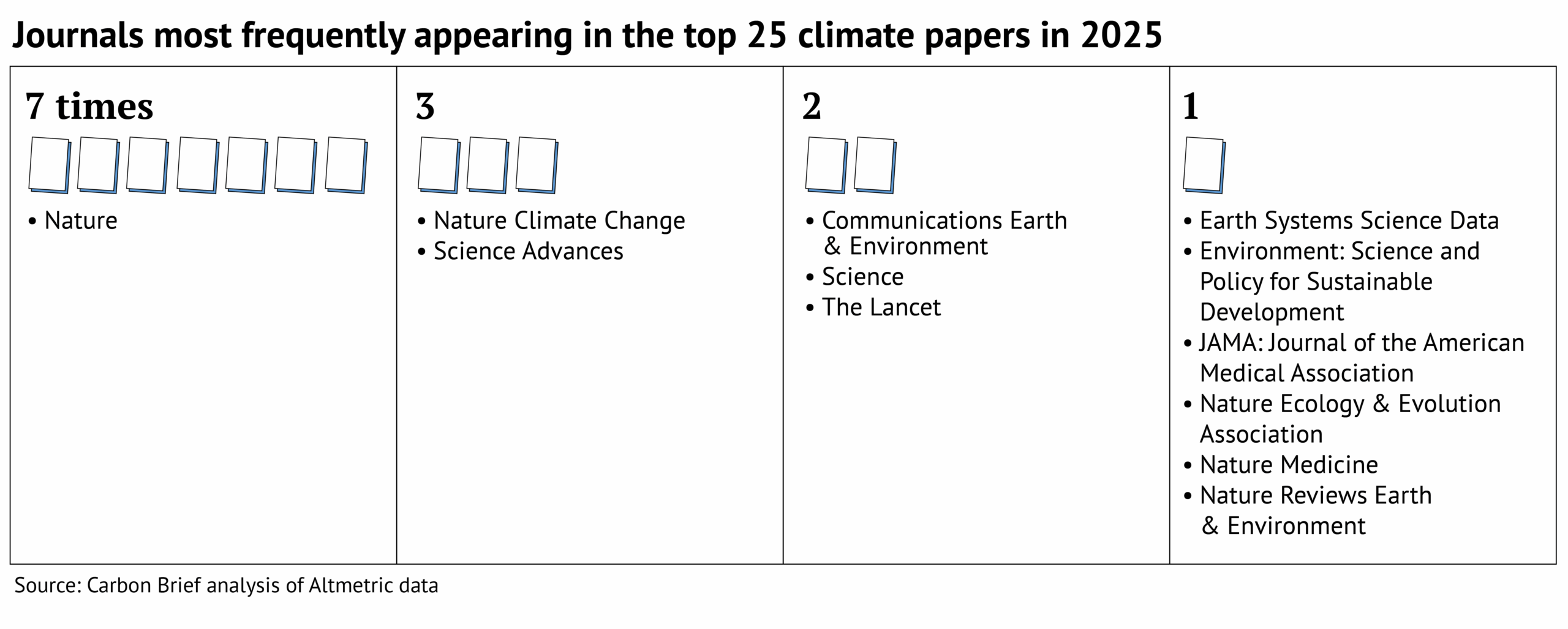
Graphic: Journals most frequently appearing in the top 25 climate papers in 2025

All the final scores for 2025 can be found in this spreadsheet.

Diversity in the top 25

The top 25 climate papers of 2025 cover a huge range of topics and scope. However, analysis of their authors reveals a distinct lack of diversity.

In total, the top 25 includes more than 650 authors – the highest number since Carbon Brief began this analysis in 2022.

This is largely due to a few publications with an exceptionally high number of authors. For example, the 2025 report of the Lancet Countdown on health and climate change has almost 130 authors alone, accounting for almost one-fifth of authors in this analysis. 

Carbon Brief recorded the gender and country of affiliation for each of these authors. (The methodology used was developed by Carbon Brief for analysis presented in a special 2021 series on climate justice.)

The analysis reveals that 88% of the authors of the climate papers most featured in the media in 2025 are from institutions in the global north. 

Global South: The “global south” is a term used to broadly describe lower-income countries in regions such as Africa, Asia and Latin America. It is often used to denote nations that are either in… Read More

Carbon Brief defines the global north as North America, Europe, Japan, Australia and New Zealand. It defines the global south as Asia (excluding Japan), Africa, Oceania (excluding Australia and New Zealand), Latin America and the Caribbean.

The analysis shows that 53% of authors are from European institutions, while only 1% of authors are from institutions in Africa.

Further data analysis shows that there are also inequalities within continents. The map below shows the percentage of authors from each country, where dark blue indicates a higher percentage. Countries that are not represented by any authors in the analysis are shown in grey.
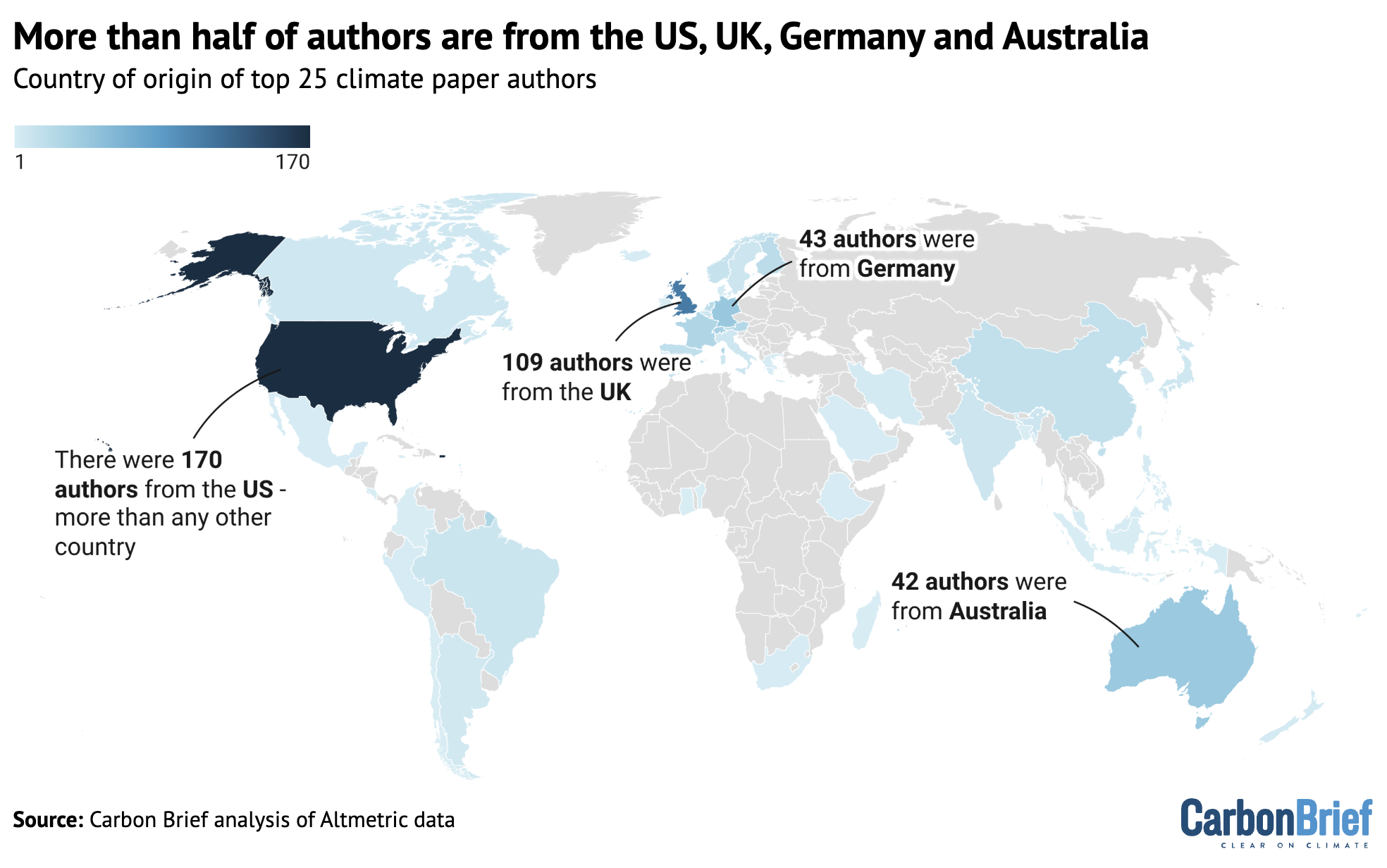
The number of all authors from the climate papers most featured in the media in 2025.
The number of all authors from the climate papers most featured in the media in 2025. The designations employed and the presentation of the material on this map do not imply the expression of any opinion whatsoever on the part of Carbon Brief concerning the legal status of any country, territory, city or area or of its authorities, or concerning the delimitation of its frontiers or boundaries. Map by Carbon Brief using Datawrapper.

The top-ranking countries on this map are the US and the UK, which account for 26% and 16% of the authors, respectively.

Carbon Brief also analysed the gender of the authors. 

Only one-third of authors from the top 25 climate papers of 2025 are women and only five of the 25 papers list a woman as lead author.

The plot below shows the number of authors from each continent, separated into men (dark blue) and women (light blue).
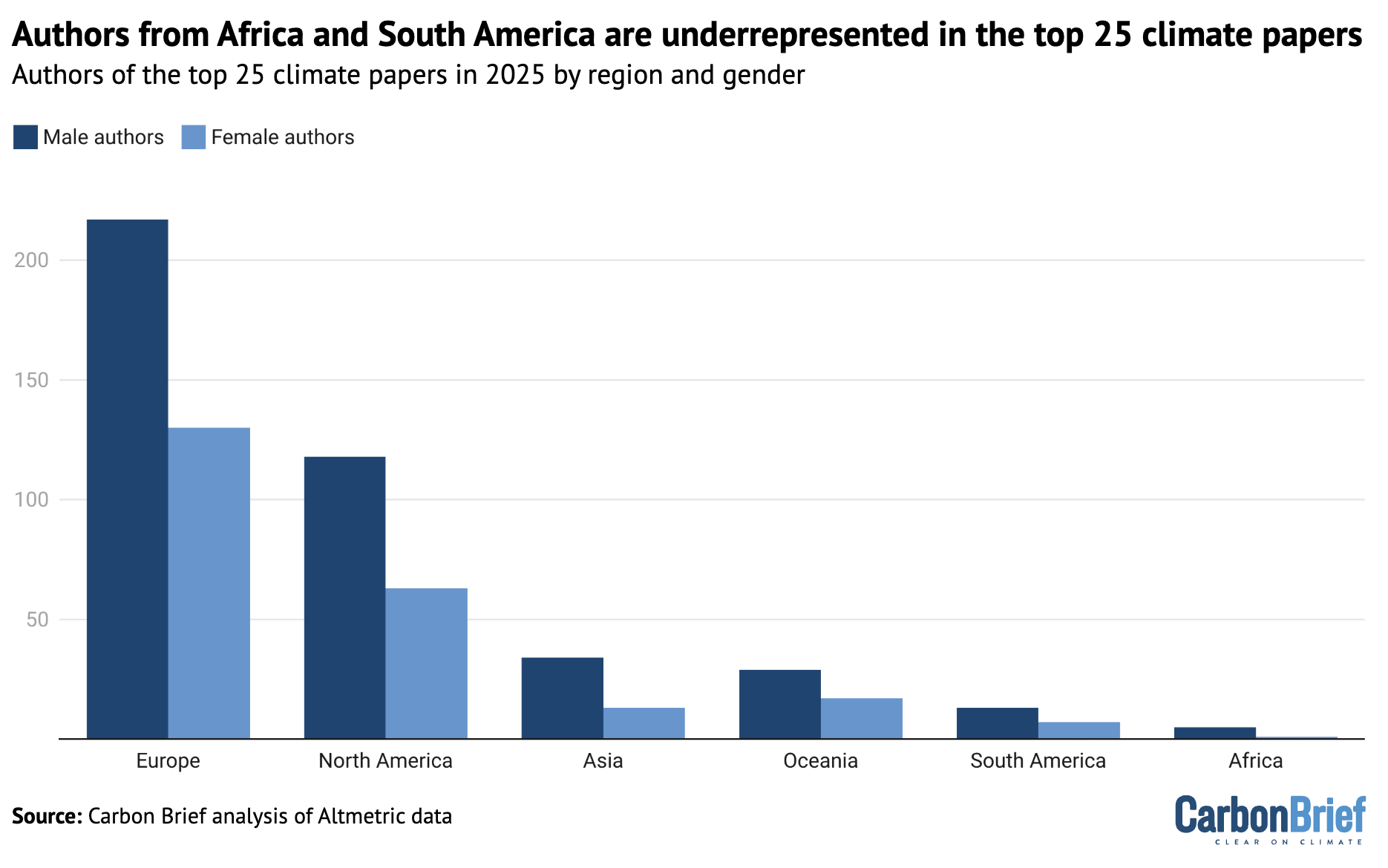
The number of men (dark blue) and women (light blue) listed as authors in the climate papers most featured in the media in 2025, shown by continent.
The number of men (dark blue) and women (light blue) listed as authors in the climate papers most featured in the media in 2025, shown by continent. Chart by Carbon Brief using Datawrapper.

The full spreadsheet showing the results of this data analysis can be found here. For more on the biases in climate publishing, see Carbon Brief’s article on the lack of diversity in climate-science research.

Elon Musk urges you to be a Fascist like him, says that you can ignore facts and reality then.
Donald Trump urges you to be a Climate Science denier like him. He says that he makes millions and millions for destroying the planet, Burn, Baby, Burn and Flood, Baby, Flood.
Orcas discuss Donald Trump and the killer apes' concept of democracy. Front Orca warns that Trump is crashing his country's economy and that everything he does he does for the fantastically wealthy.
Orcas discuss Donald Trump and the killer apes’ concept of democracy. Front Orca warns that Trump is crashing his country’s economy and that everything he does he does for the fantastically wealthy.

Original article republished from Carbon Brief under a CC license

Continue ReadingAnalysis: The climate papers most featured in the media in 2025

2025: Illegal Israeli settlement expansion in occupied West Bank hits record high

Spread the love

This work by Middle East Monitor is licensed under a Creative Commons Attribution-NonCommercial-ShareAlike 4.0 International License

A general view from Cebel al-Baba (Mount Baba) area following Israeli far-right Finance Minister Bezalel Smotrich’s approval of the “E1” project in Jerusalem on August 15, 2025. [ Issam Rimawi – Anadolu Agency]

2025 closed as a record-breaking year for illegal Israeli settlement expansion in the occupied West Bank, with Israel’s far-right coalition approving an unprecedented number of new settlements and housing projects – a push rights groups say is aimed at annexing the territory and blocking Palestinian statehood.

According to Israeli settlement watchdog Peace Now, the approvals finalized this year capped an acceleration that began under the current government, surpassing any period since the Oslo Accords were signed in 1993.

“This is nothing to compare to previous governments,” Yonatan Mizrachi of Peace Now’s Settlement Watch Team told Anadolu.

“The goal of this government … is to prevent a political solution based on a two-state solution,” he said.

41 settlements approved in 2025

Peace Now said plans for 41 new illegal settlements were approved in 2025, making it the most extensive single year of settlement approvals on record. The figure includes both newly announced settlements and the retroactive legalization of previously unauthorized outposts.

In May, Israel’s Security Cabinet approved the construction of 22 new illegal settlements on Palestinian land in the occupied West Bank – the largest expansion in decades.

The move included the reestablishment of settlements in Homesh and Sa-Nur, which were dismantled under Israel’s 2005 unilateral disengagement from the Gaza Strip.

On Dec. 21, the Security Cabinet approved an additional plan to legalize 19 more settlements in the occupied West Bank, some newly established and others long-standing outposts now granted formal status.

READ: 14 countries urge Israel to halt settlement construction in West Bank

Mizrachi said the current government moved quickly after taking office, legalizing 10 outposts in early 2023 and transforming nine of them into settlements.

Outposts are illegal even under Israeli law, while settlements are considered legal by Israel despite being illegal under international law.

Altogether, 68 settlements have been approved, legalized or initiated over the past three years, Peace Now said.

“This does not mean that all 68 settlements have already been established” Mizrachi said. “It means the process has begun – with government support, different planning committees and authorities.”

Spread across entire West Bank

The expansion is geographically wide-ranging, extending into areas where no settlements previously existed.

“Sixty-eight settlements that will be built according to the Israeli plan from the south to the north or from the north to the south,” said Mizrachi. “Including areas that today we don’t have any settlements like areas around Jenin, around Hebron.”

“It’s all over the West Bank actually,” he added.

In early 2023, there were more or less 140 settlements in the occupied West Bank, Mizrachi said. With recent approvals, that number has risen to 208.

The total number of Israeli settlers in East Jerusalem and the West Bank now stands at about 750,000.

Settlement expansion has also accelerated through construction approvals.

Peace Now on its website said Israeli authorities advanced plans for 28,163 settler housing units in 2025 – the highest figure ever recorded.

On the final day of the year, Israeli authorities approved a plan allowing settlers to return to Sa-Nur, greenlighting 126 housing units at the site evacuated in 2005, according to Israeli media.

The move was enabled by amendments introduced by the current government to the Disengagement Law, lifting restrictions on Israeli presence in parts of the northern West Bank.

Peace Now said the approval marks a return to settlement activity deep inside the northern West Bank, in densely populated Palestinian areas where settlers had not previously been present.

Blocking Palestinian statehood

Mizrachi said settlement expansion is central to the government’s strategy to prevent Palestinian statehood without formally declaring annexation.

“In the last three years, Israel has taken many steps – bureaucratic steps, advancing settlements, developing the West Bank – to increase the number of Israeli settlers,” he said.

“The aim is to prevent a Palestinian state in any political solution, because there will be so many settlements and so many locations with an Israeli presence that it would be much more difficult to evacuate.”

READ: PA’s Abbas urges pressure on Israel to halt settlement expansion and settler terrorism

He said pressure from settler movements has intensified, pushing the government toward de facto annexation while avoiding a formal declaration due to international and US pressure.

B’Tselem, the Israeli Information Center for Human Rights in the Occupied Territories, spokesperson Yair Dvir said the settlement drive is accompanied by the forcible displacement of Palestinians.

“Israel continues to advance ethnic cleansing in the West Bank, both through the construction and retroactive legalization of outposts and new settlements, and through the forcible displacement of Palestinian communities and the violent takeover of vast areas of Palestinian lands,” he told Anadolu.

Concerns for 2026

Looking ahead, Mizrachi said settlement expansion is likely to continue into 2026, an election year in Israel.

“We are assuming that the advancing of settlement, house units, financial support to the settlers will continue in 2026 – it might increase or might not,” he said. “But definitely, the pattern that we have seen in the last three years will continue.”

He added that since October 2023, dozens of Palestinian communities have been forced to flee due to settler violence.

“Many times, an outpost is built next to the Palestinian community, making it more tense for the Palestinians to stay there,” he said. “We still see a lot of settler violence, much of it coming from illegal outposts.”

Mizrachi warned the trajectory is deepening instability.

“Instead of going toward a political solution that would mean withdrawing from the West Bank,” he said, “we are just going deeper into a more problematic situation.”

READ: Israel’s direct damage to vital sectors in Gaza exceeds $33B in 2025: Gaza government

This work by Middle East Monitor is licensed under a Creative Commons Attribution-NonCommercial-ShareAlike 4.0 International License

Keir Starmer objects to criticism of the IDF. He asks how could anyone object to them starving people to death, forced marches like the Nazis did, bombing Gaza's hospitals and universities, mass-murdering journalists, healthworkers and starving people queuing for food, killing and raping prisoners and murdering children. He calls for people to stop obstructing his genocide for Israel.
Keir Starmer objects to criticism of the IDF. He asks how could anyone object to them starving people to death, forced marches like the Nazis did, bombing Gaza’s hospitals and universities, mass-murdering journalists, healthworkers and starving people queuing for food, killing and raping prisoners and murdering children. He calls for people to stop obstructing his genocide for Israel.
Orcas discuss Genocide-supporting and complicit Zionists. Donald Trump, Keith Starmer, David Lammy, Rachel Reeves, Angela Rayner and Wes Streeting are acknowledged as evil genocide-complicit and supporting cnuts.
Vote Labour for Genocide.

Continue Reading2025: Illegal Israeli settlement expansion in occupied West Bank hits record high

Heroes & Villains of 2025

Spread the love

https://morningstaronline.co.uk/article/heroes-villains-2025

 Francesca Albanese, United Nations special rapporteur on the Occupied Palestinian Territories (left) and (right) Robert Jenrick
The Morning Star sorts the good eggs from the rotten scoundrels of the year just gone

Heroes

The Birmingham Bin Strikers

Their struggle matters to us all: the largest local authority in the country seeks to tackle its financial problems by attacking the pay and conditions of its workforce, and if it gets away with it other councils will follow suit. 

Francesca Albanese

Sanctioned by US Secretary of State Marco Rubio in revenge for her UN report From an Economy of Occupation to an Economy of Genocide, her bank accounts have been frozen, and this UN special rapporteur is blacklisted and barred from the international banking system like a terrorist, forcing her to manage all transactions in cash. 

The Palestine solidarity movement

So many people deserve special mentions, but the entire movement must be honoured: the heroic hunger strikers putting their lives on the line for justice; the thousands risking 14-year prison terms to expose the absurdity of the government’s ban on Palestine Action by sitting down peacefully in public; the leading peace activists arrested and charged for organising mass demonstrations, including Palestine Solidarity Campaign director Ben Jamal and Stop the War Coalition vice-chair Chris Nineham; the millions who have marched or fundraised or spread the word about a genocide, who forced Trump to tell Netanyahu in October that he cannot “fight the world” and must concede a ceasefire.

The Campaign for Nuclear Disarmament

Under its new leader Sophie Bolt, CND has stepped up to the challenge across 2025, holding a tour bringing the arguments against rearmament to military bases across Britain and a fortnight’s peace camp in protest at Britain’s return to being Washington’s Air Strip One. 

Villains
 

“Tommy Robinson”

Stephen Yaxley-Lennon has disfigured the British political scene for years but 2025 has seen ominous new developments, from his sponsorship by the world’s richest man — far-right megalomaniac Elon Musk — to the largest far-right demonstration in British history that brought well over 100,000 onto the streets of London in September.

Sarah Pochin and Robert Jenrick

These two deserve public shaming for pushing the boundaries of explicit racism in public life: Pochin by complaining about the number of black people on telly and Jenrick with his no-white-faces-in-Handsworth drivel. Pure poison from two politicians we need to see the back of as soon as possible.

David Lammy

Lammy, because the so-called Justice Secretary is presiding over horrendous abuses of justice — refusing to meet lawyers for the Palestine Action hunger strikers, who are being held for months and years behind bars without trial, and now planning the withdrawal of the right to jury trials just as the police are getting into gear with mass arrests of obviously innocent people.

Donald Trump

The White House declares active support for far-right movements across the world (particularly in Europe), expresses open contempt for international law, blows up boats, killing their crews, in a murderous rampage across the Caribbean while seizing Venezuelan tankers in acts of naked piracy. And all while moving closer to war.

In the Middle East, Trump breaks new ground by publicly endorsing the ethnic cleansing of Palestine and has already joined a direct Israeli attack on Iran — just days ago he mooted another. 

See the original article at https://morningstaronline.co.uk/article/heroes-villains-2025

Orcas discuss Genocide-supporting and complicit Zionists. Donald Trump, Keith Starmer, David Lammy, Rachel Reeves, Angela Rayner and Wes Streeting are acknowledged as evil genocide-complicit and supporting cnuts.
Keir Starmer objects to criticism of the IDF. He asks how could anyone object to them starving people to death, forced marches like the Nazis did, bombing Gaza's hospitals and universities, mass-murdering journalists, healthworkers and starving people queuing for food, killing and raping prisoners and murdering children. He calls for people to stop obstructing his genocide for Israel.
Keir Starmer objects to criticism of the IDF. He asks how could anyone object to them starving people to death, forced marches like the Nazis did, bombing Gaza’s hospitals and universities, mass-murdering journalists, healthworkers and starving people queuing for food, killing and raping prisoners and murdering children. He calls for people to stop obstructing his genocide for Israel.
Genocide denying UK Foreign Secretary David Lammy says that UK is suspending 30 of 350 arms licences to Israel. He also confirms the UK government's support for Israel's Gaza genocide and the UK government and military's active participation in genocide.
Genocide denying UK Foreign Secretary David Lammy says that UK is suspending 30 of 350 arms licences to Israel. He also confirms the UK government’s support for Israel’s Gaza genocide and the UK government and military’s active participation in genocide.
Continue ReadingHeroes & Villains of 2025

No new North Sea drilling in 2025, new analysis finds

Spread the love

https://morningstaronline.co.uk/article/no-new-north-sea-drilling-2025-new-analysis-finds

 Campaigners from Oceana UK protest outside the Royal Courts of Justice in London, where the environmental group is taking the government to court over 31 licences for oil and gas exploration, March 26, 2025

NOT a single exploration well was drilled in North Sea waters in 2025 – the first year since oil and gas was discovered there in the 1960s, analysis finds.

Energy consultants Wood Mackenzie found oil and gas investment on the UK continental shelf, which stood at £4 billion this year, is set to plunge by more than 40 per cent in the next to £2.5bn, its lowest level for more than 50 years.

Greenpeace UK’s Paul Morozzo said: “This isn’t a temporary blip.

“The North Sea’s days as an oil and gas basin are coming to an end. Investment is falling because of physical constraints and decreased profitability.

“The real risk now is chasing a declining industry instead of preparing for what comes next. 

“Doubling down on oil and gas won’t protect jobs, energy security or household bills.

“It’s time the government took action on the cost of living crisis, as well as to protect us all against the worst impacts of climate change. 

“The way to do that is by investing in the industries of the future, not clinging to one that’s in terminal decline.”

https://morningstaronline.co.uk/article/no-new-north-sea-drilling-2025-new-analysis-finds

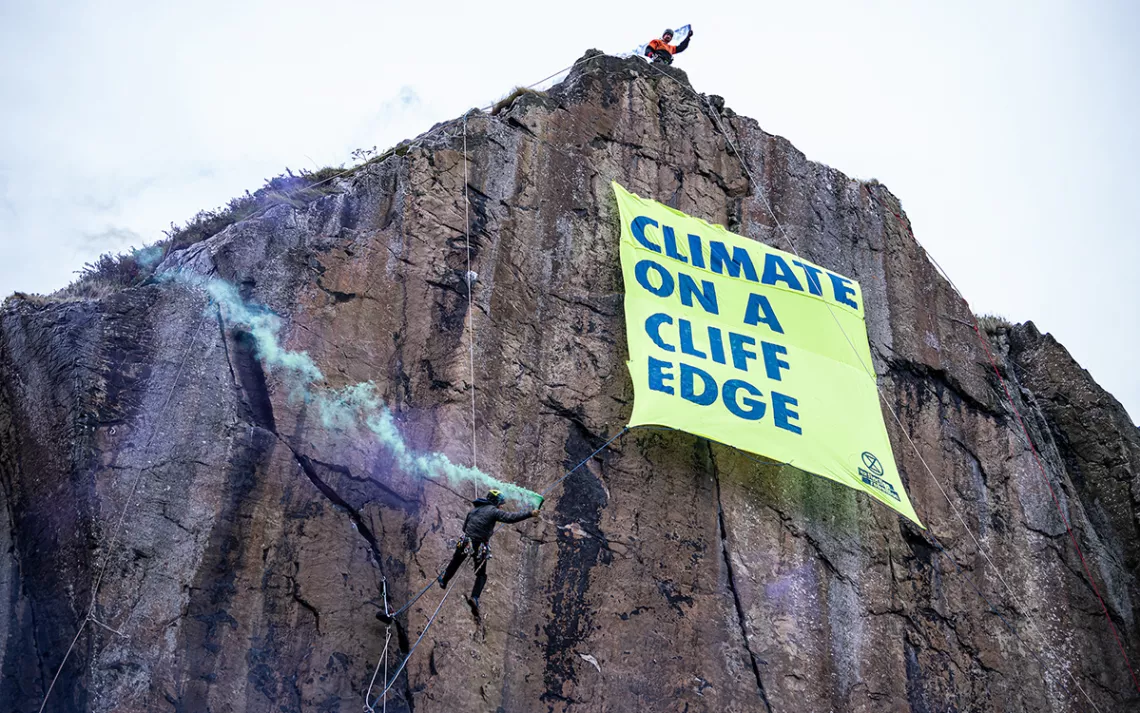
Experienced climbers scale a rock face near the historic Dumbarton castle in Glasgow, releasing a banner that reads “Climate on a Cliff Edge.” One activist, dressed as a globe, symbolically looms near the edge, while another plays the bagpipes on the shores below. | Photo courtesy of Extinction Rebellion and Mark Richards
Image of InBedWithBigOil by Not Here To Be Liked + Hex Prints from Just Stop Oil's You May Find Yourself... art auction. Featuring Rishi Sunak, Fossil Fuels and Rupert Murdoch.
Image of InBedWithBigOil by Not Here To Be Liked + Hex Prints from Just Stop Oil’s You May Find Yourself… art auction. Featuring Rishi Sunak, Fossil Fuels and Rupert Murdoch.
Continue ReadingNo new North Sea drilling in 2025, new analysis finds

Heat, drought and fire: how extreme weather pushed nature to its limits in 2025

Spread the love

https://www.theguardian.com/environment/2025/dec/29/extreme-weather-climate-change-2025-national-trust

The effects of a huge wildfire on Abergwesyn Common, mid Wales. Habitats for many species such as reptiles and birds were destroyed. Photograph: Chris Smith/National Trust

National Trust says these are ‘alarm signals we cannot ignore’ as climate breakdown puts pressure on wildlife

Extremes of weather have pushed nature to its limits in 2025, putting wildlife, plants and landscapes under severe pressure, an annual audit of flora and fauna has concluded.

Bookended by storms Éowyn and Bram, the UK experienced a sun-soaked spring and summer, resulting in fierce heath and moorland fires, followed by autumn floods.

The National Trust, which provides a snapshot of how the weather is hitting wildlife every Christmas, described it as a rollercoaster of conditions that tested nature’s resilience like never before in modern times.

Ben McCarthy, the head of nature conservation at the charity, said: “Heat, drought and fire are the defining headlines of 2025.

“Extremes in weather is nothing new, but the compounded impact of several drought years in a short period – 2018, 2022 and now 2025 – is putting untold strain on habitats and making life even more difficult for wildlife. These are alarm signals we cannot ignore, and we need to work faster, smarter and in a more joined-up way.”

https://www.theguardian.com/environment/2025/dec/29/extreme-weather-climate-change-2025-national-trust

Donald Trump urges you to be a Climate Science denier like him. He says that he makes millions and millions for destroying the planet, Burn, Baby, Burn and Flood, Baby, Flood.
Nigel Farage urges you to ignore facts and reality and be a climate science denier like him and his Deputy Richard Tice. He says that Reform UK has received £Millions and £Millions from the fossil fuel industry to promote climate denial and destroy the planet.
Elon Musk urges you to be a Fascist like him, says that you can ignore facts and reality then.
Continue ReadingHeat, drought and fire: how extreme weather pushed nature to its limits in 2025