Britain’s unearned wealth has ballooned – a modest capital tax could help avoid austerity and boost the economy

Spread the love
Canary Wharf in London. I Wei Huang/Shutterstock

Stewart Lansley, University of Bristol

Inheriting the worst set of public finances for decades, Labour was always going to face an uphill struggle trying to fund improvements to the UK’s public services.

Inflated debt and recent hikes in the cost of borrowing mean the government is faced with stark choices. For it will be difficult to meet the chancellor’s own tight fiscal rules without further tax rises or cuts in public spending.

But as the former chief economist at the Bank of England, Andy Haldane, has warned, further spending cuts would be “deeply counterproductive”.

One solution for avoiding ongoing austerity lies in raising a higher proportion of taxes from assets. For despite the UK enjoying a long personal wealth boom, little of this boom is the result of new wealth creation or higher productivity.

Much of it is unearned. Some is the product of corporate wealth extraction, where dividend payments and personal fortunes have have been prioritised over the long-term health of a company. Some privatised water firms, for example, have been turned into cash cows for their owners.

Another large part of British unearned wealth is the product of state-induced asset inflation. Since 1999, house prices in England have risen almost three times faster than incomes.

This kind of asset inflation is a classic example of “passive accumulation”. Or, as the 19th-century philosopher John Stuart Mill described it, getting rich in your sleep.

As a result, household wealth currently stands at over six times the UK’s GDP. It was three times in the 1970s.

Yet while Britain is asset rich, its tax system is heavily based on earnings from work. Taxes on income from dividends, capital gains and inheritance make a tiny contribution to the public purse.

This is a fundamental flaw of the tax system which does little to dent the growing concentration of wealth owned by the few. Through political inertia, the tax system has failed to catch up with the growing importance of wealth over income.

Inherit the earth?

The fallout from the low taxation on wealth is well illustrated by the role of inheritance.

Levels of wealth passed on after death in the UK have been rising sharply. Over the next three decades, some millennials are expected to inherit a staggering £5.5 trillion, dwarfing all previous transfers of wealth between generations.

The lion’s share of this transfer will go to the most affluent. The lifetime wealth of those with parents in the richest fifth will see their wealth grow by 29% – compared with 5% for those born to the poorest fifth.

This will only intensify the reproduction of the wealth divide of the past.

Extending the tax base is not just about fairness or revenue raising. Asset holdings are often little more than unused resources, while big inter-generational wealth transfers can play a counterproductive role in the economy.

Over a third of the UK’s wealth is stored in property (with the rest in pensions, savings and possessions). This is mostly only realised when passed on through inheritance , where its benefits accrue to the already privileged. Little of this process contributes to more productive activity, with one of its most malign effects being to fuel higher house prices, because the money is largely reinvested in property.

The unfairness of inherited wealth has long been recognised. The patron saint of economics, Adam Smith called it “manifestly absurd”.

Tractors in London street.
Farmers have protested against Labour’s plans for inheritance tax. Mark Anthony Ray/Shutterstock

A modest and phased rise in capital taxation would help to reduce the passive role played by wealth holdings. Even small changes would release funds which could be used to improve social infrastructure from schools to hospitals.

One approach would be to build on the existing tax system through higher rates and fewer reliefs and loopholes. The second would be to introduce new taxes.

In her first budget, Rachel Reeves took steps to raise revenue through the first option, from both inheritance and capital gains tax. But these were too modest to alter the overwhelming dominance of tax on earnings.

A more fundamental shift would be to reform the existing system of council tax with a larger number of tax bands at the top. Still based on 1991 property values, this is perhaps the least defensible tax in Britain. The most effective alternative would be to replace council tax and stamp duty with a single proportionate “property tax”.

Another option would be for a modest annual 1% tax on wealth over £2 million, which has the potential to raise around £16 billion a year, or double that on wealth over £1 million.

Such a measure could be sold politically as a “solidarity tax” to help pay for the things the UK needs. And while governments have been wary of the political reaction to higher taxes on wealth, the tide is turning.

Those supporting higher taxes on wealth include the Conservative-aligned think tank Bright Blue and an influential campaign group called the Patriotic Millionaires. There is also growing public support.

Continued public spending austerity would drive more years of stagnation. It would also be politically suicidal for this government, as it was for Labour in 1931 and in the 1970s. But harnessing a little more of the country’s immense private wealth would make the tax system more equitable and by providing the resources to boost social investment, ease the path to economic recovery.

Stewart Lansley, Visiting Fellow, School of Policy Studies, University of Bristol

This article is republished from The Conversation under a Creative Commons license. Read the original article.


Continue ReadingBritain’s unearned wealth has ballooned – a modest capital tax could help avoid austerity and boost the economy

Right-Wing Sleuths Find the LA Fires Culprit: Once Again, It’s Wokeness

Spread the love

Original article by Ari Paul republished from FAIR under a Creative Commons Attribution-NonCommercial-NoDerivs 3.0 Unported License.

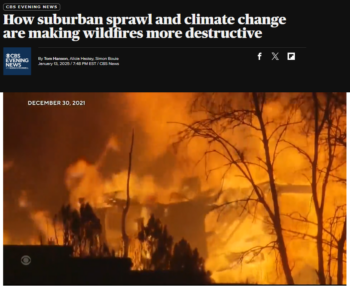
CBS Evening News (1/13/25) cited Colorado’s 2021 Marshall Fire as another example of how climate disruption is making wildfires more destructive.

The devastation of the ongoing Los Angeles fires is an alarm going off, but also the result of society having hit the snooze button long ago (Democracy Now!1/9/25CBS1/13/25). Game-changing fires destroyed Paradise, California (NPR11/8/23), in 2023, and Lahaina, Hawaii, in 2024—clear warnings, if any were still needed, that the climate catastrophe had arrived.

“The evidence connecting the climate crisis and extreme wildfires is clear,” the Nature Conservancy (7/9/24) said. “Increased global temperatures and reduced moisture lead to drier conditions and extended fire seasons.”

The scientific journal Fire Ecology (7/24/23) reported that “climate change is expected to continue to exacerbate impacts to forested ecosystems by increasing the frequency, size and severity of wildfires across the western United States.”

Now we are watching one of America’s largest cities burn. It’s a severe reminder that the kind of disruption we experienced in the beginning of the Covid pandemic in 2020 is the new normal under climate change.

The right-wing media, however, have found a culprit—it’s not climate change, but Democratic Party–led wokeness. The coverage demonstrates once again that the W-word can be used to blame literally anything in the Murdoch fantasyland.

‘Preoccupation With DEI’

Alyssia Finley (Wall Street Journal1/12/25): “A cynic might wonder if environmentalists interfered with fire prevention in hope of evicting humans.” Another cynic might wonder if the Journal publishes smears without evidence as part of its business model.

“Megyn Kelly sounded off on Los Angeles Fire Department Chief Kristin Crowley and Mayor Karen Bass,” the New York Post (1/8/25) reported. Former Fox News host Kelly said “that the officials’ preoccupation with diversity, equity and inclusion [DEI] programs distracted them from the city’s fire-combating duties.”

Wall Street Journal editorial board member Allysia Finley (1/12/25) echoed the charge: “Bloated union contracts and DEI may not have directly hampered the fire response, but they illustrate the government’s wrongheaded priorities.” In other words, the paper didn’t have evidence to blame the fires on firefighter salaries or department diversity, but decided to insinuate as much anyway.

Other conservative journalists were more direct, like CNN pundit Scott Jennings, who went on CNN NewsNight (1/8/25) to assert:

As a matter of public policy in California, the main interest in the fire department lately has been in DEI programming and budget cuts, and now we have this massive fire, and people are upset.

As the Daily Beast (1/9/25) noted, “His response was part of a Republican kneejerk reaction that included President-elect Donald Trump blaming ‘liberals’ and state Gov. Gavin Newsom.”

The Washington Post (1/10/25) reported that Trump-supporting X owner Elon Musk

has been inundating his 212 million followers with posts casting blame for the blazes on Democrats and diversity policies, amplifying narratives that have taken hold among far-right activists and Republican leaders.

Liel Leibovitz, editor-at-large at the conservative Jewish magazine Tablet, blamed the LA devastation on the “woke religion” (New York Post1/9/25).

“There are many things we’ve learned that the Los Angeles Fire Department needs—and more women firefighters isn’t one of them,” moaned National Review editor-in-chief Rich Lowry (New York Post1/15/25). “Los Angeles for years has been in the grips of a bizarre obsession with recruiting more women firefighters.”

Blaming gay singers

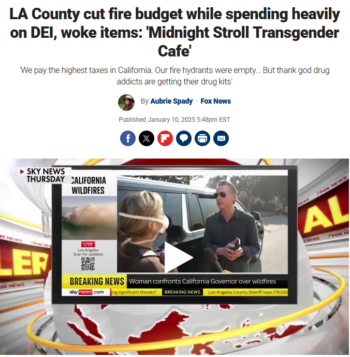
Mentioned by Fox News (1/10/25): $13,000 allocated to Lesbian, Gay, Bisexual and Transgender Heritage Month programs. Not mentioned by Fox News: a $126 million boost to the LAPD budget.

Fox & Friends (1/9/251/9/25) blamed the city’s Democratic leaders and the fire chief for the destruction. Fox News Digital (1/10/25) said:

While Los Angeles officials were stripping millions in funding from their fire department ahead of one of the most destructive wildfires in state history, hundreds of thousands of dollars were allocated to fund programs such as a “Gay Men’s Chorus” and housing for the transgender homeless.

You may notice the shift from “millions” to “hundreds of thousands”—the latter, obviously, can’t explain what happened to the former. What can far better explain it is that the city focused much more on funding cops than firefighters (Intercept1/8/25). The mayor’s budget plan offered “an increase of more than $138 million for the Los Angeles Police Department; and a decrease of about $23 million for the LA Fire Department” (KTTV4/22/24). KABC (1/9/25) reported more recent numbers, saying the “fire department’s budget was cut by $17.6 million,” while the “city’s police department budget increased by $126 million,” according to the city’s controller.

And in 2023, the LA City Council approved salary increases for cops over objections that these pay boosts “would pull money away from mental health clinicians, homeless outreach workers and many other city needs” (LA Times8/23/23). The cop-pay deal was reportedly worth $1 billion (KNBC8/23/23).

LAFD cuts under Mayor Bass were, in fact, big news (KTTV1/15/25). Fox overlooked the comparison with the police, one regularly made by city beat reporters who cover public safety and city budgets, and went straight to blaming gay singers.

Crusade against ‘woke’

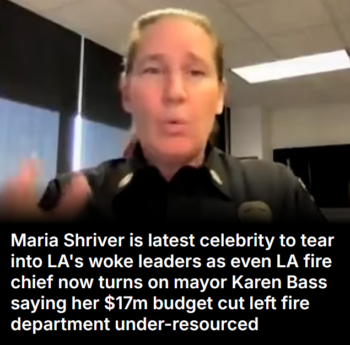
Contrary to the Daily Mail‘s headline (1/14/25), former California first lady Maria Shriver Maria Shriver did not “tear into LA’s woke leaders”; rather, she complained about LA’s insufficient funding of public needs.

Or take the Daily Mail (1/14/25), a right-wing British tabloid with a huge US footprint, whose headline said former California first lady “Maria Shriver Is Latest Celebrity to Tear Into LA’s Woke Leaders.” But the story went on to say that Shriver had decried the cuts to the LAFD, citing no evidence that she was fighting some culture war against women firefighters.

Shriver, the ex-wife of actor and former California Gov. Arnold Schwarzenegger, was pointing the finger at austerity and calling for more public spending. In other words, Shriver was siding with LAFD Chief Kristin Crowley, who had complained that city budget cuts had failed her department (CNN1/12/25). The Mail’s insistence on calling this a crusade against “woke” is just another example of how tediously the conservative media apply this word to almost anything.

While these accusations highlight diversification in the LA firefighting force, the right never offers real evidence that these hiring practices lead to any kind of hindering of fire response, as University of Southern California education professor Shaun Harper (Time1/13/25) noted. If anything, the right admits that miserly budgeting, usually considered a virtue in the conservative philosophy, is the problem.

Equal opportunity disasters

These talking points among right-wing politicians and their sycophants in the media serve several purposes. They bury the idea that climate change, driven by fossil fuels and out-of-control growth, has anything to do with the rise in extreme weather. They pin the blame on Democrats: LA is a blue city in a blue state. And they continue the racist and sexist drumbeat that all of society’s ills can be pinned on the advancement of women and minorities.

There is, of course, an opportunity to look at political mismanagement, including the cutbacks in the fire department. But natural disasters—intensified by climate change and exacerbated by poor political leadership—have ravaged unwoke, Republican-dominated states, as well, meaning Democrats don’t have a monopoly on blame.

Hurricane Ian practically destroyed Sanibel Island in Florida, a state that has been living with Trumpism for some time under Gov. Ron DeSantis. Hurricane Helene also ravaged that state, as well as western North Carolina, a state that went to Trump in the last three elections. Hurricane Harvey drowned Texas’ largest city, Houston, and the rest of Texas has suffered power outages and shortages, due to both extreme cold and summer spikes in energy demand.

Climate change, and the catastrophes it brings to the earth, does not discriminate against localities based on their populations’ political leanings. But conservative media do.

Metastasizing mythology

Ari Paul (In These Times8/31/15): “The more progress made in racial and gender diversity, the more white male firefighters will denounce the changes and say that increased diversity is only the result of lowering standards.”

Meanwhile, real firefighters know what the real problem is. The Western Fire Chiefs Association (3/5/24) said:

Global warming pertains to the increased rise in Earth’s average surface temperature, largely caused by human activity, such as burning fossil fuels and deforestation. These practices emit greenhouse gases like carbon dioxide (CO2), methane (CH4) and nitrous oxide (N2O) into the atmosphere. These gases trap heat, resulting in a gradual increase in global temperatures over time. Recent data on fire and trends suggests that global extreme fire incidents could rise by up to 14% by the year 2030, 30% by 2050, and 50% by the end of the century. The impact of global warming is seen particularly in the western United States, where record-setting wildfires have occurred in recent years. Fourteen of the 20 largest wildfires on record have been in California over the past 15 years.

Conservative media can ignore all this, because the notion that cultural liberalism has tainted firefighting isn’t new. I covered efforts to diversify the New York City Fire Department as a reporter for the city’s labor-focused weekly Chief-Leader, and I saw firsthand that the resistance to the efforts were based on the idea that minority men weren’t smart enough and women (white and otherwise) weren’t strong enough (PBS3/28/06New York Times3/18/14In These Times8/31/15).

What I found interesting in that case was that other major fire departments had achieved higher levels of integration, and no one was accusing those departments of falling behind in their duties. At the same time, while the FDNY resisted diversification, the New York Police Department, almost worshipped by right-wing media, embraced it (New York Post9/8/146/10/16).

This racist and sexist mythology has metastasized in the Republican Party and its propaganda apparatus for years. With Trump coming back into power, these media outlets will feel more empowered to regurgitate this line of thinking, both during this disaster in LA and in the disasters ahead of us.

FAIR’s work is sustained by our generous contributors, who allow us to remain independent. Donate today to be a part of this important mission.

This work is licensed under a Creative Commons Attribution-NonCommercial-NoDerivs 3.0 Unported License

Continue ReadingRight-Wing Sleuths Find the LA Fires Culprit: Once Again, It’s Wokeness

One year of Milei: hunger and resistance

Spread the love

Original article by Pablo Meriguet republished from peoples dispatch under a Creative Commons Attribution-ShareAlike 4.0 (CC BY-SA) license.

Argentine President Javier Milei. Photo: Milei / X

At one year of Milei’s presidency, we take stock of his economic policies, the impact on the working class, and perspectives for the future

A year ago, what many considered unthinkable a couple of years ago happened: Javier Milei, the eccentric libertarian economist who was almost compulsively invited by the media to increase ratings, was sworn in as president of Argentina. Gone was the neoliberal and demure option of the Argentine right wing that managed to triumph with Mauricio Macri, as well as the always latent Peronist option, which could not overcome the obstacles that the government of Alberto Fernandez left in its path.

Milei became a celebrated outsider who confronted his adversaries directly (often insulting and humiliating them), promising to lift the country out of poverty through a radical liberalization of the economy, with bold, or absurd, proposals to dollarize the economy and the eliminate the central bank. Indeed, his style as a guest on television programs was not too far removed from his actions as president of Argentina.

Erika Giménez, social communicator and a journalist with ARG Medios told Peoples Dispatch that Milei arrived with a promise that he was going to “break the State” and end all state social programs and aid to impoverished sectors because they are “a waste of money that prevents Argentina’s resurgence as a great country.” Did he succeed in his grandiose vision? What did the “lion” of Argentina manage to accomplish in his first year of governance?

Falling inflation and rising poverty

One of Milei’s main obsessions was to reduce inflation at all costs. After several setbacks that ended up increasing inflation, in October it was recorded that inflation had risen by 2.3%, the lowest percentage in several years. To achieve this, he had no qualms about firing tens of thousands of state workers (almost 36,000 according to the National Institute of Statistics and Census) and aggressively cutting the number of ministries (from 18 to 9). Social programs that had been a bulwark of the Republic for several decades were eliminated. Of the state workers who survived the layoffs, almost all have seen a reduction in their purchasing power as a consequence of the economic retrenchment policies.

Similarly, despite the fact that year-on-year inflation stood at 193%, retirees’ pensions only increased by 105%, meaning that retired elderly workers today, thanks to Milei’s government, can buy fewer things than before, because their pension was not adjusted for inflation. This incongruity provoked several mobilizations by retirees.

Likewise, Milei has refused to increase the public education budget so as not to affect the much-desired “fiscal balance”, which has led to a decline in the quality of education in the country. Also, hospital workers (doctors, nurses, and others) have reported that they have lost almost 104% of their purchasing power, which puts the country’s health care system at risk.

During Milei’s administration, poverty increased. According to data from the Observatory of the Argentine Social Debt of the Catholic University of Argentina, in the second half of 2023, 41.9% of the inhabitants of the South American country were poor, while, in the first half of 2024, the figure reached 52.9%. Similarly, private consumption fell by 9.8%.

In addition, according to Erica Giménez, inflation is currently decreasing, among other things, because people are not able to buy goods, which causes stores to reduce prices to sell more. This can lead to a distorted view of inflation as the only measure of economic improvement because, in reality, it is actually masking a more serious problem: people have lost purchasing power. “[The decrease in inflation] is quite a deceptive figure because people cannot consume because their salary is not enough to do so…The macroeconomic meters improve (as Milei wants) by not generating fiscal deficit, but this happens at the cost of the increase of unemployment, of retirement pensions, of the most needy, and of so many who are nowadays below the poverty line,” Giménez affirms.

One of the cases which shone a light on the ridiculous nature of his radical adjustment was what happened with the social kitchens, soup kitchens run oftentimes by left and progressive community organizations. Milei’s government and his Minister of Human Capital Sandra Pettovello were involved in a serious controversy when it was shown that, while the kitchens were subjected to serious budget cuts as part of the fiscal adjustment which made it impossible to feed the increasing number of hungry people, several tons of food were rotting in State warehouses. The Argentine courts had to order the immediate distribution of the food.

The defunding of university education

Probably the most important internal challenge faced by Milei during this first year was the massive demonstrations of students, professors, and university workers against the Executive’s refusal to increase the university budget. The Legislature had passed a law allowing for the budget increase, but Milei refused to comply with it and vetoed it completely. This generated a lot of discontent among Argentine students who took to the streets against the austerity policies of Milei’s libertarian government, and even went so far as to take over dozens of universities and hold university classes in the streets as a form of protest.

Giménez says in this regard, “Those who lose the most with [the veto of the law] are the professors of public universities who today are within the poor population…According to several surveys, the majority of the population agrees with the public character of health, education, etc., and of the Argentine State as protector and benefactor of these areas, so Mieli’s discourse against universities did not work because…public university education has great popular support.”

International relations

Milei has repeatedly stated that Argentina was, at some point in its history, the first world power. Therefore, what his government should do, according to his rhetoric, is to turn it into a great world power again. This “messianic” bet is synthesized in the often-used slogan “Make Argentina Great Again”, which evidently is reminiscent of Trump’s MAGA. “But Argentina never had a geopolitical weight that Milei says it once had as a first power,” Giménez tells us.

During the vote on whether or not to lift the US economic blockade of Cuba, Argentina voted along with almost all countries to call for an end to the blockade. In retaliation, Milei fired his foreign minister for this vote. According to Giménez, Argentina has historically voted against the blockade and supported other progressive international issues because it hopes that other countries will support its intention to recover the Malvinas Islands, which are currently under British control. Milei however, has wanted to assume a Trumpist international logic, says Giménez, and has assumed a fight against LGBTIQ+ groups and measures to curb climate change, while manifesting strong support in favor of Israel and the United States.

That is why the discussions at the UN on the prevention of violence against girls and women, the ceasefire in Palestine, and the withdrawal of the Argentine delegation from COP29, show the rejection of certain political causes which the president himself calls “the Cultural Battle”. As part of this battle he has attacked journalists, politicians and intellectuals, and founded the new think tank Faro Foundation whose objective is to: “To promote the ideas of economic liberalism and the historical values of Argentine culture, in order to contribute to the economic and social development of our Nation, fighting the cultural battle.” This confrontational attitude has led him to have several impasses with regional political leaders such as Colombian President Gustavo Petro.

But this confrontational attitude, more typical of a media commentator, has its limits. For example, Giménez reminds us that after announcing before his presidency that he would never negotiate with China because they are communists, Milei eventually had to negotiate with Beijing because of the importance of that country for the Argentine economy.

Read: Milei and Trump: allies in the battle for “freedom” and to combat “wokeism”

Likewise, Milei has openly positioned himself behind the geopolitical line of US President-elect Donald Trump, attending several select meetings organized by the US president. Milei, according to Giménez, intends to position himself, unsuccessfully, as an international leader who will inspire a global political transformation. Perhaps that is why he has made more trips abroad than within the country, especially to the United States. Likewise, his closeness with the International Monetary Fund stands out.

His revisionist ideological struggle

Milei has also had a significant impact on the ideological dispute in Argentina with his bizarre and aggressive speeches.

For example, he said that he would be delighted to drive the last nail in the coffin of former Peronist president Cristina Fernández, who is the subject of a judicial process that seeks to disqualify her politically and put her in prison.

He has also questioned the figures of human rights organizations on the number of dead and disappeared caused by the last military dictatorship in Argentina. His vice-president, Victoria Villarruel, is a descendant of a military family and before his death, had paid a personal visit to Rafael Videla, head of the last military dictatorship. Milei wants Argentines to forget the dictatorship as if it’s something that can be left behind, says Giménez. In order for Milei to advance his political and ideological project to “make Argentina great again”, he must break certain established and socially consensual notions “and generate other discourses closer to capitalism, revisionist, discuss the importance of the university and public employment…and that includes relativizing one of the darkest periods of Argentine history such as the military dictatorship,” Giménez explains.

Milei has vigorously gone after his ambitious goals of economic liberalization and austerity, without asking “at what cost?” The significant rejection of such policies by broad sectors of the population and the deepening of social conflict will continue and intensify. Milei still has three years left in his presidency, so the future of his government is uncertain. What is certain is that he does not seem to be slowing down his pretensions, but rather accelerating the radical neoliberal program that he defends to the hilt.

Original article by Pablo Meriguet republished from peoples dispatch under a Creative Commons Attribution-ShareAlike 4.0 (CC BY-SA) license.

Continue ReadingOne year of Milei: hunger and resistance

Disabled activist in court to challenge benefit assessment reforms

Spread the love

https://morningstaronline.co.uk/article/disabled-activists-court-challenge-benefit-assessment-reforms

Department for Work & Pensions in Westminster, London

DISABLED activist Ellen Clifford began her legal challenge against the Department for Work and Pensions (DWP) today over the government’s “disingenuous” consultation on tightening the Work Capability Assessment.

Ms Clifford, represented by lawyers from Public Law Project, appeared at the High Court in London for the first of a two-day hearing to argue that the consultation was unlawful as it did not properly explain the conditions of the proposed changes.

The challenge also argues that the primary motive behind the consultation, which ran for eight weeks in 2023, was to reduce spending on disability benefits rather than to get more people into work.

Disability rights campaigners affected by the proposed changes also held a vigil outside the Royal Courts of Justice today.

Ahead of the hearing, Ms Clifford said: “More than 400,000 people will be worse off by £416 a month if the changes proposed in this consultation go ahead.

“And then there is the risk that people will lose even more money if they are sanctioned for not being able to comply with conditions they will now need to fulfil in order to receive their benefits.

“To be blunt, this would be cataclysmic for deaf and disabled people in the UK and would push many into destitution.”

https://morningstaronline.co.uk/article/disabled-activists-court-challenge-benefit-assessment-reforms

Keir Starmer confirms that he's proud to be a red Tory continuing austerity and targeting poor and disabled scum.
Keir Starmer confirms that he’s proud to be a red Tory continuing austerity and targeting poor and disabled scum.

Continue ReadingDisabled activist in court to challenge benefit assessment reforms

Reeves orders 5% cuts across all government departments in ‘efficiency drive’

Spread the love
Keir Starmer justifies why he has to travel abroad so much

https://morningstaronline.co.uk/article/reeves-orders-5-cuts-across-all-government-departments-in-efficiency-drive

CHANCELLOR Rachel Reeves has ordered 5 per cent cuts across government departments in an “efficiency drive” that resembles austerity.

Announcing the spending review, Ms Reeves said: “I have no doubt that we can find efficiency savings within government spending of 5 per cent and I’m determined to do so.”

She said the cuts would be secured by cracking down on waste and focusing on the five “milestone” policies Prime Minister Sir Keir Starmer outlined in his government relaunch last week.

Those were boosting living standards, building more homes, cutting NHS waiting lists, ensuring children are ready for school and raising military spending to 2.5 per cent of gross domestic product.

The 5 per cent reductions are to be achieved over three years, the Treasury said, adding that the Chancellor will “work with departments to prioritise spending that supports the milestones to deliver the plan,” indicating that areas not a “milestone,” such as welfare, will be squeezed.

Ms Reeves denied that her move replicated a similar announcement by her predecessor George Osborne at the height of Tory austerity.

Green Party co-leader Adrian Ramsay said: “Labour call their 5 per cent cuts across government departments ‘efficiency savings.’ We call it what it is: cuts to services.

“This amounts to the continuation of the same damaging, unpopular and unnecessary policy that has so devastated our country over many years.”

Read the complete, original article at https://morningstaronline.co.uk/article/reeves-orders-5-cuts-across-all-government-departments-in-efficiency-drive

Continue ReadingReeves orders 5% cuts across all government departments in ‘efficiency drive’