Original article by Dana Drugmand republished from DeSmog.
The sweeping complaint details the fossil fuel industry’s coordinated campaign to deceive the public about the dangers of fossil fuels.
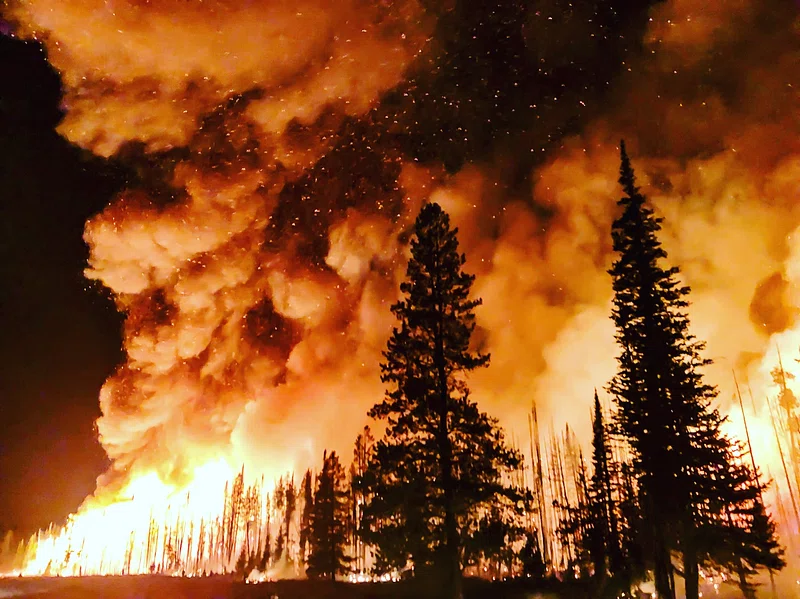
“This is a historic moment,” Rob Bonta, California’s attorney general, told reporters on Sunday, as he stood alongside Gov. Gavin Newsom on the opening day of Climate Week NYC. The pair of California leaders were there to discuss the lawsuit the state had recently filed against Big Oil on behalf of the people of California to hold fossil fuel companies accountable for the effects of climate change.
While it is not the first to seek accountability from the fossil fuel industry for its role in fueling the climate crisis, California’s lawsuit stands out in several ways: The state has a reputation for leading on climate policy; it is on the frontlines of climate change; it is a producer of oil and gas; and it is, to date, the most politically and economically powerful state to sue Big Oil.
More than three dozen states and cities are suing oil, gas, and coal companies over their role in causing climate change. But California is the first fossil-fuel-producing state to do so. That sends a clear political message that the industry “is less powerful and trusted than before,” Nick Caleb, a climate and energy attorney with Breach Collective, told DeSmog. It may signal that fossil fuel companies do not have much of a future powering the state’s economy, Caleb said.
California is facing major economic and humanitarian costs from the climate emergency. The state, with a population of nearly 40 million people, has racked up several billions of dollars in climate-related damages on top of the tragic costs to human lives. Some insurance companies are backing away from the state due to the outsized risks.
“It’s incalculable in terms of the dollars, the lives lost, the funerals, and dead bodies in Paradise, California,” Newsom said on Sunday. In 2018, the Camp Fire decimated the northern California community and killed at least 85 people.
“We all know how California has suffered from climate impacts,” Christiana Figueres, one of the key architects of the Paris Agreement, told journalists at a Covering Climate Now conference at Columbia Journalism School in New York City on Thursday. She called California’s lawsuit “a major, major upgrade … in the liabilities and in the reach that climate litigation can have.”
The lawsuit names five companies — ExxonMobil, Shell, Chevron, BP, ConocoPhillips — and one lobby group, the American Petroleum Institute. It asserts that the companies knew about the climate risks associated with burning fossil fuels and greenhouse gas emissions, yet underplayed them to the public, and it argues that the climate disasters and devastation California is experiencing could have been largely avoided or mitigated were it not for the lies and deceit of the fossil fuel industry. “California is in the throes of a climate crisis,” the case contends.
The 135-page complaint, filed Friday in superior court in San Francisco, lays out the evidence of the alleged deception in great detail. Bonta called it the “most sweeping complaint thus far.”
“You cannot read it without crawling out of your skin,” Newsom added at Sunday’s press briefing.
Many of the details and revelations are known, but are worth recapping as they explain why major oil companies are facing similar lawsuits from so many states and municipalities.
A Public Campaign of Deception
First, as the complaint notes, “Defendants have known about the potential warming effects of GHG emissions since as early as the 1950s.” Nuclear physicist Edward Teller warned the oil industry at an API event in 1959 that global warming might melt the polar ice caps and submerge coastal cities.
In the late 1960s, as the complaint details, the Stanford Research Institute issued reports that accurately predicted the atmospheric carbon dioxide (CO2) concentration in 2000. The reports, commissioned by API, further warned of the Antarctic ice cap melt, and explicitly connected CO2 rise to fossil fuel combustion.
More warnings came from industry scientists in the 1970s, but these were not disseminated publicly. Instead, Exxon realized that legislation affecting its business could take shape and decided to closely monitor the science but not publicly acknowledge or act on it. “In 1979, API and its members, including the Fossil Fuel Defendants, convened a Task Force to monitor and share cutting-edge climate research among members of the oil industry,” the complaint explains. This close assessment of potential climate impacts and climate modeling continued into the 1980s.
In 1988, an internal Shell report titled “The Greenhouse Effect” further pointed to fossil fuels as the cause of rising CO2 concentrations and warned of the devastating impacts on society.
The very real prospect of legislation and international action to combat climate change in the late 1980s and early 1990s, prompted a U-turn within the industry. The industry shifted tactics “from general research and internal discussion on climate change to a public campaign aimed at deceiving consumers and the public, including the inhabitants of California,” the complaint states. In publications and advertorials, the industry directly contradicted what it had known for decades about the role of fossil fuels in increasing CO2 emissions and temperature rise. During this time the Global Climate Coalition actively worked to undermine the public’s understanding of climate science and even to manipulate the Intergovernmental Panel on Climate Change, the UN’s climate science body.
Exxon and other oil majors also funded “fringe scientists” to peddle their views and funded dozens of think tanks and front groups to promote climate denial. The complaint calls out a few of these groups, including: the Heritage Foundation, Heartland Institute, Competitive Enterprise Institute, Frontiers of Freedom, and Committee for a Constructive Tomorrow.
A Conspiracy to “Conceal and Misrepresent”
The California lawsuit does not bring racketeering charges as some recent climate accountability lawsuits have. It does, however, refer to a conspiracy. According to the complaint, the defendants, through their trade associations and front groups like the Global Climate Coalition, “conspired to conceal and misrepresent the known dangers of burning fossil fuels.” While conspiracy is not charged, the lawsuit references it “for the purposes of establishing that California state court is the correct jurisdiction and venue for this case,” Caleb explained.
“Although the Fossil Fuel Defendants were competitors in the marketplace, they combined and collaborated with each other and with API on this public campaign to misdirect and stifle public knowledge in order to increase sales and protect profits,” the complaint argues.
The industry’s alleged deception delayed a transition to alternative and cleaner forms of energy and enabled a much greater buildup of greenhouse gas (GHG) emissions than otherwise would have occurred, the lawsuit argues, adding: “Defendants could have chosen a different path.”
Ben Franta, head of the Climate Litigation Lab at Oxford University and one of the key researchers to uncover evidence of the industry’s early climate change awareness and subsequent efforts to deceive, told DeSmog: “The bottom line is that major fossil fuel companies knew decades ago that their own products, unless replaced with safe energy sources, would cause catastrophic damage in the 21st century. They concealed their knowledge and misled the public about the reality, seriousness, cause, and solutions to the problem in order to keep selling fossil fuels and increase industry profits.”
API was instrumental to the execution of this plan. The trade association “played a key role in creating climate denialist organizations such as the Global Climate Coalition,” Franta said.
In response, API called California’s lawsuit part of an “ongoing, coordinated campaign to wage meritless, politicized lawsuits” against the oil and gas industry.
The Western States Petroleum Association, the main industry lobby for the western region including California, is not a named defendant in the complaint. Franta said API and WSPA have “both played key roles in deceiving the public about climate change and worsening climate damages,” but that “much more research to date has been conducted on API.”
Nevertheless, “their contributions to climate change are significant and actionable under California law,” Caleb told DeSmog, adding that WSPA “deserves to be held accountable” for greenwashing and deceptive conduct. WSPA has been named as a defendant in a climate lawsuit filed in June by Multnomah County, Oregon, the first such case to do so.
Industry’s Misleading Behavior Has “Not Stopped”
The complaint says the companies’ “efforts to mislead the public about climate change have not stopped.” In recent years, the oil and gas industry has shifted to prolific greenwashing. It portrays its products as “cleaner” or “low carbon,” and claims the industry is driving climate solutions.
“Just as tobacco companies promoted ‘low-tar’ and ‘light’ cigarettes … so too do Defendants peddle ‘low-carbon’ and ‘emissions-reducing’ fossil fuel products,” the complaint notes.
Yet Big Oil is now retreating on its meager climate commitments and doubling down on oil and gas production, even after raking in record profits in 2022. For instance, in June, Shell announced it would not follow through on its earlier promise to gradually decrease oil production through 2030.
“The fact that they’re still at it, rolling back ambition in real time … is shameful,” Newsom said on Sunday.
“They need to be held accountable. They need to pay for the damage that they’ve caused. They knew, they knew for years,” Bonta added.
In an emailed statement, a Shell spokesperson said the company’s “position on climate change has been a matter of public record for decades”, adding: “We do not believe the courtroom is the right venue to address climate change.”
ExxonMobil, Chevron, BP, and ConocoPhillips did not immediately respond to requests for comment.
Lawsuit Opens the “Floodgates”
Newsom and Bonta made clear on Sunday that they’re hoping the state’s decision to sue Big Oil could therefore encourage other jurisdictions to do the same. California’s actions on climate have often broken new ground and inspired other states to follow suit — a phenomenon is called the “California effect.” For example, the state has set increasingly stringent vehicle tailpipe emissions standards, implemented the country’s first economy-wide cap-and-trade program, and has recently passed a first-in-the-nation law requiring large companies to publicly disclose their greenhouse gas emissions,
Climate lawyers and activists called California’s move to sue Big Oil “historic” and “decisive.”
“The California lawsuit is the most significant litigation against the industry that’s happened yet,” said Steven Donziger, an environmental and human rights attorney who successfully sued Chevron and faced retaliation for it. “All of these lawsuits together collectively can really force the phaseout of the industry. They’re important.”
“California’s lawsuit provides major momentum in the race to protect a livable planet,” Kassie Siegel, director of the Center for Biological Diversity’s Climate Law Institute, said in an emailed statement. “This case opens a new avenue for California to lead the nation in ending deadly fossil fuels.”
Geoffrey Supran, associate professor of environmental science and policy and director of the Climate Accountability Lab at University of Miami, noted that California “is a bellwether for U.S. environmental action,” and that momentum to hold Big Oil accountable through litigation has been mounting for several years.
“Now that the fifth largest economy in the world has waded in, the floodgates are truly open,” he said.
As a state that still produces oil and gas, however, some say California is still not moving quickly enough to sever ties with the industry it is now suing. Mark Jacobson, professor of civil and environmental engineering at Stanford University, said that California “can do a lot more, faster,” noting the state continues to permit fossil gas usage in buildings, has not banned oil and gas drilling, and plans to phase out new gasoline-powered vehicles only by 2035, which is “five years after we need to transition 80 percent of the world away from fossil fuels.”
Campaign Demands “Polluters Pay”
A new activist campaign called “Make Polluters Pay,” which launched Monday in New York City, with a Times Square billboard and a six-figure digital ad buy and online petition, is supporting California’s call for more climate accountability lawsuits.
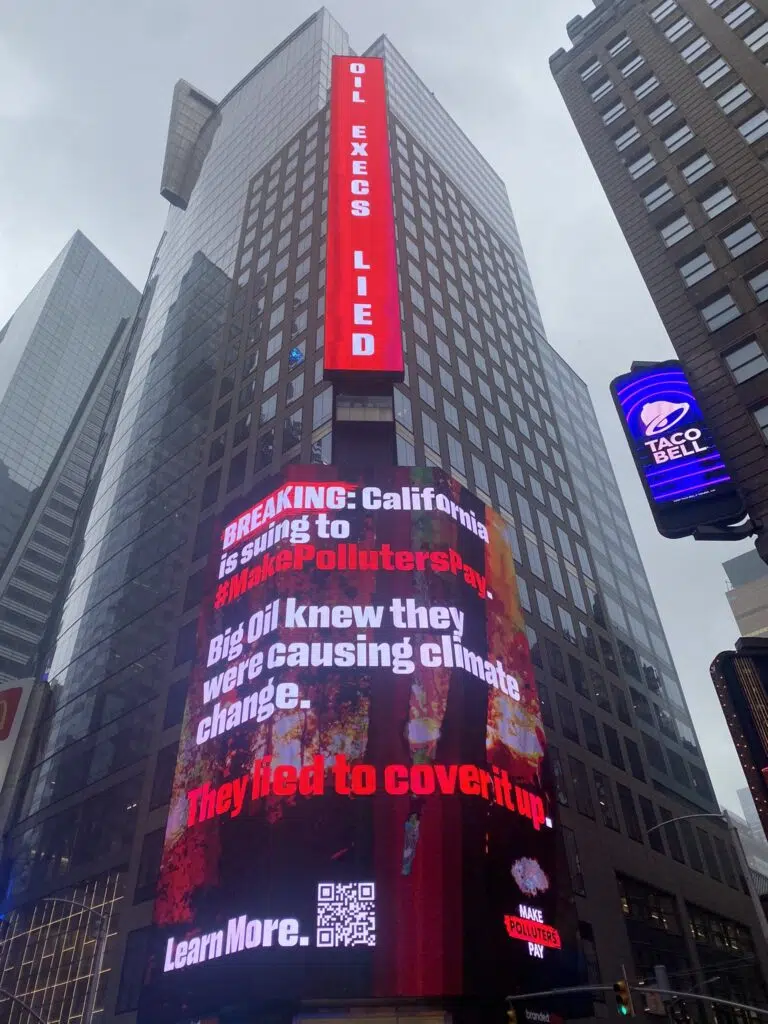
“Make Polluters Pay will be the first big public-facing campaign to build support for these climate lawsuits and the broader effort to hold the fossil fuel industry accountable for the damage they are doing to our health, climate and communities,” Jamie Henn, founder of Fossil Free Media, told DeSmog.
“I think California’s lawsuit is going to turn these climate liability cases into a serious movement that not only excites environmental lawyers, but the public writ large,” he added. “A few hundred million Americans experienced the brutal heat waves and other climate disasters this summer and they’re looking for someone to hold responsible. And when it comes to climate destruction, the answer is clear: it’s Big Oil.”
Original article by Dana Drugmand republished from DeSmog.