Law enforcement officers watch as the Thompson Fire burns over Lake Oroville in Oroville, California on July 2, 2024. (Photo: Josh Edelson/AFP via Getty Images)
“It cannot be stressed enough that this is an exceptionally dangerous and lethal situation,” the National Weather Service warned.
California Gov. Gavin Newsom on Wednesday declared a state of emergency in a northern county where a major wildfire has burned thousands of acres and forced the evacuation of thousands of residents amid near-record heat throughout much of the Golden State fueled by human-caused global heating.
The California Department of Forestry and Fire Protection (CAL FIRE) said shortly after noon local time Wednesday that the Thompson Fire, which began Tuesday morning in Butte County, had burned 3,568 acres with no containment in and around the city of Oroville, home to more than 20,000 people.
Citing an “imminent threat to life,” Newsom, a Democrat, issued an emergency declaration and said that “we are using every available tool to tackle this fire and will continue to work closely with our local and federal partners to support impacted communities.”
Millions of Californians are under an excessive heat warning FOR THE NEXT TEN DAYS with temps up to 115 degrees.
CAL FIRE said that more than 1,400 firefighters using 199 engines, 46 dozers, eight helicopters, and other equipment are battling the blaze. More than 28,000 Oroville area residents have been evacuated.
Red flag conditions are being exacerbated by low humidity and near-record temperatures throughout California. Oroville is expected to hit a high of 110°F on Wednesday, with daytime highs forecast to remain in the 110s through the holiday weekend. Dozens of daily, monthly, and all-time records could be broken throughout the state.
“It cannot be stressed enough that this is an exceptionally dangerous and lethal situation,” the National Weather Service’s (NWS) San Francisco Bay Area branch cautioned as it extended the red flag warning through Friday while preparing the public for the possibility of further extensions.
Daniel Swain, a climate scientist at the University of California, Los Angeles, said during a video briefing, “I’m not so sure that really any of us will have seen this many days at this sustained level of heat, both daytime and most importantly nighttime heat.”
Commenting on the wildfire and heatwave, Fossil Free Media director Jamie Henn said on social media that “we need the California Legislature to pass their climate superfund bill NOW to #MakePollutersPay for these fossil-fueled disasters.”
Introduced in April by California state Sen. Caroline Menjivar (D-20) but shelved the following month, S.B. 1497—the Polluters Pay Climate Cost Recovery Act—would require major fossil fuel producers to pay for their historic carbon emissions.
"We`ve seen a lot of comments & replies downplaying the severity of the heat we are expecting, & even accusing ourselves & other offices of "fearmongering". Make no mistake, this heat wave is extreme, and will likely be deadly as the days of extreme heat continue" – @NWSBayAreapic.twitter.com/mYOUhwN4Kz
The NWS said that as of Wednesday, more than 110 million people across the United States were facing either a heat advisory, watch, or warning. So far, 2024 has been the hottest year on record. Climate Central, a nonprofit news organization focusing on the worsening planetary emergency, said climate change has made the current California heatwave at least five times likelier.
Grassroots “kayaktivists,” the Rich City Rays, challenged tankers that import crude oil for Chevron and ship its refinery products around the world.
A generation of Richmond’s children, now grown, took to San Francisco Bay in nearly five dozen kayaks Sunday morning, in the shadow of Chevron’s massive refinery, headed for tankers controlled by the oil giant in an act of resistance, prayer and joy.
After singing a ceremonial song led by a local Indigenous leader, activists launched their kayaks around 9:30 a.m. from the shores of Point Molate, 20 miles north of San Francisco, to protest the environmental and health harms caused by Chevron’s Richmond Oil Refinery.
By noon, a core group of the Rich City Rays, a coalition of grassroots community groups based in Richmond, a San Francisco suburb where most residents are Asian, Black or Latino, had entered restricted waters alongside two giant tankers docked at the Chevron Long Wharf. Once activists in about 20 kayaks had jockeyed into position, side by side, they unfurled a banner with “Abolish Chevron” written in bright red letters, as the rest of the flotilla erupted in cheers.
…
Activists with Rich City Rays took to San Francisco Bay near Chevron’s Richmond Refinery to protest the oil giant’s impacts on communities of color around the world. Credit: Brooke Anderson
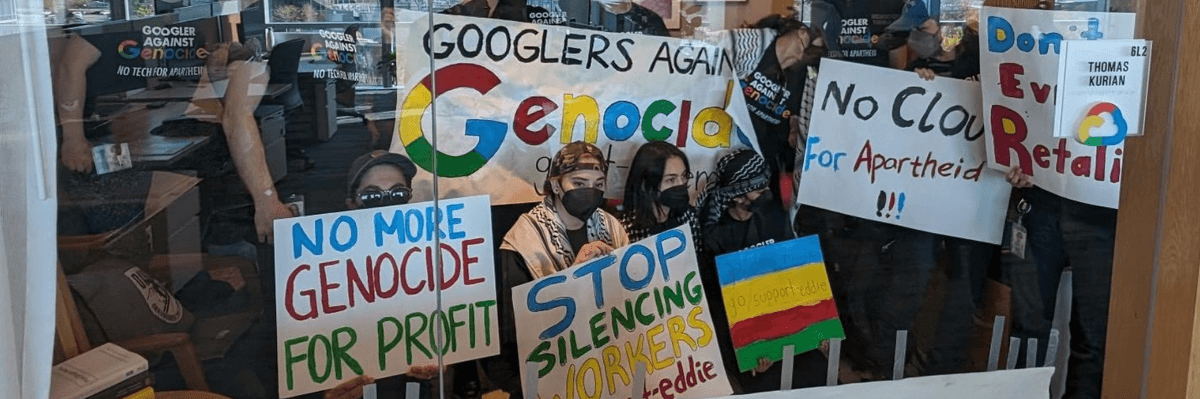
Google employees demand the company terminate its contract with the Israeli government at a protest on April 16, 2024. (Photo: No Tech for Apartheid/Medium)
“These mass, illegal firings will not stop us,” said organizers. “Make no mistake, we will continue organizing until the company drops Project Nimbus and stops powering this genocide.”
The peace coalition No Tech for Apartheid accused Google of a “flagrant act of retaliation” late Wednesday night as the Silicon Valley giant announced it had fired 28 workers over protests against its cloud services contract with the Israeli government.
The firings came after Google organizers held two 10-hour sit-ins at the company’s offices in Sunnyvale, California and New York City, demanding the termination of Project Nimbus, a $1.2 billion contract under which Google and Amazon provide cloud infrastructure and data services for Israel—without any oversight regarding whether the Israel Defense Forces uses the services in its occupation of Palestinian territories and bombardment of Gaza.
No Tech for Apartheid said in a statement that Google officials called the police to both offices to arrest nine protesters—dubbed the Nimbus Nine—on Tuesday morning, before utilizing “a dragnet of in-office surveillance” to fire nearly two dozen other employees on Wednesday.
“They punished all of the workers they could associate with this action in wholesale firings,” said the coalition, which includes Jewish Voice for Peace and MPower Change, a Muslim-led anti-war group.
Google accused the workers of “bullying,” “harassment,” defacing property, and physically impeding other employees—allegations No Tech for Apartheid rejected as it noted organizers “have yet to hear from a single executive about” their concerns over Google’s collaboration with Israel.
“This excuse to avoid confronting us and our concerns directly, and attempt to justify its illegal, retaliatory firings, is a lie,” said the workers. “Even the workers who were participating in a peaceful sit-in and refusing to leave did not damage property or threaten other workers. Instead they received an overwhelmingly positive response and shows of support.”
The organizers staged the sit-ins on the heels of reporting in Time magazine about new negotiations between Google and the Israeli government regarding further potential tech contracts.
Kate J. Sim, a child safety policy adviser at Google who said she was among those fired this week, said the terminations show “how terrified [executives] are of worker power.”
Terminated worker here. Listen when employers tell you exactly who they are
McCarthyism is alive and well. Look how terrified they are of worker power 🔥
Google employees have a history of harnessing worker power to change policies at the company. In 2018, Google terminated a deal with the U.S. Defense Department to develop drone and artificial intelligence (AI) technology through a contract called Project Maven. The decision followed the resignations of several employees and the condemnation of thousands of workers.
Calling Google CEO Sundar Pichai and Google Cloud CEO Thomas Kurian “genocide profiteers,” No Tech for Apartheid said Wednesday that they will not stop demonstrating against Project Nimbus until they get a similar result.
“The truth is clear: Google is terrified of us,” said the group. “They are terrified of workers coming together and calling for accountability and transparency from our bosses… The corporation is trying to downplay and discredit our power.
“These mass, illegal firings will not stop us,” No Tech for Apartheid added. “On the contrary, they only serve as further fuel for the growth of this movement. Make no mistake, we will continue organizing until the company drops Project Nimbus and stops powering this genocide.”
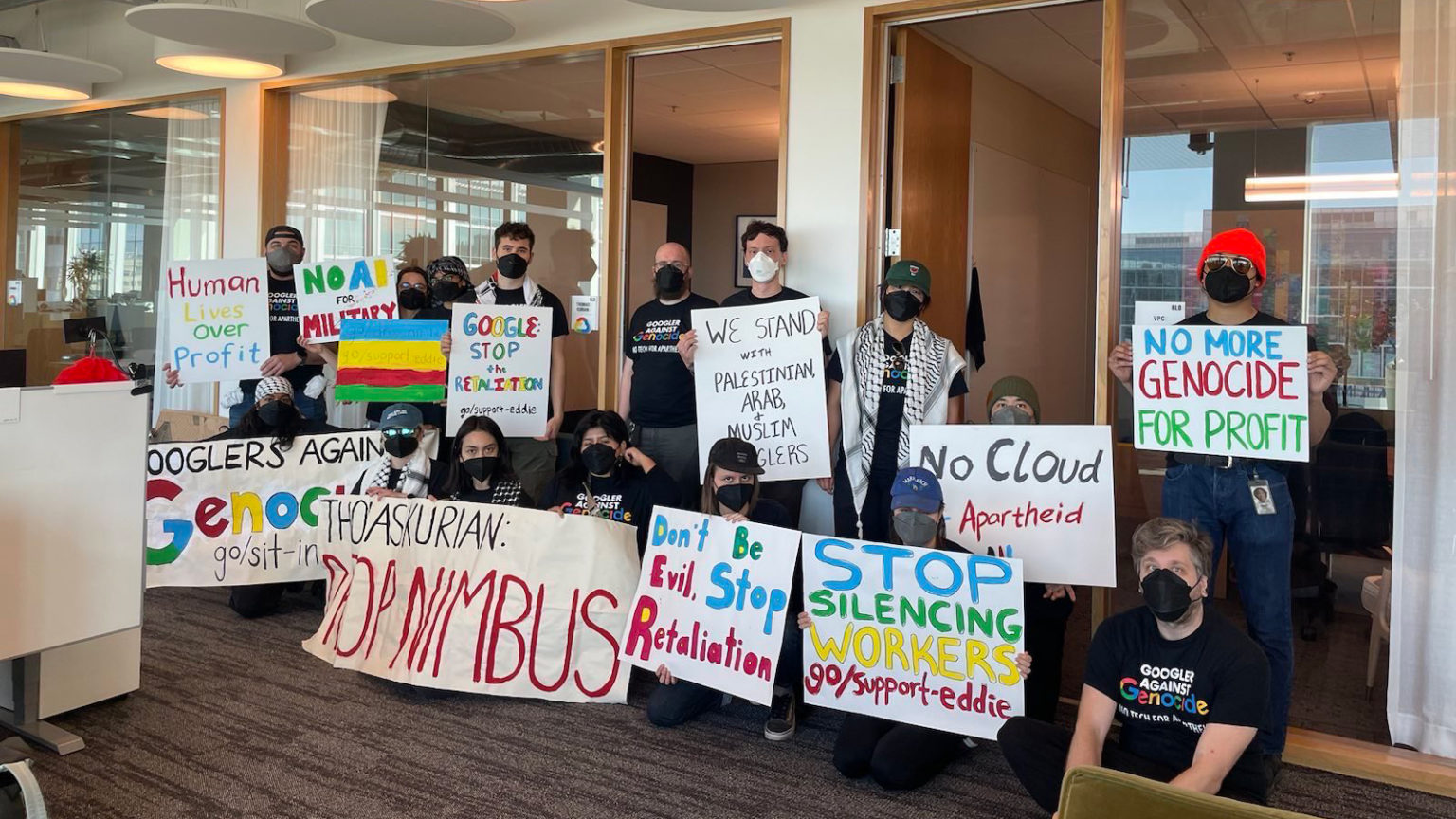
Google workers stage sit-in to end Project Nimbus (Photo: No Tech for Apartheid)
Tech workers are joining the Palestine solidarity movement in leading coast-to-coast sit ins at Google offices across the country
On April 16, Google workers led sit-ins at the office of Google Cloud CEO Thomas Kurian in Sunnyvale, California, and Google’s New York City headquarters in protest against Google’s complicity in the Israeli genocide of the Gaza Strip, through Project Nimbus, the tech giant’s contract with the Israeli government and military.
BREAKING—DOZENS OF @GOOGLE WORKERS LEAD HISTORIC COAST TO COAST-INS AT @GOOGLECLOUD CEO THOMAS KURIAN’S OFFICE IN SUNNYVALE & @GOOGLE’s NYC 10TH FLOOR COMMONS. They refuse to leave until @google stops powering the genocide in Gaza
— No Tech For Apartheid (@NoTechApartheid) April 16, 2024
Tech workers at both Amazon and Google have been organizing for years to end Project Nimbus, which is Google and Amazon’s USD 1.2 million contract with the Israeli government and military. Despite retaliation from Google including the firing of workers, the movement against Project Nimbus has only grown.
“Google is enabling and profiting from Israel’s AI-powered genocide through Project Nimbus, their USD 1 billion cloud contract with Israel. The Israeli military is also using Google Photos as part of a facial recognition dragnet across Gaza, which has led to the arrest, imprisonment, and torture of thousands of Palestinians with little to no evidence. It’s clear that the Israeli military will use any technology available to them for genocidal means,” say the Amazon and Google workers, organized in the group No Tech for Apartheid, in a recent statement. “Google workers do not want their labor to power Israel’s genocide of Palestinians in Gaza.”
This action comes days after Time Magazine reporting confirmed that Google is providing direct cloud computing services to the Israeli occupation forces, despite the company stating the contrary.
“We have been very clear that the Nimbus contract is for workloads running on our commercial platform by Israeli government ministries such as finance, healthcare, transportation, and education,” a Google spokesperson previously toldTime Magazine. “Our work is not directed at highly sensitive or classified military workloads relevant to weapons or intelligence services.” Time reporting revealed that the Israeli Ministry of Defense has its own secure entry point into the Google Cloud.
Tech workers staging the sit-ins in California and New York are demanding that the company end Project Nimbus, stop “the harassment, intimidation, bullying, silencing, and censorship of Palestinian, Arab, and Muslim Googlers,” and address health and safety issues in the workplace, which arise from the “mental health consequences of working at a company that is using their labor to enable a genocide,” workers say.
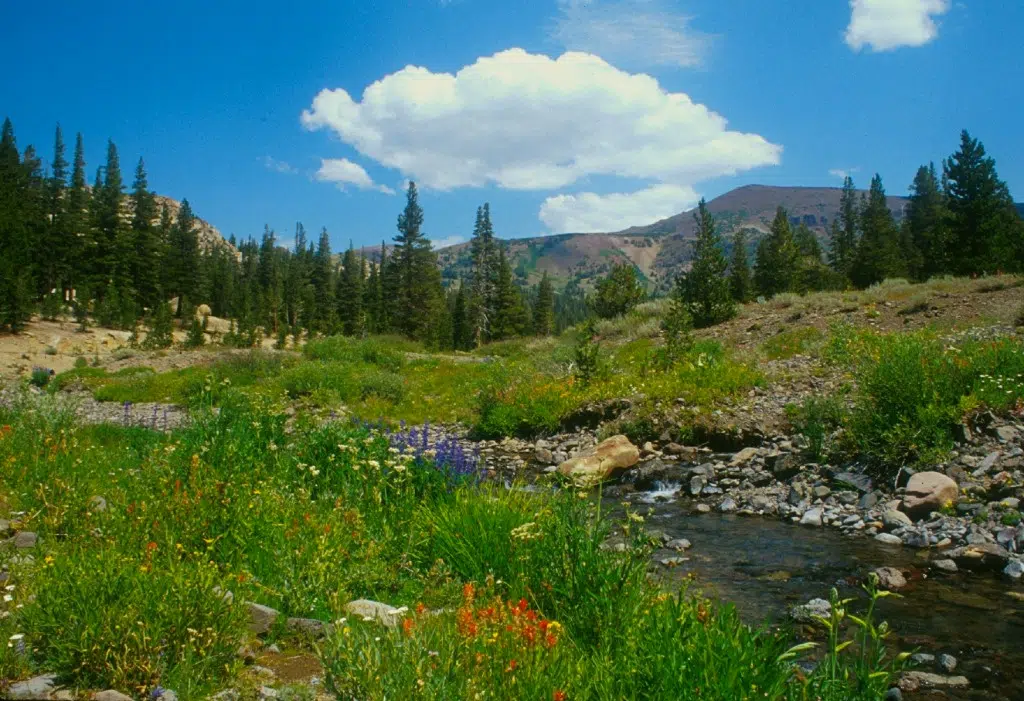
Meadow and woodlands in Tuolumne County, one of the two rural counties where Golden State Natural Resources proposes to build a wood pellet production facility. Credit: Malcolm Manners(CC BY 2.0 DEED)
Plans by biomass giant Drax to manufacture wood pellets sourced from Californian forests will endanger natural habitats and increase toxic air pollution for rural communities, campaigners warn.
The British energy company has partnered with Golden State Natural Resources, a government-linked nonprofit which plans to build two industrial plants in rural California counties that would produce one million tonnes of compressed wood fiber pellets a year.
One plant would be in Tuolumne County in the foothills of the Sierra Nevada Mountains, and the other in Lassen County in the state’s far northeast. From there, pellets would be shipped by rail to the city of Stockton, exported internationally, and burnt as biomass fuel to create electricity.
At its board meeting last Wednesday, Golden State Natural Resources ratified a Memorandum of Understanding (MOU) with Drax.
The agreement comes as a BBC investigation revealed that Drax was burning rare forest wood in the Canadian province of British Columbia.
BBC Panorama found that in 2023 the company took more than 40,000 tonnes of wood from so-called “old-growth” forests in B.C. Following the investigation, the company issued a statement expressing confidence that its “biomass is sustainable and legally harvested.”
Drax already operates 18 wood pellet plants across the U.S. and Canada, but the MOU finalized on February 28 is the most concrete indication yet of Drax’s ambition to expand into California, a state with 33 million acres of forest.
The wood pellets Drax produces are treated as “carbon neutral” under international accounting rules, based on an assumption that new-growth trees will capture the carbon lost by wood burnt for electricity. But scientists and campaigners have long disputed these claims.
A 2021 study from the European Academies Science Advisory Council concluded that burning wood for energy “is not effective in mitigating climate change and may even increase the risk of dangerous climate change.” A power station operated by Drax in the UK generates 8 percent of the UK’s “renewable” electricity, but is also the single largest emitter of carbon dioxide.
Golden State Natural Resources claims its forest management techniques reduce the risk of wildfires — a claim which has also been disputed by campaigners — and that it maintains “stringent guardrails” to ensure the sourcing of materials for pellets is sustainable. Drax also says its pellets are made from “sustainable biomass” generated from low-grade roundwood, sawmill residues, and forest residues — although several investigations have found instances of the company using primary forest materials.
The plan calls for sourcing wood from areas that encompass eight National Forests, and activists in California have raised concerns that the production of this “renewable” power could endanger vital biodiversity in the forests, home to California’s endangered gray wolves. They are also concerned that the facilities could harm local communities, some of which face high health burdens.
A January 2024 study by the journal Renewable Energy found that thousands of tons of toxic air pollutants, from nitrogen oxide to volatile organic compounds, are emitted in the pellet-making process, especially in the southeastern United States where most pellet plants are located.
Rita Frost, a forests advocate from environmental nonprofit Natural Resources Defense Council (NRDC), said the project would “diminish our forests’ ability to contribute to the fight against climate change, increase carbon emissions during a critical juncture when we must be reducing them instead, and compound health harms in vulnerable communities.”
‘Trojan Horse’
Golden State Natural Resources is a nonprofit co-founded by a state agency and a service organization that represents California’s rural counties. A document on the group’s website describes its purpose as “to build wildfire and forest resilience in the state and spur economic opportunities in rural communities.”
The MOU between Drax and the Californian nonprofit echoes those goals, stating that the companies should “work collaboratively and in good faith” to identify “potential sustainable vegetation management projects on forest land that meet the dual goals of promoting forest resilience and producing sustainable biomass fuel.”
GSNR says its proposed project would source pellet materials from a mixture of native forests undisturbed by human activity, and forests that have been subjected to logging cycles but allowed to regenerate, as well as privately managed timberland.
On its “Frequently Asked Questions” page, GSNR claims that its removal of accumulated fuel will help California’s forests burn “with less frequency and less intensity over the long term.”
A quarter of California — more than 25 million acres — is classified as under very high or extreme fire threat, with over 25 percent of the state’s population living in these high fire-risk areas. The counties where GSNR plans to cite its facilities have small populations but are no strangers to fire; the second-largest fire in state history, which covered nearly one million acres, burned partially in Lassen County.
But the practice of removing trees or thinning forests to reduce fire danger is controversial, and some experts say it can actually increase the severity of fires.
Michelle Connolly, an ecologist and director of Conservation North, says GSNR is justifying its activity by using “scientific-sounding language to make it seem like they know what they’re doing.”
“Logging and road building in any kind of primary forests is associated with increasing fire risk,” she said.
“Fire is the latest Trojan Horse for industry to get into natural forests they otherwise might not get to violate. Pellets originating from primary forest are not sustainable in any way, shape or form.”
Megan Fiske, a wildlife biologist at the Central Sierra Environmental Resource Center and a Tuolumne County resident, also has concerns over the impact of the clearance on forest health and natural habitats.
Each facility would source wood from a 100-mile radius, an area that includes eight National Forests and a major biodiversity hotspot. Dozens of endangered or threatened species take refuge in these zones — including California’s fledgling population of gray wolves, which were threatened with extinction and have only recently returned to the state.
“We need to restore the forest ecosystem and its natural processes,” Fiske told DeSmog.
“Removing the nutrients and other benefits imparted by ‘biomass’ does not restore the forest ecosystem or its natural processes, which provide tremendous ecosystem services.”
Environmental Pollution
The number of industrial wood pellet mills has risen rapidly in the U.S. and Canada to meet a rising demand for biomass-fuelled energy in Europe and Asia.
The two production plants planned for California are located in former timber industrial areas in rural counties, where drought and other extreme weather events associated with rising temperatures from climate change compound existing health inequalities.
Tuolumne County, which is home to part of Yosemite National Park, has a higher-than-average pollution burden, high rates of asthma and cardiovascular disease, and a high poverty rate, according to data in CalEnviroScreen 4.0 Indicator Maps.
Residents in Lassen have similar health outcomes to the state average, but on average die earlier than their neighbors.
The mapping tool CalEnviroScreen shows that the communities living around the port of Stockton, where the pellets will be shipped from, are some of the most disadvantaged in the state, based on factors including poor air quality, low income, and poor health indicators.
Though subject to environmental regulations, the production of pellets can release vast amounts of sawdust and other harmful particulates that impact air quality.
In May 2023, The Guardian reported a U.S. plant supplying wood pellets to Drax had violated air pollution limits in Mississippi. A September 2022 investigation by Unearthed found Drax was driving “environmental racism” after air pollution claims in the southeastern United States. Drax paid out $3.2 million to settle.
“These are not the kinds of jobs that our rural communities deserve. They are low wage positions and extremely dangerous working conditions.” – Nick Joslin
Nick Joslin, forest and watershed watch program manager at the Mount Shasta Bioregional Ecology Center, resides in Siskiyou County, an area where wood would be sourced and then transported by truck to the pellet mill in the Lassen County town of Nubieber.
“Siting a facility of this size in a small town is completely irresponsible,” he said.
“There are no services and no housing. Where would any newly employed people live? Where would they receive basic services or send their kids to school? The facility would run 24 hours a day with noise, lighting, dust, and noxious fumes.”
Golden State Natural Resources has also said the project will create 128 full-time jobs once both sites are operational, but Joslin is skeptical that these will provide the economic opportunities the county needs.
“These are not the kinds of jobs that our rural communities deserve. They are low wage positions and extremely dangerous working conditions,” Joslin added.
Fiske, of Tuolumne County, says the counties of the Sierra Nevada once exploited by the gold, timber, and water industries are now being hit by the latest cycle of commercial-scale resource extraction.
“We must keep the rivers clean and healthy, we must keep the forests from emitting too much wildfire smoke. All while the logging trucks and water trucks deteriorate our local roads and slow and impede traffic. All while employees are imported from elsewhere to take the temporary, barely living wage jobs.”
‘False Solutions’
As a “renewable” energy provider, Drax has benefited from billions of pounds in subsidies from the UK government. The thinktank Ember has estimated it will have collected more than £11 billion between 2012 and 2027, when the support runs out.
The company is now looking to gain an estimated £31.7 billion in additional subsidies for the controversial technology of bioenergy, carbon capture and storage (BECCS) — where emissions from burning organic matter are captured and buried underground.
Advocates promote this as a “carbon negative” climate solution, but experts and campaigners have argued that BECCS is technically unproven, and that the practice poses risks for biodiversity, land, and food security.
The UK government this year approved two new carbon capture units at Drax’s Yorkshire power station, while Drax is looking to roll out the technology to other countries — among them the U.S.
DeSmog reported in 2022 that Drax had lobbied California’s government to build a BECCS plant in the state, describing it as an “ideal location.” A UK government consultation on Drax’s future subsidies closed on Thursday (February 29), with a decision expected in April.
Campaigners say both the burning of biomass, and the attempted capture of its emissions, is deeply flawed.
“For California, there’s no time to waste on false solutions like this,” Rita Frost of NRDC told DeSmog.
“Any climate plan that relies on BECCS development with Drax is extremely high risk. Funds should instead be directed to wind and solar energy, which are not only low-cost and low-risk, but actually help fight the climate crisis.”
Drax and Golden State Natural Resources did not respond by publication time to specific questions submitted.